ANSI Roller Chain and Links
284 Products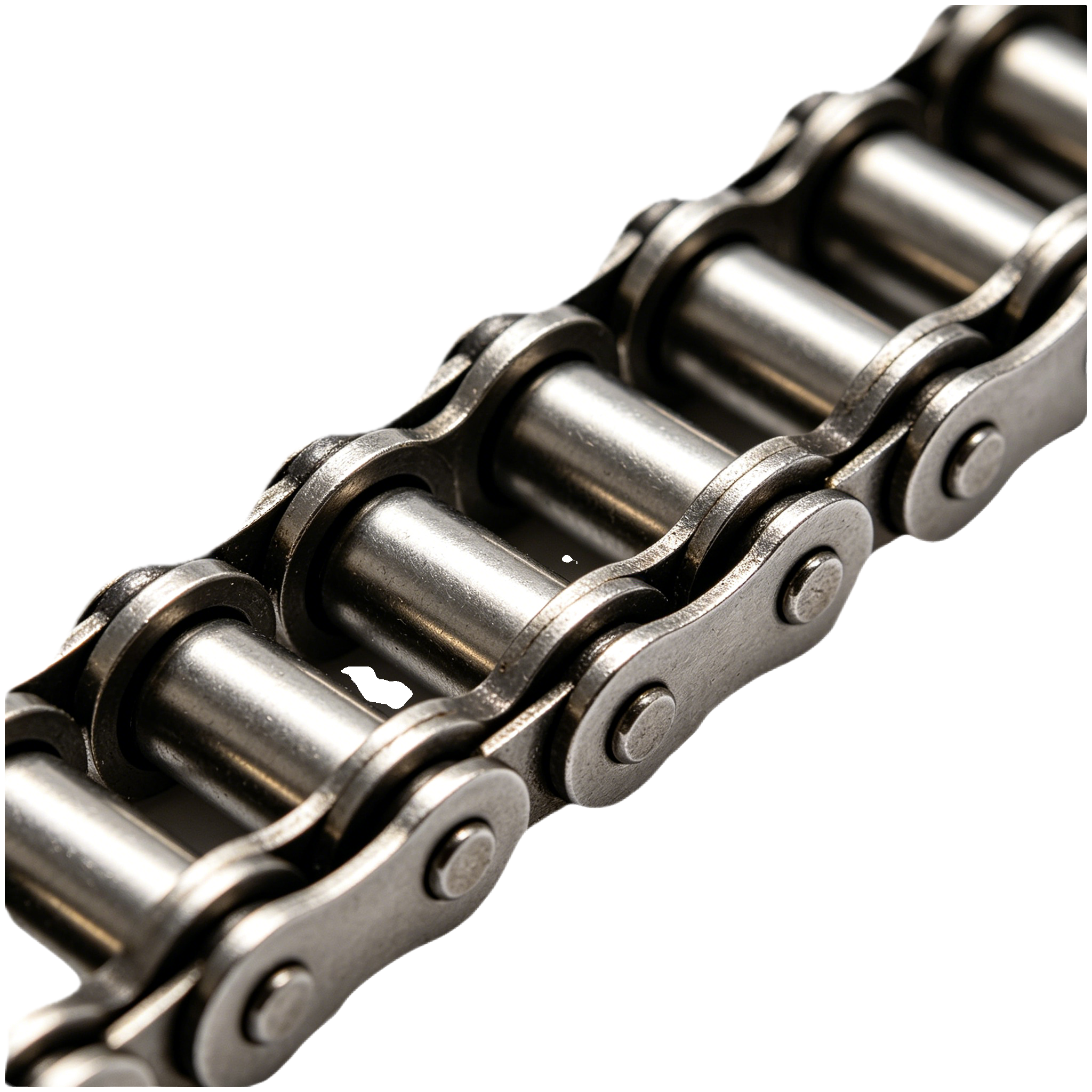
What Is ANSI Roller Chain?
ANSI roller chain is a power transmission chain built to ANSI B29.1 dimensions, made of pins, bushings, rollers, and link plates that engage sprocket teeth to transfer rotational power. LILY Bearing stocks ANSI roller chain in trade sizes #25 through #160, in single and double strand construction, and in steel, stainless steel, and plastic to match load, environment, and maintenance requirements.
Shop ANSI Roller Chain by Type
ANSI roller chain in this category is organized around four independent choices: how much load the base construction needs to carry, whether the chain needs corrosion protection, whether it needs to run without relubrication, and whether it needs a special pitch or pin design for a specific mechanical function. Corrosion resistance and maintenance-free construction are treatments that can be layered onto several of the base chain families below, rather than separate chain types on their own.
By Load Capacity
These four options share the same pitch and roller dimensions at a given trade size, but differ in link plate thickness and weight — choose based on how much load the drive needs to carry and how much mass the application can tolerate.
- Inch ANSI Roller Chain and Links — standard-weight construction for general machinery, agricultural, and mechanical equipment
- Heavy Duty ANSI Roller Chain and Links — thicker link plates for heavy machinery, conveyors, and high-wear industrial equipment
- Lightweight ANSI Roller Chain — thinner plates for lighter-duty drives, robotics, and small conveyors where reducing mass matters
- Extended-Life Lightweight ANSI Roller Chain and Links — lightweight construction engineered for longer service life in automated systems and conveyors
Corrosion-Resistant Options
Corrosion resistance is added to several of the chain families above and below through stainless steel construction or protective coatings — select the version that matches both the environment and the base chain function you need.
- High-Strength Corrosion-Resistant ANSI Roller Chain and Links — stainless steel or corrosion-resistant coating for heavy loads in outdoor, marine, or chemical-processing environments
- Ultra-Corrosion-Resistant ANSI Roller Chain and Links — advanced stainless alloys or specialized coatings for the most corrosive marine and chemical-processing settings
- Corrosion-Resistant Maintenance-Free ANSI Roller Chain and Links — combines self-lubrication with corrosion resistance for food, marine, and chemical-plant use
- High-Strength Corrosion-Resistant Double-Pitch ANSI Roller Chain and Links — double-pitch chain built for heavy-duty conveying in moisture or chemical exposure
- Corrosion-Resistant Double-Pitch ANSI Roller Chain and Links — double-pitch chain for food processing, outdoor, and marine conveying applications
- Corrosion-Resistant Hollow-Pin ANSI Roller Chain and Links — hollow-pin design with corrosion resistance for harsh environments needing frequent attachment changes
Maintenance-Free / Self-Lubricating Options
Both options below use self-lubricating materials or coatings to reduce friction and wear without regular relubrication; a corrosion-resistant version of this construction is listed above.
- Maintenance-Free ANSI Roller Chain and Links — self-lubricating construction for food processing, packaging, and clean-running automation
- Extended-Life Maintenance-Free ANSI Roller Chain and Links — self-lubricating design built for extended service life without relubrication
Double-Pitch (Light-Duty Conveying)
Double-pitch chain spaces standard-diameter rollers twice as far apart, reducing weight and part count for slower-speed conveying rather than high-speed power transmission; corrosion-resistant versions are listed above.
- Double-Pitch ANSI Roller Chain and Links — extended pitch reduces weight for light-duty conveying and agricultural machinery
Hollow-Pin & Flexible Construction
These options change the chain's pin or link geometry for a specific mechanical function — mounting attachments or bending through tight spaces — rather than for load capacity or environment; a corrosion-resistant hollow-pin version is listed above.
- Hollow-Pin ANSI Roller Chain and Links — hollow pins let attachments be added or removed without disassembling the chain
- Ultra-Flexible ANSI Roller Chain and Links — extra flexibility for conveyor systems with tight spaces or unusual movement paths
ANSI Roller Chain Size Reference
| ANSI Trade Size | Pitch |
|---|---|
| #25 | 0.25″ |
| #35 | 0.375″ |
| #40 | 0.5″ |
| #41 | 0.5″ |
| #50 | 0.625″ |
| #60 | 0.75″ |
| #80 | 1″ |
| #100 | 1.25″ |
| #120 | 1.5″ |
| #140 | 1.75″ |
| #160 | 2″ |
#41 is a lightweight version of #40 chain at the same 0.5″ pitch. Every size above is available in single-strand or double-strand (-2) construction. Double-strand chain adds a parallel row of links on a common pin to increase load capacity within the same pitch, without moving up to a larger, heavier chain size.
Where Is ANSI Roller Chain Used?
- General industrial machinery — drives, gearboxes, and low- to medium-speed power transmission
- Conveying and material handling — package conveyors, bulk material transfer, palletizing lines
- Agricultural equipment — combines, balers, and other harvesting and processing machinery
- Food and beverage processing — bottling, canning, and packaging lines using corrosion-resistant or maintenance-free chain
- Outdoor and marine equipment — using corrosion-resistant or ultra-corrosion-resistant chain
Frequently Asked Questions
What does an ANSI roller chain trade number mean?
The trade number represents the chain's pitch in eighths of an inch — for example, #40 chain has a 4/8″ (0.5″) pitch and #80 chain has an 8/8″ (1″) pitch. A "-2" suffix, such as #40-2, indicates double-strand construction at the same pitch.
What is the difference between standard and heavy duty ANSI roller chain?
Heavy duty ANSI roller chain uses thicker link plates than standard chain at the same pitch, which increases fatigue resistance and wear life under higher loads. Standard chain is sized for typical machinery loads, while heavy duty chain is intended for demanding, high-wear applications such as heavy conveyors and industrial equipment.
When should I choose corrosion-resistant ANSI roller chain instead of standard steel chain?
Choose corrosion-resistant or ultra-corrosion-resistant chain whenever the chain will be exposed to moisture, washdown, chemicals, or outdoor and marine conditions, since standard carbon steel chain will rust and lose strength in those environments. Standard steel chain is the right choice for dry, indoor, general-purpose applications where corrosion isn't a factor.
What is double-pitch ANSI roller chain used for?
Double-pitch chain uses the same roller and pin diameter as standard chain but spaces the links at twice the pitch, which reduces weight and part count for a given length. It's used in light-duty conveying and slower-speed drives, such as agricultural equipment, rather than high-speed power transmission.
What does hollow-pin roller chain allow that standard chain doesn't?
Hollow-pin chain uses pins with a bore through the center, so brackets, guides, or other attachments can be bolted directly through the pin without removing a link or disassembling the chain. Standard solid-pin chain requires disassembly to add or reposition attachments.
Should I choose single-strand or double-strand ANSI roller chain?
Single-strand chain is the standard choice for most drives and is sufficient for the majority of ANSI roller chain applications. Double-strand chain adds a second row of links on a common pin to increase load capacity within the same pitch, and is the right choice when a drive's load or horsepower requirement exceeds what the single-strand version of that pitch can carry.