Linear Ball Bearings for Support Rail Shafts
59 Products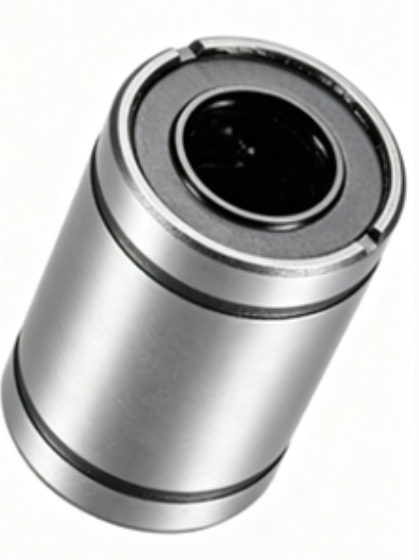
Linear ball bearings for support rail shafts are a specialized sub-category of linear ball bearings designed specifically to work with supported rail (support rail / shaft support) systems, rather than free-standing unsupported shafts. In this configuration, the shaft itself is continuously backed by a rigid support rail or channel along its entire length, which allows for longer travel distances, reduced shaft deflection, and higher load capacity than an unsupported shaft of the same diameter could otherwise achieve.
What Are Support Rail Shaft Linear Ball Bearings and How Do They Work?
In a standard (unsupported) linear ball bearing setup, the shaft is fixed only at its two end points, meaning shaft diameter must increase significantly to resist bending or sagging over longer spans. A support rail system solves this by continuously supporting the shaft along a base rail, distributing load along the full shaft length rather than concentrating stress at the end mounts.
The linear ball bearing itself still uses recirculating steel balls running in a raceway against the shaft surface, but the bearing housing is typically designed with a flat bottom or slot to accommodate the support rail beneath the shaft, allowing the bearing to travel smoothly along the supported length. Key advantages of this configuration include:
- Longer travel spans — support rails allow much longer shaft lengths without excessive sag compared to unsupported shafts
- Higher load capacity — continuous shaft support reduces bending stress, allowing greater loads relative to shaft diameter
- Reduced vibration and deflection — full-length support improves rigidity and positioning stability under dynamic loads
- Cost-effective for long-stroke applications — avoids the need for oversized shaft diameters purely to resist deflection
Product Line Overview
- Common Linear Ball Bearings for Support Rail Shafts are vital components in many precision motion systems, ensuring accuracy, reliability, and efficiency across various industrial and automation applications. These serve as the standard, general-purpose option for supported-shaft linear motion systems where moderate load and travel requirements apply.
- High-Load Linear Ball Bearings for Support Rail Shafts, when used in conjunction with a guide rail system, can withstand greater radial and axial loads, offering better wear resistance and fatigue strength. These are specified for heavier industrial automation, material handling, and equipment subject to higher operating forces or shock loading along the supported shaft span.
- High-Temperature Linear Ball Bearings for Support Rail Shafts are heat-resistant and corrosion-resistant, suitable for high-temperature applications that require additional support and reliable performance under thermal stress. These are the appropriate choice for supported-rail systems operating near ovens, furnaces, or other heat-generating equipment where standard seals and lubricants would degrade prematurely.
What is the difference between a support rail shaft bearing and a standard (unsupported) linear ball bearing?
A standard linear ball bearing runs on a shaft that is only fixed at its two end points, limiting practical shaft length before deflection becomes a problem. A support rail shaft bearing is designed to work with a shaft that is continuously backed by a rail along its entire length, enabling much longer travel spans and higher load capacity without needing a larger-diameter shaft.
When should I choose a support rail system instead of an unsupported shaft?
Support rail systems become necessary once travel length or load requirements would cause an unsupported shaft to deflect or sag beyond acceptable tolerances. As a general rule, longer strokes, heavier loads, or applications requiring high positioning accuracy over extended travel distances benefit most from a supported-rail configuration.
Can support rail shaft bearings be retrofitted onto an existing unsupported shaft system?
Generally, no — support rail bearing housings are specifically shaped to interface with the support rail beneath the shaft, so converting an unsupported system typically requires replacing both the shaft/rail assembly and the bearing units to ensure proper fit and load transfer.
How much more load can a supported shaft system handle compared to an unsupported one?
The exact increase depends on shaft diameter, support rail spacing, and bearing series, but continuous rail support significantly reduces bending moment along the shaft, generally allowing considerably higher load ratings and longer spans than an unsupported shaft of the same diameter — always consult the specific load rating tables for the bearing and rail combination being used.
What maintenance is required for support rail shaft bearing systems?
Maintenance typically includes periodic re-lubrication of the ball circuit, inspection of the shaft surface for wear or contamination, and checking that the support rail remains clean and free of debris, since particulate buildup on the rail can affect smooth bearing travel and accelerate wear.
Are high-load and high-temperature variants interchangeable, or can they be combined?
These variants address different operating conditions — load capacity and thermal resistance — and are typically manufactured as separate product lines optimized for their specific requirement. If an application requires both elevated temperature and high load capacity, it's important to check with the specific product specifications, as a single variant may not address both conditions simultaneously.
What industries commonly use support rail shaft linear ball bearing systems?
Common applications include CNC machinery, long-stroke automation equipment, gantry systems, packaging machinery, and any equipment requiring extended linear travel with high positioning accuracy — situations where an unsupported shaft would be impractical due to length or load requirements.