Slewing Bearing
2184 Products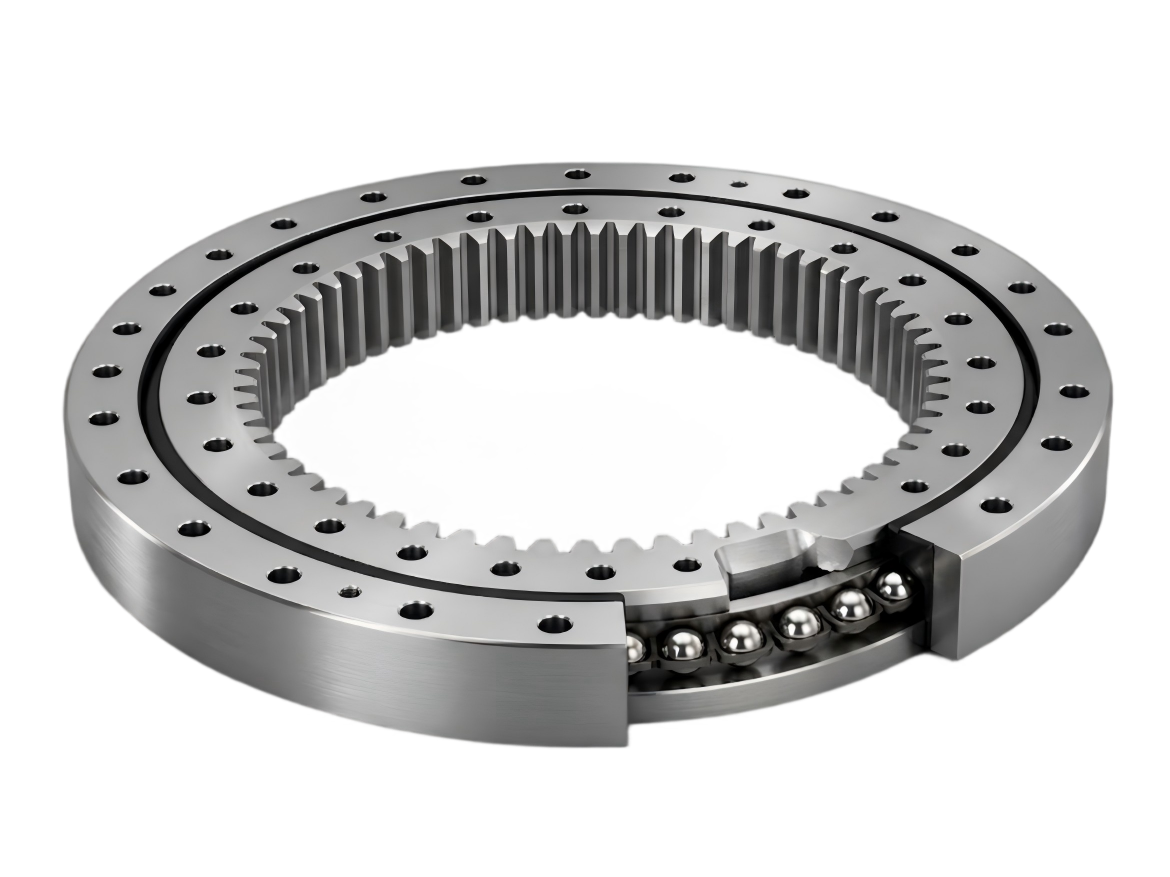

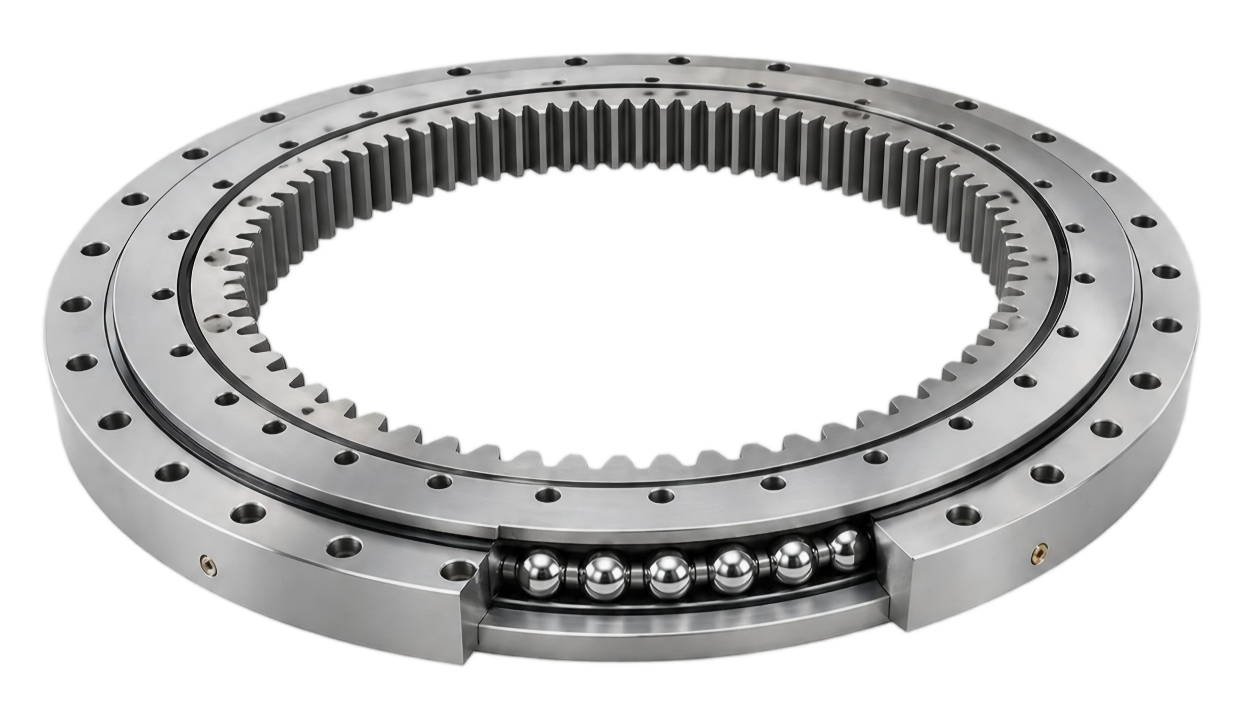


What Is a Slewing Bearing?
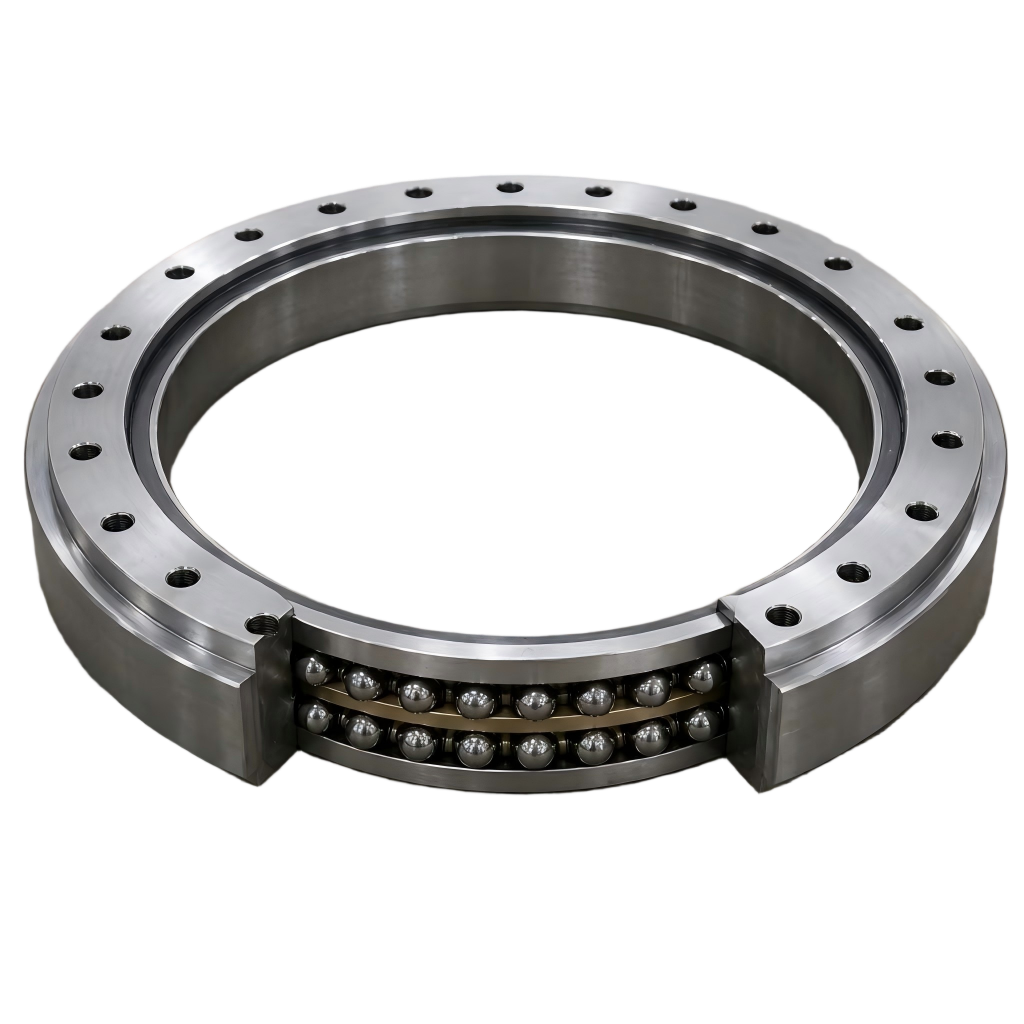
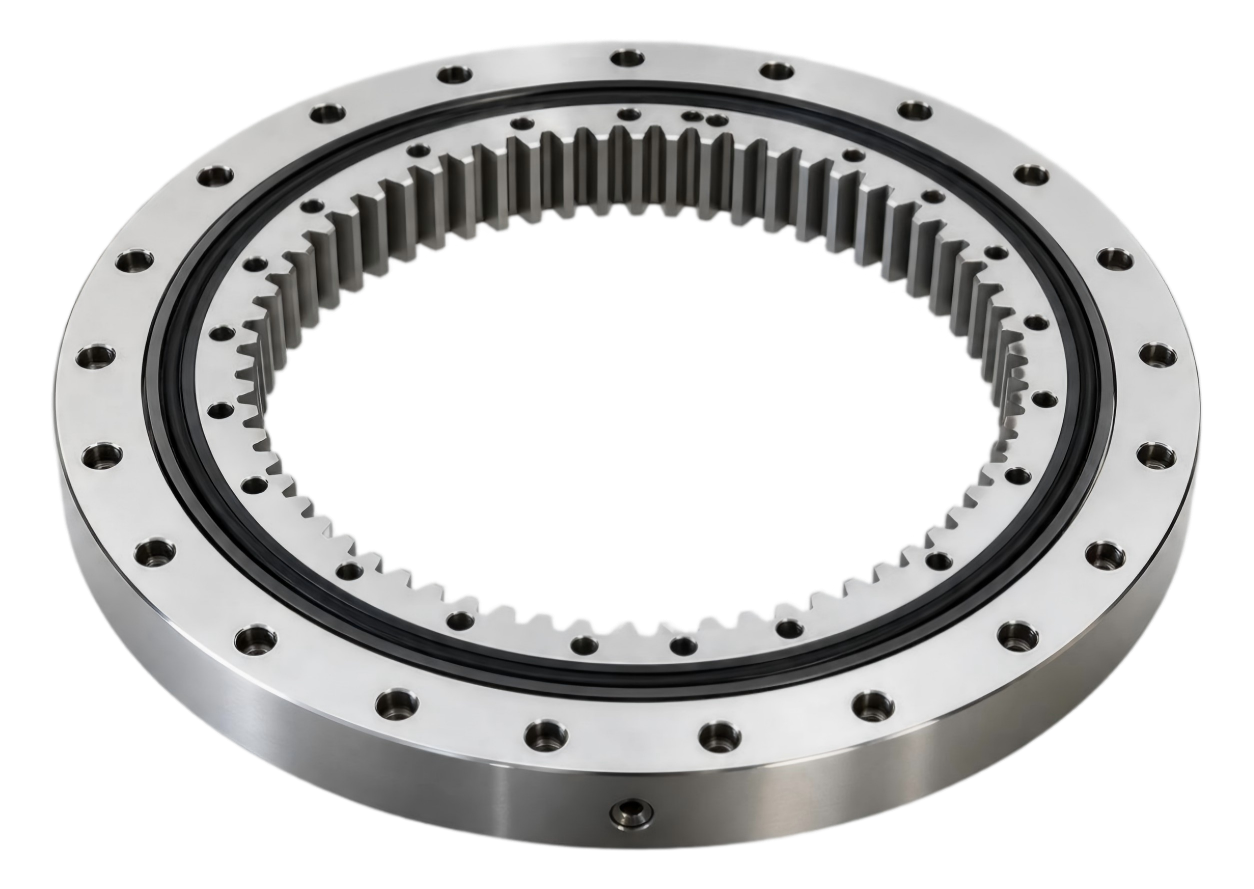
A slewing bearing — also called a slewing ring, slew ring, slew bearing, or turntable bearing — is a large-diameter rotational bearing designed to support combined axial load, radial load, and tilting moment while enabling slow-speed continuous or oscillating rotation. Slewing bearings are classified by gear configuration (without gear, external gear, or internal gear), rolling element type (ball or roller), and ring structure (single-row, double-row, or three-row/four-point contact), and can be custom-manufactured to non-standard dimensions and specifications.
What Makes Slewing Bearings Different from Standard Bearings
Unlike standard ball or roller bearings that primarily handle radial loads, slewing bearings are engineered for multi-directional load support:
|
Feature |
Slewing Bearings |
Standard Bearings |
|
Load Type |
Combined radial + axial + moment |
Primarily radial |
|
Rotation Range |
360° continuous or oscillating |
360° continuous |
|
Mounting |
Bolted to structural frame |
Press-fit into housing |
|
Size Range |
30mm to 6,475mm+ bore |
Typically smaller |
|
Gear Integration |
Common (external/internal) |
Rare |
|
Applications |
Cranes, excavators, wind turbines, robots |
Motors, gearboxes, instruments |
|
Operating Speed |
Low relative to standard bearings (often below |
Medium to high |
Key Insight: Slewing bearings aren't "better" than standard bearings — they serve different purposes. Choose slewing bearings when you need large diameter rotation with combined load support and optional gear drive.
Key Components of a Slewing Bearing
Inner Ring:
- Mounts to rotating component (shaft, turret, arm)
- May include gear teeth (internal gear configuration)
- Precision-machined raceway for rolling elements
Outer Ring:
- Mounts to stationary structure (base, housing, frame)
- May include gear teeth (external gear configuration)
- Precision-machined raceway for rolling elements
Rolling Elements:
- Ball-type: Spherical balls for high-speed, low-friction applications
- Roller-type: Cylindrical rollers for heavy-load, high-stiffness applications
- Distribute loads between inner and outer rings
Seals:
- Protect rolling elements from contamination (dust, moisture, debris)
- Retain lubrication within bearing
- Typically NBR (Nitrile Butadiene Rubber) material
Gear Teeth (if applicable):
- Enable driven rotation via pinion gear
- External gear: Teeth on outer diameter
- Internal gear: Teeth on inner diameter
- Without gear: For direct-drive or belt-drive applications
How Does a Slewing Bearing Work?
Understanding how slewing bearings work helps you select the right type for your application and ensure proper installation and maintenance.
Rotation Mechanism Explained
Slewing bearings enable smooth rotation through:
Rolling Contact:
- Rolling elements (balls or rollers) roll between inner and outer ring raceways
- Minimal friction enables smooth rotation at slow speeds, whether continuous or oscillating
- Lubrication reduces wear and extends service life
Load Distribution:
- Rolling elements distribute loads across multiple contact points
- Multiple rolling elements share load simultaneously
- Enables support of combined radial, axial, and moment loads
Gear Drive (if applicable):
- Pinion gear engages with bearing gear teeth
- Converts motor rotation to bearing rotation
- Gear ratio determines output speed and torque
Load Capacity: Axial, Radial, and Moment Loads
Slewing bearings handle three load types simultaneously:
Radial Load:
- Force perpendicular to bearing axis
- Example: Weight of rotating arm acting on bearing
- LILY range: 520 to 62,404 lbs dynamic radial load
Axial Load:
- Force parallel to bearing axis (thrust)
- Example: Vertical forces from payload or structural loads
- Varies by bearing type and configuration
Moment Load:
- Overturning or tilting force
- Example: Offset payload creating leverage on bearing
- LILY range: 1 to 82,600,000 ft-lbs moment load rating
Why Combined Load Support Matters: Real-world applications rarely experience pure radial or pure axial loads. Crane booms, excavator arms, and wind turbine rotors all create complex load combinations. Slewing bearings are specifically engineered for these multi-directional loading conditions.
Bearing Turning Torque:
- Torque required to rotate the bearing itself, distinct from the external tilting moment and load capacity ratings above
- Specified as normal and maximum operating values (Mz normal, Mz max)
- Depends on load condition, preload, seal friction, and gear configuration — calculated per application rather than published as a fixed catalog value
- See [Slewing Bearing Torque: What It Is, How to Calculate It & Key Factors] for a detailed guide to torque calculation and the factors that affect it.
Types of Slewing Bearings — Ball, Roller, and Cross Roller
Slewing bearings come in several types, each optimized for specific load conditions, speed requirements, and precision needs.
Single Row Ball Slewing Bearing
Features:
- Single row of ball rolling elements
- Compact cross-section relative to load capacity
- High-speed capability with low friction
Advantages:
- Lower friction for faster rotation
- Suitable for high-speed applications
- Cost-effective for standard applications
- Accounts for approximately 75% of typical product lines
Limitations:
- Lower load capacity compared to roller types
- Lower stiffness under moment loads
Typical Applications:
- Light to medium-duty cranes
- Small to medium excavators
- Industrial robots
- Precision rotary tables
- AGV/AMR mobile platforms
Double Row Ball Slewing Bearing
Features:
- Two rows of ball rolling elements
- Higher load capacity than single-row designs
- Better load distribution across bearing
Advantages:
- Significantly higher axial and moment load capacity
- Better load distribution
- Increased stiffness under combined loading
- Still maintains relatively high-speed capability
Limitations:
- Larger cross-section than single-row
- Higher cost than single-row designs
Typical Applications:
- Tower cranes
- Large excavators
- Wind turbine yaw systems
- Heavy-duty rotary tables
Cross Roller Slewing Bearing
Features:
- Cylindrical rollers arranged perpendicular to each other
- Highest load capacity per unit cross-section
- Superior stiffness and minimal deflection
Advantages:
- Highest load capacity and stiffness
- Excellent precision for indexing applications
- Compact design for given load capacity
Limitations:
- Lower speed capability than ball types
- Higher friction
- Premium cost
Typical Applications:
- Ultra-high precision rotary tables
- Robotics joints requiring extreme stiffness
- Precision indexing applications
- Machine tool rotary axes
Three-Row Roller Slewing Bearing
Features:
- Three separate roller rows for axial and radial loads
- Maximum load capacity for large diameter applications
- Independent optimization of axial and radial capacity
Advantages:
- Maximum load capacity
- Robust design for extreme conditions
- Suitable for largest diameter bearings
Limitations:
- Largest cross-section
- Lowest speed capability
- Highest cost
Typical Applications:
- Mining shovels
- Large cranes (offshore, port)
- Heavy-duty wind turbine pitch systems
- Extreme-duty construction equipment
Type Comparison Table
|
Type |
Load Capacity |
Speed |
Stiffness |
Precision |
Cost |
Best For |
|
Single Row Ball |
Medium |
High |
Medium |
Good |
Low-Medium |
High-speed, light-medium loads |
|
Double Row Ball |
Medium-High |
Medium-High |
Medium-High |
Good |
Medium |
Combined loads, wind turbines |
|
Cross Roller |
High |
Medium |
Very High |
Excellent |
High |
Ultra-precision, high stiffness |
|
Three-Row Roller |
Very High |
Low |
Very High |
Good |
Very High |
Extreme loads, large diameters |
Key Specifications and What They Mean
Understanding slewing bearing specifications helps you communicate requirements clearly and select the right bearing for your application.
Load Ratings Explained (Axial, Radial, Moment)
Dynamic Radial Load:
- Maximum radial load bearing can support during rotation
- LILY range: 520 to 62,404 lbs
- Determines bearing suitability for rotating applications with radial forces
Dynamic Thrust (Axial) Load:
- Maximum axial load bearing can support during rotation
- Varies by bearing type and configuration
- Critical for applications with significant vertical forces
Moment Load Rating:
- Maximum overturning/tilting moment bearing can support
- LILY range: 1 to 82,600,000 ft-lbs
- Critical for cantilevered loads (crane booms, excavator arms)
Static Load Ratings:
- Maximum load bearing can support when stationary
- Typically higher than dynamic ratings
- Important for applications with long stationary periods under load
Gear Specifications: External vs Internal Gear vs Without Gear
External Gear (790 models in LILY catalog):
- Gear teeth on outer diameter
- Easier to access for pinion engagement
- Common in robot base applications
- Better for external motor mounting
- Tooth count range: 36 to 460 teeth
Internal Gear (686 models):
- Gear teeth on inner diameter
- More compact overall design
- Protected from contamination
- Common in space-constrained designs
- Tooth count range: 36 to 460 teeth
Without Gear (707 models):
- No integral gear
- Used with external drive systems
- Maximum design flexibility
- Common in direct-drive or belt-drive applications
Gear Precision:
- LILY offers Gear Class 4 precision (ISO 1328 high precision grade)
- Higher precision = lower backlash = better positioning accuracy
- Critical for robotics and precision applications
Precision Classes
Bearing Machining Precision:
- LILY offers P2 precision class (ISO highest grade)
- P2 specifies extremely tight tolerances for dimensions and runout
- Ideal for high-precision robotics and automation applications
Gear Machining Precision:
- LILY offers Gear Class 4 precision
- Higher precision enables lower backlash
- Critical for smooth transmission and accurate positioning
Size Range: How to Read Dimensions (ID, OD, Height)
Inside Diameter (ID / Bore):
- Diameter of inner ring bore
- Determines minimum shaft size
- LILY range: 1.181" to 254.918" (30mm to 6,475mm)
Outside Diameter (OD):
- Diameter of outer ring
- Determines maximum housing size
- LILY range: 2.165" to 281.600" (55mm to 7,153mm)
Height (Width):
- Axial height of bearing
- Determines space requirement in axial direction
- LILY range: 0.250" to 14.120" (6mm to 359mm)
Reading a Bearing Designation: Example: "1.181" ID × 2.165" OD × 0.250" Height"
- First number: Inside diameter (bore)
- Second number: Outside diameter
- Third number: Axial height
Common Applications by Industry
Slewing bearings are found across diverse industries where rotation under load is required.
Construction Equipment (Cranes, Excavators)
Cranes:
- Mobile cranes: Base rotation, boom articulation
- Tower cranes: Slewing mechanism for 360-degree coverage
- Overhead cranes: Rotary joints for multi-axis movement
- Typical Type: Roller type for high load capacity
- Size Range: Medium to large (20" to 100"+ OD)
Excavators:
- Upper structure rotation (house rotation)
- Boom and arm articulation joints
- Typical Type: Roller type for heavy loads
- Size Range: Medium (20" to 60" OD)
Other Construction Equipment:
- Concrete pump trucks: Boom rotation
- Loaders: Articulation joints
- Bulldozers: Blade rotation mechanisms
Wind Energy (Wind Turbines)
Pitch Systems:
- Adjust blade angle for optimal power generation
- Three bearings per turbine (one per blade)
- Typical Type: Large roller type with internal gear
- Requirements: Extreme load capacity, long service life (20+ years)
Yaw Systems:
- Rotate nacelle to face wind direction
- Single large bearing per turbine
- Typical Type: Large roller type with external gear
- Requirements: High moment load capacity, reliable operation in harsh conditions
Size Range: Very large (100" to 200"+ OD)
Industrial Automation (Robotics, Rotary Tables)
Industrial Robots:
- Base rotation joints
- Arm segment rotation
- Wrist rotation modules
- Typical Type: Ball type for high-speed, low friction; Roller type for heavy-payload robots
- Size Range: Small to medium (2" to 20" ID)
- Precision: P2 class for high repeatability
SCARA Robots:
- Base rotation
- Arm rotation joints
- Typical Type: Ball type with external or internal gear
- Precision: P2 class for accurate pick-and-place
Precision Rotary Tables:
- CNC machining rotary axes
- Indexing tables for assembly
- Inspection equipment rotation
- Typical Type: Ball type or cross roller for high precision
- Precision: P2 class with Gear Class 4
Aerospace and Defense
Applications:
- Radar antenna rotation
- Turret systems
- Missile launch systems
- Satellite deployment mechanisms
- Typical Type: Precision ball or roller type
- Requirements: AS9100 certification, full traceability, extreme reliability
LILY Capability: AS9100 certified for aerospace supply chain qualification
Marine and Offshore
Applications:
- Cranes on ships and offshore platforms
- Dynamic positioning systems
- Deck machinery rotation
- Typical Type: Roller type with corrosion protection
- Requirements: Corrosion resistance, high load capacity, reliable operation in saltwater environments
Medical Equipment
Applications:
- Surgical robot joints
- Medical imaging equipment rotation (CT, MRI)
- Patient positioning systems
- Typical Type: Precision ball type with stainless steel components
- Requirements: High precision, clean operation, biocompatible materials where applicable
How Do I Choose a Slewing Bearing?
Choosing the right slewing bearing starts with defining your application's rotation type, load conditions, drive configuration, and any special requirements. LILY Bearing's engineering team performs the load and life calculations — you provide the working conditions below.
Step 1: Define Application and Movement
Application:
- Axis of rotation: horizontal, vertical, or alternating
- Load application points on the bearing
Movement:
- Movement type: positioning only, slewing, or continuous rotation
- Slewing range (°), if not continuous rotation
- Number of revolutions: normal and maximal (rev/min)
Step 2: Provide Load and Torque Data
For each load type below, report the max working load, max test load (e.g. 25% overload condition), and extreme load (e.g. shocks or out-of-operation), and note whether the bearing is rotating or stationary under each condition:
- Axial loads (Fz)
- Radial loads (Fx, Fy)
- Tilting moment (Mx, My)
- Bearing turning torque (Mz normal, Mz max)
Note: You don't need to calculate final load values yourself — report the working conditions above and LILY's engineering team will perform the load and life calculations.
Step 3: Specify Drive and Gear Configuration
- Number of drives and their mounting positions
- Gear configuration: without gear, external gear, or internal gear
Step 4: Note Reference and Special Requirements
- Existing or chosen bearing drawing number, if available
- B10 life, continuous rotation, or variable load requirements, if applicable
- Special environmental conditions: corrosive media, dirt, or temperatures outside the standard -25°C to +60°C range
- Special dimensioning requirements: precision, acceptance conditions, material testing, dimensions
Step 5: Evaluate Supplier Options
Key Supplier Evaluation Criteria:
Certifications:
- ISO 9001: Quality management system
- AS9100: Aerospace quality (if applicable)
- IATF 16949: Automotive quality (if applicable)
Product Range:
- Does supplier offer suitable types for your application?
- Size range coverage for your requirements
- Gear configuration options
Technical Support:
- Application engineering assistance available?
- Load calculation support?
- Installation guidance?
Custom Capability:
- Can supplier modify standard designs?
- Prototype support available?
- Custom gear specifications?
Quality Documentation:
- Material test reports available?
- Dimensional inspection reports?
- Traceability documentation?
Questions to Ask Your Supplier
- "What certifications do you hold, and what is the scope?"
- "Can you provide material test reports for bearing components?"
- "What is your process for custom design requests?"
- "Do you provide application engineering support?"
- "What quality documentation comes with each bearing?"
- "Can you provide references from similar applications?"
For a deeper walkthrough of the load calculation methodology, including service factors and step-by-step formulas, see our guide on [selecting a slewing bearing for your application].
Why Choose LILY Bearing as Your Slewing Bearing Supplier?
LILY Bearing combines manufacturing capabilities with OEM-focused support — offering the precision, flexibility, and reliability industrial buyers need.
AS9100 + ISO 9001 + IATF 16949 Certifications
LILY Certification Portfolio:
- ISO 9001: Quality management system for general manufacturing
- AS9100: Aerospace quality management (required for aerospace primes)
- IATF 16949: Automotive quality management (valuable for automotive crossover)
Why Three Certifications Matter:
- Comprehensive quality coverage from industrial to aerospace to automotive-grade production
- Single audit covers diverse customer requirements
- Multiple certification bodies provide independent oversight
60,000+ SKU — Wide Selection for Fast Delivery
LILY Product Breadth:
- Total SKU: 60,000+ bearing types across all categories
- Slewing Bearing Models: 2,183 models across 46 series
- Size Range: Inside diameter from 1.181" to 254.918" (30mm to 6,475mm)
OEM Advantages:
- One-stop procurement for multiple bearing types
- Reduced supplier qualification burden
- Technical consistency across product lines
- Fast delivery from inventory for standard items
2,183 Slewing Bearing Models Across 46 Series
Series Coverage:
- BB Series, RK Series, HS Series, VL Series, XT Series, XS Series
- Light Series, Medium Size Four-Point Contact
- Customized Four-Point Contact, Customized Crossed Cylindrical
- 1000/3000/5000/6000/7100/10000 Series
- And 30+ additional series
Type Distribution:
- Ball Type: 1,644 models (75.3%) — for high-speed, low-friction applications
- Roller Type: 539 models (24.5%) — for heavy-load, high-stiffness applications
Custom Slewing Bearing Solutions (Customized Series Available)
LILY Custom Capabilities:
- Non-Standard Dimensions: Bore, OD, width modifications
- Special Materials: Stainless steel, specialty alloys
- Modified Configurations: Seals, lubrication options
- Custom Gear: Non-standard tooth count, module, pressure angle
Customized Series: 38+ models specifically designed for custom applications, demonstrating proven custom capability.
Custom Process: 1. Submit requirements (drawings, specifications, application details) 2. Engineering review and feasibility assessment 3. Prototype production (if required) 4. Customer approval and testing 5. Production run with full documentation
Size Range: 1.181" to 254.918" (30mm to 6,475mm)
Complete Size Coverage:
- Small: 1.181" to 7.874" ID — for robotics, precision equipment
- Medium: 7.874" to 50" ID — for construction equipment, industrial automation
- Large: 50" to 254.918" ID — for wind turbines, large cranes, mining equipment
Why Size Range Matters:
- One supplier for diverse application needs
- Simplified procurement across product lines
- Consistent quality standards regardless of size
Precision Manufacturing: P2 Accuracy, Gear Class 4
LILY Precision Capabilities:
- Bearing Precision: P2 class (ISO highest grade)
- Gear Precision: Class 4 (ISO 1328 high precision grade)
Benefits for Your Application:
- Improved positioning accuracy for robotics and automation
- Reduced vibration and noise
- Extended service life through even load distribution
- Better system-level performance
Engineering Support and Technical Consultation
LILY Support Capabilities:
- Application engineering assistance
- Load and life calculations
- Bearing selection and sizing
- Mounting and installation guidance
- Failure analysis support
Communication: English-speaking technical team for clear, efficient collaboration with USA buyers.
Serving US Buyers with English-Language Support
US Market Support:
- English-language technical documentation
- English-speaking engineering support team
- Clear communication for specifications and requirements
- Responsive support for questions and issues
Logistics:
- Efficient shipping to USA
- Export documentation handled
- Tracking and delivery confirmation
26 Years Experience (Since 2000)
LILY Company Profile:
- Founded: 2000 (26 years of bearing production)
- Headquarters: Shanghai, China
- Production Facilities: Owned factories in Luoyang and Zhenjiang
- Workforce: 200+ employees including engineering and quality teams
- Annual Capacity: Approximately 50 million bearings across all product lines
Experience Benefits:
- Refined manufacturing processes over 25 years
- Deep knowledge of slewing bearing requirements across industries
- Established supply chain stability
- Ongoing investment in equipment and training
Own Factories in Luoyang and Zhenjiang, China
Manufacturing Control:
- Owned production facilities (not outsourced)
- Direct control over quality at every production stage
- Vertical integration from raw materials to finished bearings
- Calibrated measurement systems for quality verification
Factory Locations:
- Luoyang: Major bearing manufacturing hub in China
- Zhenjiang: Additional production capacity
FAQ — Slewing Bearing Basics
What is the difference between a slewing bearing, slewing ring, slew ring, slew bearing, and turntable bearing?
These are all names for the same type of rotational bearing, designed to handle combined radial, axial, and moment loads. "Slewing bearing" and "slewing ring" are the industry-standard terms, with "slew ring" and "slew bearing" as informal shorthand common in spoken inquiries. "Turntable bearing" is an alternative term used in some industries. All these terms describe the same product type.
What are the main types of slewing bearings?
The main types are: (1) Ball-type slewing bearings — for high-speed, low-friction applications with medium load capacity, accounting for approximately 75% of typical product lines; (2) Roller-type slewing bearings — for heavy-load, high-stiffness applications, covering about 25% of product lines; (3) Cross roller slewing bearings — for ultra-high precision and extreme stiffness applications. Selection depends on your load, speed, and precision requirements.
How do I know what size slewing bearing I need?
Size selection depends on your application requirements: (1) Determine available space (bore diameter, outer diameter, height constraints); (2) Calculate load requirements (axial, radial, moment loads); (3) Consider precision needs (P2 class for high-precision applications); (4) Evaluate gear configuration needs (external gear, internal gear, or without gear). LILY Bearing offers sizes from 1.181" to 254.918" inside diameter. Consult with our engineering team for personalized recommendations based on your specific application.
Can I get a custom slewing bearing?
Yes. LILY Bearing offers custom slewing bearing solutions including non-standard dimensions, special materials, modified configurations (seals, lubrication), and custom gear specifications. We have a dedicated Customized series with 38+ models and provide engineering support for prototype and production runs. Contact our engineering team with your requirements for feasibility assessment and quotation.
What certifications do you have for slewing bearings?
LILY Bearing holds ISO 9001 (quality management), AS9100 (aerospace quality management), and IATF 16949 (automotive quality management) certifications. Additionally, 96.5% of our products comply with RoHS environmental directive. These certifications ensure consistent quality across diverse industry requirements. Certificate numbers available upon request for verification.
What is the size range you offer?
We offer slewing bearings with inside diameter from 1.181 inches to 254.918 inches (30mm to 6,475mm), outside diameter from 2.165 inches to 281.600 inches (55mm to 7,153mm), and height from 0.250 inches to 14.120 inches (6mm to 359mm). This covers applications from small collaborative robots to large wind turbines and construction equipment. Dynamic radial load capacity ranges from 520 to 62,404 lbs, with moment load ratings from 1 to 82,600,000 ft-lbs.
Do you provide selection support for slewing bearing applications?
Yes. LILY Bearing provides comprehensive selection support including application engineering assistance, load and life calculations, precision class recommendations, gear configuration optimization, and custom design consultations. Our English-speaking engineering team is available to discuss your application requirements. Contact us with your load specifications, speed requirements, and accuracy needs for personalized recommendations.
Ready to Select the Right Slewing Bearing for Your Application?
LILY Bearing offers 2,183 slewing bearing models across 46 series, with AS9100-certified quality, 60,000+ SKU inventory, and custom solutions for diverse industrial applications.
Next Steps:
1. Request a Quote Submit your requirements with application details, load specifications, and size constraints. Our engineering team will respond with recommendations and pricing.
2. Contact Our Engineering Team Have technical questions? Our English-speaking engineering team is available to discuss your application requirements and provide personalized recommendations.
3. Download Selection Guide Use our comprehensive checklist to document your requirements and streamline the selection process.