- Interchangeable With :
- FRANKE
Wire Race Bearing
530 Products



What Are Wire Race Bearings?
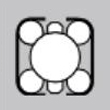
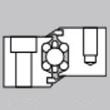
A wire race bearing replaces the machined inner and outer rings of a conventional bearing with hardened, precision-ground steel wire raceways set into a surrounding housing. Balls run directly on these race rings rather than on the mating structure itself, so the housing can be made from steel, aluminum, or even plastic without affecting bearing performance. The design was patented in 1934 by Erich Franke, who needed an extremely low-profile bearing for a space-constrained optical instrument — the same compact, lightweight principle still drives the design today. Because the race rings carry axial, radial, and moment loads at the same time, wire race bearings are often called “4-point-contact” bearings. LILY Bearing’s wire race bearing elements (LEL, LED, LER, LEG, LDD, and LDL series) are interchangeable with FRANKE.
Shop Wire Race Bearings by Series
| Series | Raceway Profile | Cage / Housing | Best For |
|---|---|---|---|
| LEL Series | Round profile, ground raceway | Plastic cage, retained balls | General-purpose, cost-sensitive designs that need maximum mounting freedom |
| LED Series | Double profile, ground or profiled raceway | Plastic cage, retained balls | Compact assemblies needing combined axial, radial, and tilting-moment capacity |
| LER Series | Rectangular profile, profiled raceway | Plastic cage, retained balls | Designs that need a wider contact footprint for higher static capacity |
| LEG Series | 2-ring bearing element, profiled raceway | Plastic cage, retained balls | Simplified radial-load designs that only need two race rings instead of four |
| LDD Series | Slim ground raceway | Encapsulating steel housing | Ready-to-install slim bearings where a self-contained housed unit is preferred |
| LDL Series | Steel or aluminum bearing assembly | Double-sided seal, with or without gear | Sealed, geared rotary assemblies such as turntables and positioning stages |
Wire race bearings are sized to the bore rather than to a fixed catalog OD/ID pairing: several of LILY’s series, including LEL and LER, are manufactured across a continuous diameter range from roughly 70 mm up to 2,000 mm, so the mating shaft and housing can be engineered around the application instead of around a fixed bearing footprint.
Where Are Wire Race Bearings Used?
- Robotic joints, rotary arms, and grippers
- Medical and laboratory imaging equipment, including CT scanners and microscope XY stages
- Machine tool rotary tables and precision spindles
- Aerospace actuators and satellite pointing mechanisms
- Optical, semiconductor, and other high-precision positioning stages
- Material handling turntables and rotary indexers
Frequently Asked Questions
Do wire race bearings need special maintenance or lubrication?
No special maintenance is required. Wire race bearings run on a light film of grease and are largely maintenance-free in service — they just need periodic re-lubrication on a schedule set by the operating environment and duty cycle, the same as any precision rolling bearing.
How is a wire race bearing different from a standard ball bearing?
A standard bearing has thick, self-supporting inner and outer rings that must be rigid enough to hold their own geometry. A wire race bearing has little structure of its own — the thin wire raceways rely on the surrounding housing for support — which is what lets the overall assembly be far more compact and lighter for the same load and moment capacity.
What's the difference between LILY's four-ring and two-ring wire race bearing elements?
LEL, LED, and LER are four-ring elements — two inner and two outer race rings — built to carry axial, radial, and moment loads at the same time in one unit. LEG simplifies this to two race rings for radial-only requirements, trading some load versatility for a smaller parts count and lower cost. Choose a four-ring series for combined-load applications, and LEG when the mounting only needs to resist radial load.
Which LILY wire race bearing series should I choose?
Start with LEL for a general-purpose, four-ring ground raceway at the lowest cost. Move to LED if the application needs a single bearing to carry axial, radial, and tilting-moment loads together. Choose LER when a wider raceway contact area is needed for higher static capacity, LEG when a simpler two-ring radial-only design is sufficient, LDD when a self-contained slim housed unit is preferred over loose race rings, and LDL when the assembly needs a sealed, and optionally geared, rotary unit rather than bare bearing elements.