- Interchangeable With :
- IMO
Slewing Drivers
54 Products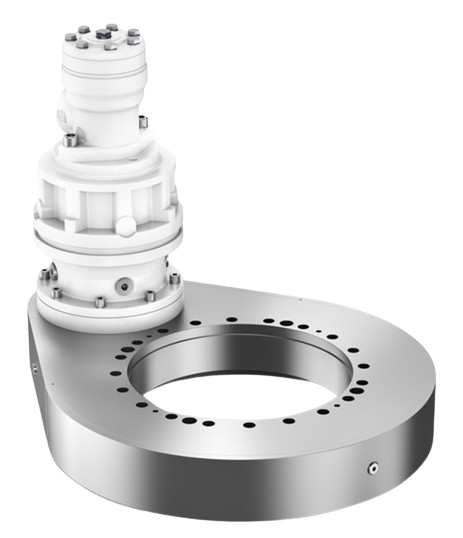
What Is a Slewing Drive?
A slewing drive (also called a slewing driver or slew drive) is a self-contained gearbox that combines a slewing bearing with a driving gear set — worm or straight-tooth (spur) — and a sealed housing in a single unit. Unlike a standalone slewing bearing, which only supports rotation passively, a slewing drive lets a motor power the rotation directly: the input shaft turns the gearing, the gearing meshes with teeth machined into the bearing ring, and the ring rotates the output housing through a full 360° while carrying axial, radial, and tilting-moment loads at the same time. LILY Bearing stocks slewing drivers in worm-gear and spur-gear configurations, interchangeable with IMO, spanning 3,002 N·m to 446,504 N·m of output torque.
Shop Slewing Drives by Series
| Series | Drive Style | Raceway Diameter | Max Tilting Moment | Best For |
|---|---|---|---|---|
| SP-H Series | Straight teeth (spur) | 455–955 mm | 153–562 kN·m | Faster output speeds, higher efficiency |
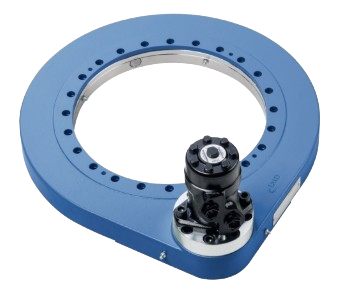
| SP-I Series | Straight teeth (spur) | 229–1091 mm | 22–353 kN·m | Compact, lighter-duty rotation |
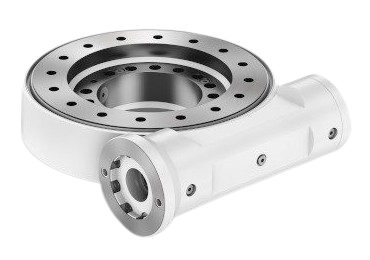
| WD-H Series | Worm | 280–725 mm | 94–1052 kN·m | High single-stage reduction, low output speed |
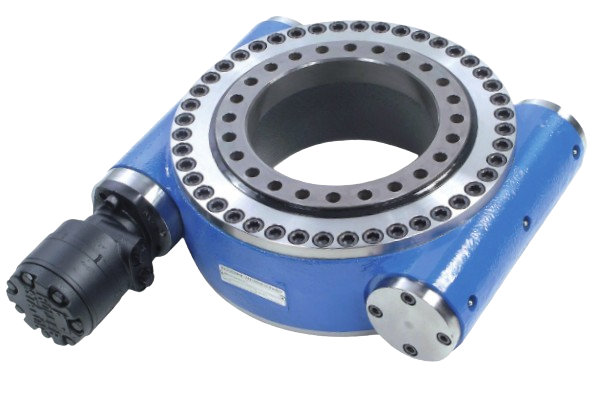
| WD-L Series | Worm | 156–713 mm | 9–1095 kN·m | Widest size range, 1- or 2-row raceway options |
Every series is available in single-drive or dual-drive (2 drive) configurations. Adding a second motor and gear mesh roughly doubles the rated output torque on the same base size — for example, the WD-H 0645 goes from 76,310 N·m with 1 drive to 152,610 N·m with 2 drive.
Worm Gear vs. Spur Gear Slewing Drives
A worm-driven slewing drive (WD Series) uses a worm shaft meshing with a wheel integrated into the bearing race, giving a high reduction ratio in one stage and a compact, low-speed output well suited to cranes, solar trackers, and turntables. A spur-gear (straight-tooth) slewing drive (SP Series) uses a straight-cut pinion driving external teeth on the bearing ring, which typically runs faster and at higher mechanical efficiency than a worm design, at the cost of a lower single-stage reduction ratio.
A note on self-locking: worm gearing is often assumed to be inherently self-locking, but that depends on the lead angle and number of starts of the specific worm. Check the datasheet for the part you're specifying — a gear set that isn't rated as self-locking still needs a separate holding brake to keep a suspended or overturning load from back-driving the drive when power is removed.
Where Are Slewing Drives Used?
- Cranes, aerial work platforms, and truck-mounted lifts
- Solar trackers and heliostats
- Wind turbine yaw and pitch systems
- Robotic arms, turntables, and automated positioning equipment
- Construction and material-handling machinery
- Agricultural equipment such as irrigation arms and harvesters
Frequently Asked Questions
What's the difference between a slewing drive and a slewing bearing?
A slewing bearing only supports rotation — it needs an external pinion, motor, and gearbox to turn it. A slewing drive integrates the bearing, drive gearing, and housing into one plug-and-play unit that a motor can turn directly. If you need the bearing alone, see LILY's slewing ring bearings.
Are LILY's slewing drives self-locking?
It depends on the part. Self-locking behavior is a function of the worm's lead angle and number of starts, not a given for every worm-driven unit, and it doesn't apply to spur-gear drives at all. Always confirm the self-locking rating on the specific part's datasheet before assuming the gearing alone will hold a load without a brake.
What's the difference between a 1 drive and a 2 drive slewing drive?
A 1 drive unit uses a single motor and gear mesh on the bearing ring. A 2 drive unit adds a second motor and gear mesh on the same ring, roughly doubling the rated output torque — useful when a single motor can't deliver the torque or redundancy the application needs.
What torque range does LILY's slewing drive catalog cover?
From 3,002 N·m up to 446,504 N·m across gear modules 4 to 12, in both worm-gear (WD Series) and spur-gear (SP Series) styles, all interchangeable with IMO.