Needle Bearings
4688 Products




Space-constrained design? High radial loads? LILY Bearing specializes in needle bearings that solve both challenges. Our engineers can help you select the right bearing for your application.
What is a Needle Bearing?
A needle bearing is a cylindrical roller bearing with an important difference: its rolling elements are extremely slender. These thin rollers—typically ≤5mm in diameter and 3-10 times longer than wide—look like needles, which is exactly how this bearing type got its name.
Key Advantages of Needle Bearings
Maximum load in minimum space – Needle bearings pack more load capacity into a smaller cross-section than any other rolling bearing type.
Compact, lightweight assemblies – Their slim profile enables designs that simply aren't possible with standard bearings.
Rigid under pressure – Minimal deflection under load means your shaft stays where you need it, even in demanding applications.
Smooth, efficient operation – Low friction translates to less heat, less wear, and better power transmission.
Better economics – Superior load-to-space ratio often means smaller housings, lighter assemblies, and lower overall system cost.
Our Comprehensive Product Range
Select the ideal type for your application from our precision-engineered portfolio.
Drawn Cup Needle Roller Bearings
Drawn cup needle roller bearings combine economy with performance. Their thin-walled stamped construction makes them lightweight and cost-effective—perfect when you need high-volume production and tight radial space.
What sets them apart: Low cost, low weight and small footprint. Ideal for press-fitting into light-alloy housings.
Which style do you need?
- Open-End Design: Go with caged rollers if you're running at higher speeds. Need maximum load? Choose full-complement (all rollers, no cage)—just remember to add grease after installation.
- Closed-End Design: Built-in end cap keeps dirt out and can handle light axial forces too.
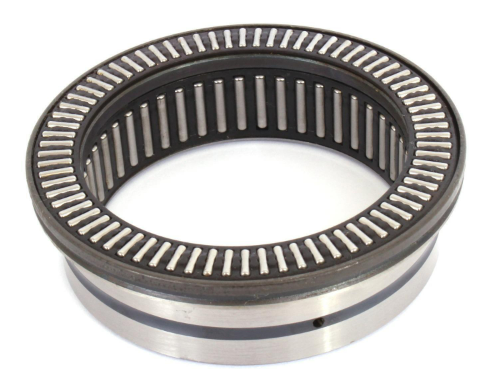
Machined Ring Needle Roller Bearings
Think of these as the "serious" version of needle bearings. Machined ring bearings trade the stamped shell for a solid, precision-machined outer ring. The result? Better guidance, higher rigidity, and longer life in demanding applications.
What you get:
- Solid machined rings that guide rollers with precision
- High rigidity for applications that can't tolerate flex
- Easier to install and maintain than bearing assemblies without rings
- Long service life under demanding conditions
Needle Roller and Cage Assemblies
This is needle bearing design at its most minimal. No inner ring. No outer ring. Just caged rollers running directly on your shaft and housing. It's the ultimate space-saver, but it demands precision from your surrounding components.
Critical note: The needle rollers run directly on your shaft and housing, so these surfaces must be hardened (≥58 HRC) and precision-ground. Softer materials or loose tolerances will lead to rapid wear and early failure.
Drawn Cup Roller Clutches (One-Way Clutches)
Drawn cup roller clutches are compact, one-way locking devices that transmit torque in one direction while allowing free rotation (overrun) in the opposite. Their thin-walled, stamped construction is designed for precise motion control in minimal radial space.
The mechanism: Picture spring-loaded rollers sitting in angled ramps. Rotate one way, they wedge tight—torque transfers. Rotate the other way, they release—shaft spins freely. No electronics, no adjustment needed.
Thrust Needle Roller Cage Assemblies & Thrust Washers
Designed for pure axial loads in minimal axial space. These assemblies combine caged needle rollers with hardened thrust washers to create ultra-compact thrust bearing arrangements.
What you get:
- Extremely low axial height profile
- High axial load capacity in minimal space
- Caged needle rollers for controlled roller spacing
- Hardened washers provide precision raceways
Critical requirement: Shaft and adjacent surfaces must be flat, hardened (≥58 HRC), and ground to tight tolerances for optimal performance.
Selecting Your Needle Bearing: A Practical Guide
Choosing the right needle bearing comes down to understanding your application. Here's what matters:
- Start with your loads. How much force? Which direction—radial, axial, or both? This determines the basic bearing type you need.
- Measure your space. Know exactly how much room you have, both radially and axially. Needle bearings excel in tight spaces, but you still need precise dimensions.
- Consider operating conditions. What's your speed range? Operating temperature? Can you use grease, or do you need oil circulation? These factors narrow your options quickly.
- Think about the environment. Will the bearing see dirt, water, chemicals, or extreme temperatures? Environmental factors affect both bearing type and seal selection.
- Match the bearing type to your needs. Use our online selector tool, or talk to our engineers if your application has multiple constraints.
- Get the clearance right. This is where many designs go wrong:
- For bearings with cages: Specify the internal clearance group based on your shaft fit and thermal expansion
- For cage-only assemblies: Focus on shaft and housing tolerances—these create your running clearance
Not sure about clearance? You're not alone—it's one of the trickiest parts of bearing selection. Our engineers can review your fits, loads, and speeds to get it right the first time.
What Are Needle Bearings Used For?
- Automotive: Transmissions, engines (rocker arms, piston pins), steering columns, differentials.
- Industrial Automation: Robotics (joint arms, grippers), linear guides, CNC rotary tables.
- Heavy Machinery: Construction equipment, agricultural machinery, material handling systems.
- Aerospace & Defense: Actuators, control systems, auxiliary power units (APUs).
- Consumer Products: Power tools, home appliances, fitness equipment.
Why LILY Bearing?
Manufacturing precision that shows in performance
We machine to tolerances tighter than industry standards. The result? Bearings that run smoother, last longer, and perform more consistently than typical off-the-shelf options.
Material science that extends bearing life
Our case-hardening and heat treatment processes are optimized for needle bearing applications specifically. We've tested extensively to find what actually works in the field, not just what looks good in a spec sheet.
Engineering support that actually helps
Call our technical team, and you'll speak with engineers who understand bearing applications—not a call center reading from a script. They'll review your design, challenge assumptions if needed, and help you get it right.
Certifications that mean something
ISO 9001 for quality management. IATF 16949 for automotive quality systems. These certifications require continuous auditing and improvement—they're not one-time achievements.
The Alternative Major OEMs Don't Want You to Know About
Need INA-level performance without the lead times or premium pricing? Our needle bearings are precision-engineered as direct replacements for Schaeffler and other major brands—same specs, better availability.