

How Are Springs Made? Materials, Process & Steps Explained
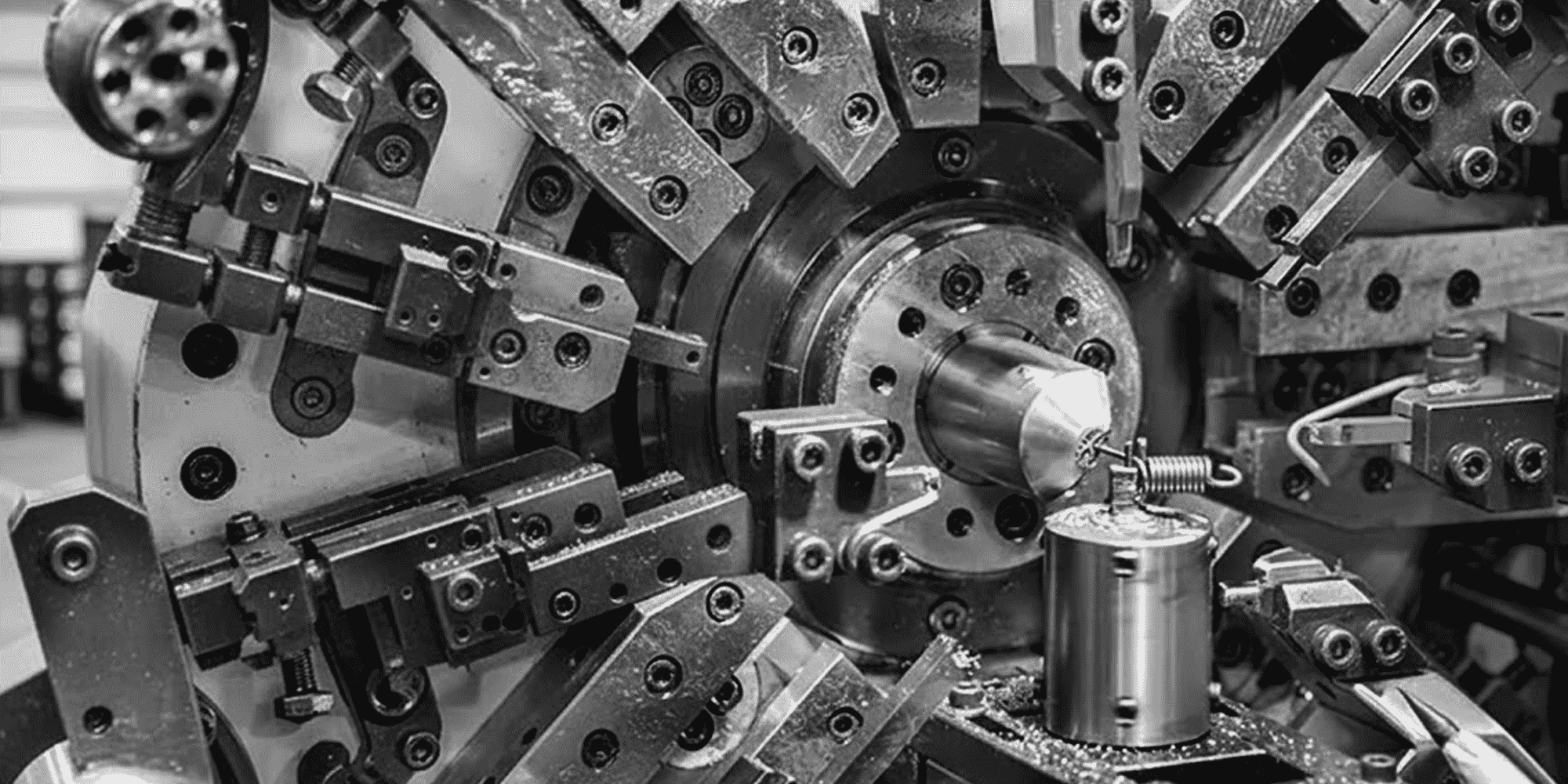
Springs are made through a multi-step process: wire is coiled on a CNC machine, cut to length, stress-relieved through heat treatment, ground flat...
Table of Contents
Most spring failures we see at Lily Bearing trace back to the same root cause: the spring was treated as an afterthought.
The bearing got carefully specified, the shaft got toleranced, the housing got reviewed — and then someone grabbed a spring from the stockroom because it looked about right.
That works until it doesn't: the die starts cracking every few thousand strokes, the oil seal weeps at six months, the valve seat won't hold pressure.

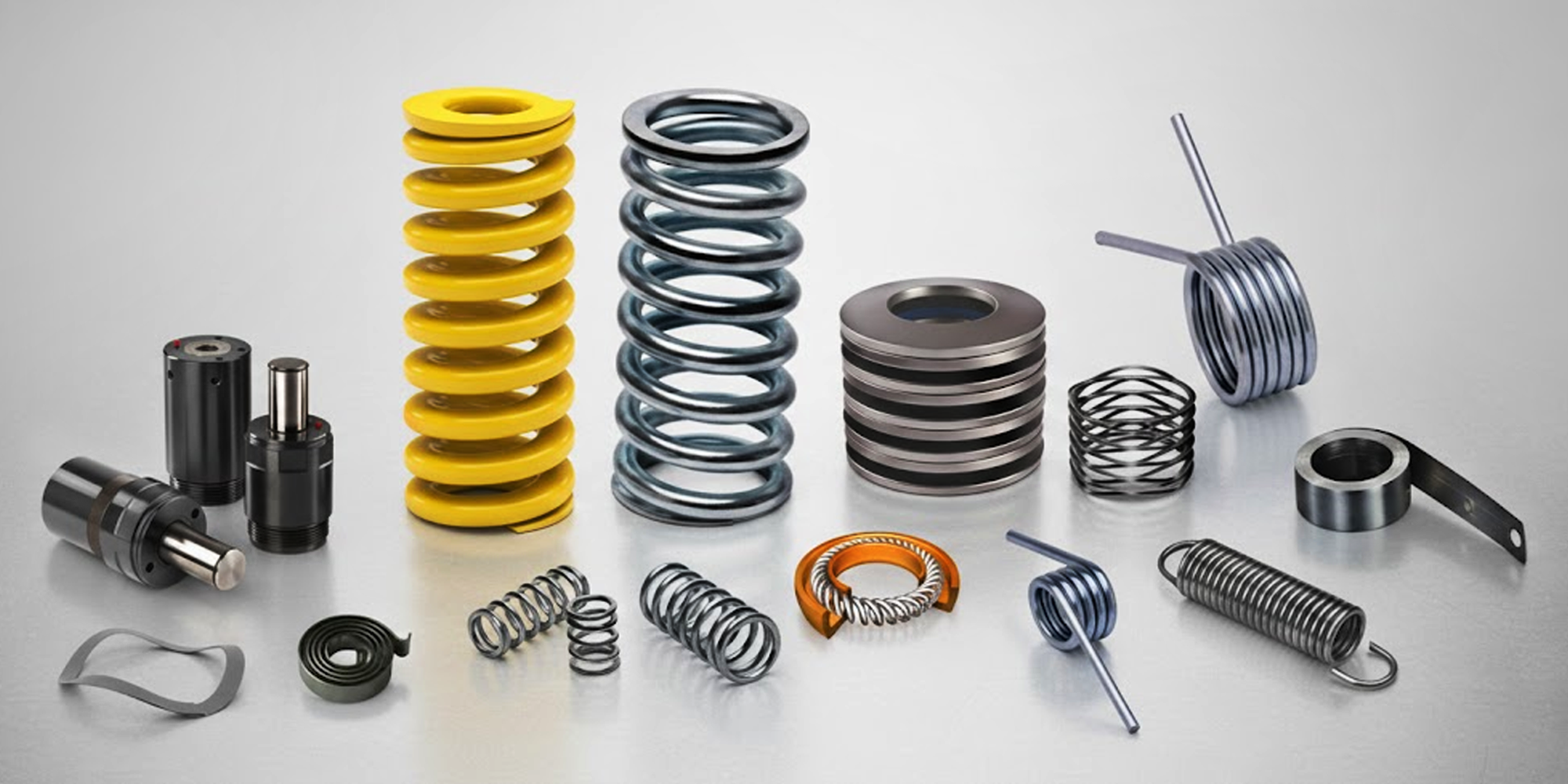
This guide covers the nine industrial spring types, what each one actually does, which materials hold up in which environments, and the selection mistakes that cause most of the failures we're called about.
If you already know which type you need, jump straight to the materials table or the FAQ.
Every spring stores mechanical energy when deformed and releases it when the force is removed.
The spring rate (k, in N/mm) defines stiffness — how much force is needed per mm of deflection.
Two things matter most at spec time: rate must match the system dynamics, and fatigue life matters more than static load capacity.
Springs in production presses and valve trains fail from fatigue, not overload.
→ Full breakdown: A Comprehensive Guide to Factors Affecting Spring Performance
Use this table to narrow your selection before reading the detailed sections below.
|
Spring Type |
Load Direction |
Max Temp |
Key Applications |
Typical Material |
|
Compression |
Axial push |
Varies by material |
Valves, engines, general machinery |
Music wire / Chrome-Si |
|
Extension |
Axial pull |
Varies by material |
Garage doors, farm equipment |
Music wire / Stainless |
|
Torsion |
Rotational torque |
Varies by material |
Door hinges, clips, transmissions |
Music wire / Chrome-Si |
|
Wave |
Axial (low deflection) |
Varies by material |
Bearing pre-load, aerospace gearboxes |
Stainless / 17-7 PH |
|
Disc (Belleville) |
Axial (high load, tiny travel) |
Up to 300°C+ |
Bolted joints, pressure valves |
Chrome-Si / Stainless |
|
Garter |
360° radial inward |
Varies by material |
Oil seal lip reinforcement |
Stainless / Music wire |
|
Rotor |
Rotational, small radial space |
Varies by material |
Small motors, timers, electrical instruments |
Music wire / Stainless |
|
Die Spring |
Axial push (high cycle) |
Up to 246°C |
Stamping dies, injection moulds |
Chrome-vanadium alloy |
|
Gas Spring (N₂) |
Axial (near-constant) |
−30°C to +80°C |
Stamping dies, liftgate supports |
Nitrogen in steel cylinder |
|
Strip / Flat |
Custom / bending |
Varies by material |
Electrical contacts, latches |
Phosphor bronze / SS |
Note: "Varies by material" means the temperature limit is set by the wire material chosen, not the spring geometry. See the Materials section for specifics.
The speed table above covers all nine types. Below are the ones that need a word of context beyond what the table shows.
For a full breakdown of each type with application examples, see our complete guide: Types of Springs and Their Applications
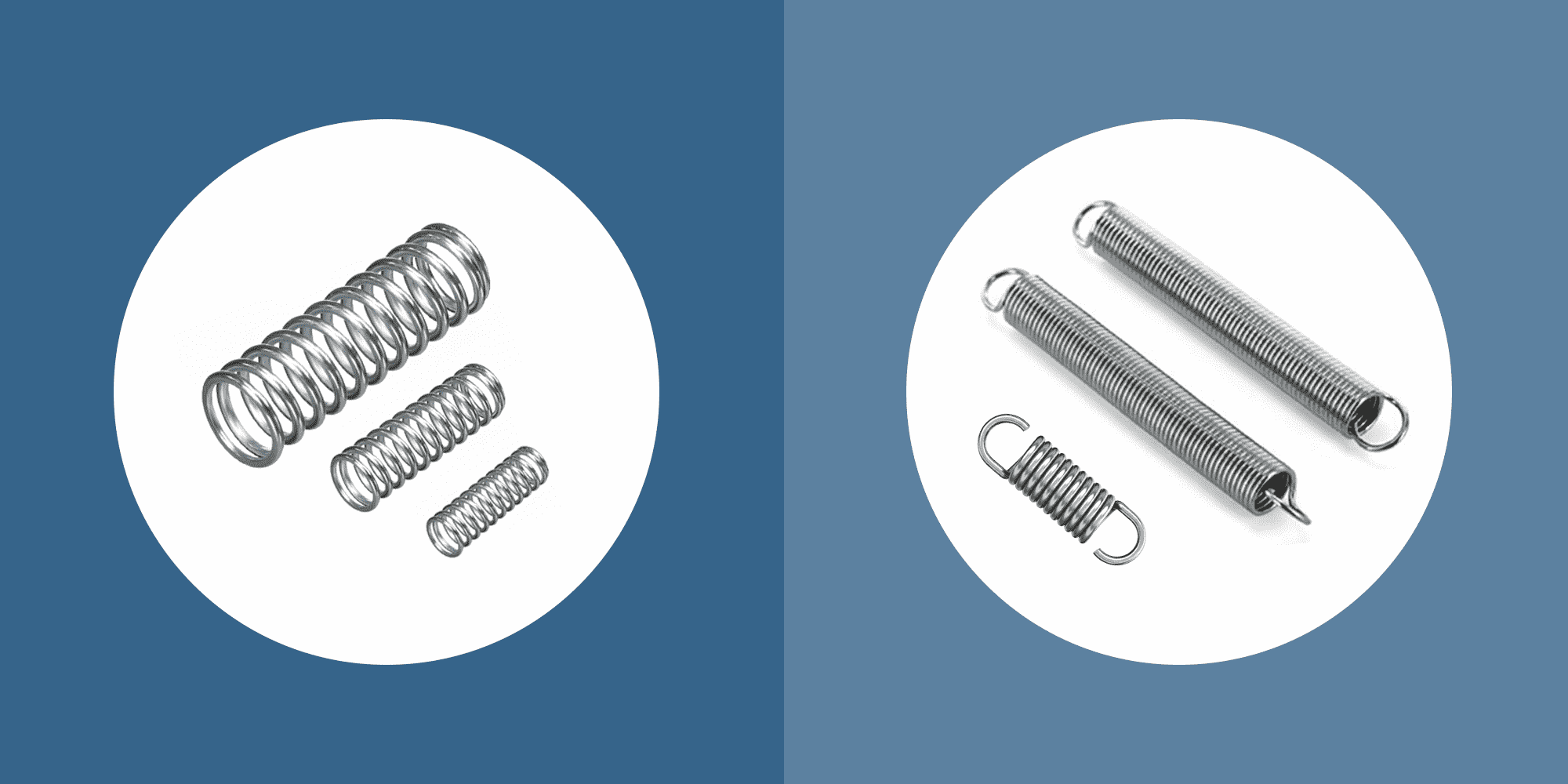
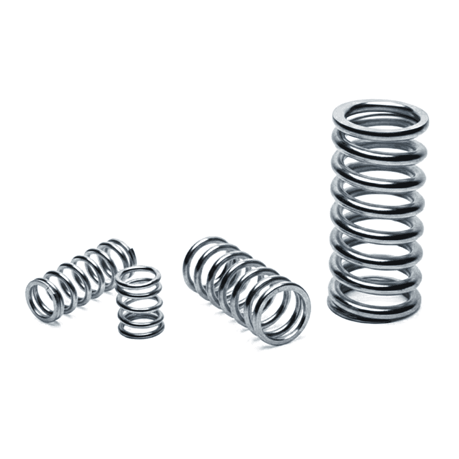
The default choice for most applications.
Rates from 0.1 to 1,000+ N/mm.
One rule: never work past 80% of available deflection (free length minus solid height).
Beyond that, coils touch and fatigue cracks start.
→ What Is a Compression Spring?

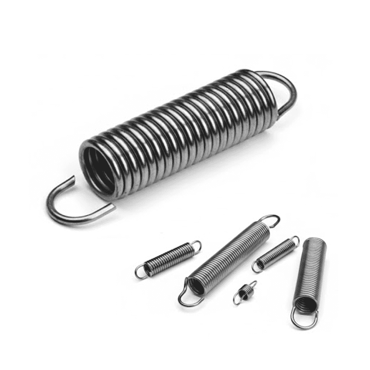
Resist pull rather than push. Most carry initial tension — a built-in pre-load before any extension occurs.
Always confirm initial tension with your supplier; it is not always listed on catalogue pages.
→ Compression vs. Extension Springs

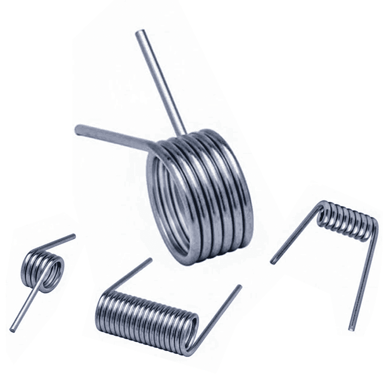
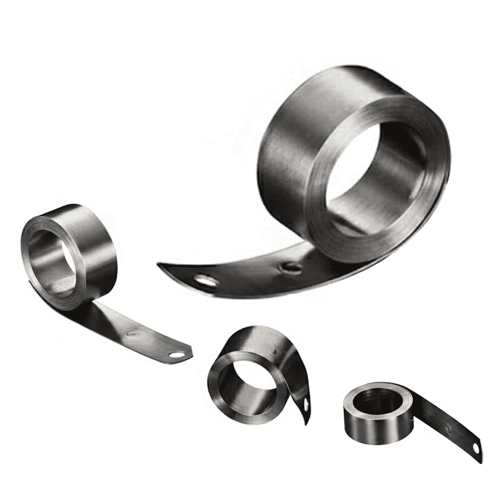
These don't push or pull; they twist. They provide rotational force (torque) around an axis.

Best for: Heavy door hinges, clip mechanisms, and clothespins.
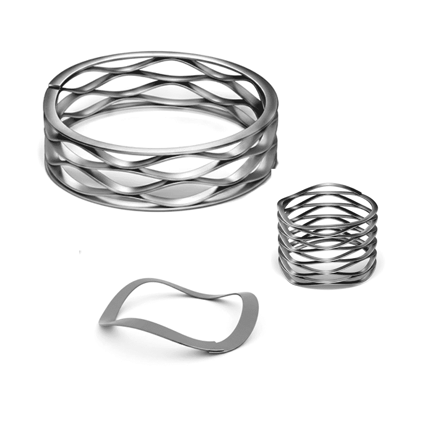
Imagine a wavy, flat metal washer. They provide the same force as a coil spring but occupy 50% less axial space.

Best for: Precision bearings and aerospace gearboxes where every millimeter counts.
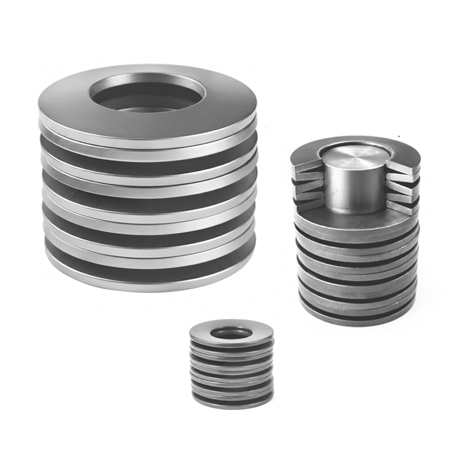
Small, cone-shaped washers that handle massive loads with almost zero movement.

Best for: Heavy-duty bolting and high-pressure industrial valves.
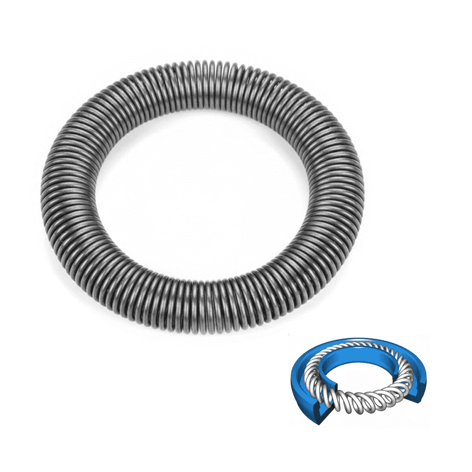
An extension spring joined at both ends to form a perfect ring. They provide 360-degree inward pressure.

Best for: Keeping oil seals tight around rotating shafts.
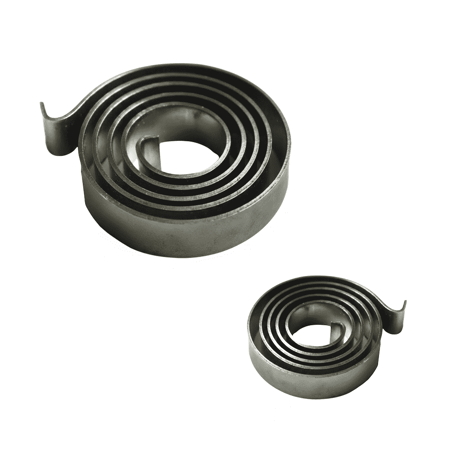
Designed to provide rotational force in very small radial spaces. They are the "muscle" inside many turning mechanisms.

Best for: Small motors, timers, and specialized electrical instruments.
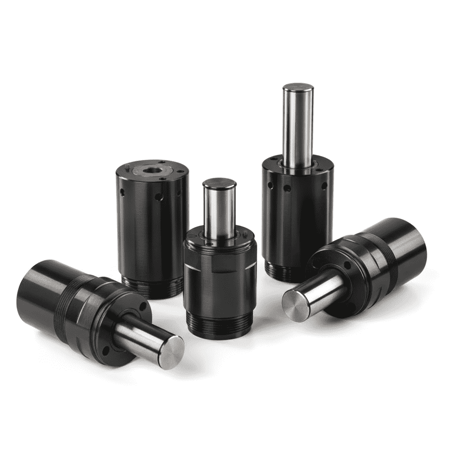
Instead of wire, these use highly compressed nitrogen gas inside a cylinder to provide extremely high, constant force.

Best for: Heavy-duty stamping dies and automotive lift-gate supports.
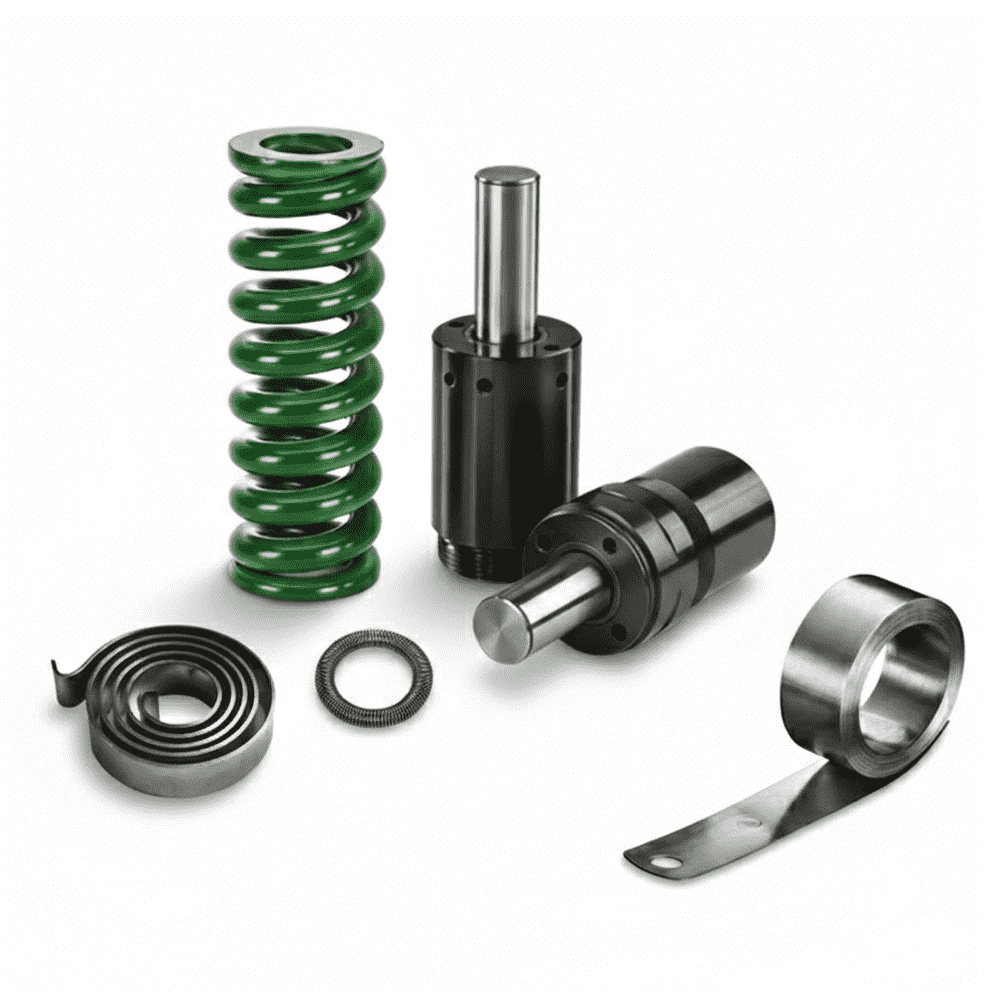
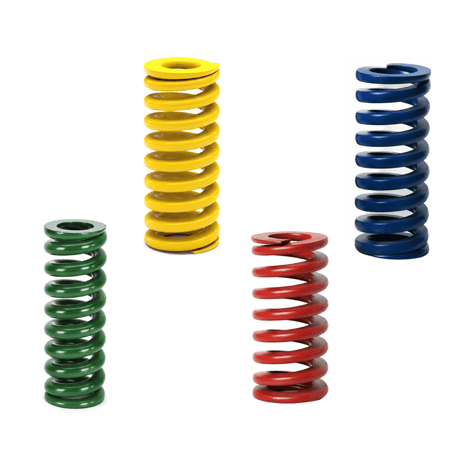
Specifically built for high-stress environments like stamping dies. These aren't your average coils. They are engineered to survive millions of rapid, high-pressure compressions.
You’ll notice they are often color-coded. This is a universal language for their load capacity, ranging from light to extra-heavy duty.

Flat, custom-shaped springs often used for their unique force profiles or electrical conductivity.

Best for: Electrical contacts and complex mechanical assemblies.
The right spring geometry in the wrong material will still fail.
Material selection is driven by three factors: operating environment (temperature, corrosive media, humidity), mechanical demands (load levels, fatigue cycles), and any regulatory requirements (food contact, medical, aerospace certification).
The table below summarises the practical choices:
|
Material |
Standard |
Max Temp |
Corrosion Resistance |
Best Used When... |
|
Music Wire |
ASTM A228 |
121°C |
Poor – needs coating |
Max performance at ambient temp, high fatigue life needed, cost-sensitive |
|
Chrome-Silicon |
ASTM A401 |
246°C |
Poor – needs coating |
Engine valves, die springs, high-stress high-temp applications |
|
Stainless 302/304 |
ASTM A313 |
288°C |
Good |
Corrosive or humid environments; food, medical, general industrial |
|
Stainless 316 |
ASTM A313 |
288°C |
Excellent (chlorides) |
Marine, chemical plant, pharmaceutical – anywhere chlorides are present |
|
17-7 PH Stainless |
AMS 5678 |
343°C |
Good |
High cycle fatigue + corrosion resistance needed together |
|
Inconel 718/X-750 |
AMS 5662 |
700°C+ |
Excellent |
Jet engines, gas turbines, extreme-temperature service only |
|
Phosphor Bronze |
ASTM B197 |
~95°C |
Good |
Electrical contacts where conductivity is as important as spring force |
The table covers the main options.
One distinction worth spelling out: both 302/304 and 316 stainless are rated to 288°C, but 316 contains molybdenum.
That makes it substantially more resistant to pitting in chloride environments — marine, pharmaceutical, food processing.
In those applications, 302/304 will pit. Use 316. Both grades are weaker than music wire, so expect a larger spring for the same force.
A spring in a consumer product can fail without consequence. A spring in a stamping die or valve train cannot.
Industrial-grade springs are made to defined standards — ISO 10243 for die springs, DIN 2098 for compression springs, or customer drawings verified by first-article inspection.
Each batch is tested for load at defined heights, outside diameter, free length, and squareness.
Material certs trace the alloy back to the mill heat.
Consider what that means in production.
A press running at 40 strokes per minute accumulates 2.4 million cycles per thousand hours.
A spring not built to a fatigue-rated spec won't reach that count. When it fails, it's not just the spring.
It's tooling damage, scrap parts, and downtime — typically ten to a hundred times the spring's cost.
When sourcing, ask:
What standard is this made to?
What is the rated fatigue life at my load and deflection?
Is there a material cert?
Can you provide a test report?
If a supplier can't answer those questions, that's the answer.
These are the patterns we see most often when customers contact us after a spring failure — not theoretical risks, but recurring causes behind actual tooling damage, seal failures, and unplanned downtime.
This is the single most common cause of premature spring failure.
Available deflection = free length minus solid height.
At 80% of that, you have a safe working buffer.
At 100%, you have coil-to-coil contact, a spike in stress, and a fatigue crack starting.
Check this before anything else.
Blue springs in a heavy-duty application, red springs in an extra-heavy-duty application — both fail early.
Calculate working load and deflection, identify where you fall on the duty rating chart, and choose the rating that puts you within the intended stress range. If you're between ratings, go up, not down.
Music wire starts to lose load above 121°C.
Chrome-silicon is rated to 246°C. Standard stainless is rated to 288°C.
Applications near heat-treatment equipment, engine compartments, heated dies, or industrial ovens need a material check — not just a spring rate check.
Zinc and paint coatings can flake under repeated flexing in high-cycle applications, contaminating the system.
In precision bearings, food equipment, or clean-room environments, an uncoated stainless spring is often the better choice, even if it costs more.
The most expensive version of this: a customer replaces a failed die spring with the same part number, it fails again in the same place, and on the third cycle they finally call us.
In almost every case, the deflection was running over spec or the duty rating was wrong from the original design.
Root cause first, then re-specify.
A die spring is a compression spring built to tighter standards for high-cycle stamping and moulding.
It uses rectangular wire instead of round, which increases load capacity and fatigue resistance within the same outside diameter.
It is duty-rated and colour-coded per ISO 10243. A standard compression spring may look similar but is not certified to the same fatigue spec.
Start with the required force at your working deflection.
Divide force (N) by deflection (mm) to get the minimum spring rate in N/mm.
Then add margin for preload and tolerance.
For critical applications, contact the Lily Bearing engineering team — we offer complimentary load analysis.
AISI 302/304 and 316 are both rated to 288°C (550°F).
Above that, use 17-7 PH (343°C) or Inconel X-750.
One important note: the temperature at which a spring starts to lose load may be lower than the material's structural limit.
Always check the spring material datasheet, not just the alloy spec.
Die springs are coil springs with a linear force-deflection curve.
Gas springs use compressed nitrogen to generate near-constant force across the stroke.
Gas springs produce much higher force in a smaller package.
They also eliminate the force increase that causes forming defects in deep-draw dies.
The two serve different purposes and are not interchangeable.
Initial tension is a pre-load built into the spring during manufacturing.
It is the force you must overcome before the coils begin to separate.
In latching and tensioning applications, this sets the minimum closing force at zero extension.
It is not always listed on catalogue pages — ask your supplier.
You need three things: the installed inside diameter, the required radial force per unit length at that diameter, and the operating environment.
The supplier derives free diameter and spring rate from those inputs.
Do not specify by free diameter alone — installed tension is what determines sealing performance.
Springs are rarely the most expensive component in a machine.
They are often the component whose failure costs the most — in downtime, tooling damage, or warranty returns.
At Lily Bearing, we stock compression, extension, torsion, wave, disc, die, garter, and nitrogen gas springs across standard sizes and materials.
Engineering support is available for non-standard requirements.
If you want a second opinion on load rating, material selection, or fatigue life, contact our engineering team.
We offer complimentary load analysis for qualified applications.
Explore our full spring catalogue or download datasheets for standard sizes from the product pages.
Springs are made through a multi-step process: wire is coiled on a CNC machine, cut to length, stress-relieved through heat treatment, ground flat...
The short answer: no single person invented the spring. But if you want the name most associated with turning springs from a crude mechanical trick...
Compression vs. extension springs? One pushes, one pulls. Both store and release mechanical energy—just in different directions. Selecting the...