

A Comprehensive Guide to Factors Affecting Spring Performance
All precision spring manufacturers recognize that spring performance is a critical concern. If a spring lacks reliability, the equipment it supports...
4 min read
William
:
Feb 27, 2026 3:07:03 AM
A compression spring is an open-coil helical spring that resists compressive axial forces. When load is applied, it shortens and stores potential energy; when released, it returns to its original free length. They are widely used in automotive, industrial, and medical applications.
When you think of a "spring," the image that likely comes to mind is a compression spring.
As the most common type of metal spring, these devices are essential for storing mechanical energy and resisting compressing forces.
But what exactly makes them work, and how do you choose the right one for your specific application?
In this guide, we will break down the mechanics, types, and crucial design factors of compression springs.
A compression spring is an open coil helical spring designed to offer resistance to a force applied axially. Unlike other types of springs — such as extension springs which stretch to pull components together, or torsion springs which work by twisting — compression springs are designed specifically to be compressed.

When a load is applied, the spring becomes shorter, capturing potential energy.
When the load is removed, the spring expands to return to its original position and length.
Because of this capability to store and release energy efficiently, they are among the most versatile energy storage devices available.
The force a compression spring exerts is governed by Hooke's Law:
F = k × x
In practical terms: if your spring has a rate of 10 N/mm and you compress it 5mm, it pushes back with 50N. This linear relationship holds as long as the spring isn't compressed beyond its elastic limit.
Understanding the specific terminology is essential when selecting or designing a spring.
The length of the spring when it is not under any load.
The solid height is the total height of the spring when it is compressed until all coils are touching.
It is vital to know this dimension to ensure the spring fits within the space allotted in your mechanism without bottoming out.
The choice of spring material directly impacts durability, strength, and performance. Material selection is also governed by industry standards — for example, music wire is specified under ASTM A228, which defines its tensile strength and composition requirements. Common materials include:
For a closer look at how these materials are processed, see our guide on how springs are made.
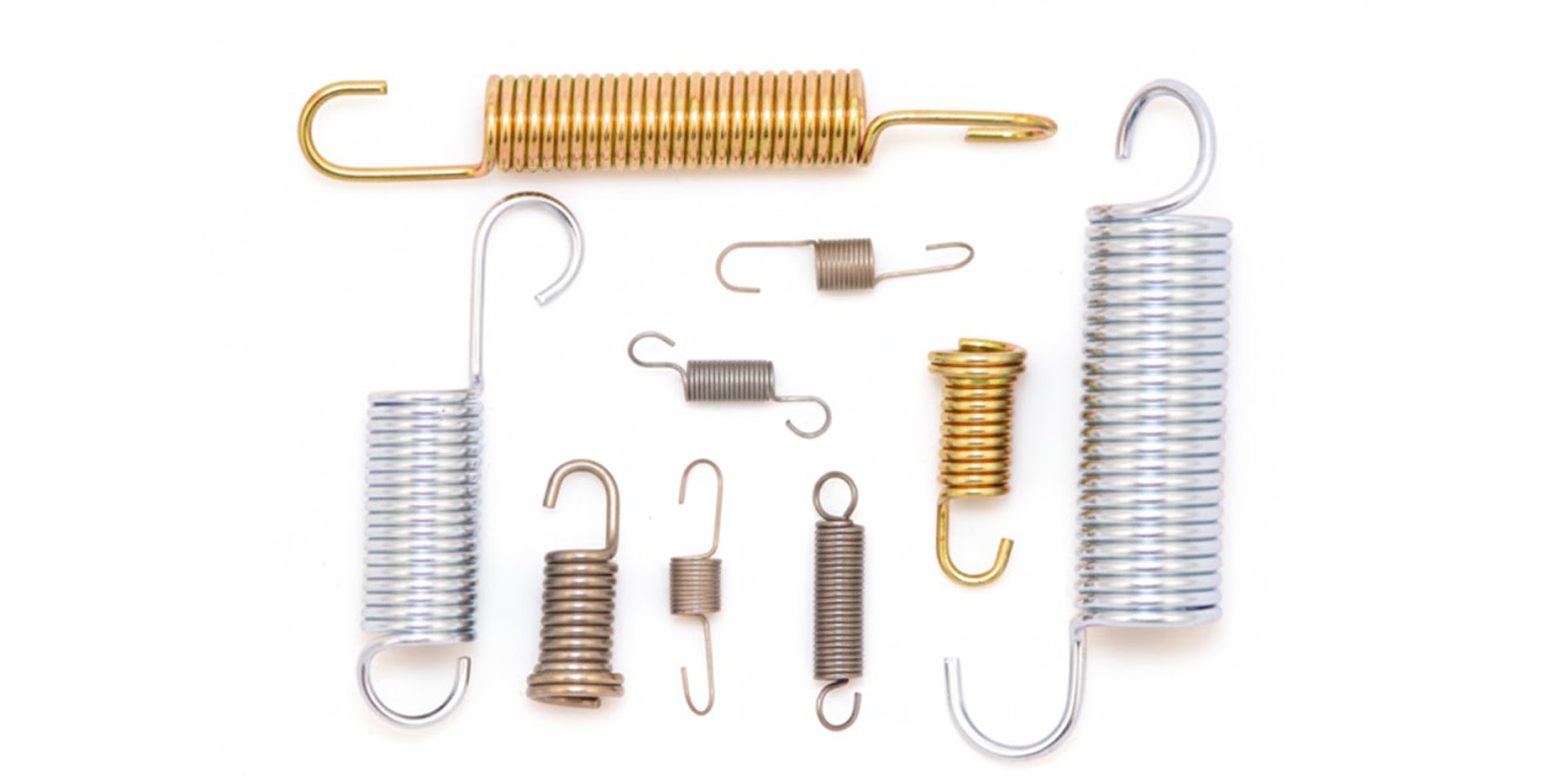
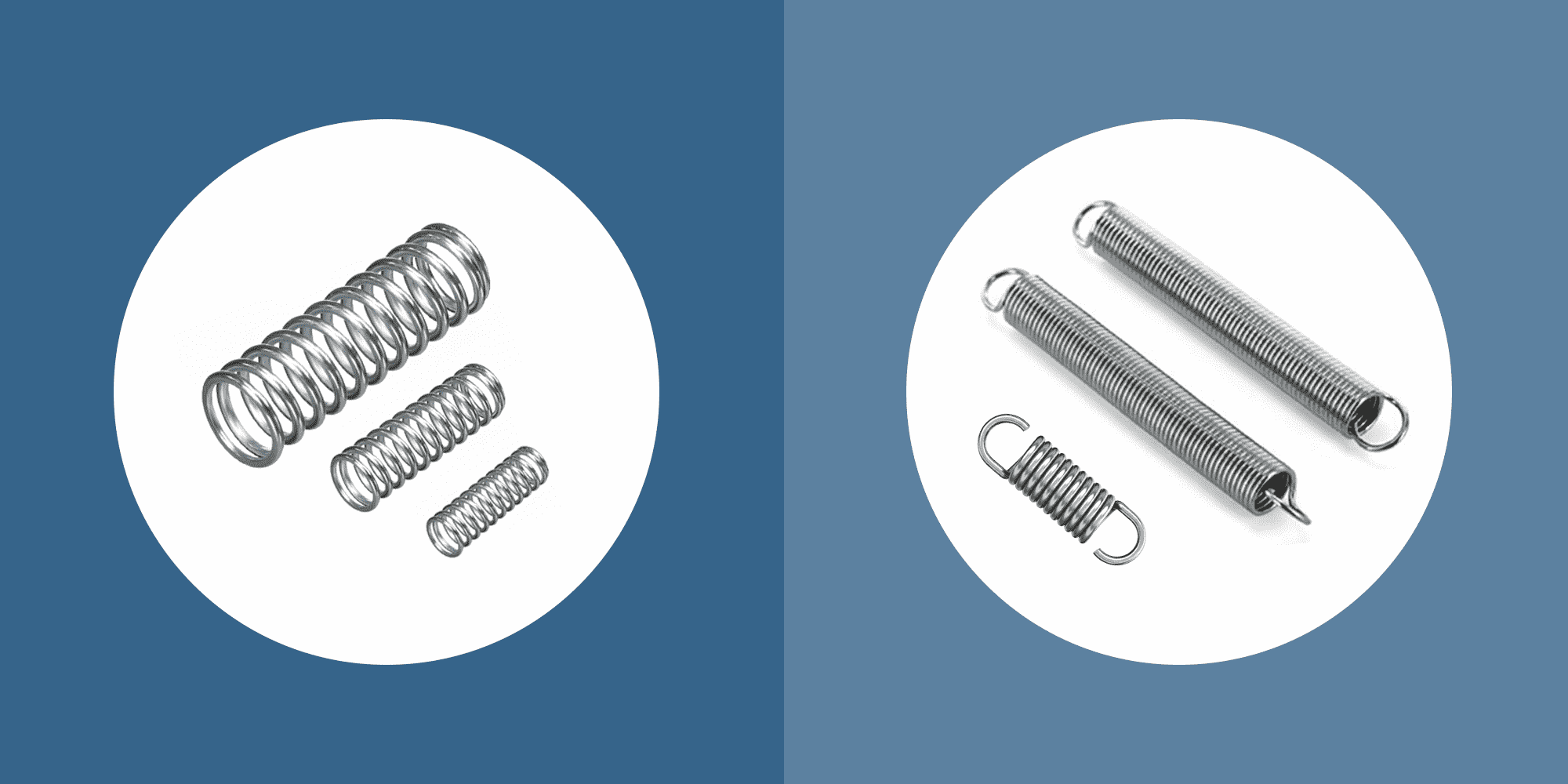
These two spring types are often confused. Here is how they differ — for a more detailed breakdown, see our full guide on compression vs extension springs.
| Compression Spring | Extension Spring | |
|---|---|---|
| Load direction | Push (compressive) | Pull (tensile) |
| Coil type | Open coil | Closed coil |
| Resting state | Coils are separated | Coils are touching |
| Common use | Shock absorption, pressure control | Retraction, tension holding |
| Example | Car suspension, pen click | Garage door, trampolines |
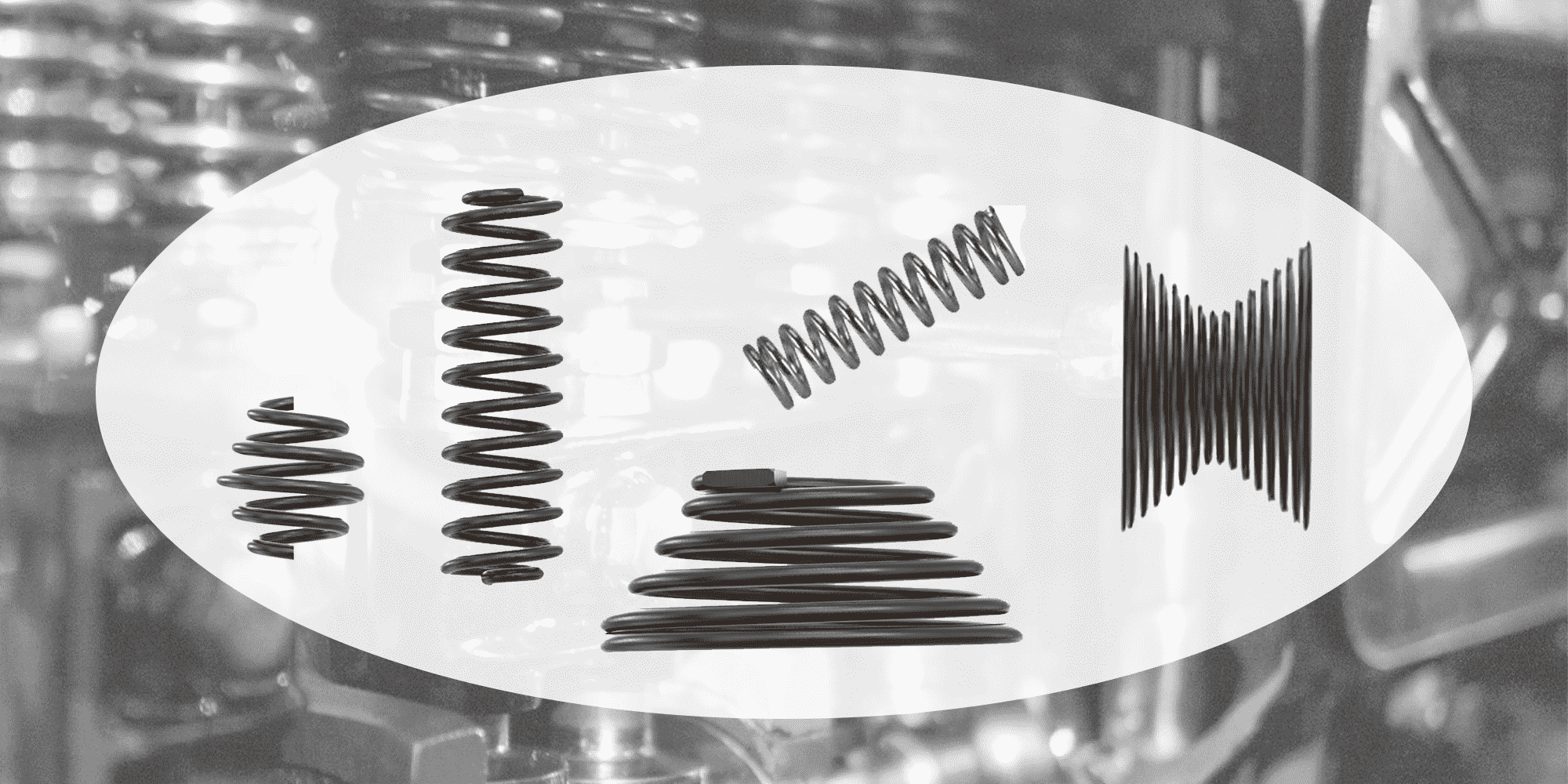
While the standard cylinder is the most common, different types of compression springs are tailored for specific functions.
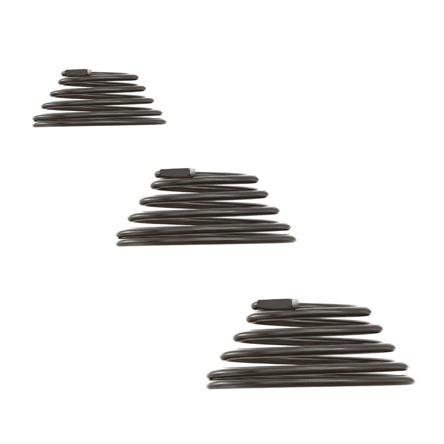
These springs are tapered, allowing them to nest inside themselves.
They are excellent for reducing the solid height and offer non-linear load characteristics, meaning they get stiffer as they compress.

.png?width=449&height=449&name=Barrel%20Springs%20(Convex).png)
.png?width=449&height=449&name=Hourglass%20Springs%20(Concave).png)
These springs have different distances between coils along their length.
This allows for progressive resistance, perfect for applications requiring variable force throughout the stroke.
Compression spring applications are nearly endless, found in almost every industry from consumer goods to heavy machinery. For a broader look at how springs are used across industries, see our master guide to industrial springs.
To ensure the spring functions correctly and has a long lifespan, engineers must consider several factors during spring design. For a deeper dive into these variables, our guide on factors affecting spring performance covers them in detail.
When a spring is compressed, the material is stressed in torsion.
If the stress exceeds the material's elastic limit, the spring will experience a permanent set (it won't return to its original length).
If a spring is too long and narrow, it may buckle (bend sideways) when compressed. Designers often use guide rods to prevent this.
The ends of the spring determine how it sits in the mechanism. Common types include:
Selecting the right spring comes down to four key parameters:
Start with how much force the spring needs to exert and at what compressed length. This determines the required spring rate (k = F ÷ x).
Measure the available length and diameter in your assembly. Make sure the spring's solid height doesn't exceed the minimum space when fully compressed.
For general indoor use, music wire is sufficient. If the spring will be exposed to moisture or chemicals, go with stainless steel. For high-temperature or high-cycle applications, chrome silicon is the better choice.
If the spring needs to sit flat against a surface, choose closed and ground ends. For most standard applications, closed and not ground is sufficient.
Compression springs are simple yet powerful components vital to modern engineering.
By understanding the relationship between spring rate, solid height, and spring material, you can select the perfect type of compression spring to meet your requirements.
Whether you are designing a complex medical device or a simple household item, proper spring design is the key to functionality and longevity.
When force is applied along the spring's axis, the coils compress and store potential energy. Remove the force, and the spring returns to its original length. The stiffer the spring (higher spring rate), the more force required to compress it — this is defined by Hooke's Law: F = k × x.
They're used across almost every industry. Common examples include car suspension systems, surgical tools, pacemakers, industrial stamping presses, and everyday items like pens and keyboards. Anywhere a mechanism needs to absorb force or return to a resting position, compression springs are usually involved.
Compression springs are designed to be pushed together — they resist compressive force. Extension springs do the opposite; they stretch under load and pull components back together. The coil structure looks similar, but they're built for opposite load directions.
The three most common are music wire (high strength, general use), stainless steel (corrosion-resistant environments), and chrome silicon (high-stress or high-temperature applications). Material choice directly affects the spring's lifespan and performance under load.
Most failures come down to two things: exceeding the material's elastic limit (causing permanent set, where the spring won't return to its original length) or buckling, which happens when the spring is too long and narrow relative to its load. Proper design and material selection prevent both.
All precision spring manufacturers recognize that spring performance is a critical concern. If a spring lacks reliability, the equipment it supports...
Compression vs. extension springs? One pushes, one pulls. Both store and release mechanical energy—just in different directions. Selecting the...
Springs are key components in many mechanical systems. They store energy, absorb impacts, maintain applied force, and regulate motion. They are...