


Home/
Blog/
Gear Ratio Calculator – Instant Results + Complete Guide

5 min read

Gear Ratio Calculator: How to Calculate & Apply Gear Ratios

Gear Ratio Calculator: How to Calculate & Apply Gear Ratios
Gear Ratio Calculator – Instant Results + Complete Guide
11:42

Quick answer: Gear ratio = driven gear teeth ÷ drive gear teeth. A 60-tooth driven gear meshed with a 20-tooth drive gear gives a 3:1 ratio — one output rotation per three input rotations, at three times the torque.

Gear Ratio Calculator

⚙ Gear Ratio Calculator

Enter gear teeth counts and motor specs — results update instantly

Gear Ratio
 
: 1
Output RPM
RPM
Output Torque
Nm (actual)

📐 Worked Example

Conveyor drive: 15-tooth pinion → 45-tooth spur gear, 1,450 RPM input, 10 Nm, 97% efficiency

GR = 45 ÷ 15 = 3:1  |  Output RPM = 1,450 ÷ 3 = 483 RPM  |  Output torque = 10 × 3 × 0.97 = 29.1 Nm

Gear Ratio Formula

The fundamental relationship is straightforward:

GR = Tdriven ÷ Tdrive

Where Tdriven is the tooth count on the output gear and Tdrive is the tooth count on the input gear. The same ratio applies to shaft speeds:

GR = RPMinput ÷ RPMoutput

And to torque — applying an efficiency factor:

Torqueoutput = Torqueinput × GR × η

No real gearbox runs at 100% efficiency.

Spur gears typically hit 96–99%; worm gear sets can fall to 50–90% depending on lead angle.

Always apply an efficiency factor before sizing your motor.

The American Gear Manufacturers Association (AGMA) publishes standardized efficiency ratings for each gear type.

Gear Ratio by Gear Type

Each gear configuration has a practical ratio range. Working outside it usually means you are using the wrong gear for the job.

⚙ Gear Type Comparison: Ratio Range, Efficiency & Application

Gear Type Ratio Range (single stage) Efficiency Shaft Arrangement Best For
Spur Gears 1:1 – 6:1 96–99%
 
Parallel Conveyors, machine tools, packaging
Helical Gears 3:1 – 10:1 96–99%
 
Parallel High-speed, low-noise drives
Bevel / Miter Gears 1:1 – 6:1 93–97%
 
Intersecting 90° Right-angle drives, differentials
Worm Gears 5:1 – 300:1 50–90%
 
Non-intersecting 90° High reduction, self-locking
Planetary 3:1 – 10:1 per stage 97–99%
 
Inline (coaxial) Robotics, servos, high torque density

Spur Gears

Spur Gears


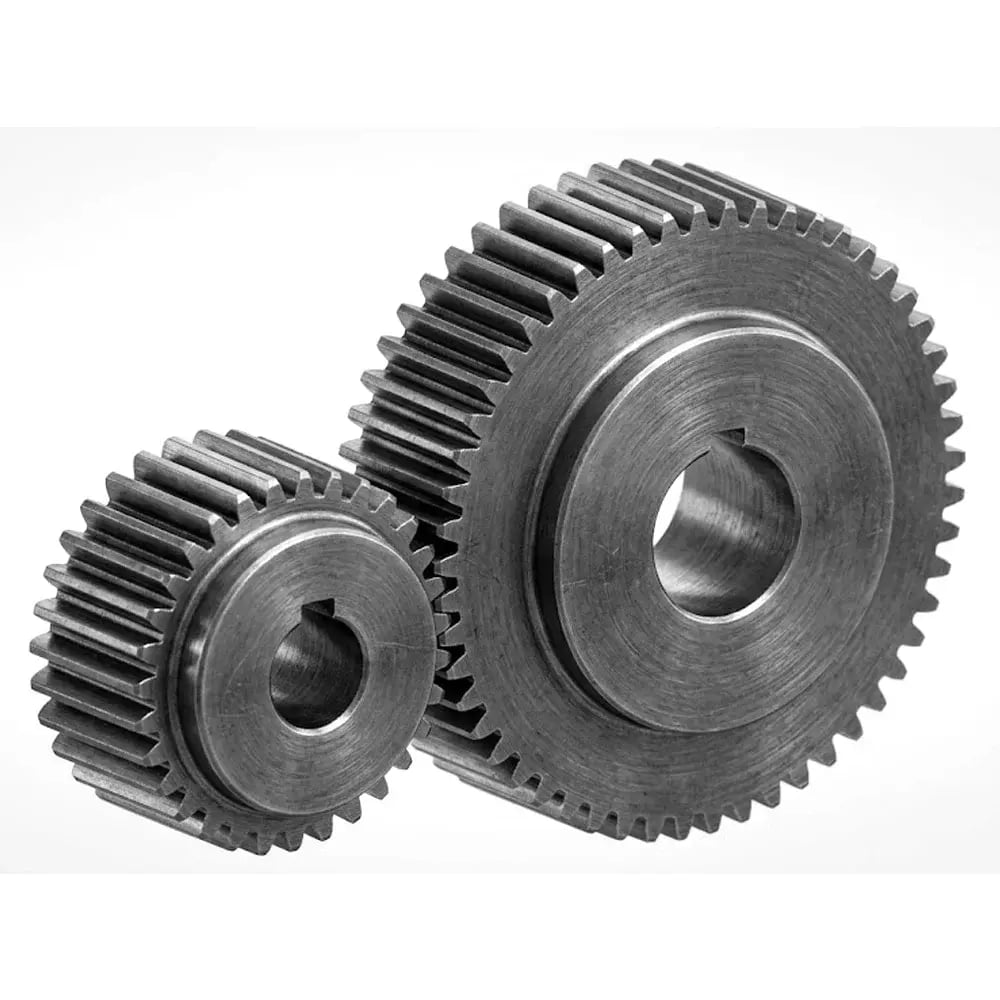
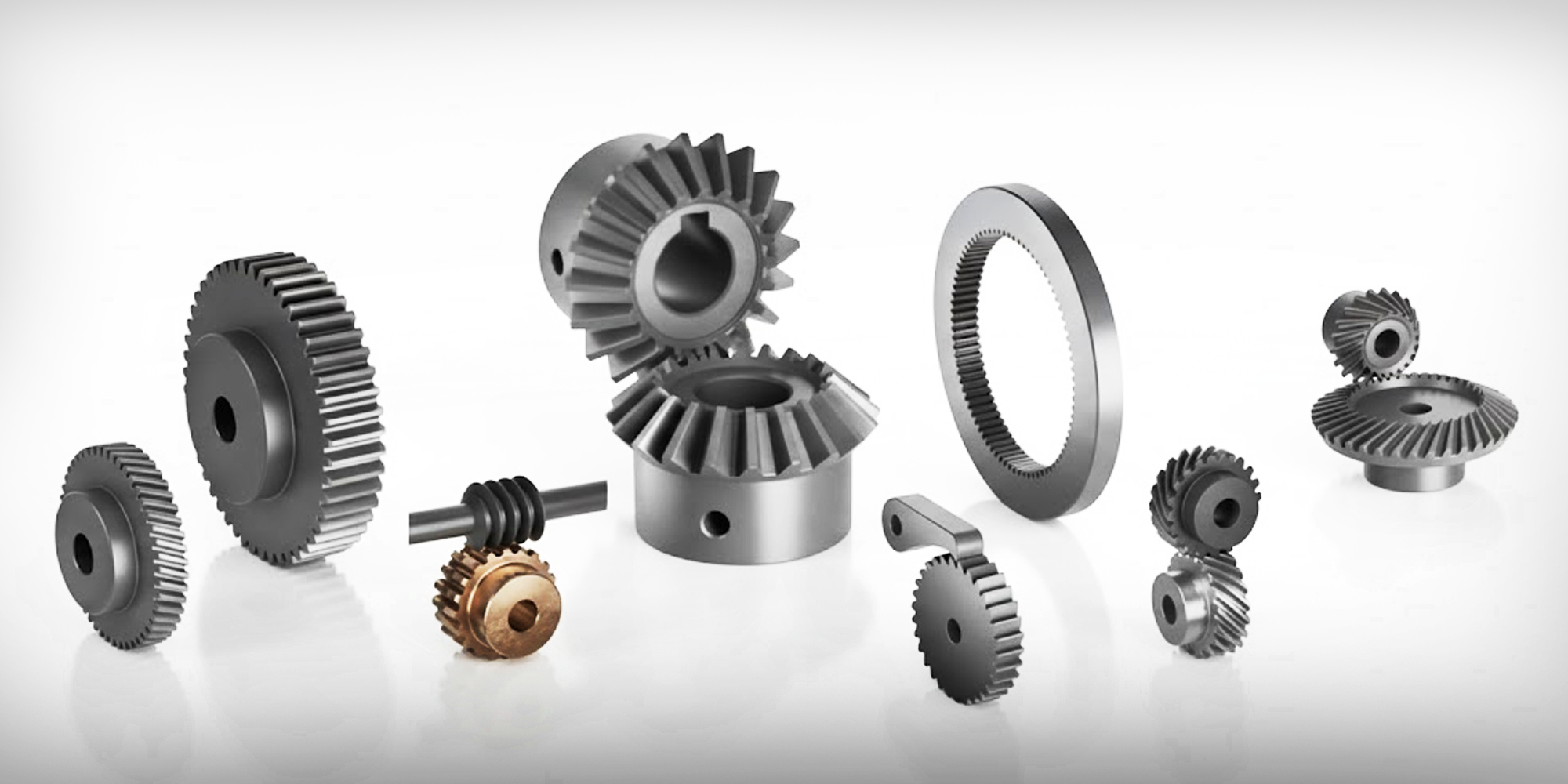
Straight-tooth cylindrical gears — the most common choice for parallel shafts.

A single spur stage handles ratios from 1:1 up to about 6:1; multi-stage arrangements push that to 20:1.

Efficiency sits at 96–99%, making spur gears the default for conveyors, machine tools, and packaging lines where noise is not a constraint.

→ Browse Spur Gears

Helical Gears

Helical Gears

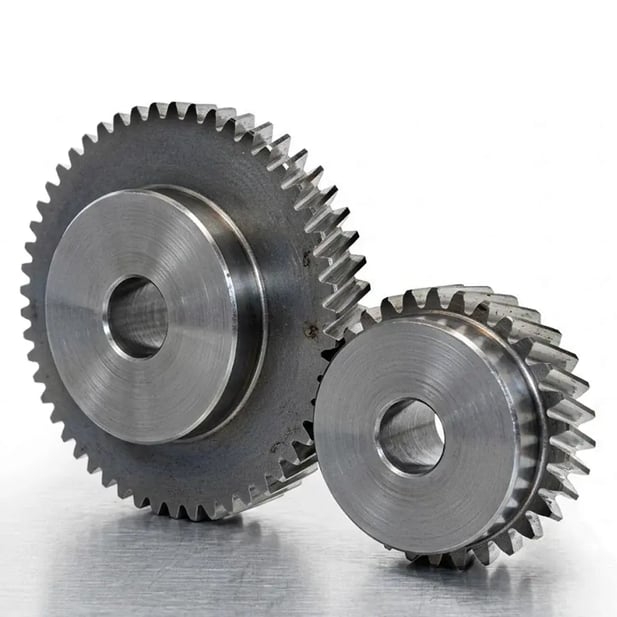
Angled teeth engage progressively rather than all at once — cutting vibration and noise significantly at the same pitch-line velocity, while maintaining 96–99% efficiency.

Practical ratio range is 3:1 to 10:1 per stage.

Automotive transmissions, compressors, and high-speed industrial drives favor helical gears when quiet operation matters.

→ Browse Helical Gears

Bevel Gears (Including Miter Gears)

Bevel Gears

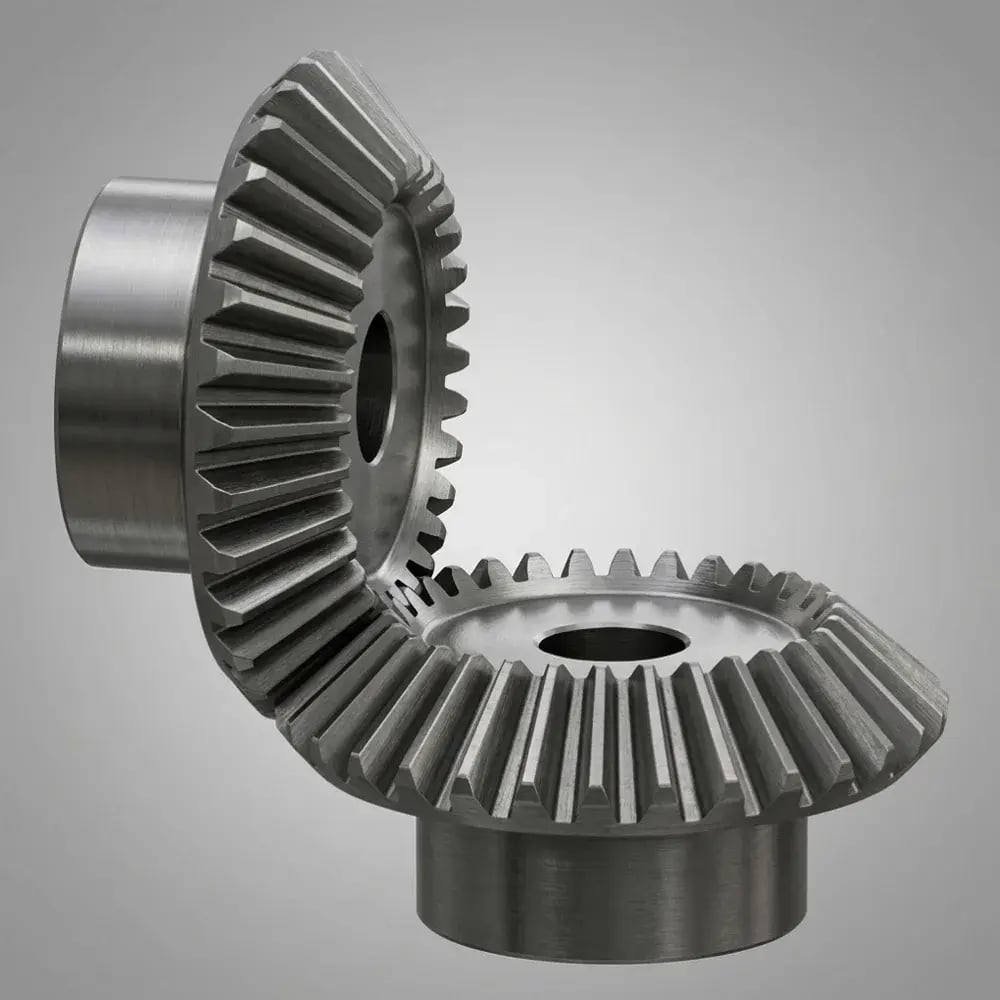
Bevel gears redirect power between intersecting shafts — most often at 90°.

Miter gears are a special case: equal tooth counts on both gears, giving a 1:1 ratio at the angle change.

Standard bevel pairs cover 1:1 to 6:1 at 93–97% efficiency.

Right-angle conveyors, differential drives, and hand tools are typical applications.

→ Browse Miter Gears and Bevel Gears

Worm Gears

Worm Gears

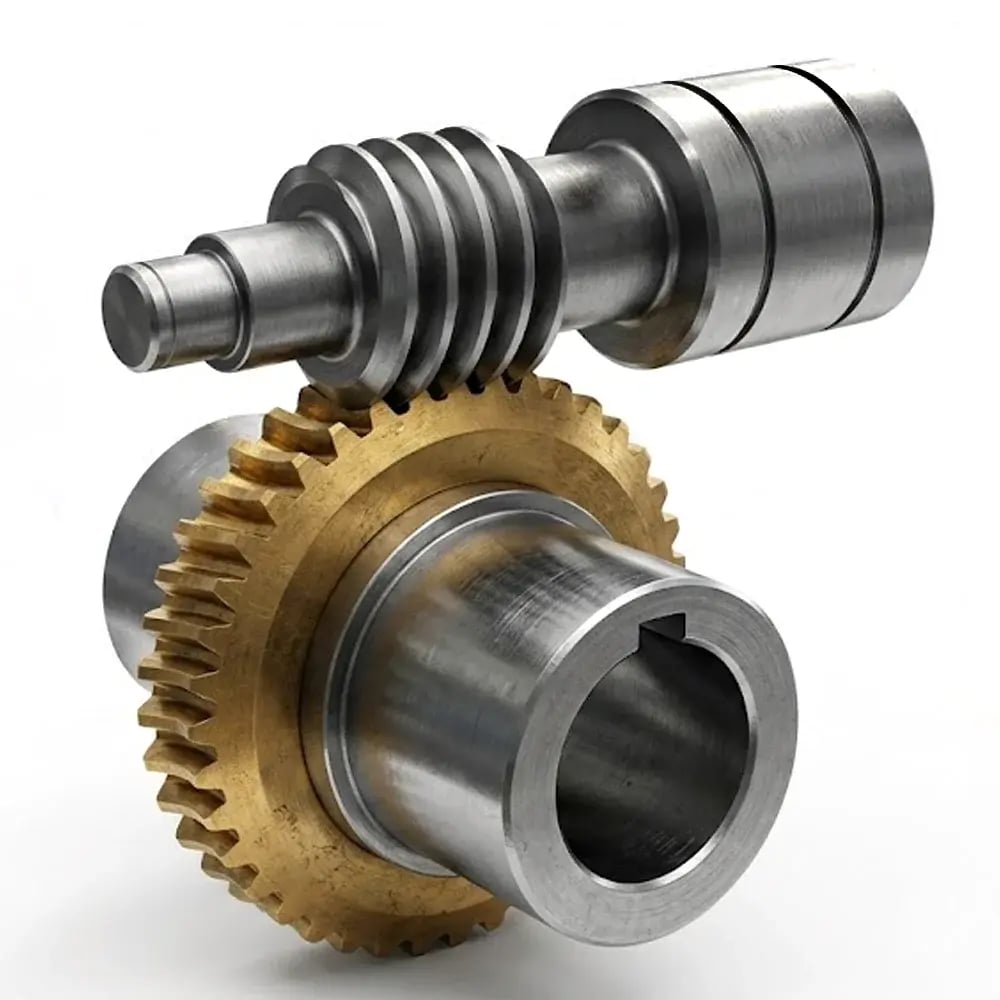
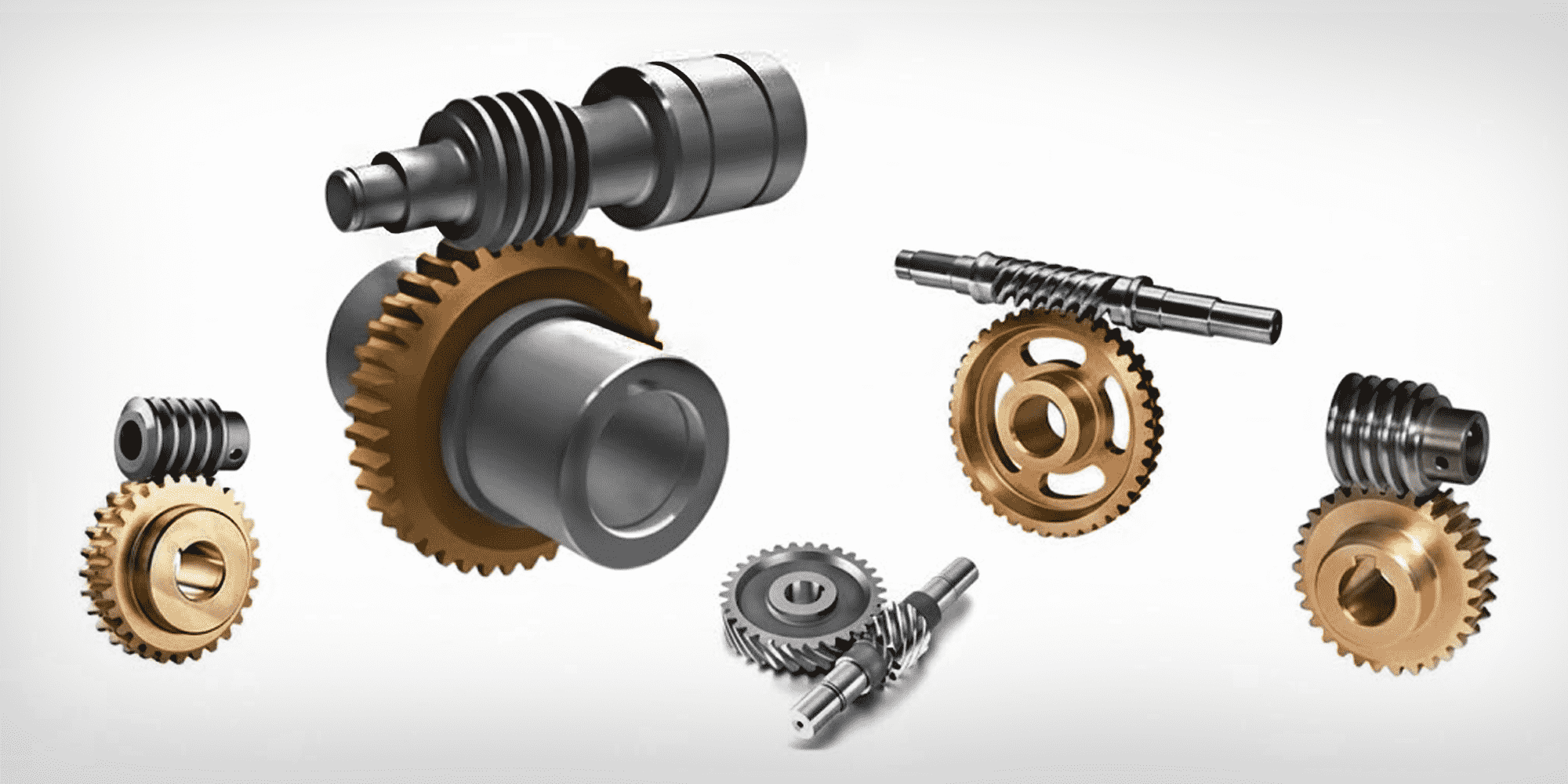
A screw-form worm drives a worm wheel at 90°.

The geometry allows ratios from 5:1 to 300:1 in a single compact stage — no other gear type matches that range without stacking multiple stages.

The trade-off is efficiency: 50–90%, dropping sharply as ratio increases.

Above roughly 20:1, most worm sets become self-locking, meaning back-driving from the output side is impossible without a separate input.

That built-in holding capability eliminates the need for an external brake in lifting equipment and packaging machinery.

→ Browse Worms and Worm Gears

Gearboxes

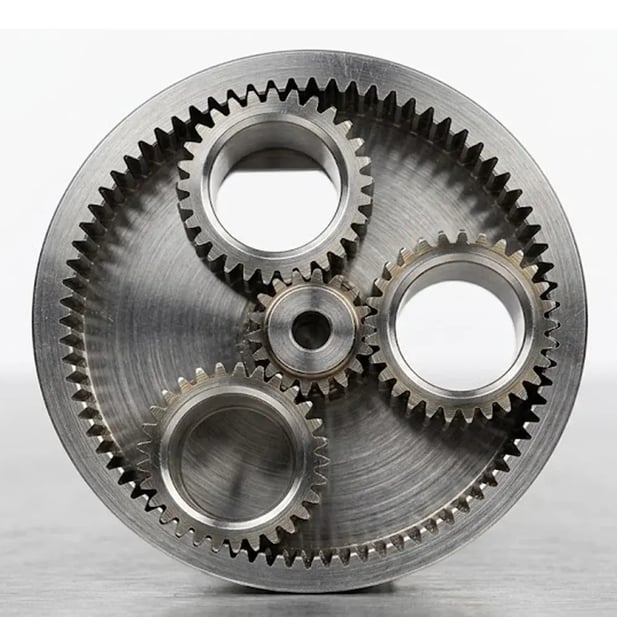
Three or more planet gears share the load simultaneously around a central sun gear — the highest torque density of any gear arrangement. Efficiency reaches 97–99% per stage.

Single-stage planetary units cover 3:1 to 10:1; stacked two-stage units reach 100:1.

Robotics, servo axes, wind turbines, and precision automation rely on planetaries where compactness and high efficiency are both required.

Planetary Gearboxes

How to Choose the Right Gear Ratio

Picking the right ratio takes four numbers: required output speed, required output torque, available input speed, and available input torque.

1

Define output requirements. Work backward from the machine. A conveyor belt running at 0.5 m/s with a 200 mm drive drum needs the drum shaft at (0.5 ÷ (π × 0.2)) × 60 ≈ 47.7 RPM.

2

Know your motor speed. A standard 4-pole induction motor at 60 Hz runs at 1,720–1,760 RPM. A servo motor might peak at 3,000 RPM. Use nameplate data, not nominal values.

3

Calculate the required ratio. GR = Input RPM ÷ Required output RPM. Using the conveyor example with a 1,460 RPM motor: GR = 1,460 ÷ 47.7 = 30.6:1. A standard 30:1 or 31:1 gearbox fits — achievable in a single worm stage, or two helical stages in series.

4

Check torque. Verify that output torque at the selected ratio covers your load, with a service factor applied. Most industrial drives use a service factor of 1.25 to 2.0 depending on shock loading conditions, per AGMA guidelines.

→ Gear Type Selection Guide

Shaft Arrangement Required Ratio Recommended Gear Type
Parallel shafts Up to 6:1 Spur Gears or Helical Gears
Right-angle (90°) Up to 6:1 Miter Gears and Bevel Gears
Right-angle (90°) 5:1 to 300:1 Worms and Worm Gears
Inline / coaxial 3:1 to 100:1 Planetary Gearbox
Any — complete drive Application-specific Gearmotor

Compound Gear Ratios

When one gear pair cannot reach the required ratio, stages are arranged in series. The total ratio multiplies across stages:

GRtotal = GRstage 1 × GRstage 2 × GRstage 3 ...

Two-Stage Compound Gear Ratio — Example

Stage 1
4:1
×
Stage 2
5:1
=
Total Ratio
20:1

Combined efficiency at 97% per stage: 0.97 × 0.97 = 94.1% — not 97%. Each additional stage multiplies efficiency losses. Factor this into your motor sizing.

This is why planetary stages are often stacked: two 5:1 stages give 25:1, three give 125:1, all inline without the efficiency penalty of worm-on-worm arrangements.

Gear Ratio, Speed Ratio, and Torque Ratio

All three terms describe the same physical relationship — expressed from different starting points:

Term Formula Context
Gear ratio T_driven ÷ T_drive Gear design and selection
Speed ratio RPM_input ÷ RPM_output Shaft speed calculations
Torque ratio Torque_out ÷ Torque_in Drive sizing (at 100% efficiency)

A 5:1 gear ratio means 5 input rotations per output rotation, one-fifth the speed, and (at 100% efficiency) five times the torque. In practice, subtract gearbox losses from that torque figure.

Common Mistakes When Calculating Gear Ratios

⚠️

Skipping efficiency

A worm gearbox at 50:1 and 70% efficiency delivers 50 × 0.70 = 35× your input torque — not 50×. Size your motor for actual output, not theoretical maximum.

⚠️

Ignoring inertia matching

In servo and stepper systems, the reflected load inertia (load inertia ÷ GR²) should ideally land within 1:1 to 10:1 of motor rotor inertia. A mechanically correct ratio with a 50:1 inertia mismatch causes overshoot and slow settling times.

⚠️

Over-staging

Every gear stage adds cost, backlash, weight, and efficiency loss. If a single 30:1 worm stage meets the requirement at adequate efficiency, a three-stage spur train is the wrong answer.

⚠️

Designing around ideal ratios

Standard gearboxes come in preferred ratio steps: 5, 7, 10, 15, 20, 25, 30, 40, 50. Design the system to accept available ratios rather than chasing a calculated ideal that does not exist in a catalog.

Frequently Asked Questions

What gear ratio gives more torque?

Any ratio above 1:1 multiplies output torque. A 4:1 reduction delivers four times the input torque (minus gearbox losses) at one-quarter the input speed.

What is a good gear ratio for a DC gearmotor?

Can gear ratio be less than 1?

How does gear ratio affect motor current draw?

How do I find the gear ratio of an existing gearbox without a nameplate?

Need the Right Gear for Your Ratio?

Browse our full range of precision gears — spur, helical, bevel, worm, and more — with detailed specs and immediate availability.

Browse All Gears Shop Gearmotors
What Are Worm Gears? Types, Ratio, Mechanism & Applications

What Are Worm Gears? Types, Ratio, Mechanism & Applications

Worm gears are everywhere in daily life. You'll find them in car steering systems, conveyor belts, and stand mixers—often working invisibly behind...
Read More
Types of Gears: A Complete Guide to Selection & Application

Types of Gears: A Complete Guide to Selection & Application

Gears remain fundamental components in mechanical systems worldwide, transferring motion and power between rotating shafts. Knowing which gear to...

Read More
What Are Spur Gears? Types, Design, Uses & How to Choose the Right One

What Are Spur Gears? Types, Design, Uses & How to Choose the Right One

Walk into any factory, open up a household appliance, or look inside a medical device, and you'll almost certainly find a spur gear doing quiet,...

Read More