

Home/
Blog/
Cast Iron Pillow Block Bearings: HT200 vs HT250 Grade Guide

12 min read

Cast Iron Pillow Block Bearings: HT200, HT250, and HT300 Explained

Cast Iron Pillow Block Bearings: HT200, HT250, and HT300 Explained
Cast Iron Pillow Block Bearings: HT200 vs HT250 Grade Guide
25:46

Cast iron is the default housing material for pillow block bearings—and for good reason.

But "cast iron" isn't a single material.

There's HT150, HT200, HT250, HT300, and beyond.

The grade matters more than most buyers realize, and choosing the wrong one is one of the most common reasons pillow block housings crack during installation or fail prematurely in service.

This guide covers what makes cast iron work well as a bearing housing material, how to read the grade markings, when it outperforms other materials, and when you should switch to something else entirely.


What Is a Cast Iron Pillow Block Bearing?

A cast iron pillow block bearing is a pre-assembled mounted unit where the housing—the outer block that bolts to a mounting surface—is made from gray cast iron. Also referred to as pedestal bearings or plummer block bearings in some markets.

Inside sits a bearing insert, typically a deep-groove ball bearing or spherical roller bearing, along with seals and a locking mechanism to secure the assembly to the shaft.

Cast iron pillow block bearing (pedestal bearing) UCP series

The shaft runs parallel to the mounting surface.

Most standard cast iron pillow block housings follow the UCP or UKP series designation.

They're pre-greased, sealed, and ready to install straight from the box.

New to pillow block bearings? See our complete overview of types, components, and locking mechanisms:
What Are Pillow Block Bearings

What makes cast iron the dominant housing material isn't any single property—it's the combination of adequate strength, excellent vibration damping, good machinability, and low cost.

No other common housing material matches that combination at the same price point.


Cast Iron Grades: HT200 vs HT250 vs HT300

The "HT" prefix stands for gray cast iron.

The number that follows indicates the minimum tensile strength in MPa for a 30mm diameter test sample, per GB/T 9439-2010 standard (international equivalent: ISO 185:2019 — Grey Cast Irons Classification).

So HT250 means a minimum tensile strength of 250 MPa.


The grade gap that matters most

Many suppliers—particularly at the lower price end—use HT150 for pillow block housings.

At 150 MPa tensile strength, HT150 is already marginal.

But the real-world numbers are worse: at wall thicknesses of 30–40mm—typical for a pillow block housing boss—actual tensile strength drops to just 120 MPa.

A slightly overtightened housing bolt is all it takes to crack it.

This is one of the most common reasons cheap pillow block bearings fail during installation rather than in service—the housing gives out before the bearing does.

If a supplier can't confirm the grade, assume the worst and walk away.


HT200 — Standard Grade

Tensile strength: 200 MPa minimum  |  Compressive strength: ~620–700 MPa  |  Hardness: ~163–197 HB

The most common grade for standard duty cast iron pillow block bearings.

Adequate for general industrial conveyors, agricultural machinery, and light-to-medium shaft loads.

Cost-effective and widely available.


HT250 — Preferred Grade

Tensile strength: 250 MPa minimum  |  Compressive strength: ~750 MPa  |  Hardness: ~180–230 HB (typically ~209 HB)

The preferred grade for most industrial applications.

Better wear resistance, higher load capacity, and more consistent dimensional stability than HT200.

Carbon content typically 3.16–3.30%, silicon 1.79–1.93%.

The European equivalent is EN-GJL-250; US equivalent is ASTM A48/A48M — Gray Iron Castings Grade 220 or Grade 260.


HT300 — Heavy Duty Grade

Tensile strength: 300 MPa minimum  |  Compressive strength: ~900 MPa  |  Hardness: ~187–255 HB (typically ~225 HB)

HT300 is the heavy-duty grade used in split housings, large-format pillow blocks, and high-load bearing applications across mining, paper mills, and power generation.

The higher strength comes from tighter control of the microstructure: carbon content typically runs 2.90–3.10%, silicon 1.40–1.70%—lower than HT250, which produces finer pearlite and fewer free ferrite zones. The result is higher hardness, better wear resistance, and significantly improved fatigue resistance under cyclic loading.

The European equivalent is EN-GJL-300; the closest US equivalent is ASTM A48 Grade 300.

Manufacturing cost is higher than HT250—expect a 15–25% price premium on the housing—but for applications with continuous heavy radial loads or cyclic stress (paper mill rolls, crusher drive shafts, large fan housings), the fatigue life improvement justifies the cost difference.

When to specify HT300 over HT250:

  • Shaft diameter above 80mm with heavy continuous radial load
  • Cyclic or reversing loads that create fatigue stress on the housing boss
  • Mining, quarrying, or bulk material handling equipment
  • Paper mill and power generation applications with 24/7 operation
  • Any application where housing wall thickness exceeds 40mm

For standard industrial use—conveyors, pumps, gearboxes, agricultural drives—HT250 is sufficient and more cost-effective. HT300 is not a universal upgrade; it's a targeted choice for genuinely demanding conditions.


Quick rule of thumb

For standard industrial use, specify HT250 as a minimum. If a supplier only offers HT200, it's still acceptable for light duty. Reserve HT300 for heavy cyclic loads, large shaft diameters, or 24/7 high-load operations. If they can't confirm the grade at all, look elsewhere.


Full Tensile Strength Data by Grade and Wall Thickness (GB/T 9439)

The standard tensile strength figure (e.g. "250 MPa" for HT250) applies to a single 30mm test specimen. Actual strength in a real casting varies with wall thickness—thicker sections cool more slowly, producing coarser graphite and lower strength. This is why housing wall thickness matters when specifying a grade.

Gray Iron Grade

Single Specimen Tensile Strength (MPa)

Wall Thickness (mm)

Actual Casting Tensile Strength (MPa)

HT100


100


>2.5–10

130

>10–20

100

>20–30

90

>30–40

80

HT150


150


>2.5–10

175

>10–20

145

>20–30

130

>30–40

120 ⚠️ — inadequate for most housings

HT200


200


>2.5–10

220

>10–20

195

>20–30

170

>30–40

160

HT250


250


>4.0–10

270

>10–20

240

>20–30

220

>30–50

200

HT300


300


>10–20

290

>20–30

250

>30–50

230

HT350


350


>10–20

340

>20–30

290

Source: GB/T 9439-2010, Gray Cast Iron Standard. HT150 at 30–40mm wall thickness drops to 120 MPa—inadequate for most pillow block housing applications.


Quick rule of thumb

For standard industrial use, specify HT250 as a minimum. If a supplier only offers HT200, it's still acceptable for light duty. Reserve HT300 for heavy cyclic loads, large shaft diameters, or 24/7 high-load operations. If they can't confirm the grade at all, look elsewhere.


Key Material Properties Explained


Vibration Damping — Gray Cast Iron's Biggest Advantage

Gray cast iron contains interconnected flake graphite distributed throughout its metal matrix.

These graphite flakes interrupt the propagation of stress waves and convert vibrational energy into heat through internal friction—a mechanism called internal damping.

The numbers: gray cast iron has roughly twice the damping capacity of ductile iron, and ductile iron has roughly twice that of steel (U.S. Bureau of Mines, RI-9068).

Stereo microscope comparison of gray cast iron flake graphite and ductile cast iron spheroidal graphite at 100x magnification

In practical terms, a cast iron pillow block housing running on a vibrating conveyor or pump protects the bearing insert significantly better than a steel housing under the same conditions.

This is exactly why gray cast iron—despite its relatively modest tensile strength—remains the dominant material for machine tool beds, engine blocks, and bearing housings worldwide.


Compressive Strength

Gray cast iron's tensile strength is modest—200–300 MPa depending on grade.

But its compressive strength is 3 to 4 times higher than its tensile strength.

HT200 reaches around 600 MPa in compression; HT250 around 750 MPa; HT300 around 900 MPa.

For a pillow block housing that's primarily loaded in compression by the shaft and bolts, this asymmetry works in cast iron's favor.


Thermal Conductivity

Cast iron has a thermal conductivity of approximately 46–50 W/(m·K)—roughly 3 times higher than thermoplastics.

In a bearing housing, this means heat generated by the rotating bearing insert dissipates into the housing and surrounding structure rather than concentrating at the contact zone.

Bearings running cooler last longer, all else being equal.


Machinability

Gray cast iron machines well.

The graphite flakes act as a built-in lubricant, producing short, brittle chips rather than the long stringy chips you get with steel.

This makes it easier and cheaper to machine the housing bore to tight tolerances, which directly affects bearing fit and performance.

Lily Bearing maintains hole-to-hole tolerances within ±0.2mm across our cast iron housing range.


Natural Oxide Layer

When exposed to air and moisture, gray cast iron forms a passive iron oxide layer that provides basic corrosion protection.

It's not as robust as the passive layer on stainless steel, but it does provide meaningful protection in dry indoor environments and moderate outdoor exposure.

Surface coatings—paint, black oxide, powder coat—extend this protection further.


Cast Iron vs Other Housing Materials

Property Gray Cast Iron (HT250) Ductile Iron Cast Steel Stainless Steel Thermoplastic
Tensile strength 250 MPa 400–500 MPa 480–620 MPa 515+ MPa (304/316) 40–80 MPa
Compressive strength ~750 MPa ~900 MPa High High Low
Vibration damping Excellent Good Moderate Moderate Good
Impact resistance Low (brittle) High Very high High Moderate
Corrosion resistance Moderate Moderate Low Excellent Excellent
Max operating temp ~250°C (housing only)* ~300°C ~400°C ~400°C ~120°C
Relative cost Low Medium Medium-high High Medium
Best for General industrial, vibration-prone Heavy shock loads Extreme loads Washdown, food, marine Food, medical, chemical

* 250°C refers to the cast iron housing material limit. The bearing insert and grease typically impose a lower practical limit—standard NLGI #2 grease begins to degrade above 120°C, and the bearing insert may require specialty lubrication above that threshold.


Cast Iron vs Ductile Iron

Ductile iron (also called nodular or spheroidal graphite iron) has graphite in spherical form rather than flakes.

That change in graphite morphology dramatically improves tensile strength and impact resistance—but it also eliminates the interconnected graphite network that makes gray iron such an effective vibration damper.

If your application involves heavy shock loads or high tensile stress, ductile iron is the better choice.

If vibration damping is the priority, gray cast iron wins.


Cast Iron vs Cast Steel

Most buyers who specify cast steel housings for standard conveyor or pump applications are over-engineering the solution.

Cast steel's tensile strength of 480–620 MPa and excellent impact resistance are genuinely needed for extreme applications—jaw crushers, hammermills, heavy press equipment.

For everything else, you're paying a significant cost premium and giving up vibration damping in exchange for strength you'll never use.

Gray cast iron's compressive strength of ~750 MPa (HT250) is more than adequate for the compression-dominant loading that pillow block housings actually experience.


Cast Iron vs Stainless Steel

Stainless steel (304 or 316 grade) has tensile strength above 515 MPa and excellent corrosion resistance in wet, chemical, or food-grade environments.

It costs significantly more than cast iron.

For dry industrial environments with no special hygiene requirements, cast iron makes more economic sense.

For anything involving frequent washdown, moisture exposure, or food contact, stainless steel is the correct choice regardless of cost.


When to Choose Cast Iron—and When Not To

Cast iron pillow block bearing on industrial conveyor vs stainless steel bearing in food processing washdown environment

✅ Choose Cast Iron When:

  • Application involves vibration or noise reduction (conveyors, pumps, fans)

  • Loads are radial and moderate to heavy, but not severe impact

  • Operating temperature stays below 120°C (grease and insert limit; housing itself tolerates up to ~250°C)

  • Environment is dry or moderately humid indoors

  • Budget is a primary consideration

  • Standard industrial machinery: gearboxes, agricultural drives, HVAC equipment


❌ Don't Use Cast Iron When:

  • Frequent washdown or submersion (use stainless steel)

  • Food, pharmaceutical, or FDA-regulated environments (use stainless steel or thermoplastic)

  • Severe shock or impact loads—rock crushers, hammermills (use ductile iron or cast steel)

  • Corrosive chemical exposure (use stainless steel or thermoplastic)

  • Marine or saltwater environments (use stainless steel with appropriate seals)

  • Operating temperature above 250°C sustained (use cast steel or ductile iron)

Before selecting a housing material, confirm you have the right bore size for your shaft: Pillow Block Bearing Size Chart


ℹ️ A note on "food processing" applications

Cast iron is sometimes used in dry food processing (grain handling, feed mills) where washdown isn't frequent and contamination risk is low.

But for any wet food processing—meat, dairy, beverage—stainless steel or food-grade thermoplastic is the only appropriate choice.

Don't compromise on this.


Deciding between a pillow block and a flange unit for your application?
Pillow Block vs. Flange Units: Full Comparison


Common Bore Sizes for Cast Iron Pillow Block Bearings

Cast iron pillow block bearings are available in a wide range of bore sizes to match standard shaft diameters. Most housings follow the UCP (set screw locking) or UKP (adapter sleeve) series in metric sizing, with inch-bore variants widely used in North American and agricultural applications.

Series Bore Range (metric) Common Inch Equivalents Typical Applications
UCP 200 12–60 mm 1/2″, 5/8″, 3/4″, 7/8″, 1″, 1-1/4″, 1-1/2″, 1-3/4″, 2″ Conveyors, fans, light-to-medium industrial drives
UCP 300 15–90 mm 1″, 1-1/4″, 1-1/2″, 1-3/4″, 2″, 2-1/2″, 3″, 3-7/16″ Agricultural machinery, gearboxes, heavier radial loads


The most commonly ordered inch bore sizes are 3/4″ (19.05mm) and 1″ (25.4mm) in the UCP 200 series, and 1-1/2″ (38.1mm) and 1-3/4″ (44.45mm) in the UCP 300 series. These cover the majority of agricultural, conveyor, and general industrial shaft sizes.

When ordering, specify bore size, series, and locking mechanism (set screw vs. adapter sleeve / UKP series) to ensure the correct fit. A housing selected for the wrong bore will affect bearing preload, alignment, and ultimately service life.

For a full size reference including shaft tolerances and housing dimensions: Pillow Block Bearing Size Chart


Common Applications for Cast Iron Pillow Block Bearings

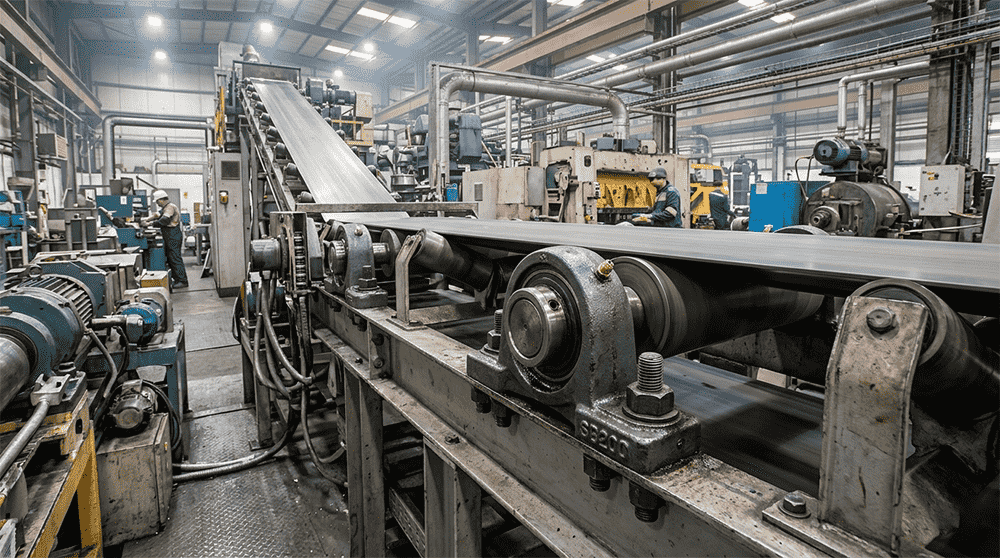
Cast iron pillow block bearings installed on a conveyor system in an industrial factory


Industrial Conveyor Systems

Cast iron pillow blocks are the workhorses of conveyor drives.

They support the drive shaft and idler rollers, absorb the vibration from uneven belt loading, and handle the continuous radial loads without the need for frequent maintenance.

The vibration damping reduces noise in enclosed conveyor structures—a practical benefit in manufacturing plants where noise regulations apply.


Agricultural Machinery

Harvesters, balers, seeders, and grain elevator conveyors all run in environments with heavy dust, moisture, fertilizer exposure, and shock loads from debris.

Cast iron's natural oxide layer provides baseline corrosion protection, and its compressive strength handles the heavy radial loads typical of agricultural drives.

Triple-lip seals paired with cast iron housings extend service life significantly in these conditions.

Seal selection matters as much as housing material in agricultural and dusty environments: Pillow Block Bearing Seals: Lip vs. Labyrinth Guide


Industrial Fans and Pumps

Fans and pumps generate continuous vibration from rotating imbalance and fluid dynamics.

Cast iron housings absorb this vibration and prevent it from transmitting into the shaft and bearing insert—reducing wear on internal components and extending service life.

The thermal conductivity also helps manage heat buildup in continuously running equipment.


Gearboxes and Power Transmission

Gear meshing generates both radial load and significant vibration at gear mesh frequency.

Cast iron housings dampen this vibration, protecting adjacent bearings and reducing audible noise.

This is why gray cast iron remains the dominant material for gearbox housings despite decades of alternative materials being available.


Construction Equipment

Concrete mixers, rock crushers, and earth-moving equipment expose bearings to abrasive dust and shock loads.

Cast iron's compressive strength handles the loads; paired with labyrinth or taconite-style seals, the housing keeps abrasive contamination away from the bearing insert.

For the most severe shock applications—jaw crushers, for example—ductile iron or cast steel housings are a better fit.


Maintenance Tips for Cast Iron Pillow Block Bearings

Cast iron housings themselves need very little attention—they don't wear, they don't corrode quickly, and they don't need adjustment.

The maintenance focus is on the bearing insert inside, not the housing.

Keep grease fresh.

Most cast iron pillow blocks ship pre-packed with NLGI #2 lithium complex grease.

In clean indoor environments, re-lubrication intervals run 1,500–2,500 hours. In agricultural or dusty settings, that drops to around 200 hours.

Always use a grease compatible with the factory fill.

Use Class 8.8 bolts minimum and torque to spec.

Cast iron doesn't yield like steel—overtightening cracks the housing boss rather than stretching the bolt.

Check housings quarterly for hairline cracks around the bolt bosses, and watch for abnormal noise, excessive vibration, or grease leaking at the seals.

Any of these signals a problem with the bearing insert, not the housing itself.

For grease selection, re-lubrication intervals, and full failure diagnosis: Best Grease for Pillow Block Bearings

For failure causes and prevention: Common Failures and How to Avoid Them


FAQ


What grade of cast iron is used in pillow block bearings?

Most quality pillow block bearing housings use HT250 or HT300 gray cast iron, offering tensile strengths of 250 MPa and 300 MPa respectively.

HT200 (200 MPa) is an acceptable mid-range option.

Avoid HT150—it's too brittle for most industrial applications and prone to cracking during installation or under load.

If a supplier can't confirm the grade, that's a red flag.


Why does cast iron dampen vibration better than steel?

Gray cast iron contains interconnected flake graphite distributed throughout its matrix.

These graphite flakes interrupt stress wave propagation and convert vibrational energy into heat through internal friction.

Gray cast iron has roughly twice the damping capacity of ductile iron, and ductile iron has roughly twice that of steel.

This is why gray cast iron remains the standard material for pillow block bearing housings and machine tool beds in vibration-prone applications.


When should I not use a cast iron pillow block bearing?

Avoid cast iron in: frequent washdown or submersion environments (use stainless steel), food processing or pharmaceutical applications requiring FDA compliance (use stainless steel or thermoplastic), severe shock load applications like jaw crushers or hammermills (use ductile iron or cast steel), and corrosive chemical exposure environments.

For everything else—general industrial, agricultural, HVAC, conveyor—cast iron is usually the right call.


What is the difference between HT200 and HT250?

HT200 has a minimum tensile strength of 200 MPa and compressive strength of 620–700 MPa.

HT250 has a minimum tensile strength of 250 MPa, compressive strength around 750 MPa, and hardness of approximately 209 HB.

For standard applications, HT200 works. For heavier loads, higher speeds, or significant vibration, HT250 is the better choice and worth specifying explicitly when ordering.


What are the properties of HT300 cast iron?

HT300 gray cast iron has a minimum tensile strength of 300 MPa and compressive strength of approximately 900 MPa, with typical hardness of 187–255 HB. Carbon content runs 2.90–3.10% and silicon 1.40–1.70%—tighter than HT250, producing finer pearlite and improved fatigue resistance. The European equivalent is EN-GJL-300; the US equivalent is ASTM A48 Grade 300. It is used in heavy-duty pillow block applications including mining equipment, paper mill rolls, and large-format power transmission housings where cyclic loading or large shaft diameters demand higher material performance than HT250 provides.


What bore sizes are available for cast iron pillow block bearings?

Cast iron pillow block bearings in the UCP 200 series cover bore sizes from 12mm to 60mm, with common inch sizes including 1/2″, 3/4″, 1″, and 1-1/2″. The UCP 300 series extends this range up to 90mm, covering shaft sizes up to 3-7/16″. Always match the bore to your exact shaft diameter and specify the locking method—set screw or adapter sleeve—when ordering.


Can cast iron pillow block bearings handle outdoor applications?

Yes, with limitations. Cast iron forms a natural oxide layer that provides basic corrosion protection outdoors.

A surface coating—paint, black oxide, or powder coat—extends this significantly.

For dry outdoor applications like agricultural equipment or construction machinery, cast iron with appropriate seals performs well.

For marine environments, saltwater exposure, or anything involving regular water contact, switch to stainless steel housings.


Final Thoughts

Cast iron became the default pillow block housing material for a reason.

The vibration damping alone justifies it in most industrial applications, and the combination of strength, machinability, and cost is hard to beat.

But "cast iron" isn't one thing—HT250 and HT150 are worlds apart in practice, and knowing which grade you're getting matters.

If your application fits the profile—moderate-to-heavy radial loads, vibration-prone environment, temperatures below 120°C operating, no special hygiene requirements—cast iron is the right choice.

If it doesn't fit, now you know what to switch to and why.

Ready to install? Our step-by-step guide covers shaft prep, housing alignment, torque values, and expansion unit setup: How to Install Pillow Block Bearings →


Technical note:

Material property data references GB/T 9439-2010 (gray cast iron standard), with international equivalents EN-GJL-250, EN-GJL-300, and ASTM A48. Vibration damping comparisons reference Visnapuu, Nash & Turner (1987), U.S. Bureau of Mines Report RI-9068, "Damping Properties of Selected Steels and Cast Irons." Always verify cast iron pillow block housing grade specifications with your supplier before ordering for critical applications. Lily Bearing assumes no liability for applications specified without consulting the relevant manufacturer documentation.


How Hard Is It To Repair Alternator Bearing By Yourself

How Hard Is It To Repair Alternator Bearing By Yourself

Alternator bearings are critical components that allow the alternator rotor to spin smoothly, ensuring stable power generation for your car’s...
Read More
Top 7 Roller Bearing Companies in America (2026)

Top 7 Roller Bearing Companies in America (2026)

The United States is home to some of the most capable roller bearing manufacturers on Earth — companies that have been solving friction problems...

Read More
Black Oxide vs. Zinc Phosphate for Bearings: Which Should You Use?

Black Oxide vs. Zinc Phosphate for Bearings: Which Should You Use?

Both black oxide and zinc phosphate are conversion coatings — they chemically react with the metal surface rather than depositing a separate layer...

Read More