

Home/
Blog/
Types of Pulleys: Belt, Idler, Rope & Timing | LILY Bearing

6 min read

Types of Pulleys and Their Uses: Belt, Idler, Rope & Timing

Types of Pulleys and Their Uses: Belt, Idler, Rope & Timing
Types of Pulleys: Belt, Idler, Rope & Timing | LILY Bearing
11:20

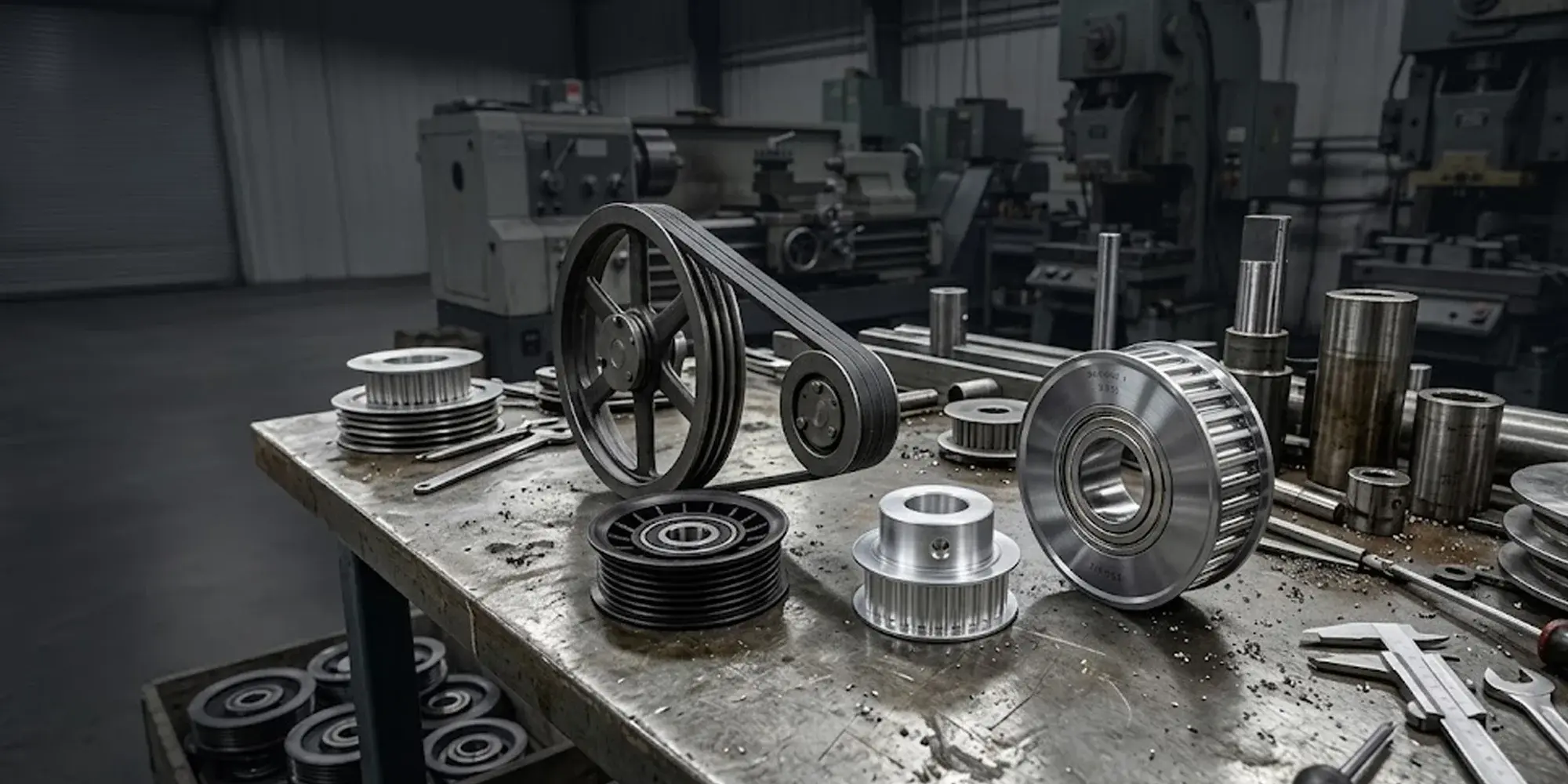
A pulley is one of the six classical simple machines—but that simplicity is deceptive.

In modern industrial and mechanical applications, pulleys span dozens of configurations, each optimized for a specific function: transmitting torque, redirecting force, maintaining belt tension, or lifting loads.

Choosing the wrong type costs more than just efficiency; it causes premature wear, misalignment, and system failure.

This guide breaks down the main types of pulleys—belt, idler, rope, and timing—and explains exactly where and why each one is used.

How Pulleys Are Classified

Most pulley classification systems use one of three criteria: function (what role the pulley plays in the system), drive type (the medium connecting the pulley—belt, rope, or chain), or design configuration (single groove, double, quick-disconnect, etc.).

In practice, these overlap. A timing belt pulley is classified by drive type (synchronous belt) and tooth profile (trapezoidal or curvilinear).

Understanding all three layers helps you spec the right component on the first attempt.

INFOGRAPHIC
Pulley Classification at a Glance
BY FUNCTION
Drive Pulley · Idler Pulley · Tensioner Pulley
Defines the role: power input, direction change, or tension control
BY DRIVE TYPE
Belt · Rope / Cable · Timing Belt · Chain
Determines groove profile, tooth geometry, and material requirements
BY DESIGN
Single / Double Groove · Quick-Disconnect · Corrosion-Resistant
Affects installation method, load capacity, and service environment

Belt Pulleys

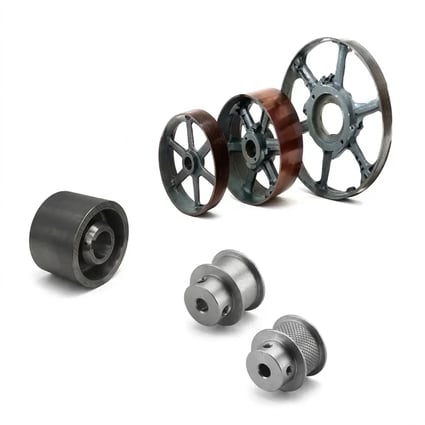
Belt pulleys transmit rotational power between shafts using a continuous belt—no direct shaft-to-shaft contact.

They are the workhorse of industrial drive systems: HVAC units, agricultural machinery, machine tools, and automotive accessories all rely on belt pulleys.

V-Belt Pulleys (Sheaves)

The V-belt pulley—also called a sheave—has a trapezoidal groove that mates with the wedge profile of a V-belt.

The wedging action amplifies friction, allowing high torque transmission without belt slippage.

Standard groove angles range from 34° to 40°, with tighter angles used for high-speed, low-torque applications.

V-Belt Pulleys (Sheaves)

V-belt systems can transmit power over center distances up to 5 m and are tolerant of minor shaft misalignment (typically ±0.5°).

They are not suitable for precise speed ratios because belt slip of 1–3% is inherent to the design.

Flat Belt Pulleys

Flat belt pulleys have a smooth, crowned face—the slight crown (typically 1:100 taper) keeps the belt centered under load.

They run quieter than V-belt systems and are preferred where high-speed operation (up to 50 m/s belt speed) or crossed-belt configurations are required.

Flat Belt Pulleys

The trade-off is lower power density per unit width compared to V-belt designs, requiring wider pulleys for equivalent torque transmission.

V-Belt vs Flat Belt Pulley: Key Differences
V-Belt Pulley (Sheave)
Groove angle
34° – 40° trapezoidal
Belt slip
1 – 3% (inherent)
Max center distance
Up to 5 m
Best for: high-torque, vibration-tolerant drives
Flat Belt Pulley
Crown ratio
1:100 (self-centering)
Max belt speed
Up to 50 m/s
Power density
Lower per unit width
Best for: high-speed, quiet, crossed-belt drives

Idler Pulleys

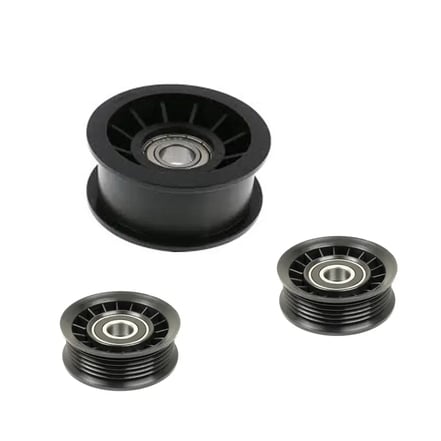
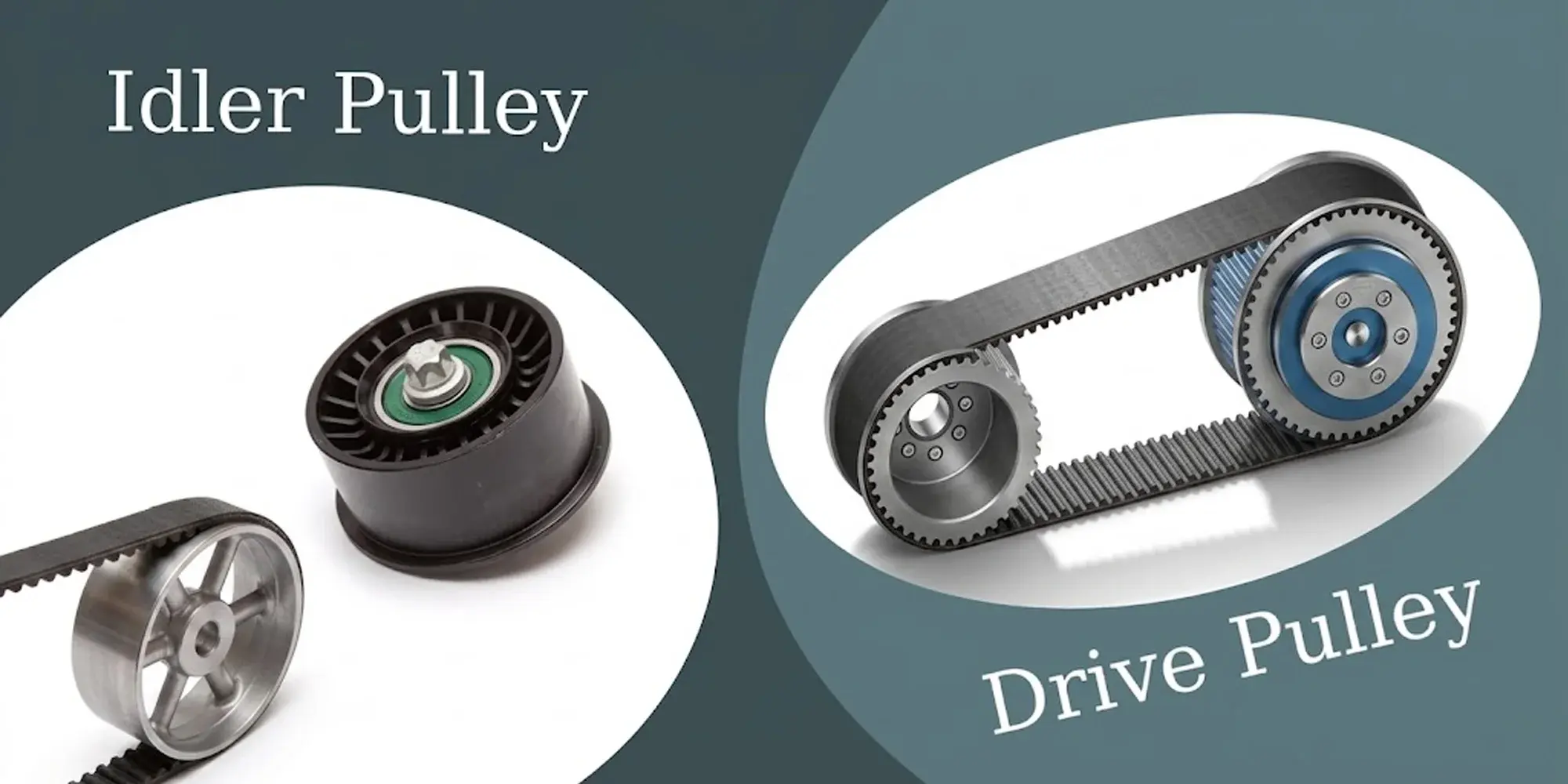
An idler pulley does not transmit power—it guides, supports, or tensions a belt or chain without connecting to a drive shaft.

Every automotive engine has at least one; modern serpentine systems often use three or more.

For a detailed breakdown of how idler and drive pulleys differ in design, failure modes, and field identification, see our idler pulley vs drive pulley comparison.

Idler Pulleys

Idler pulleys serve two distinct purposes depending on placement: tensioner idlers maintain minimum belt tension on the slack side, while guide idlers redirect the belt path or increase wrap angle on the drive pulley.

Increasing wrap angle from 120° to 180° can raise torque capacity by 30–40%, depending on the friction coefficient.

Most idler pulleys run on sealed ball bearings, and bearing failure—not groove wear—is the dominant failure mode.

A squealing or grinding noise from an idler almost always means the bearing is failing.

Idler Pulley vs Drive Pulley
IDLER PULLEY
DRIVE PULLEY
SHAFT CONNECTION
Spins freely on fixed axle
Locked to rotating shaft
POWER TRANSMISSION
✗ None
✓ Full torque transfer
INTERNAL BEARING
✓ Sealed ball bearing
✗ Uses shaft bearing
PRIMARY FAILURE MODE
Bearing seizure / wear
Groove wear / keyway damage
REPLACE WHEN
Noisy · At belt service interval
Groove worn · Keyway failed

Rope & Cable Pulleys (Sheaves)

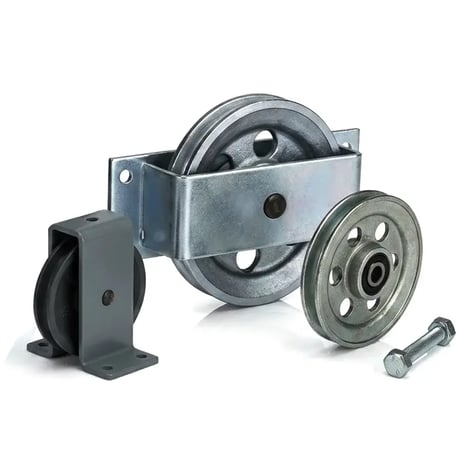
In lifting and rigging applications, the sheave is the grooved wheel; the pulley is the complete assembly including the frame (block) and fastening hardware.

The groove profile must closely match the rope or cable diameter—a groove that's too wide allows the rope to twist and wear unevenly, while too narrow a groove pinches and accelerates fatigue cracking in the wire strands.

Rope Pulleys

A single fixed pulley only changes the direction of the applied force—the mechanical advantage (MA) is 1:1.

A single movable pulley provides an MA of 2:1, meaning a 500 kg load requires only 250 kg of pull force (ignoring friction).

In practice, friction losses in sheave bearings reduce effective MA by 3–5% per sheave, which is why rigging engineers always calculate friction factors into load calculations for critical lifts.

Mechanical Advantage by Pulley Configuration
CONFIGURATION THEORETICAL MA EFFECTIVE MA
Single fixed pulley
Direction change only
1 : 1 ≈ 0.97 : 1
Single movable pulley
Halves required effort
2 : 1 ≈ 1.9 : 1
2-sheave block & tackle
4 rope segments support load
4 : 1 ≈ 3.6 : 1
4-sheave block & tackle
8 rope segments support load
8 : 1 ≈ 6.5 : 1
Effective MA assumes 3% friction loss per sheave (grease-lubricated bronze bushing). Ball-bearing sheaves: ~1.5% per sheave.

Timing Belt Pulleys

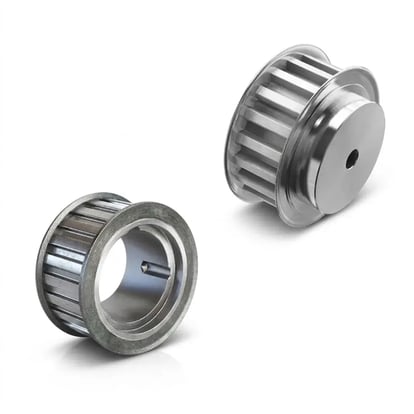
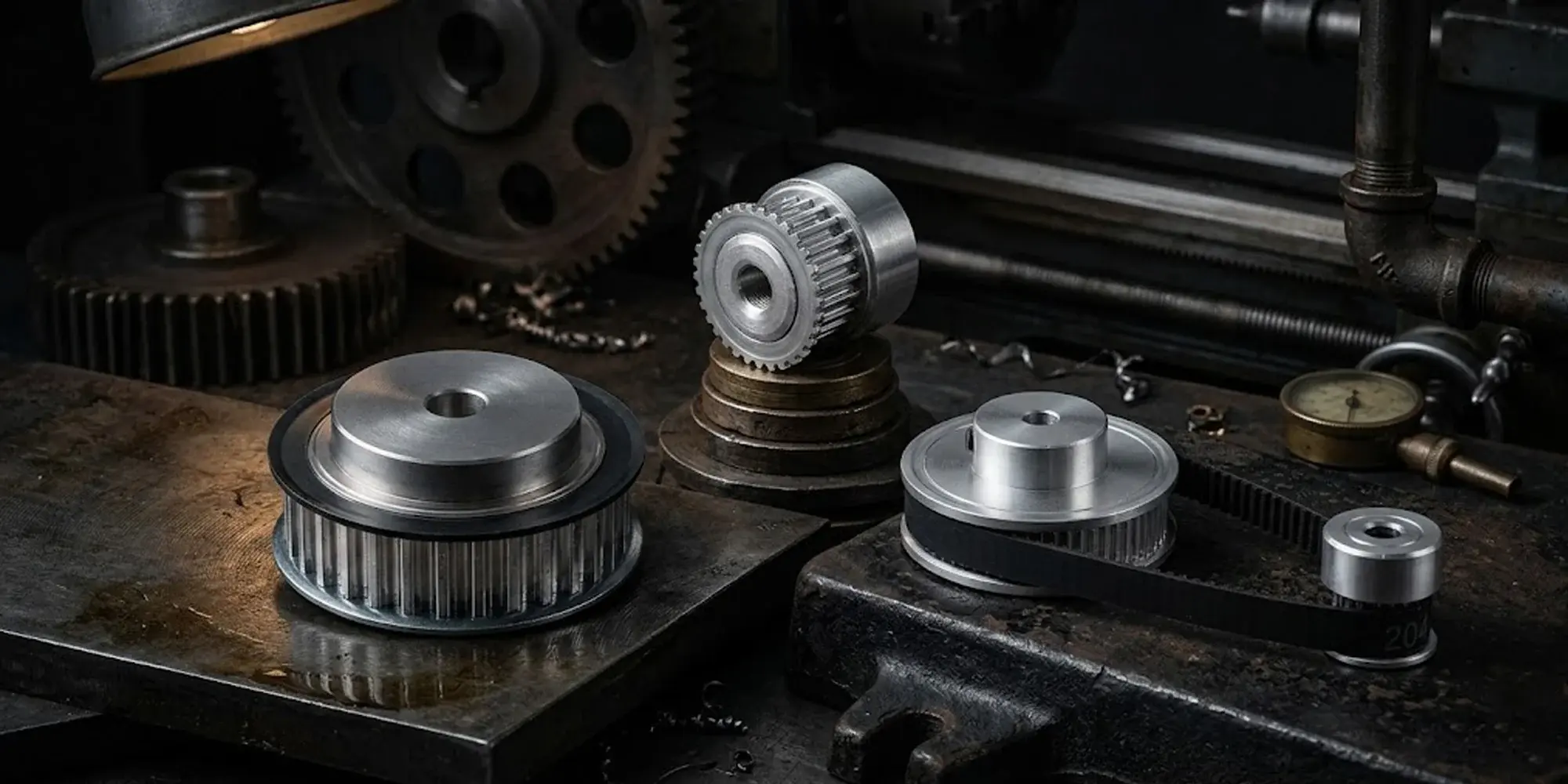
Timing belt pulleys are toothed pulleys designed to mesh with the teeth of a synchronous (timing) belt.

Unlike V-belt or flat belt systems, there is no slip—the tooth engagement creates a positive mechanical lock between belt and pulley, maintaining an exact speed ratio between input and output shafts.

Timing Belt Pulleys

This makes timing pulleys the only viable choice for applications where position accuracy or speed synchronization is non-negotiable: CNC machine axes, 3D printer extruders, robotic arms, and automotive valve timing systems all depend on timing belt drives.

For full specification guidance—pitch selection, tooth count, bore configuration, and material—see our timing belt pulley guide.

Tooth profile matters as much as pitch.

Trapezoidal teeth concentrate stress at the tooth root, limiting fatigue life at high loads.

Curvilinear tooth profiles—such as GT2 and HTD—distribute stress more evenly, increasing torque capacity by 20–30% for the same pitch and pulley diameter.

Timing Belt Pulley Series: Pitch & Power Range
MXL
Pitch: 0.080" / 2.032 mm · Power: <0.5 kW · Tooth: Trapezoidal
Applications: Medical instruments, office automation, miniature actuators
XL
Pitch: 0.200" / 5.08 mm · Power: 0.5 – 3 kW · Tooth: Trapezoidal
Applications: 3D printers, packaging machinery, linear motion, servo drives
L
Pitch: 0.375" / 9.525 mm · Power: 1 – 7.5 kW · Tooth: Trapezoidal
Applications: Industrial automation, conveyor drives, servo motor systems
H
Pitch: 0.500" / 12.7 mm · Power: 5 – 22 kW+ · Tooth: Trapezoidal
Applications: Machine tools, printing presses, heavy industrial automation

How to Choose the Right Pulley Type

Pulley Type Selection Framework
1
Does speed ratio accuracy matter?
YES → Use a Timing Belt Pulley (zero slip)
NO → Proceed to Step 2
 
2
Are you lifting or redirecting a rope / cable?
YES → Use a Sheave / Rope Pulley (D:d ≥ 20×)
NO → Proceed to Step 3
 
3
Is the pulley transmitting power or guiding?
GUIDING → Use an Idler Pulley (no shaft connection needed)
POWER → Use a Drive Pulley (V-belt or flat belt)
 
4
Check environment
Corrosive / wet / food-grade → Stainless steel or anodized aluminum + sealed bearings
Dry, controlled industrial → Standard steel or cast iron is adequate
Always verify load rating, belt compatibility, and bore fit before final specification.
Common Applications by Pulley Type
Pulley Type Industries Key Spec
V-Belt Pulley HVAC, agriculture, automotive accessories Groove angle, sheave diameter
Flat Belt Pulley Textile, high-speed machine tools Crown ratio, face width
Timing Belt Pulley CNC, robotics, 3D printing, automotive Pitch, tooth count, profile
Idler Pulley Automotive, conveyor, any belt system Bearing type, groove diameter
Rope / Sheave Construction, marine, mining, rescue D:d ratio, WLL rating
LILY Bearing

Browse Our Timing Belt Pulley Range

L, XL, H, and MXL series in aluminum, steel, and corrosion-resistant configurations. 497 products in stock.

View Timing Belt Pulleys →

FAQ

What is the difference between a pulley and a sheave?

A sheave is the grooved wheel itself. A pulley is the complete assembly—sheave, axle, bearing, and housing (block). In belt-drive contexts, the terms are used interchangeably. In rigging and lifting, the distinction matters for component replacement and load rating purposes.

Can I use a V-belt pulley with a timing belt?

No. V-belt pulleys have smooth or trapezoidal groove profiles designed for friction drive. Timing belts require toothed pulleys with matching pitch and tooth geometry. Running a timing belt on a V-belt sheave will strip the belt teeth within a short period of operation.

How many teeth should a timing belt pulley have?

A general rule is no fewer than 10–12 teeth in mesh with the belt at any time to distribute load evenly. For high-torque applications, 18–24 teeth on the smaller pulley is a common starting point. Fewer teeth increase per-tooth stress and accelerate belt fatigue.

What causes idler pulley failure?

Bearing failure accounts for the majority of idler pulley failures. Contamination (dirt, moisture), inadequate lubrication, and excessive belt tension are the three leading causes. Most OEMs recommend replacing idler pulleys every 60,000–100,000 km in automotive applications, regardless of apparent condition.

What material is best for timing belt pulleys?

Aluminum is the default choice—it machines precisely, resists corrosion adequately in most environments, and has a favorable strength-to-weight ratio. Steel pulleys are specified for high-load, high-cycle applications. For food processing, pharmaceutical, or marine environments, anodized aluminum or 316 stainless steel with sealed bearings is the appropriate specification.

Idler Pulley vs Drive Pulley: What's the Difference?

Idler Pulley vs Drive Pulley: What's the Difference?

Open any belt-driven machine—an automotive engine, an industrial conveyor, a CNC router—and you'll find at least one pulley that spins without being...
Read More
What Is a Timing Belt Pulley? How It Works, Types & Selection Guide

What Is a Timing Belt Pulley? How It Works, Types & Selection Guide

In any drive system where the output shaft must rotate at a precise, predictable ratio to the input shaft—think CNC machine axes, robotic joints,...

Read More
What Are Pillow Block Bearings? Types, Parts & How to Choose (2026)

What Are Pillow Block Bearings? Types, Parts & How to Choose (2026)

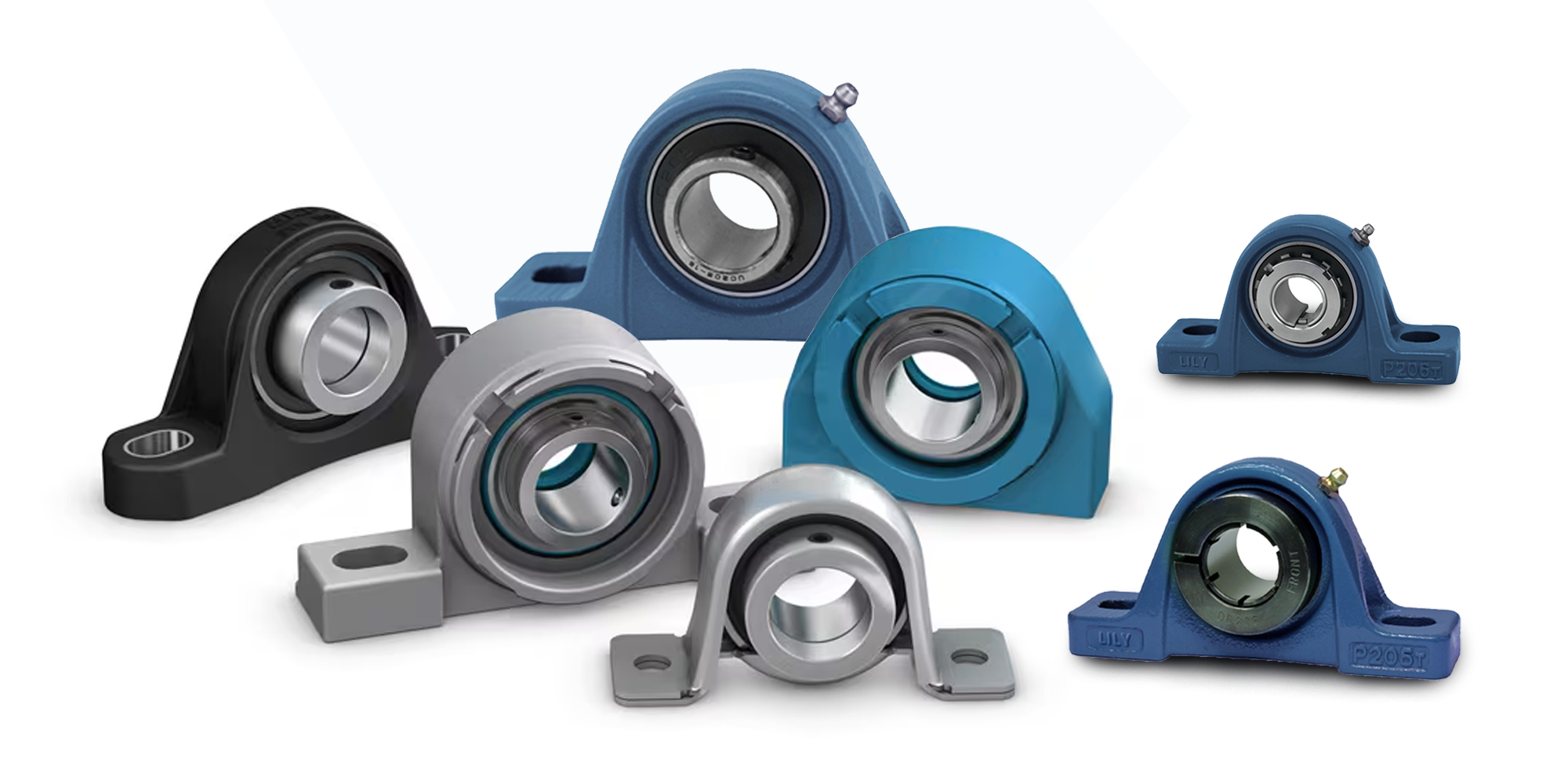
A pillow block bearing is a pre-assembled unit that mounts a bearing insert into a housing, ready to bolt directly onto a machine frame. Unlike...

Read More