


Home/
Blog/
Stainless Steel Slewing Bearings for Corrosion-Resistant Applications

8 min read

Stainless Steel Slewing Bearings for Corrosion-Resistant Applications

Stainless Steel Slewing Bearings for Corrosion-Resistant Applications
18:03

Stainless steel slewing bearings for corrosion-resistant applications may be considered when U.S. industrial equipment is exposed to humidity, outdoor conditions, wet operation, cleaning cycles, or material compatibility concerns. Suitability still depends on the actual environment, load conditions, bearing configuration, maintenance expectations, and verified material option.

The important point is simple: stainless steel is not a universal answer to every corrosion concern. A buyer should describe the exposure, the equipment, and the required slewing bearing configuration before assuming that a stainless steel option is appropriate.

This guide is written for OEM engineers, procurement teams, MRO buyers, and industrial equipment manufacturers preparing a quote request or application review.

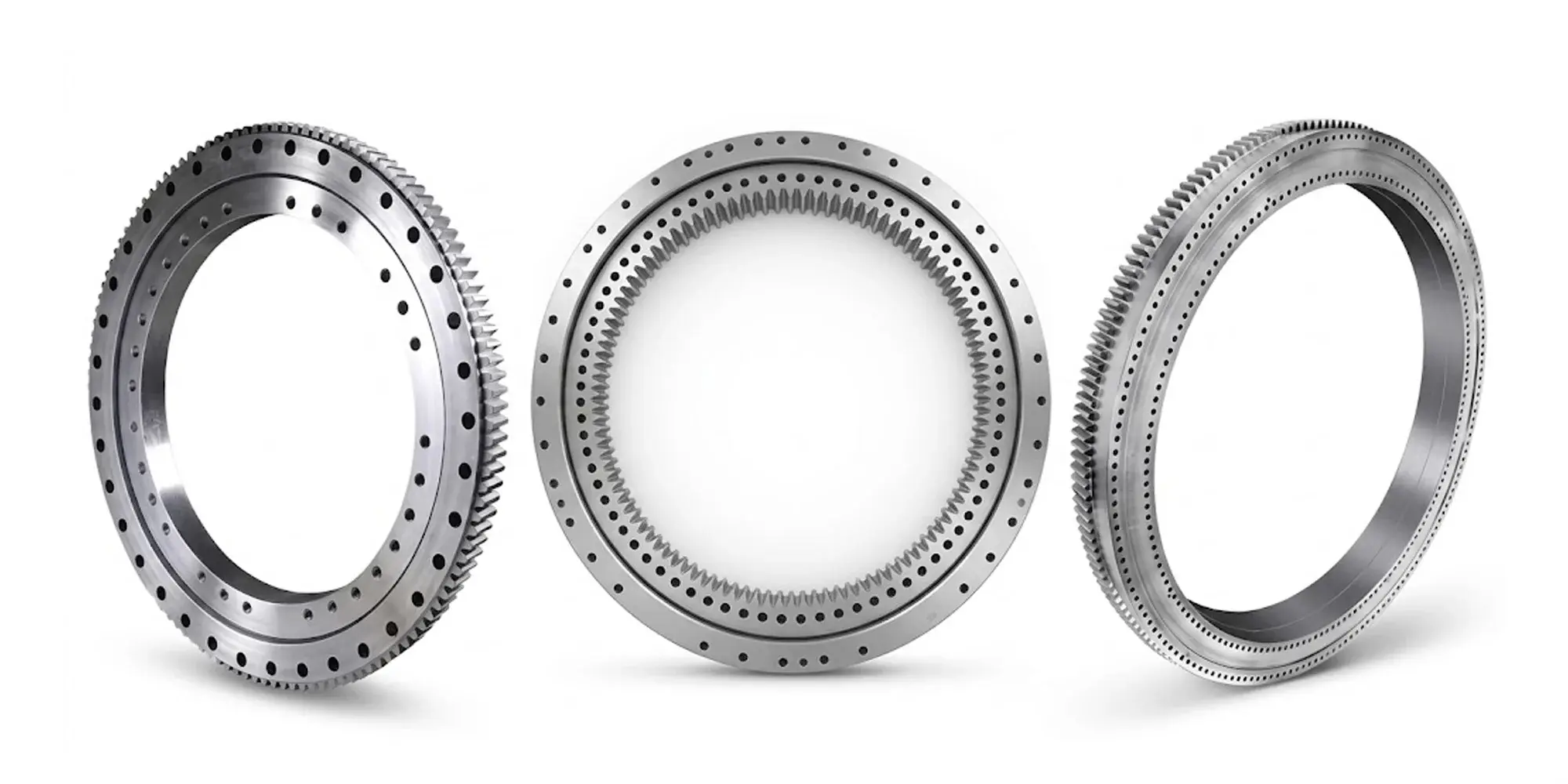
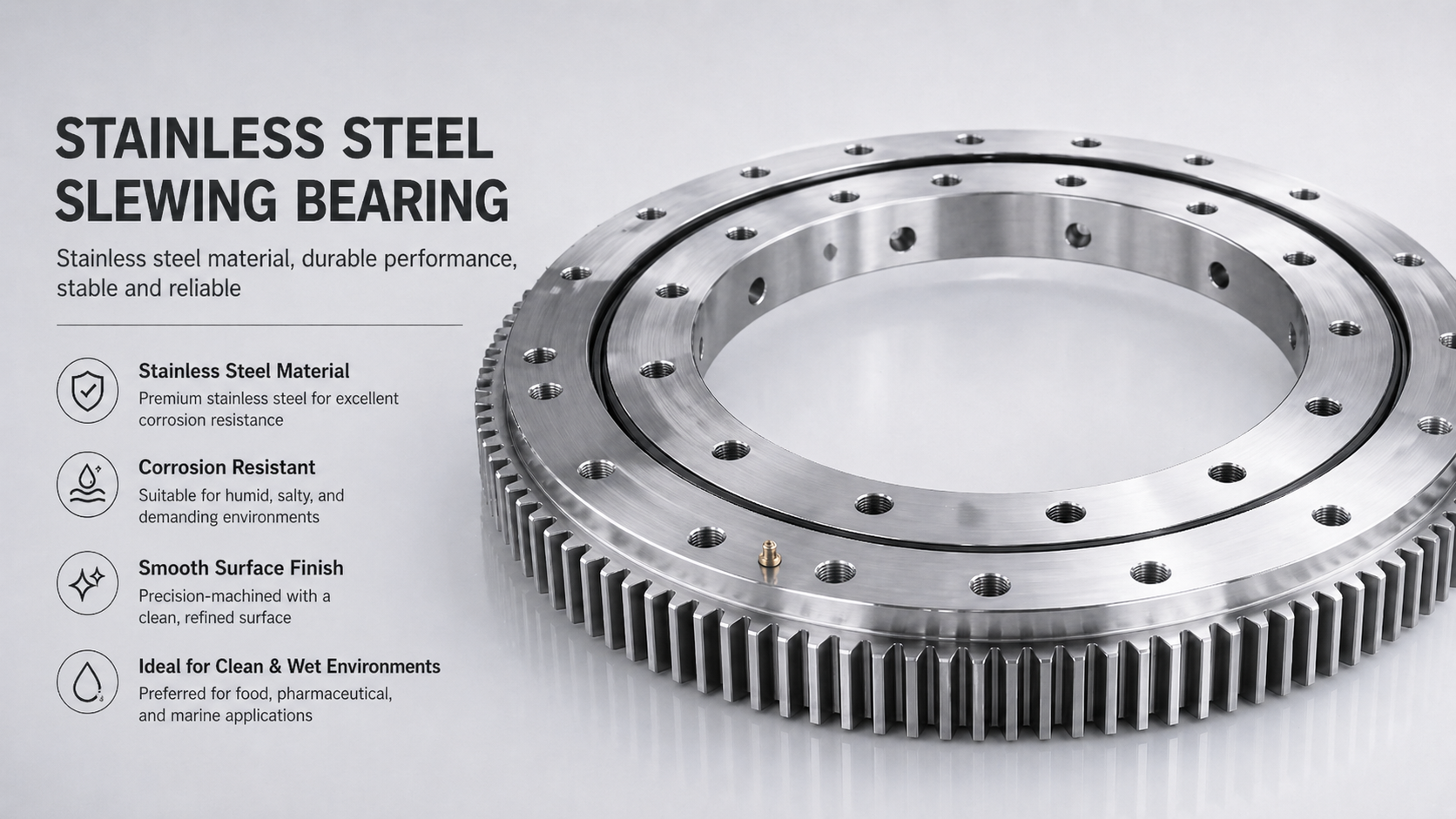
Stainless steel slewing bearing being reviewed for an industrial corrosion-resistant application


When Stainless Steel Slewing Bearings May Be Considered

Buyers may consider stainless steel slewing bearings when corrosion exposure, humidity, outdoor conditions, wet operation, cleaning cycles, or material compatibility are relevant to the application. Suitability should still be reviewed against load, speed, dimensions, mounting, environment, maintenance expectations, and verified material options.

A stainless steel slewing bearing may be discussed when the operating environment creates corrosion concerns that a standard material may not address well enough. Common buyer concerns include:

· equipment exposed to humidity or condensation

· outdoor industrial machinery

· intermittent wet conditions

· cleaning cycles or water exposure

· exposed equipment where covers or protection are limited

· environments where material compatibility must be clarified

· replacement bearings showing corrosion symptoms

These conditions do not automatically make stainless steel the right choice. They are reasons to disclose more information before the quote stage.

For example, “outdoor use” can mean many things. It could mean occasional rain under a cover, constant exposure on uncovered equipment, or moisture combined with dust and poor maintenance access. Those are different discussions. The same applies to wet operation, cleaning cycles, coastal air, or chemical exposure concerns.


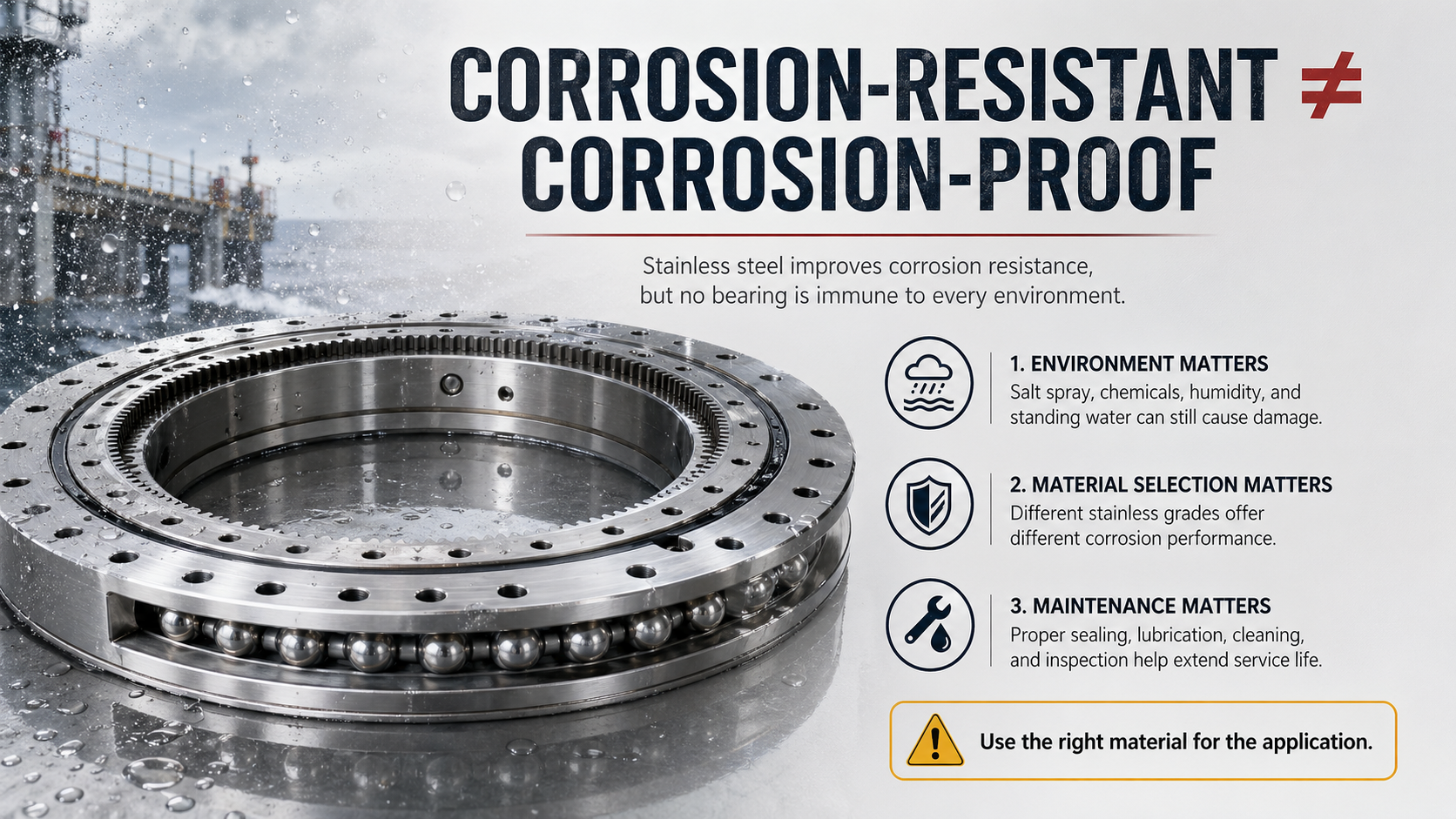
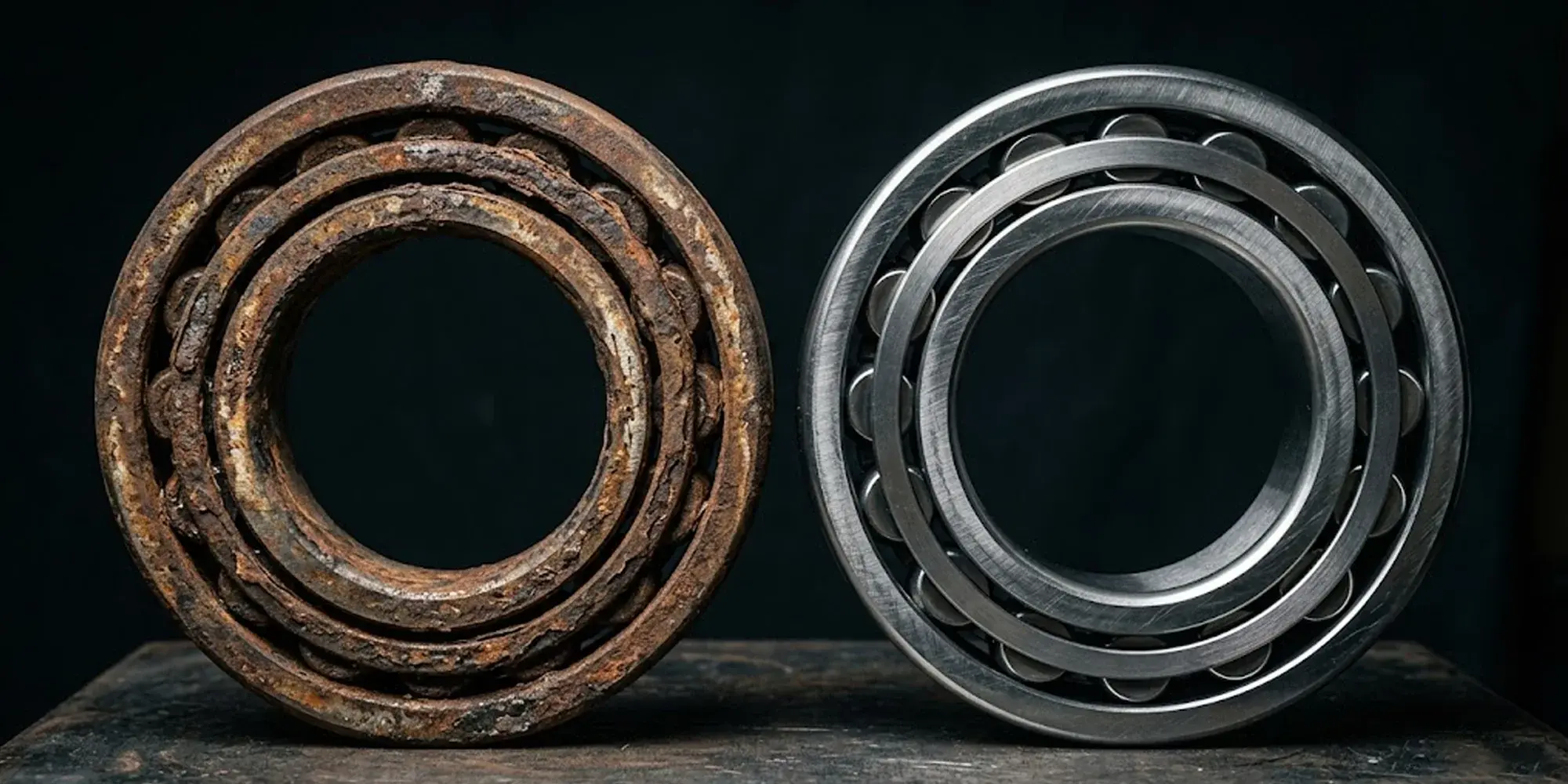
Corrosion-Resistant Does Not Mean Corrosion-Proof

Corrosion-resistant does not mean corrosion-proof. Stainless steel can help address certain corrosion-exposure concerns, but it should not be treated as a guaranteed solution for every environment.

Caution visual explaining that corrosion-resistant stainless steel slewing bearings are not corrosion-proof


Stainless steel can still corrode depending on the material option, exposure type, cleaning agents, chlorides, temperature, surface condition, maintenance expectations, and exposure duration. A corrosion-resistant application should be reviewed as a real operating environment, not reduced to a material label.

Buyers should avoid assuming that stainless steel will solve every corrosion issue. Instead, describe the environment and ask whether the listed material option is appropriate for the required bearing configuration.

This matters because corrosion exposure is rarely isolated from the rest of the bearing application. Load, speed, mounting, gear design, lubrication expectations, replacement history, and operating environment all affect the discussion.


Application Details That Affect Material Suitability

Material is only one part of slewing bearing selection. For a stainless steel slewing bearing review, the supplier needs to understand both the corrosion exposure and the mechanical requirements.

For a stainless steel slewing bearing review, buyers should provide drawings or dimensions, load conditions, speed, mounting and gear requirements, operating environment, corrosion exposure details, quantity, and documentation needs.

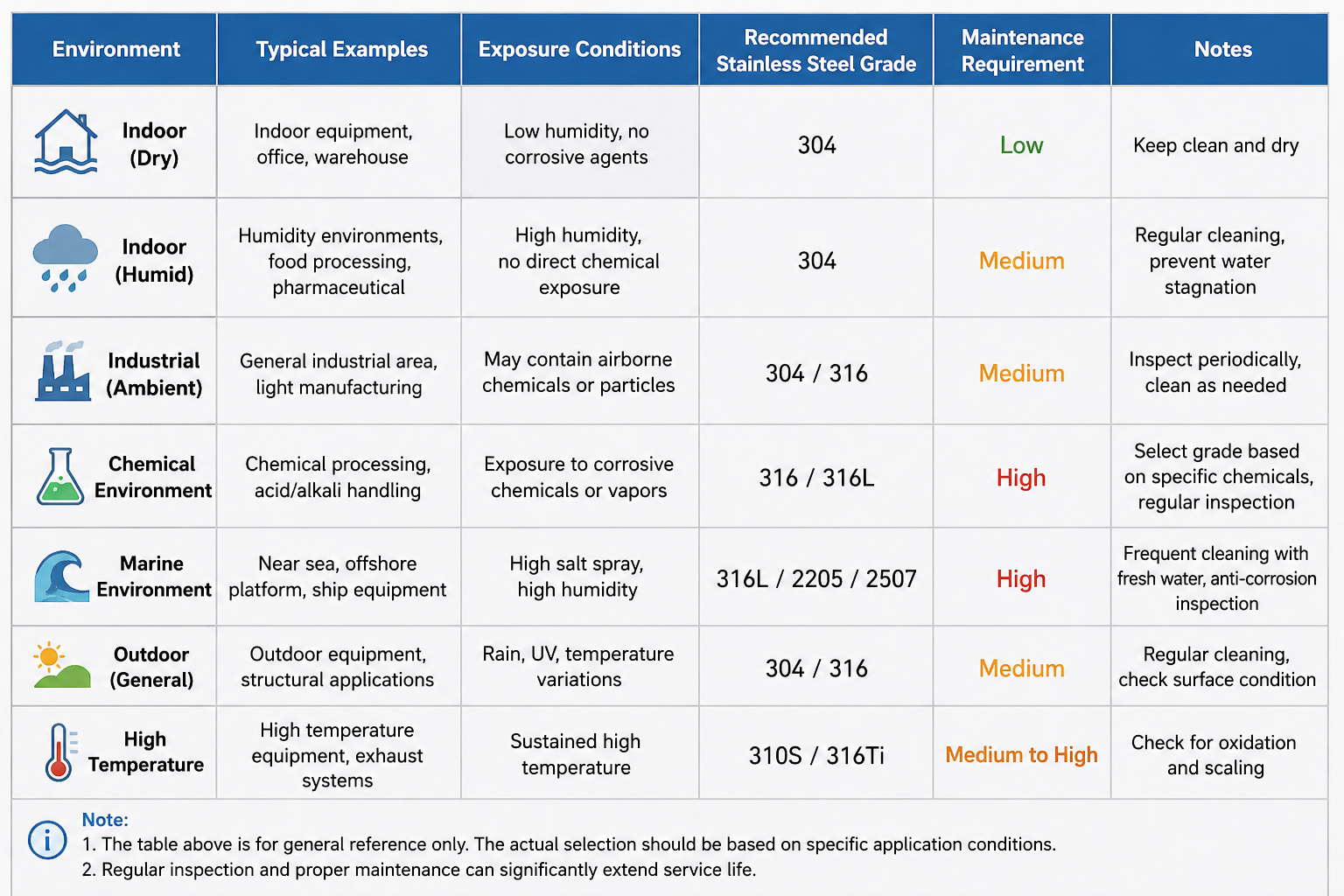
Environment exposure review table for stainless steel slewing bearing inquiries


Environment and Exposure Requirements Table

Environment / Exposure Type What Buyers Should Describe Cautious Wording Boundary
Outdoor / Exposed Equipment Rain exposure, humidity, cover or shielding, drainage, maintenance access, and whether the bearing is continuously exposed. Do not assume weather suitability without review.
Humid / Wet Conditions Frequency and duration of moisture exposure, condensation, standing water risk, and maintenance expectations. Do not assume absolute protection from corrosion.
Cleaning Cycles / Washdown-type Exposure Water exposure, cleaning frequency, cleaning agents (if any), and whether the bearing is directly or indirectly exposed. Do not imply food, sanitation, or washdown certification.
Chemical Exposure Concerns Chemical type, concentration, temperature, contact method, and exposure time. Treat as an application disclosure item, not a broad product claim.
Coastal / Salt-air Exposure Salt-air exposure, splash risk, distance from exposure source, and maintenance conditions. Do not assume saltwater suitability or marine classification.
Food / Medical Compliance Concerns Compliance or receiving requirements that the buyer must meet. Do not imply regulated food or medical compliance without approved evidence.


The table is not a suitability chart. It is a preparation tool. The buyer should use it to describe the operating environment before requesting a quote.

Load, speed, and movement pattern

Corrosion concerns do not remove the need to review load and motion. Buyers should provide axial load, radial load, moment load if known, speed, indexing pattern, rotation angle, duty cycle, or intermittent movement behavior.

If exact load values are not available, describe the equipment and operating duty. That gives the supplier a clearer starting point than material preference alone.

Dimensions and mounting requirements

Slewing bearing dimensions and mounting details still matter. Buyers should provide inside diameter, outside diameter, overall height, mounting hole pattern, bolt circle if available, and any interface constraints.

For replacement bearings, field measurements should be labeled clearly. If dimensions were taken from a worn or damaged bearing, say so.

Gear type and bearing configuration

Stainless steel discussion should not ignore configuration. Buyers should identify whether the project requires internal gear, external gear, gearless configuration, standard or flanged type, and ball or roller type if known.

If the gear details are unknown, photos may help start the discussion. Do not guess the gear type if the existing bearing is damaged or the drawing is incomplete.

Replacement vs new design

A new OEM design and a replacement project require different inquiry details. An OEM project may need space constraints, design loads, mounting requirements, and expected quantity. A replacement project may need an old part number, photos, field measurements, equipment model, and corrosion symptoms from the existing bearing.


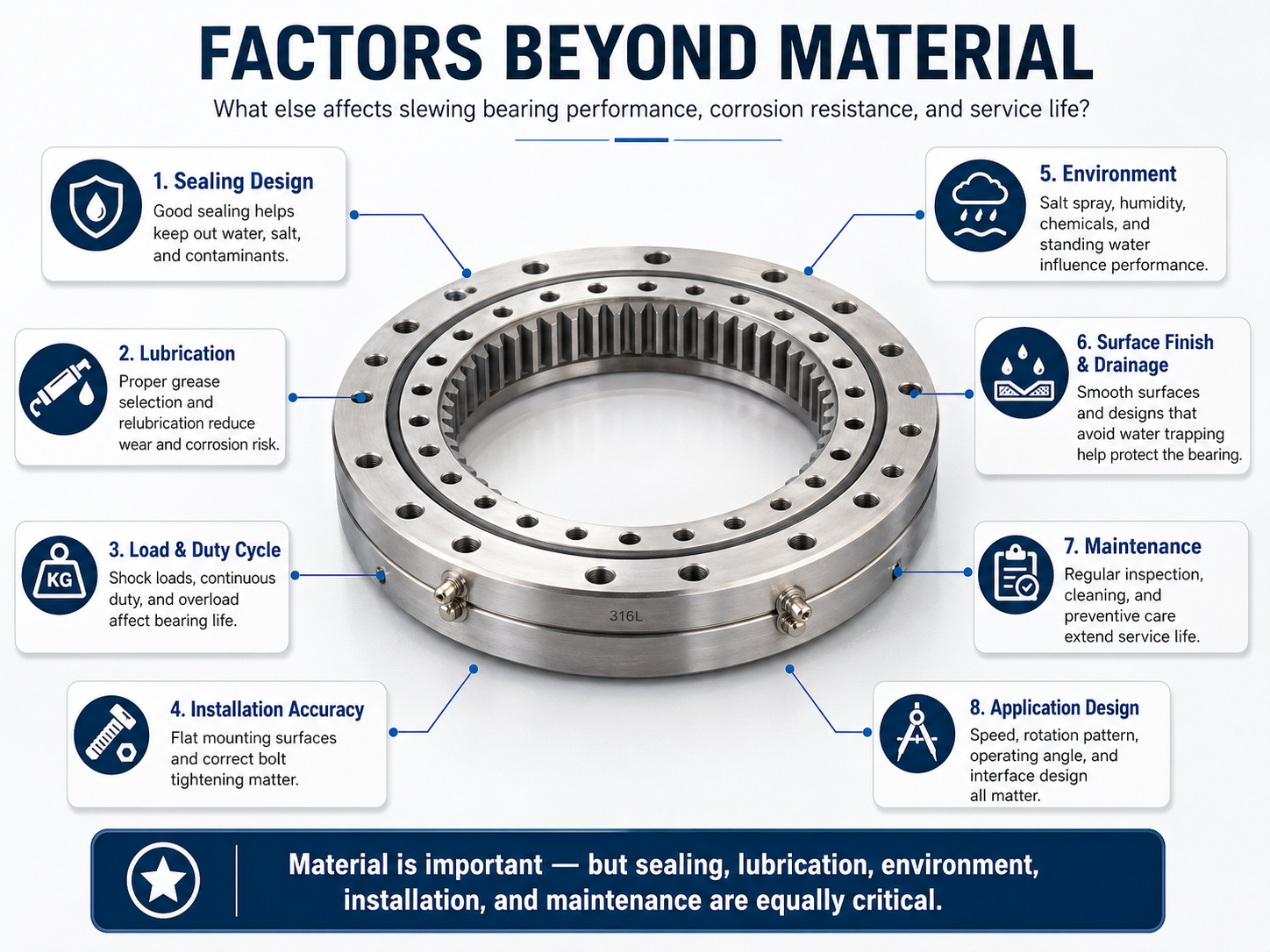
Slewing Bearing Factors Beyond Material

A stainless steel option should be reviewed together with the required slewing bearing form and function. Material preference alone does not define the bearing.

Diagram of slewing bearing selection factors beyond stainless steel material


Important factors include:

· inside diameter, outside diameter, and overall height

· ball or roller type if known

· internal gear, external gear, or gearless configuration

· standard or flanged type if relevant

· mounting hole pattern and interface constraints

· load context and movement pattern

· operating environment and exposure duration

· replacement context or new design context

· inch or metric unit basis

· quantity and documentation needs

Because stainless material suitability depends on the product listing and the application environment, buyers should confirm whether a stainless steel ring material option is appropriate for the required configuration.

Listed ring material options include 42CrMo, 50Mn, or 440C stainless steel, depending on the product listing.

That sentence should be treated as listing-dependent material information, not as a universal statement about every slewing bearing.


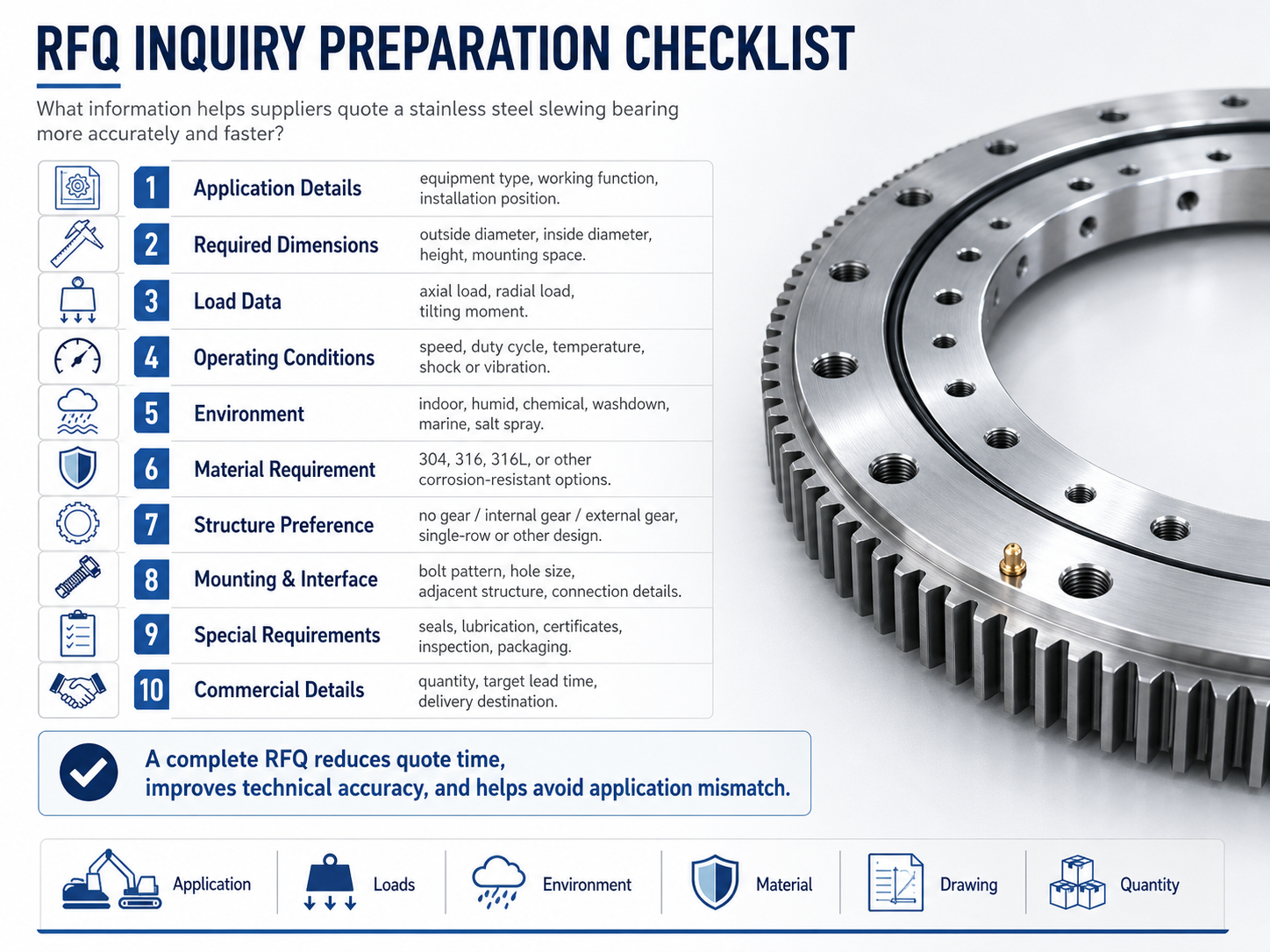
What Buyers Should Prepare Before Requesting a Quote

A clear inquiry helps the supplier understand whether stainless steel should be reviewed and what additional questions need to be answered.

Inquiry checklist for requesting a stainless steel slewing bearing application review


Inquiry preparation checklist

Before requesting a quote, prepare as much of the following as possible:

· drawing, sketch, or existing part number

· whether the request is for a new design, replacement, repair, or redesign

· inside diameter, outside diameter, and overall height

· mounting hole pattern, bolt circle, number of holes, hole size, bolt size, and interface constraints

· gear type: internal gear, external gear, gearless, or unknown

· gear details such as tooth count, module, diametral pitch, pitch diameter, gear face width, gear position, mating pinion information, and tooth load if known

· ball or roller preference if already specified

· standard or flanged requirement if already specified

· inch or metric unit basis, plus whether dimensions are nominal, measured, or copied from a worn part

· axial load, radial load, moment load, shock load, overturning moment, and any safety-factor assumptions if available

· speed, indexing pattern, rotation angle, duty cycle, start-stop frequency, and expected service hours

· operating orientation and whether the bearing is horizontal, vertical, tilted, or exposed to uneven loading

· operating environment

· corrosion exposure details

· exposure frequency and duration

· cleaning cycle or water exposure if relevant

· chemical type, concentration, contact method, and temperature if chemical exposure is a concern

· coastal or salt-air exposure details if relevant

· lubrication expectations, relubrication access, seal preference, and whether contamination or wash water can reach the raceway area

· temperature range and whether condensation, freeze-thaw, or thermal cycling is expected

· quantity, annual usage estimate, prototype/production stage, and target delivery destination

· replacement context, including equipment model, old part number, nameplate photos, installation photos, damage/corrosion photos, and field measurements if available

· documentation or receiving requirements

· packaging, labeling, shipping destination, and import/receiving notes if relevant

If a detail is unknown, label it as unknown. A clear statement of uncertainty is more useful than an unstated assumption.


Corrosion exposure details to include

For corrosion-related review, include practical exposure details rather than broad labels. Instead of writing only “corrosive environment,” describe what is present:

· moisture, humidity, or condensation

· rain, outdoor exposure, or uncovered installation

· cleaning water or wash cycles

· cleaning agents or chemicals, if any

· salt-air or coastal exposure if relevant

· temperature range if important to the application

· maintenance access and expected service conditions

This information helps determine whether stainless steel should be part of the material discussion and whether other application details need review.


How LILY Bearing Can Review Project Details

LILY Bearing supplies slewing bearings as part of its precision bearing and related component product range. Its slewing bearing catalog includes more than 2,000 product listings across internal gear, external gear, and gearless configurations, with ball and roller types, standard and flanged bearing types, and both inch and metric product data.

For buyers evaluating stainless steel slewing bearings for corrosion-resistant applications, LILY Bearing can support selection and custom design discussions when drawings, dimensions, load conditions, gear and mounting details, operating environment, corrosion exposure, quantity, and documentation needs are provided.

Because material suitability depends on the product listing and the application environment, buyers should confirm whether a stainless steel ring material option is appropriate for the required configuration.

Pre-sale communication can help clarify whether the material request, configuration, operating environment, and documentation requirements have been described clearly before quotation. After-sales support may also help buyers keep project information organized for repeat orders or future replacement discussions.


Questions to Ask Before Choosing Stainless Steel for a Slewing Bearing

Before choosing stainless steel for a slewing bearing, buyers should ask practical questions that connect material choice to the actual application.

Useful questions include:

· What type of corrosion exposure is present?

· Is the exposure occasional, continuous, splash-related, cleaning-related, outdoor, or chemical-related?

· Are there chlorides, cleaning agents, or other substances that should be disclosed?

· Is the bearing directly exposed or partially protected?

· What load, speed, and movement pattern should be considered?

· What gear and mounting configuration is required?

· Is stainless steel listed for the required bearing configuration?

· Are documentation or receiving requirements needed before quotation?

· Is this a new design, a replacement, or a custom project?

· Are photos or field measurements available for replacement review?

These questions help avoid treating corrosion exposure as a simple yes-or-no material decision.


When to Request Application Review From a Supplier

Request application review when corrosion exposure and bearing requirements need to be considered together.

That is often the case when:

· the equipment operates outdoors or in wet conditions

· cleaning cycles or water exposure are part of the application

· chemical exposure concerns exist

· coastal or salt-air exposure may be relevant

· the old bearing shows corrosion symptoms

· the required configuration is not a simple standard replacement

· load, gear, mounting, and material requirements need to be reviewed together

· documentation or receiving requirements must be clarified before quotation

The goal is not to claim that one material solves every exposure problem. The goal is to provide enough information for a useful review.


FAQ


Are stainless steel slewing bearings corrosion-proof?

No. Corrosion-resistant does not mean corrosion-proof. Stainless steel can help address certain corrosion-exposure concerns, but suitability depends on the material option, environment, exposure duration, maintenance expectations, load, and bearing configuration.


When should buyers consider stainless steel slewing bearings?

Buyers may consider stainless steel slewing bearings when humidity, outdoor exposure, wet conditions, cleaning cycles, or material compatibility are relevant to the application. The actual environment and bearing requirements should still be reviewed.


What corrosion exposure details should I provide before requesting a quote?

Provide the exposure type, moisture frequency, outdoor exposure, cleaning cycle, chemical type if relevant, concentration if known, temperature if important, salt-air exposure if relevant, exposure duration, and maintenance expectations.


Can stainless steel slewing bearings be used outdoors?

They may be considered for outdoor applications, but outdoor use should be described clearly. Buyers should provide information about rain exposure, humidity, cover or shielding, maintenance access, and exposure duration before assuming material suitability.


Are stainless steel slewing bearings suitable for washdown environments?

Washdown-type exposure should be reviewed carefully. Buyers should describe water exposure, cleaning frequency, cleaning agents if any, and documentation or receiving requirements. Do not assume food or washdown compliance without approved evidence.


What information is needed for a stainless steel slewing bearing quote?

A useful quote request should include drawings or dimensions, load conditions, speed, gear and mounting requirements, bolt-hole and gear details, operating environment, corrosion exposure details, lubrication or sealing expectations, quantity, replacement context if relevant, and documentation needs.


How do stainless steel slewing bearings compare with standard slewing bearings?

The difference should be reviewed by application. Stainless steel may be considered where corrosion exposure or material compatibility matters, but buyers still need to evaluate load, speed, dimensions, gear type, mounting, environment, maintenance expectations, and listing-specific material options.


What if the application involves salt air or chemical exposure?

Salt-air or chemical exposure should be disclosed as a project condition. Buyers should provide exposure type, concentration if relevant, contact method, temperature, duration, and maintenance expectations so the application can be reviewed carefully.


Does 440C stainless steel apply to every slewing bearing listing?

No. Listed ring material options include 42CrMo, 50Mn, or 440C stainless steel, depending on the product listing. Buyers should confirm whether the required configuration has an appropriate stainless steel ring material option.


Conclusion: Treat Stainless Steel as an Application Review Question

Stainless steel slewing bearings may be considered for corrosion-resistant applications, but the material should not be treated as a universal solution. Corrosion-resistant does not mean corrosion-proof, and suitability depends on the actual environment, exposure type, bearing configuration, load, speed, mounting, quantity, and documentation needs.


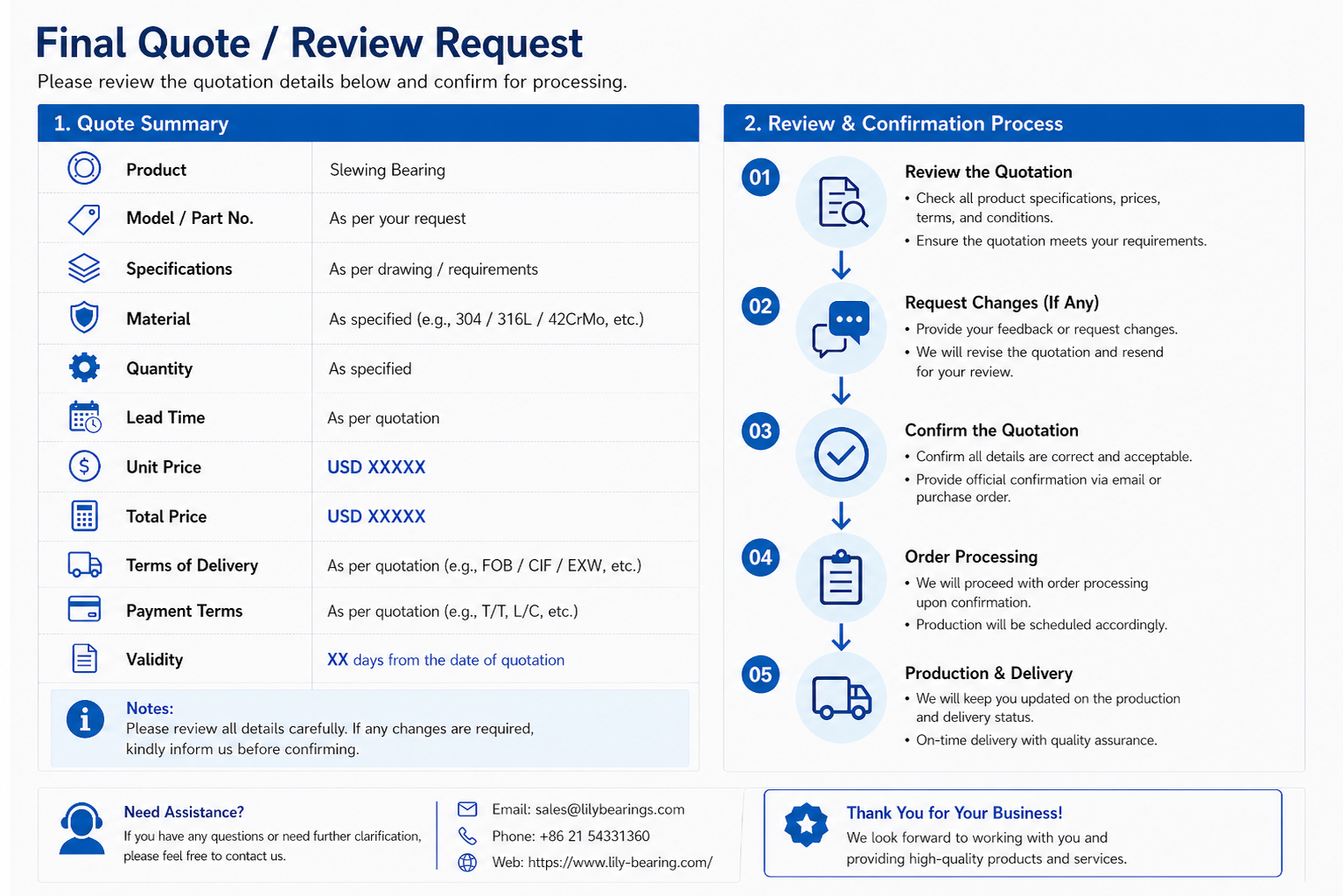
Application review request materials for a stainless steel slewing bearing quote

If you are evaluating stainless steel slewing bearings for a corrosion-resistant application, send LILY Bearing your drawings, dimensions, load conditions, gear and mounting details, operating environment, corrosion exposure, quantity, replacement context, and documentation needs for review.


Stainless Steel vs. Coated Bearings: Understanding the Real Trade-Offs

Stainless Steel vs. Coated Bearings: Understanding the Real Trade-Offs

Corrosion-resistant bearings come in two broad approaches: use a material that resists corrosion intrinsically, or use a standard bearing with a...
Read More
How to Install Pillow Block Bearings: Step-by-Step Guide

How to Install Pillow Block Bearings: Step-by-Step Guide

Quick Answer — 8 Steps Clean and inspect the shaft Slide the bearing into position Lightly bolt the housing down Set the final mounting...

Read More
440C vs. 304 vs. 316 Stainless Steel Bearings: Choosing the Best Grade for Corrosive Environments

440C vs. 304 vs. 316 Stainless Steel Bearings: Choosing the Best Grade for Corrosive Environments

When selecting stainless steel bearings for harsh environments, many engineers assume that all "stainless" options offer the same protection. ...

Read More