

Home/
Blog/
Needle Bearings vs Roller Bearings: 2026 Selection Guide

5 min read

Needle Bearings vs Roller Bearings: 2026 Selection Guide

Needle Bearings vs Roller Bearings: 2026 Selection Guide
10:51

Can you fit a bearing with 35,000N load capacity in a 30mm radial envelope? The answer is no for cylindrical roller bearings, but yes for needle bearings.

Needle bearings win on compactness but lose on thrust load capacity—and this trade-off defines the entire comparison.

Choosing among roller bearing types—especially the needle bearing versus all others—isn't just about matching specifications. It's about deciding between radial space efficiency and comprehensive load management.

Your design's success hinges on understanding which matters more.


Roller Bearings Family: Complete Overview


What Are Roller Bearings?

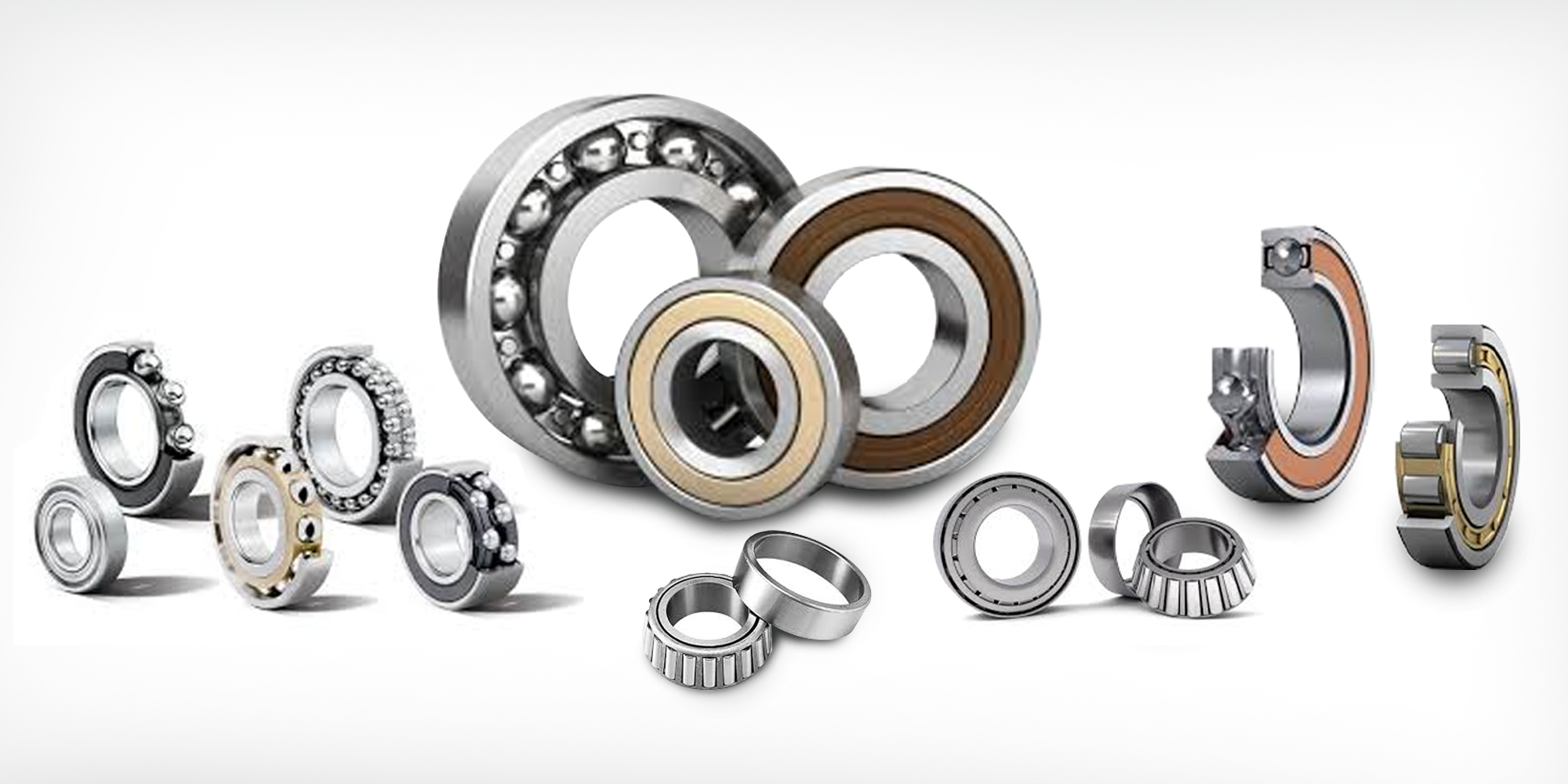
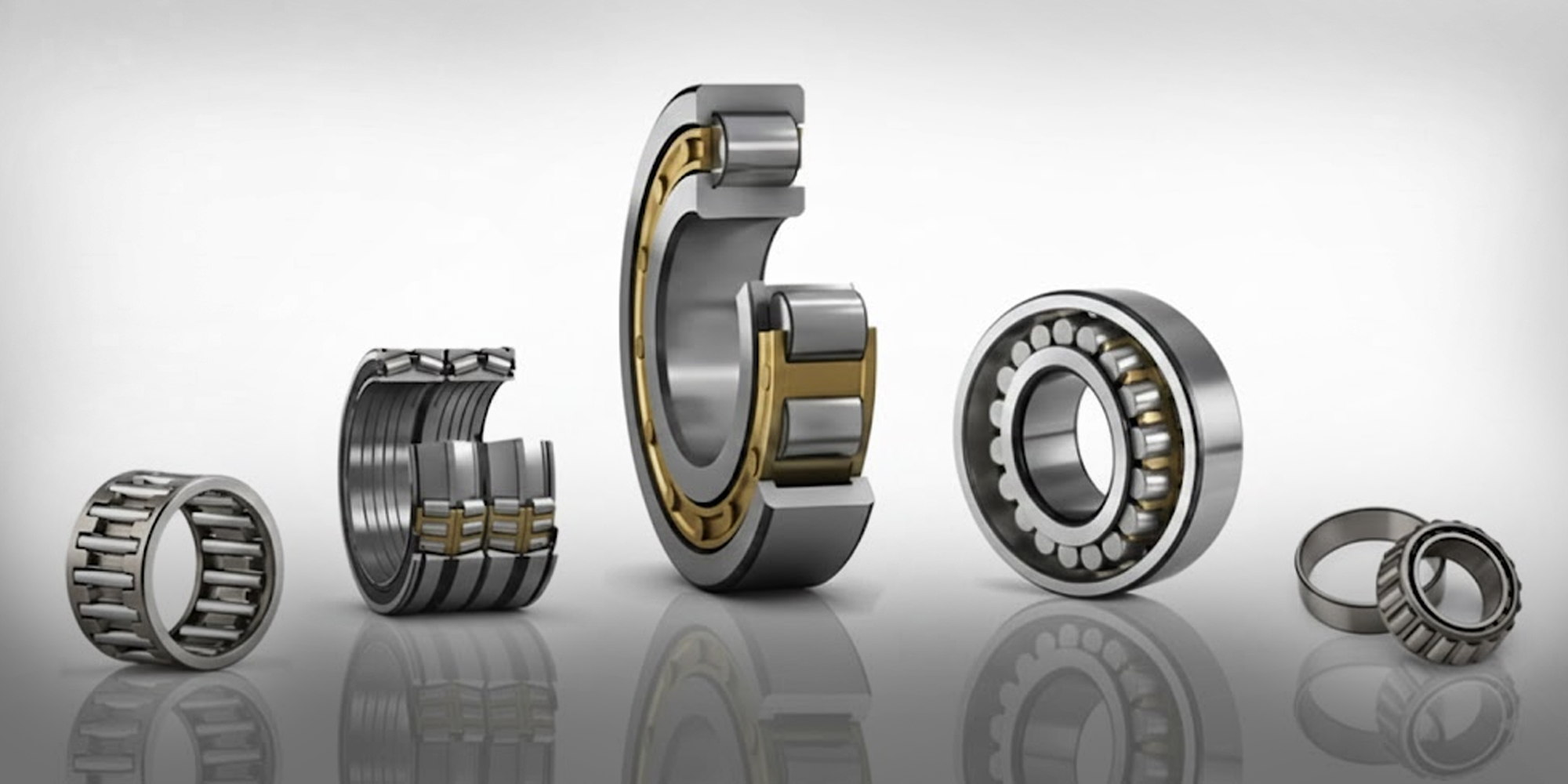
Roller bearings use cylindrical, tapered, or barrel-shaped rolling elements (rollers) to support loads between rotating and stationary components.

They handle both radial and axial forces with high efficiency.

Their core principle is replacing sliding friction with rolling friction, drastically reducing energy loss and wear.

roller bearings

Key characteristics of roller bearings:

  • Rolling elements are cylinders, not spheres
  • Line contact with raceways (vs. point contact in ball bearings)
  • Higher load capacity for a given size
  • Better suited for heavy radial loads
  • Generally lower maximum speeds than ball bearings

The line contact between rollers and raceways distributes loads over a larger surface area.

As a result, roller bearings typically carry 30-50% more load than ball bearings of the same size.


The 5 Main Types of Roller Bearings

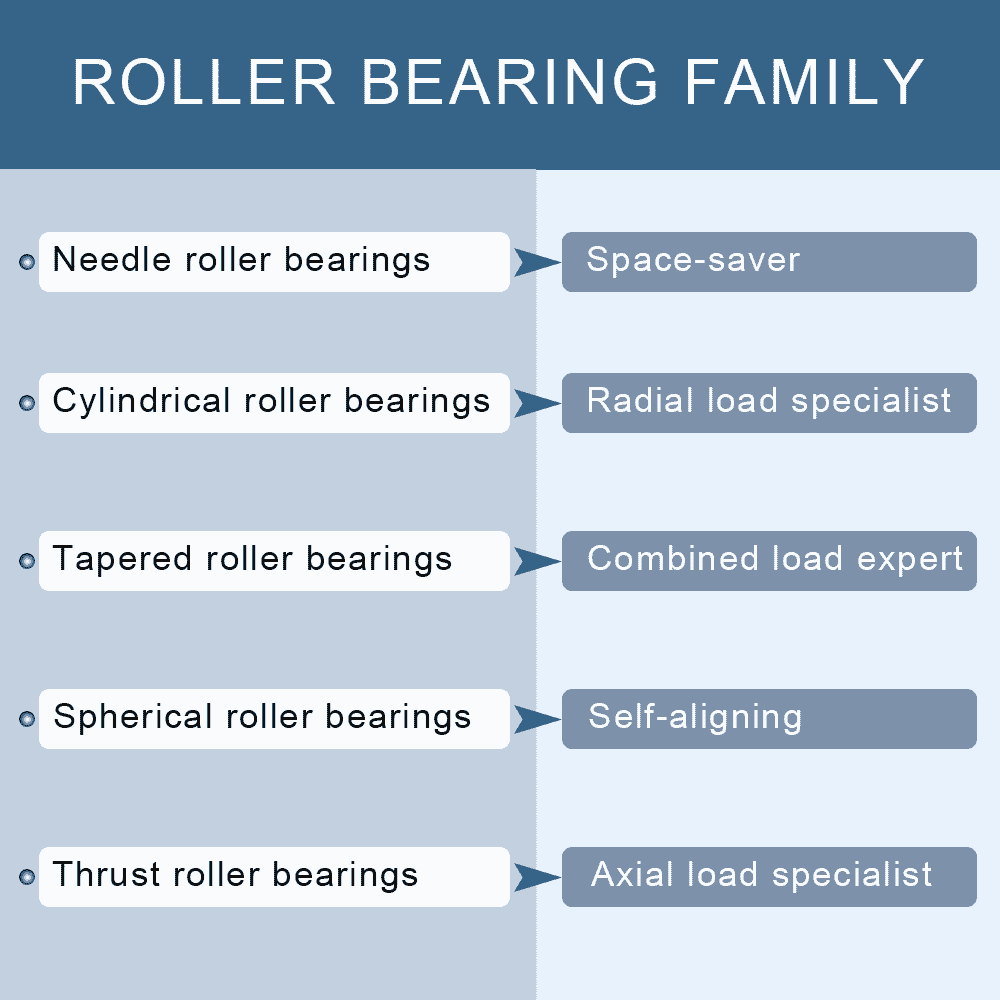
The roller bearing family includes five distinct types, each optimized for specific applications:

Roller Bearing Family

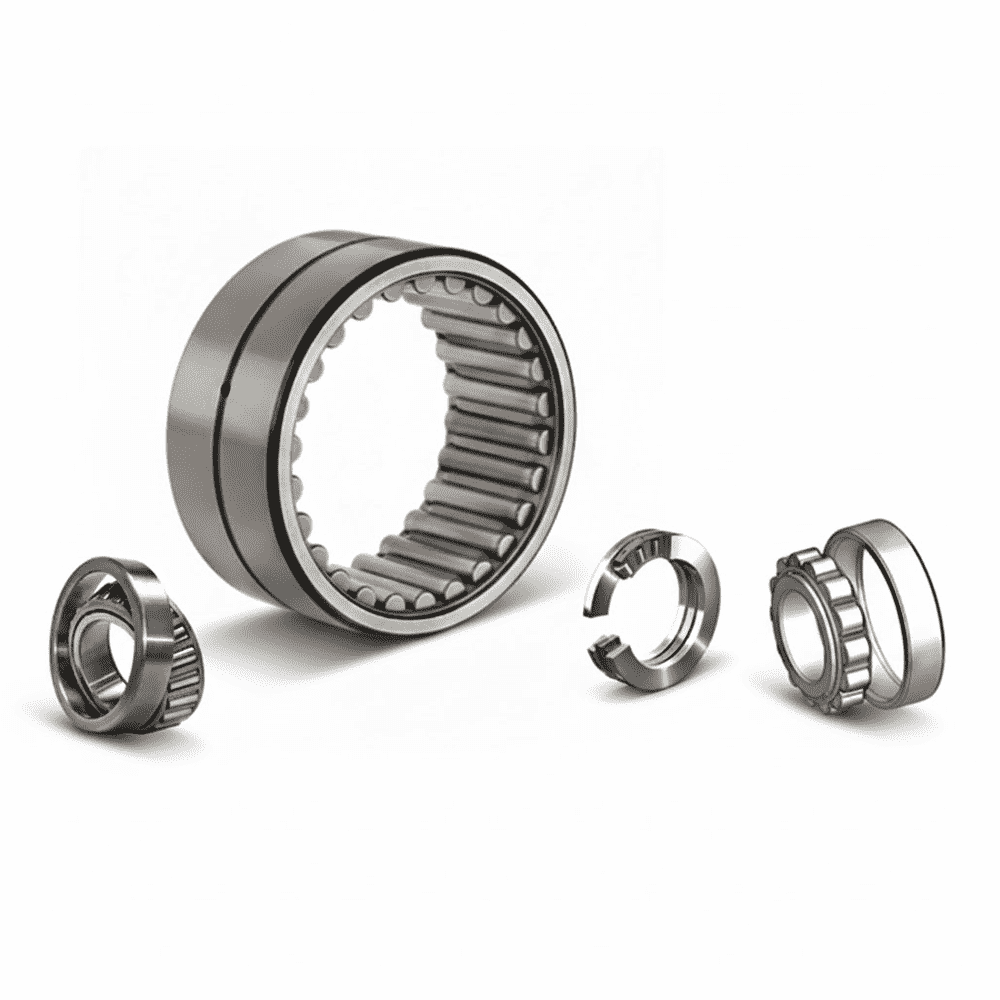
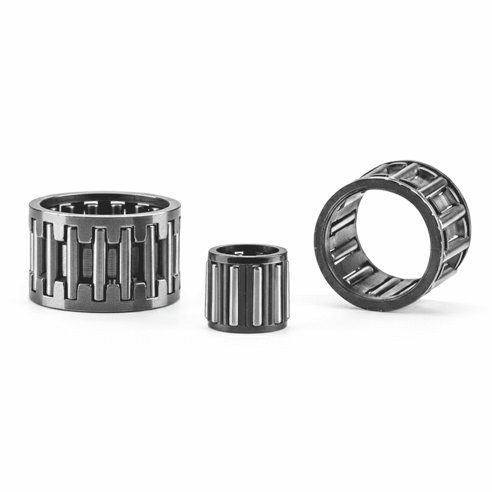
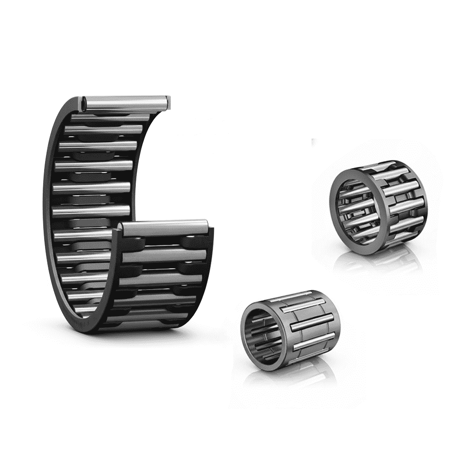
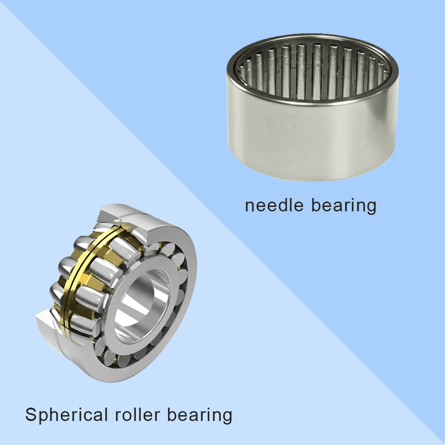
  • Needle Roller Bearings: These use extremely thin, long rollers (length-to-diameter ratio ≥ 4:1, often 10:1). They require the smallest radial space of any bearing type.
needle roller bearings
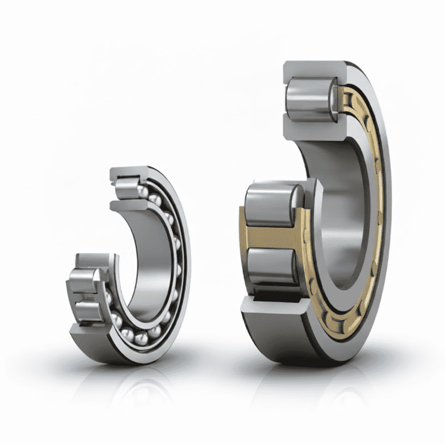
  • Cylindrical Roller Bearings: The workhorses for heavy radial loads. These use rollers with a length roughly equal to their diameter. They offer excellent radial load capacity and can accommodate higher speeds than most other roller types.

Cylindrical Roller Bearings

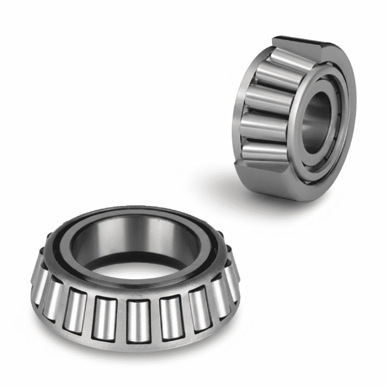
Tapered Roller Bearings
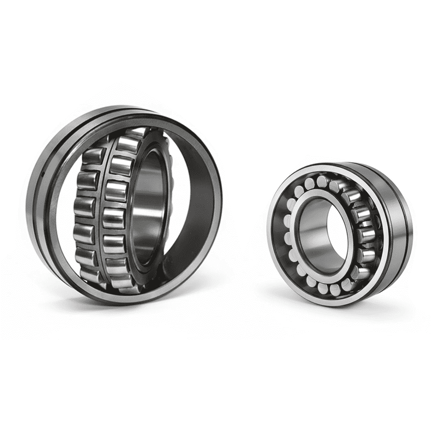
  • Spherical Roller Bearings: The heavy-duty champions with self-aligning capability. They accommodate shaft misalignment up to 2-3 degrees thanks to barrel-shaped rollers running on a spherical outer raceway. These are essential in heavy industrial applications like mining equipment and large gearboxes.

Spherical Roller Bearings

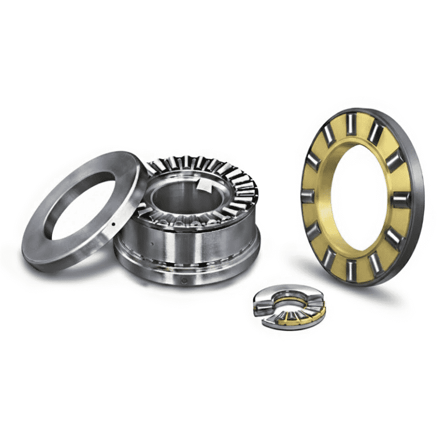
Thrust Roller Bearings

A Note on Specialized Designs:

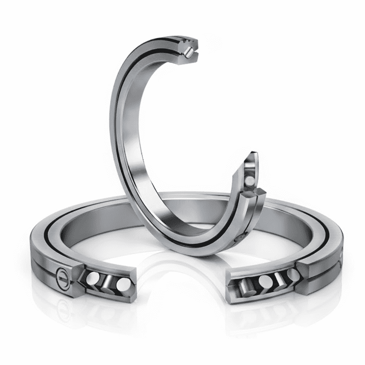
The five types above cover the majority of industrial applications. In applications demanding exceptional precision, rigidity, and multi-directional load capacity (e.g., robot joints, rotary tables), cross roller bearings provide a specialized solution.

cross roller bearings-1


Needle Roller Bearings: Deep Dive


Design Characteristics and Construction

The defining feature of a needle roller bearing is its slender, needle-like cylindrical rollers.

By design standard, these rollers have a length at least three to four times their diameter, with ratios of 4:1 to 10:1 being common.

For instance, a needle roller might have a diameter of only 2 mm but a length of 12 mm, achieving an aspect ratio of 6:1.

This geometry allows for a bearing assembly with a minimal radial cross-section.

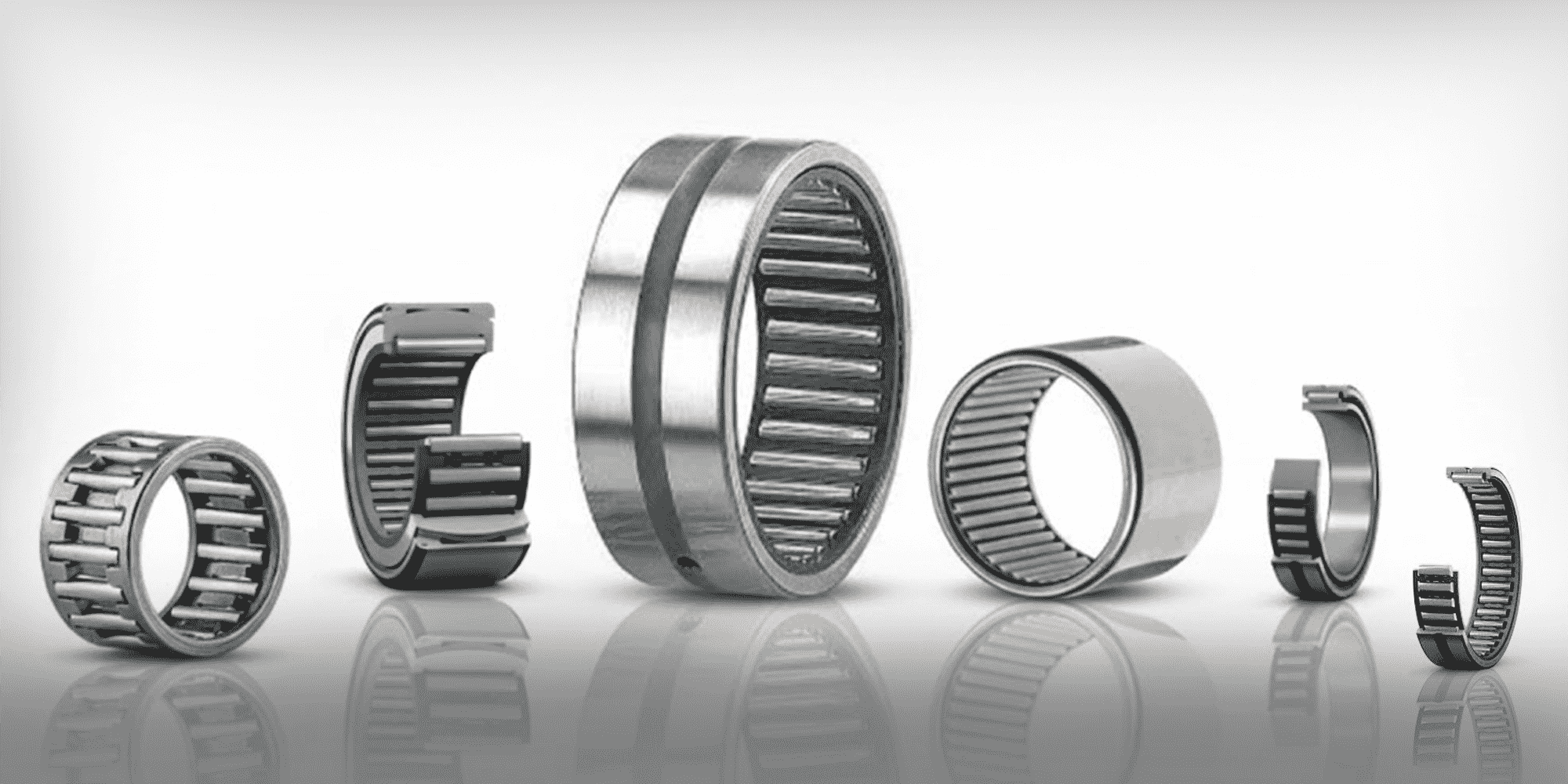
They come in several configurations to suit different mounting scenarios:

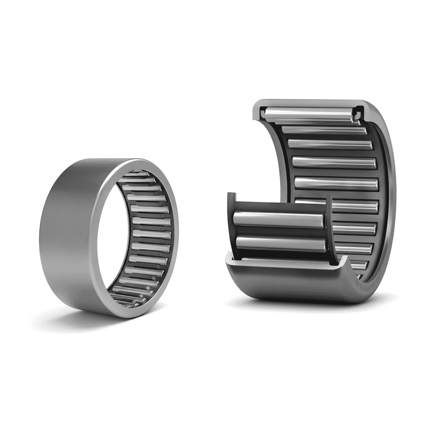
Drawn Cup Needle Bearings

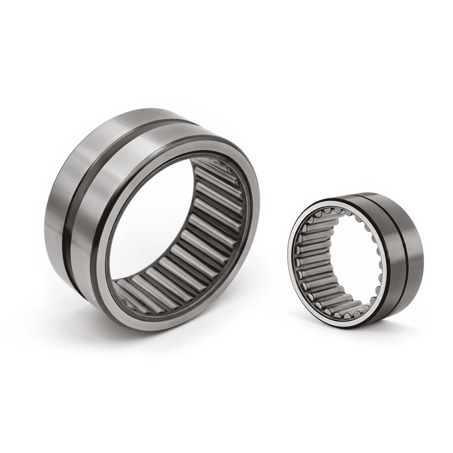
Machined Ring Needle Bearings

Cage and Roller Assemblies


Key Advantages and Strengths

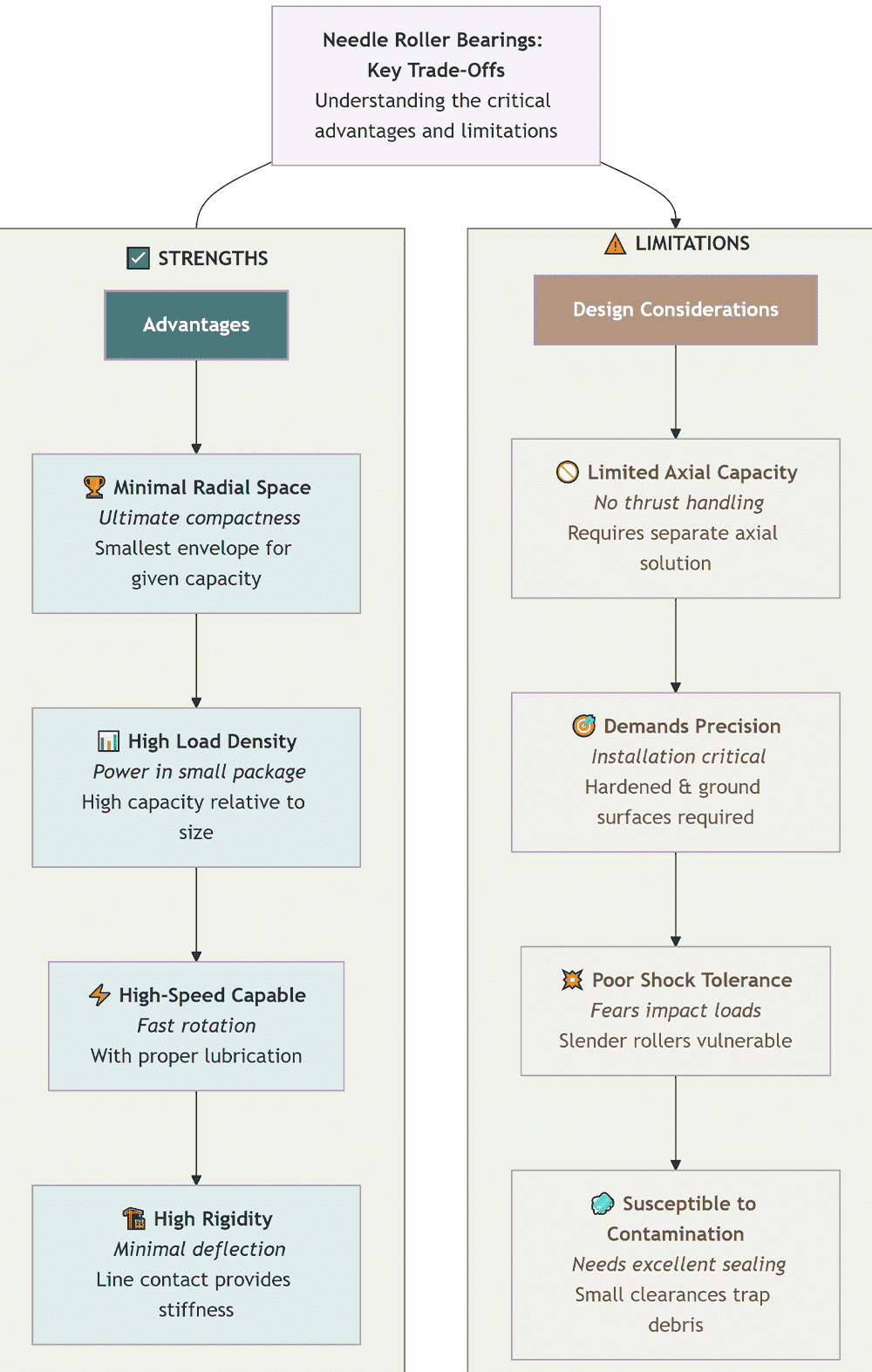
  • Minimal Radial Space: This is their paramount advantage. They allow for drastic downsizing of housing dimensions, enabling lighter and more compact machinery.
  • High Load Capacity Relative to Size: Despite their small size, they offer a high radial load density. They can support significant loads within their constrained footprint.
  • High-Speed Performance: With proper lubrication, certain designs can operate effectively at high rotational speeds.
  • High Rigidity and Precision: The line contact and numerous rollers provide good stiffness and minimize deflection under load.


Limitations and Design Considerations

  • Limited Axial Load Capacity: Standard needle bearings cannot handle substantial thrust loads. Axial guidance requires special washers or combined designs.
  • High Sensitivity to Installation Accuracy: Successful installation requires precise alignment, smooth surface finish, and proper hardness on shaft and housing surfaces. Edge loading caused by misalignment can lead to premature failure.
  • Poor Performance with Shock Loads: Unlike robust roller types, slender rollers cannot withstand heavy impact or vibratory loads.
  • Sensitivity to dirt: Compact design and small clearances allow dirt to enter easily, so effective sealing is essential.

advantages and limitations of needle bearings


Needle vs. Roller Bearings: Which Bearing Fits Your Design?

Scan this table for the core trade-offs. Your first question: Is my design driven by space or by performance?


Quick Reference Comparison Table

Feature

Needle Roller Bearings

Cylindrical Roller Bearings

Tapered Roller Bearings

Spherical Roller Bearings

Primary Load

Radial only

Radial (some axial variants)

Combined (Radial & Axial)

Radial & Moderate Axial

Space Efficiency

Excellent (Thinnest section)

Good

Moderate

Poor (Larger cross-section)

Speed Capability

High

Excellent

Medium

Medium

Misalignment Tolerance

Extremely Low (Requires precision)

Low

Low

Excellent (Self-aligning)

Installation Complexity

High (Precision fit critical)

Medium

High (Requires setting)

Medium

Relative Cost

Low

Medium

Medium-High

High

Best For...

Compact spaces, linkages, transmissions

Machine tool spindles, electric motors

Wheel hubs, gearboxes, heavy radial and axial loads

Misaligned shafts, heavy machinery, vibrating screens


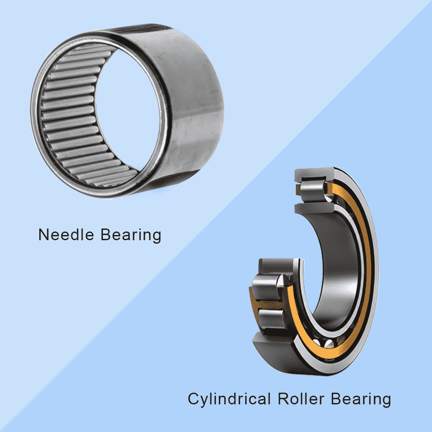
Needle vs. Cylindrical Roller Bearings

This is the most common "either-or" scenario for designers facing radial load challenges.

  • Load & Space Trade-off: The choice is fundamental. Choose needle bearings when radial space is critical and you need maximum load in minimal space (e.g., transmission gears). Choose cylindrical roller bearings when space allows and you prioritize ultimate load capacity, speed, or easy installation.
  • Speed & Friction: Both suit high-speed applications. Cylindrical roller bearings with cages typically achieve higher maximum speeds through superior roller guiding and reduced friction.
  • Axial Load: Standard designs of both handle little to no axial load. Special flanged or double-flanged versions exist for both types to provide axial location.

Needle vs. Cylindrical Roller Bearings-1


Needle vs. Other Roller Types

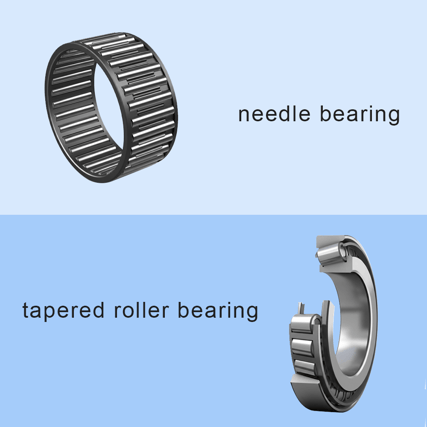
  • Needle vs. Tapered: This is a comparison of a radial-only specialist vs. a combined-load expert. If your application involves significant thrust loads, use tapered roller bearings—never needle bearings.
Needle vs. Tapered Roller Bearings
  • Needle vs. Spherical: This pits precision against forgiveness. A needle bearing demands perfect alignment for a long life. A spherical bearing will happily accommodate misalignment caused by mounting errors, shaft deflection, or runtime loads, making it ideal for long shafts or "dirty" industrial environments.

Needle vs. Spherical Roller Bearings


Application-Based Selection Guide


When Needle Roller Bearings Are the Optimal Choice

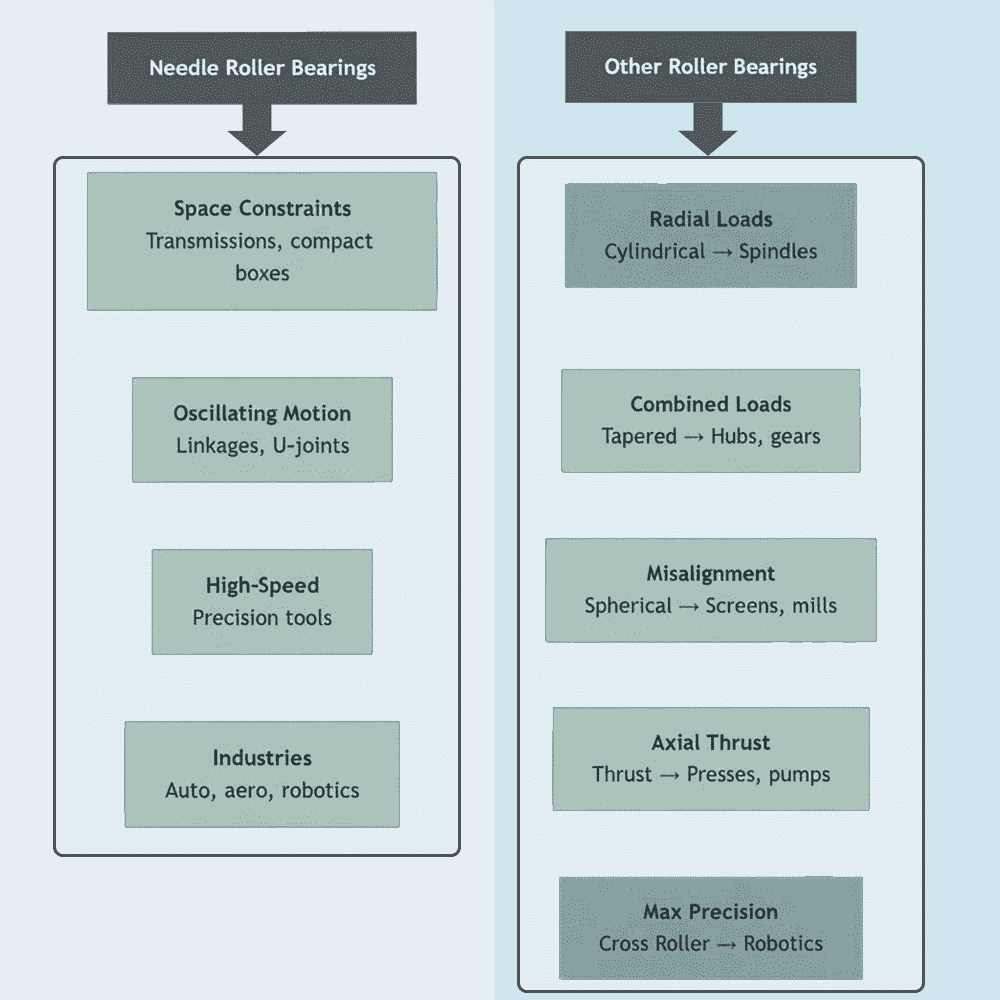
Select needle bearings when your design is driven by one or more of the following factors:

  • Extreme Radial Space Constraints: Planetary gear sets, automotive transmissions, compact gearboxes, and hydraulic pumps.
  • Oscillating Motion: Linkages, rocker arms, and universal joint crosses where the bearing doesn't complete full rotations.
  • High-Speed, Precision Applications: Certain machine tool components, precision spindles where space is limited.
  • Industry Applications: Automotive (transmissions, U-joints), Aerospace (actuators), Robotics (compact joints), and Packaging Machinery.


When Other Roller Bearings Are More Suitable

  • Heavy Radial Loads (ample space): Use cylindrical roller bearings in machine tool spindles, large motors, and industrial gearboxes.
  • Combined Radial and Axial Loads: Use tapered roller bearings in wheel hubs, differentials, conveyor rollers, and heavy gearboxes.
  • Shaft Misalignment or Deflection: Use spherical roller bearings in vibrating screens, textile machinery, marine shafts, and rolling mills.
  • High Axial Thrust Loads: Use thrust roller bearings in screw presses, vertical pumps, and crane hooks.
  • For Maximum Precision in Compact Spaces: When your design cannot compromise on rigidity and rotational accuracy under multi-directional loads (e.g., robotics, precision stages), consider cross roller bearings. 

Application-Based Selection Guide


Technical Selection Factors and Best Practices


Load Calculations and Bearing Life

All bearings have a Basic Dynamic Load Rating (C) used to calculate L10 life. L10 life represents the operating time at which 90% of bearings survive under a given load (P).

The fundamental life equation is:

L10 = (C/P)^p (where p=10/3 for roller bearings).

Critical Consideration for Needle Bearings: Published (C) ratings assume ideal conditions:

  • Perfect alignment
  • Proper hardness of adjacent parts (typically 58-64 HRC)
  • Excellent lubrication

Deviations—especially misalignment causing edge loading—drastically reduce actual bearing life below calculated L10.

For cylindrical and spherical bearings, the life calculation is generally more robust for typical industrial mounting.


Installation and Maintenance Considerations

This is the make-or-break phase for needle bearings. Their performance is highly sensitive to correct installation.

  • Housing and Shaft Specifications: They require hardened (and often ground) shafts and housings. Using them on a soft shaft is a guaranteed path to rapid failure via brinelling.
  • Geometric Tolerances: Strict control of bore and shaft roundness, taper, and alignment is non-negotiable.
  • Lubrication: While all bearings need proper lubrication, the compact space in needle bearings can make re-lubrication challenging. Grease selection and sealing are paramount. Other roller bearings often offer more generous space for lubricant reservoirs and re-lubrication features.


Conclusion: Making the Right Choice

The needle bearings vs roller bearings debate has one answer: it depends on your primary constraint. Choose needle roller bearings to win in extreme radial space. Choose cylindrical, tapered, or spherical roller bearings to win in raw load capacity, combined loading, or misalignment forgiveness.

Your Quick-Answer Checklist:

  • Space-Critical? → Needle Bearing.
  • Load-Critical or Thrust/Misalignment? → Other Roller Bearing.
  • Can you afford precision mounting? If no, reconsider Needle.

Stuck between close specs? Get a confident design review. Get a free bearing selection consultation from LILY Bearing‘s engineers today.


What Are Needle Bearings? Compact, High-Capacity Design

What Are Needle Bearings? Compact, High-Capacity Design

Designing compact machinery? You face a key trade-off: supporting substantial radial loads in severely limited space. Needle bearings solve this...

Read More
Needle Bearings in Robotics: Achieving Torque Density and Precision

Needle Bearings in Robotics: Achieving Torque Density and Precision

In the world of robotics, the glory usually goes to the complex code and the vision systems. Flashy end-effectors also often take the spotlight. At...

Read More
What Are Bearings and Their Functions?

What Are Bearings and Their Functions?

Bearings are often unseen, yet they play a fundamental role in ensuring the smooth and efficient functioning of countless machines, devices, and...

Read More