

 Robert
Ball Bearings vs. Roller Bearings
 William : Aug 27, 2025 11:02:19 PM
Bearings are essential parts of machines and equipment. They reduce friction, making it easier for parts to move smoothly. Two main types of bearings
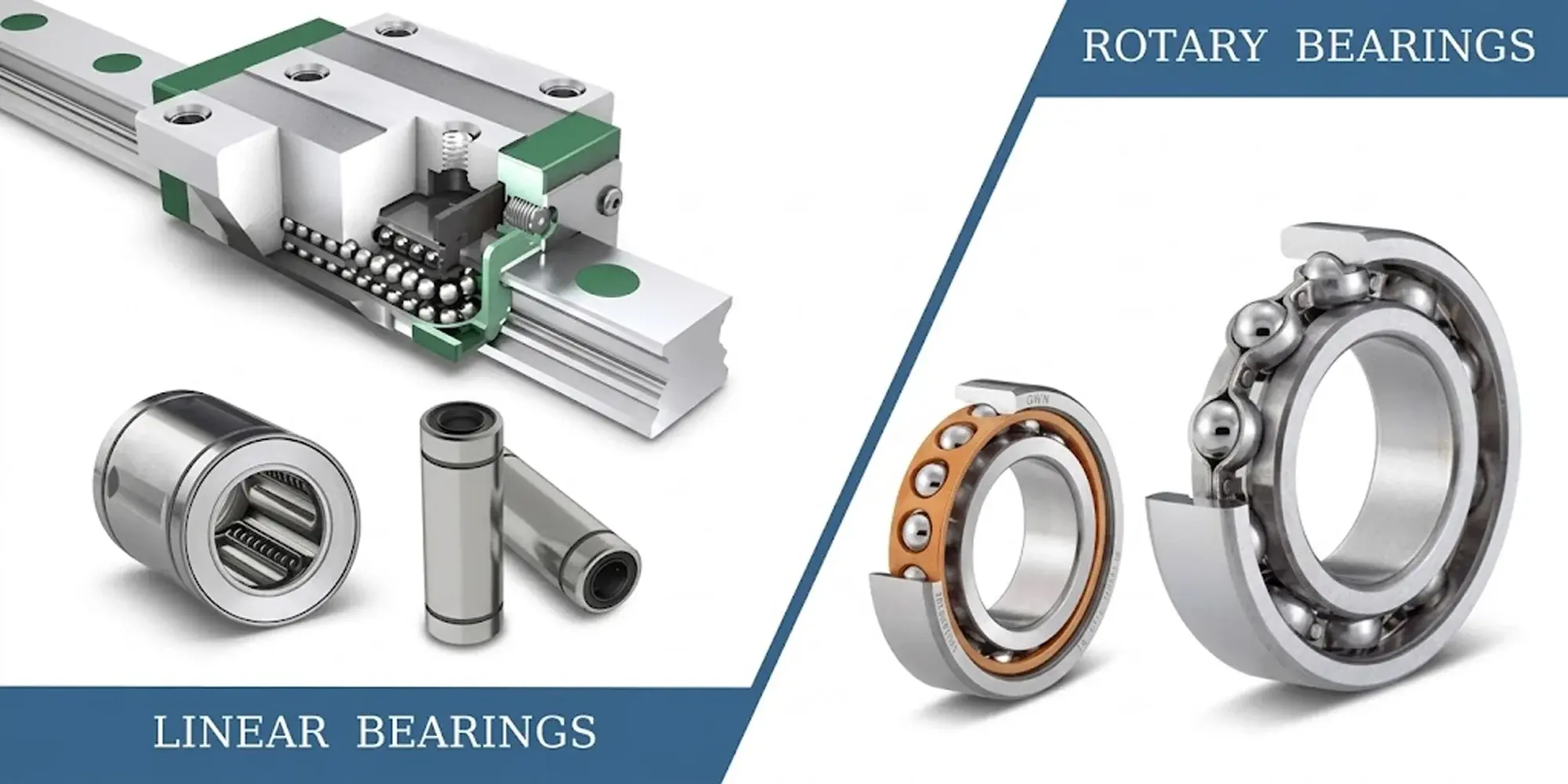
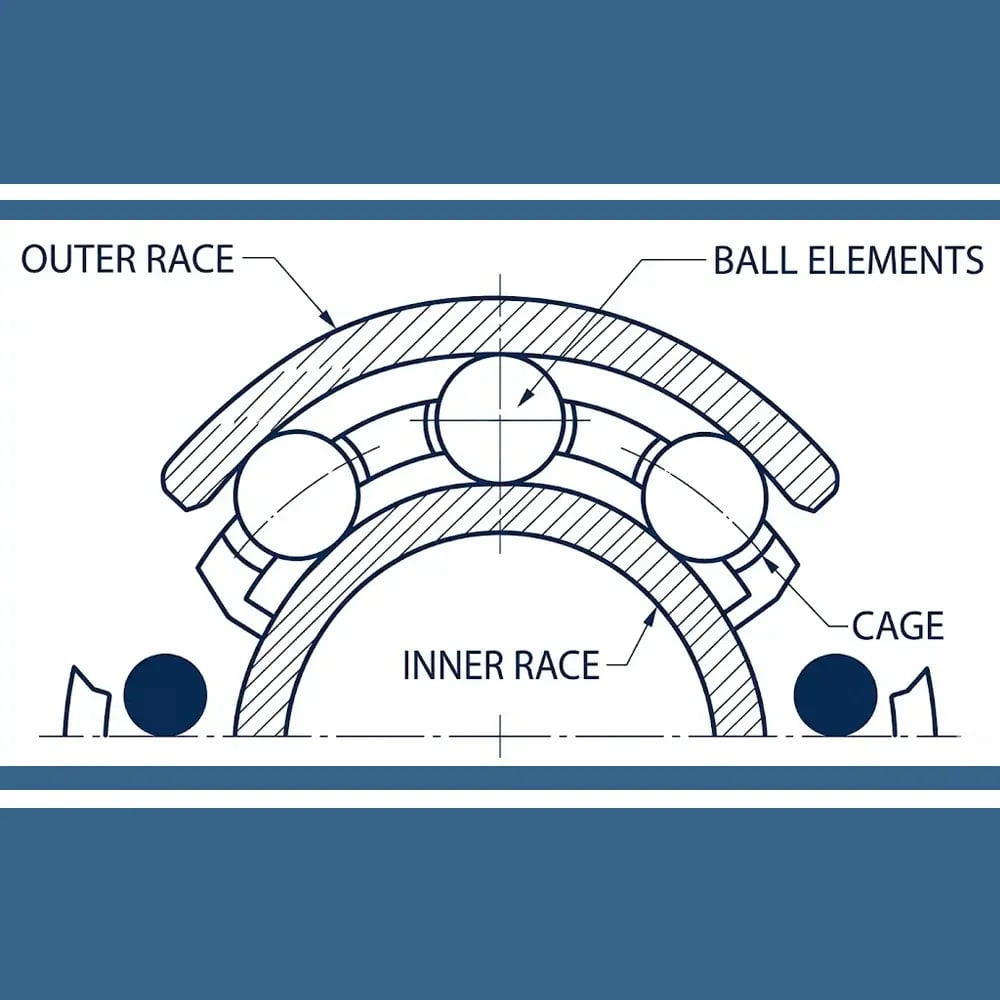
At a glance, both types have rolling elements, raceways, and load ratings.
But put a rotary bearing in a linear application and you'll have a failed machine — sometimes within hours.
These two product categories solve completely different motion problems, and understanding why matters whether you're buying, designing, or troubleshooting.
Rotary bearings support rotating shafts. The inner race spins relative to the outer race. Think motor spindles, wheel hubs, pump shafts, gearbox outputs — anywhere one component rotates relative to another.
Linear bearings support translating (sliding) components. A carriage moves back and forth along a shaft or rail. Think CNC axes, 3D printer beds, drawer slides, injection mold ejectors — anywhere something moves in a straight line.
%20vs%20rotary%20ball%20bearing%20spinning%20in%20place%20(right)%20%E2%80%94%20illustrating%20the%20fundamental%20difference%20in%20motion%20type.webp?width=1000&height=1000&name=Linear%20bearing%20carriage%20translating%20along%20a%20rail%20(left)%20vs%20rotary%20ball%20bearing%20spinning%20in%20place%20(right)%20%E2%80%94%20illustrating%20the%20fundamental%20difference%20in%20motion%20type.webp)
Some designs combine both — some combination bearings handle simultaneous rotation and linear translation — but they're specialized products, not the default.
For a full overview of linear bearing types and brands, see our Top 10 Linear Bearing Brands Guide.
Rotary bearings are classified by the load direction they handle well:
Linear bearings are designed for transverse loads — forces perpendicular to the direction of travel.
A profiled rail carriage (see our linear guide selection) supports load in all four transverse directions: radial, reverse radial, and both lateral directions.
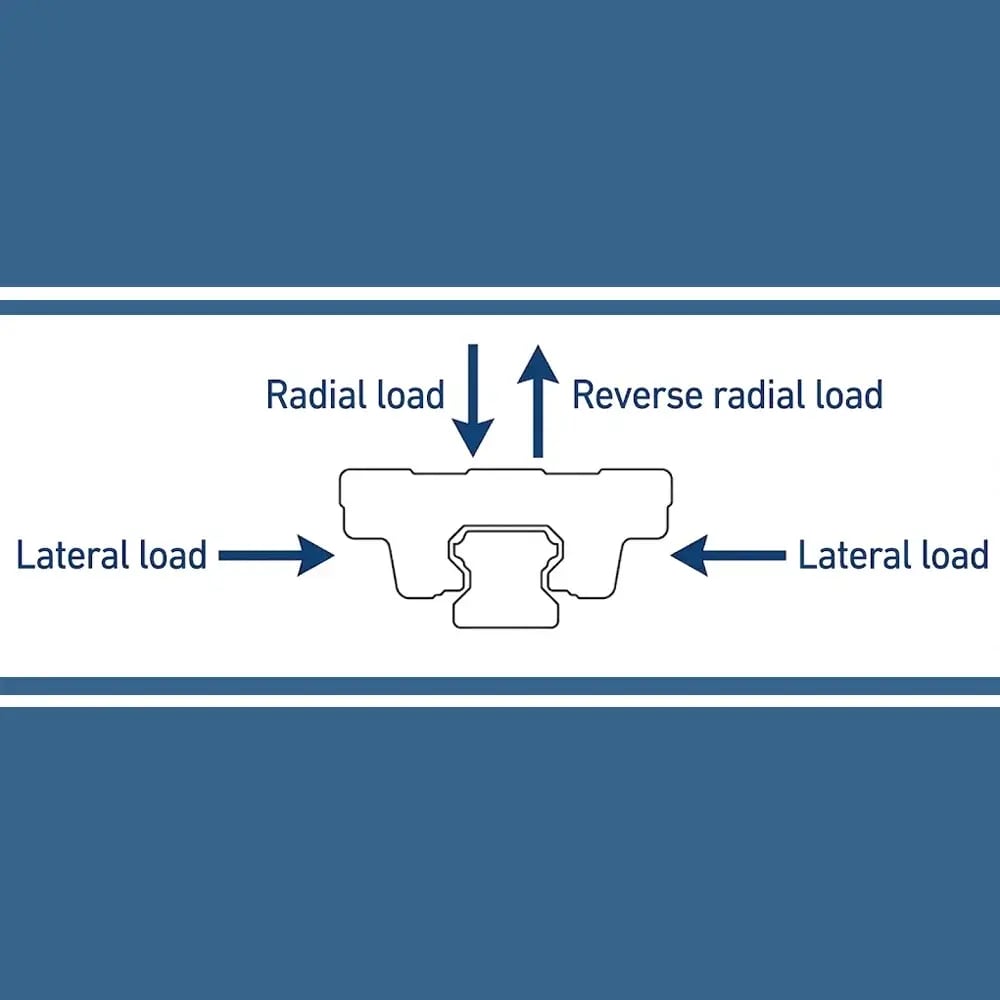
A round-shaft linear bearing (LMxxUU series) handles radial load only.
Rotary bearings can handle very high rotational speeds. A 6205 deep groove ball bearing runs comfortably at 10,000–15,000 RPM. Angular contact bearings in machine tool spindles routinely exceed 20,000 RPM. The motion is continuous and load distribution is consistent.
Linear bearings are rated by velocity, not RPM. Most standard recirculating ball linear guides handle 1–2 m/s continuous travel speed. High-speed variants push that to 3–5 m/s.
Polymer plain bearings can reach up to 3 m/s under light loads at room temperature, though speed limits drop significantly under heavy load or elevated temperature. Always check the manufacturer's pv (pressure × velocity) limit for your specific conditions.
Rotary bearings are preloaded axially (via locknut or interference fit) or radially (through housing bore tolerance). Preload eliminates internal clearance and increases stiffness.
Linear bearings are preloaded by adjusting the fit between rolling elements and raceways. A light preload (class C0) leaves a small amount of clearance — low friction but some positional play. A medium preload (C1) eliminates clearance.
For precision positioning, preload selection is critical. A C1 preload on a 25mm profiled rail carriage increases rigidity by roughly 40% compared to C0, at the cost of about 20% more friction force.
Rotary bearings:
Deep groove ball bearing friction coefficient is typically 0.001–0.003. Tapered roller bearings run 0.003–0.005.
Linear bearings:
Recirculating ball profiled guides run μ = 0.003–0.005 — comparable to rotary bearings. Round-shaft ball bearings (LMxxUU) run slightly higher at 0.004–0.008. Polymer plain bearings run 0.05–0.15 dry — 10–50× higher friction, but zero lubrication required.
Always use the manufacturer's actual friction coefficient for your specific product when sizing a motor or actuator — not a generic estimate.
Rotary bearings are typically grease-packed at the factory. A lightly loaded, slow-running bearing might go 3–5 years between grease intervals.
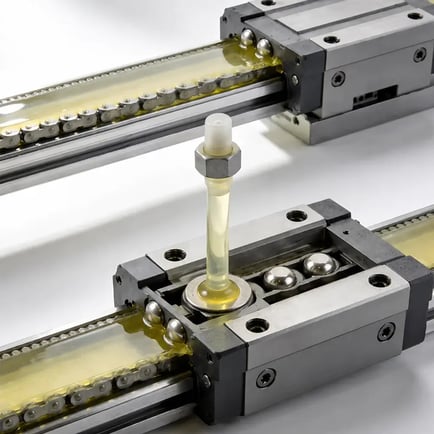
Linear bearings require more frequent lubrication in most cases. High-speed CNC linear guides often use automatic oil lubrication systems that deliver 0.01–0.05 mL per 1,000 mm of travel. Infrequent lubrication is one of the leading causes of premature linear bearing failure — see our Noise & Failure Guide for diagnosis and prevention details.
Exception: self-lubricating polymer plain bearings run completely dry, with solid lubricant embedded in the polymer matrix.
Both types use L10 life — the travel or operating time at which 10% of a population is statistically expected to have failed. For background on how L10 is defined, see the Wikipedia article on rolling-element bearings.
Rotary bearings calculate life in hours:
Where C = dynamic load rating (N), P = equivalent dynamic load (N), n = rotational speed (RPM). Standard rotary bearings in moderate service: 20,000–50,000 operating hours.
Linear bearings calculate life in kilometers of travel:
Per standard; ISO 14728 uses a 100 km baseline — always check your manufacturer's documentation.
Worked example — 25mm profiled rail carriage (C = 10 kN) at P = 5 kN:
That number surprises engineers the first time they see it. Linear bearing life is often much shorter than rotary bearing life in high-cycle applications — which is why maintenance planning matters.
No. There is no application where you can substitute a rotary bearing for a linear bearing, or vice versa. The geometry, load paths, and motion types are fundamentally incompatible.
Cam followers and track rollers — these are rotary bearings used as linear guide components. The roller itself spins (rotary motion) but translates along a track (linear motion). The bearing is still rotating.
Linear ball bearings on round shafts — the LMxxUU bearing looks vaguely like a sleeve, but it contains recirculating ball elements internally. It is definitively a linear bearing.
Linear-rotary combination bearings — these genuinely combine both motions. They're rare, expensive, and used in applications like pick-and-place heads.
Get the motion type right first.
Unsure which bearing type fits your application?
Tell us your stroke, load, speed, and precision requirement in the comments, and we can point you in the right direction.
No. The geometry and load paths are fundamentally incompatible. A rotary bearing in a linear application will fail quickly — sometimes within hours.
Most recirculating ball guides need relubrication every 100 km of travel. High-speed CNC applications typically use automatic oil systems. Exception: self-lubricating polymer plain bearings run completely dry.
It depends on load and travel rate. A standard 25mm profiled rail carriage at half its dynamic load rating, running 30 cycles/min on a 100 mm stroke, gives roughly 1,100 operating hours — much shorter than most engineers expect.
Profiled rails handle load in all four transverse directions and suit precision or high-moment applications. Round-shaft bearings (LMxxUU) handle radial load only — simpler, cheaper, good for light-duty use.
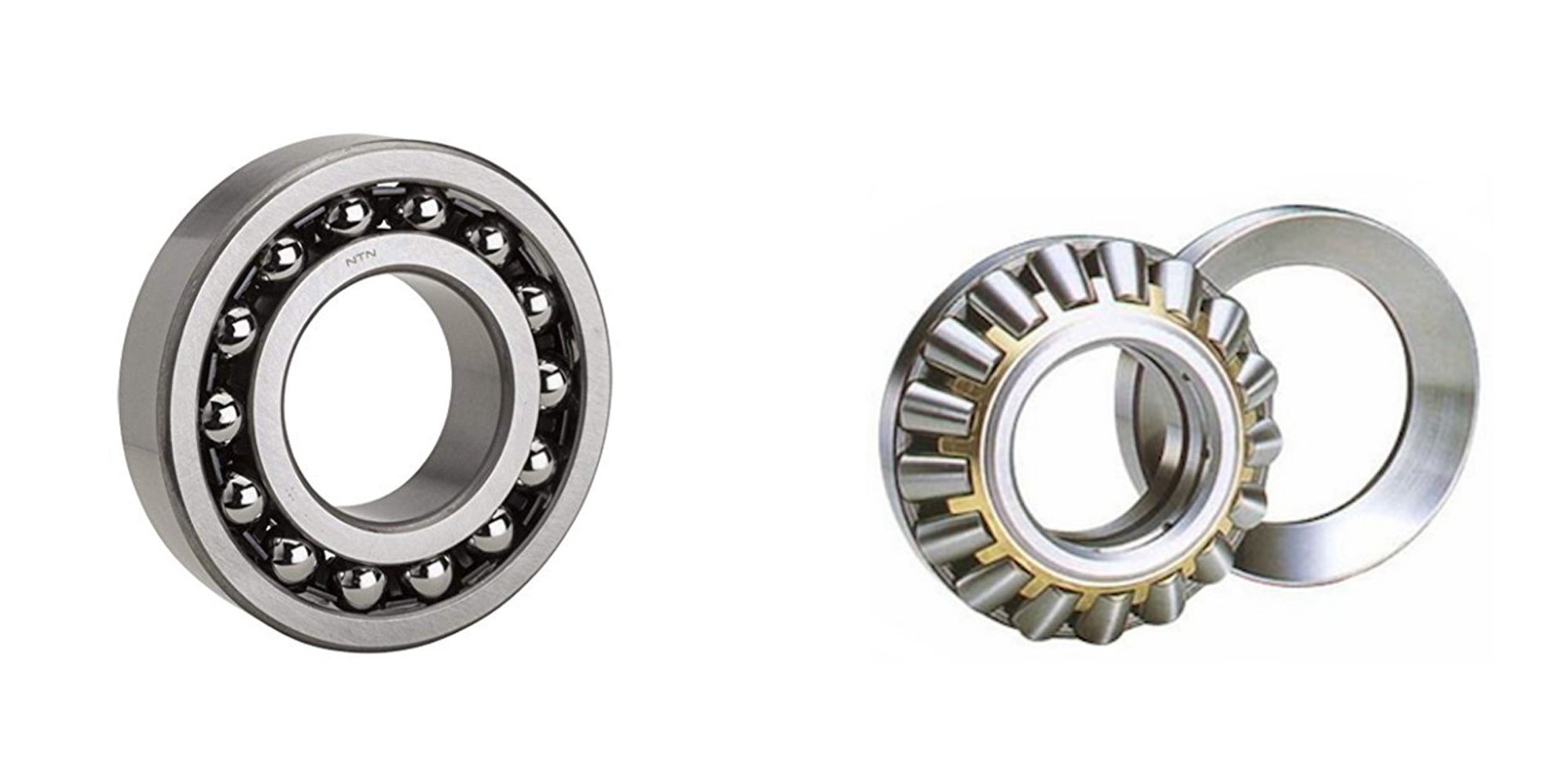 William : Aug 27, 2025 11:02:19 PM
Bearings are essential parts of machines and equipment. They reduce friction, making it easier for parts to move smoothly. Two main types of bearings
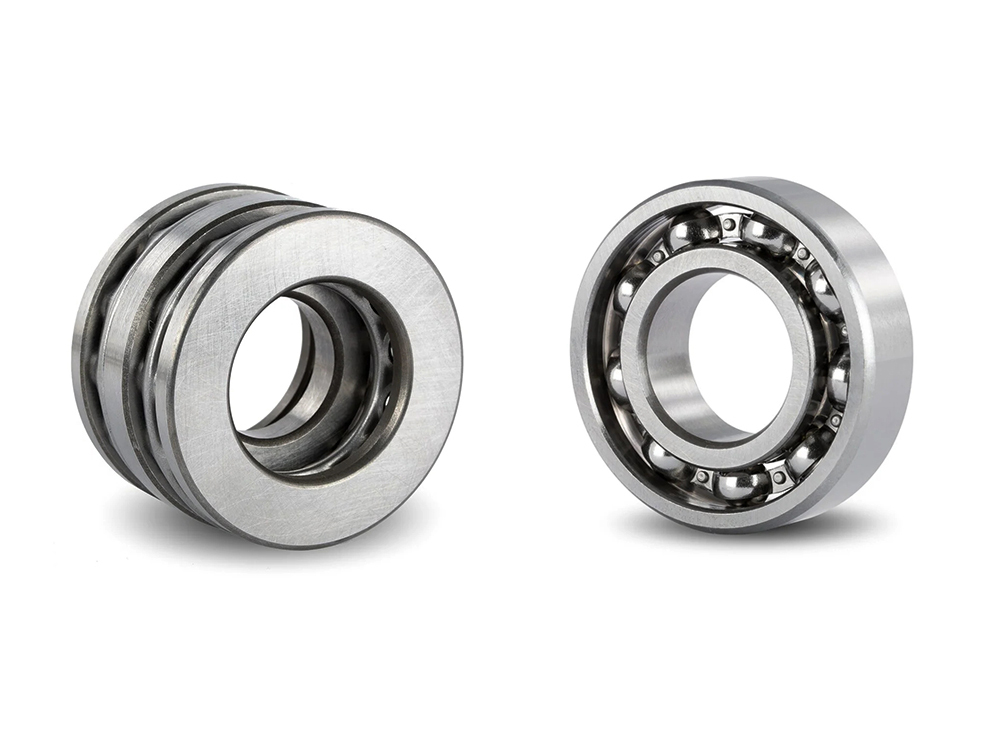 William : Aug 27, 2025 1:43:38 AM
In the world of machinery, ball bearings play a pivotal role. They reduce friction and ensure smooth operation of various mechanical systems. But did...
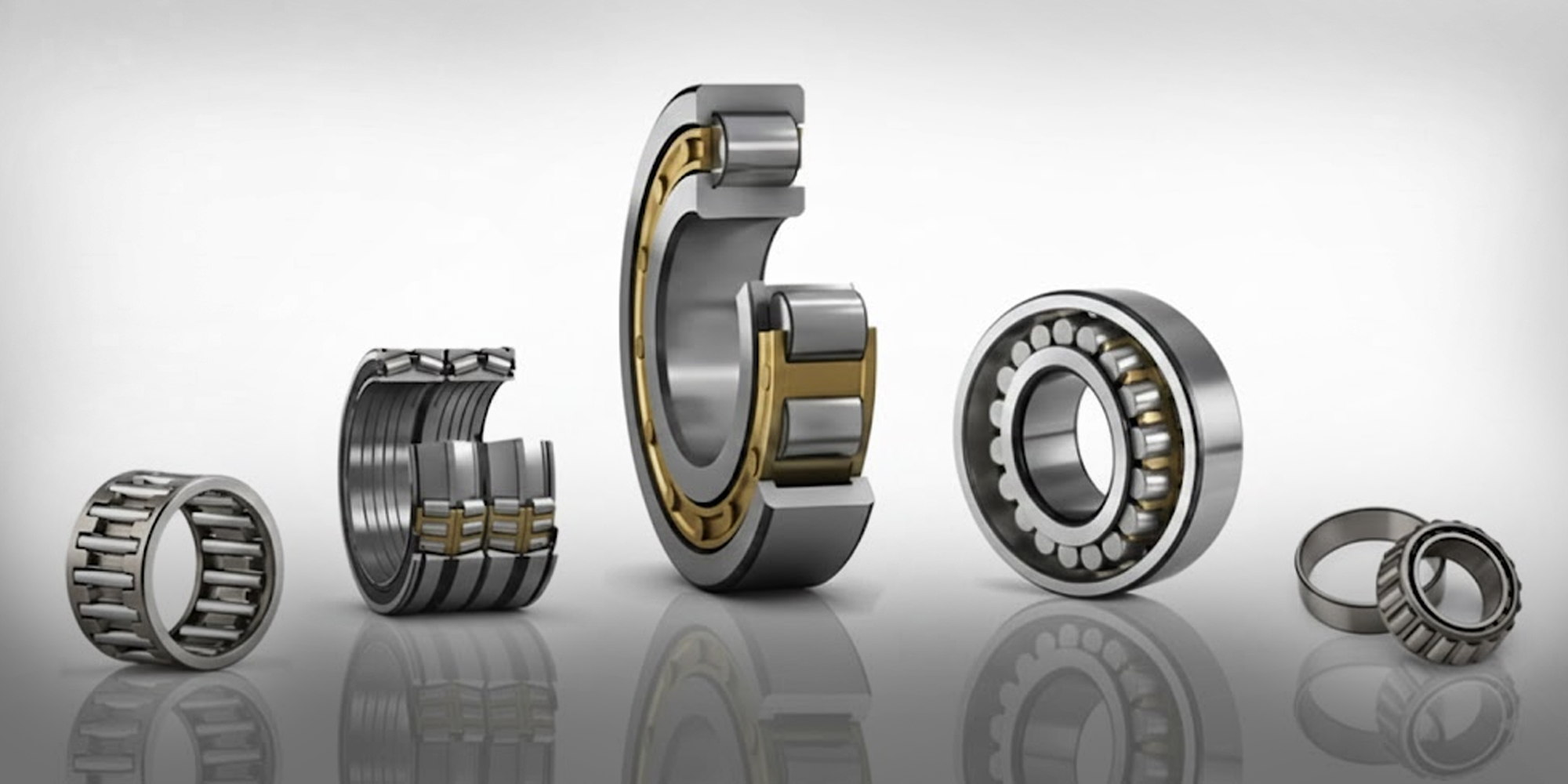 William : Dec 10, 2025 10:15:32 PM
Can you fit a bearing with 35,000N load capacity in a 30mm radial envelope? The answer is no for cylindrical roller bearings, but yes for needle...