

Home/
Blog/
Linear Bearings: Ball vs. Roller — How to Choose

5 min read

Linear Bearings: Ball vs. Roller — What Actually Matters When You Choose

Linear Bearings: Ball vs. Roller — What Actually Matters When You Choose
Linear Bearings: Ball vs. Roller — How to Choose
11:24


Both ball and roller linear bearings carry loads along a shaft. Their internal geometry — point contact vs. line contact — determines speed capability, rigidity, noise level, and price. Here is what the numbers tell you, and how to pick the right type for your application.

What Is a Linear Bearing?

A linear bearing is a machine element that constrains motion to a single axis while minimizing friction.

It rides on a hardened, ground shaft — typically EN31 or SUJ2 bearing steel — and can sustain millions of reciprocating cycles without measurable wear under correct lubrication.

The two dominant internal designs, ball and roller, start from the same concept but diverge sharply in the physics of contact.

Key distinction

Ball bearings create point contact with the shaft. Roller bearings create line contact. That single geometric difference drives nearly every trade-off discussed below.

Infographic 1 — Contact geometry: how each type works
Linear ball bearing
Six circular balls arranged evenly around a central shaft. Red dots mark the single point where each ball contacts the shaft. Shaft
Point contact
Contact: Single point per ball
Max speed: 1–3 m/s
Load range: ~500–5,000 N
Friction μ: 0.002–0.004
Cost: Lower
Linear roller bearing
Four rectangular rollers arranged around a central rectangular rail. Red lines mark the full line contact between each roller and the rail face. Rail / shaft
Line contact
Contact: Full line across roller
Max speed: 0.5–1.5 m/s
Load range: ~2,000–50,000 N
Friction μ: 0.003–0.008
Cost: Higher

Load Capacity: Why Contact Geometry Changes Everything

Hertzian contact theory explains the gap directly.

A sphere pressed against a cylinder produces a contact patch measured in fractions of a millimeter.

A cylinder pressed against a flat rail produces a contact patch that runs the full length of the roller, typically 10–25 mm.

Spread the same force across a larger area, and peak contact stress drops substantially, extending fatigue life under the same load.

In practical terms: a standard LM20 linear ball bearing (20 mm bore, 32 mm OD) carries a dynamic load rating of roughly 1,100 N.

A comparably sized roller-guide carriage on the same shaft class routinely handles 5,000–8,000 N.

That 4–7× difference is not marketing — it is geometry.

Infographic 2 — Radial load capacity: same bore class
Two vertical bars. Ball bearing bar reaches roughly 1100N. Roller bearing bar reaches 5000-8000N, approximately five times taller. 0 2,000 4,000 6,000 N ~1,100 N ~5,000–8,000 N Linear ball LM20, 20 mm bore Linear roller Same bore class 4–7× load capacity

Dynamic C rating, illustrative comparison. Actual values vary by manufacturer and series.

Moment load matters equally.

Roller bearings distribute that moment across a longer contact patch and often across multiple roller rows, maintaining stiffness when the load is eccentric or cantilevered.

Ball bearings deform more readily under the same moment, which shows up as positional error in precision gantries or axis stages.

Speed, Friction, and Precision

Point contact carries less material at once, so it generates less heat per stroke. That is why linear ball bearings tolerate higher velocities.

Manufacturer catalogs typically rate linear ball bearings for 1–3 m/s continuous stroke velocity; linear roller units are usually derated to 0.5–1.5 m/s depending on roller diameter and preload.

Ball recirculating bearings exhibit coefficients of friction in the range of 0.002–0.004 — roughly half that of a plain sleeve bearing.

Roller linear systems typically fall between 0.003 and 0.008 depending on preload class.

At high duty cycles or in battery-powered equipment, that difference adds up over millions of strokes.

Positional accuracy in linear motion depends on how much the bearing deflects under load. Roller bearings win here.

Line contact distributes load across a larger area, which means the Hertz deflection — the tiny elastic deformation at the contact interface — is smaller for the same applied force.

In semiconductor wafer handling, high-precision CNC, and laser positioning systems, that submicron difference matters.

Infographic 3 — Where each type is used
Linear ball bearing
Load < 2,000 N  |  Speed > 0.5 m/s  |  Cost-sensitive
3D printers & CNC routers
Laboratory instruments
Light-duty robotics
Pick-and-place automation
Sliding drawer & positioning rigs
Linear roller bearing
Load > 2,000 N  |  High rigidity  |  Precision-critical
CNC machining centers
Automotive stamping presses
Pharma packaging lines
Semiconductor wafer stages
Heavy industrial gantries

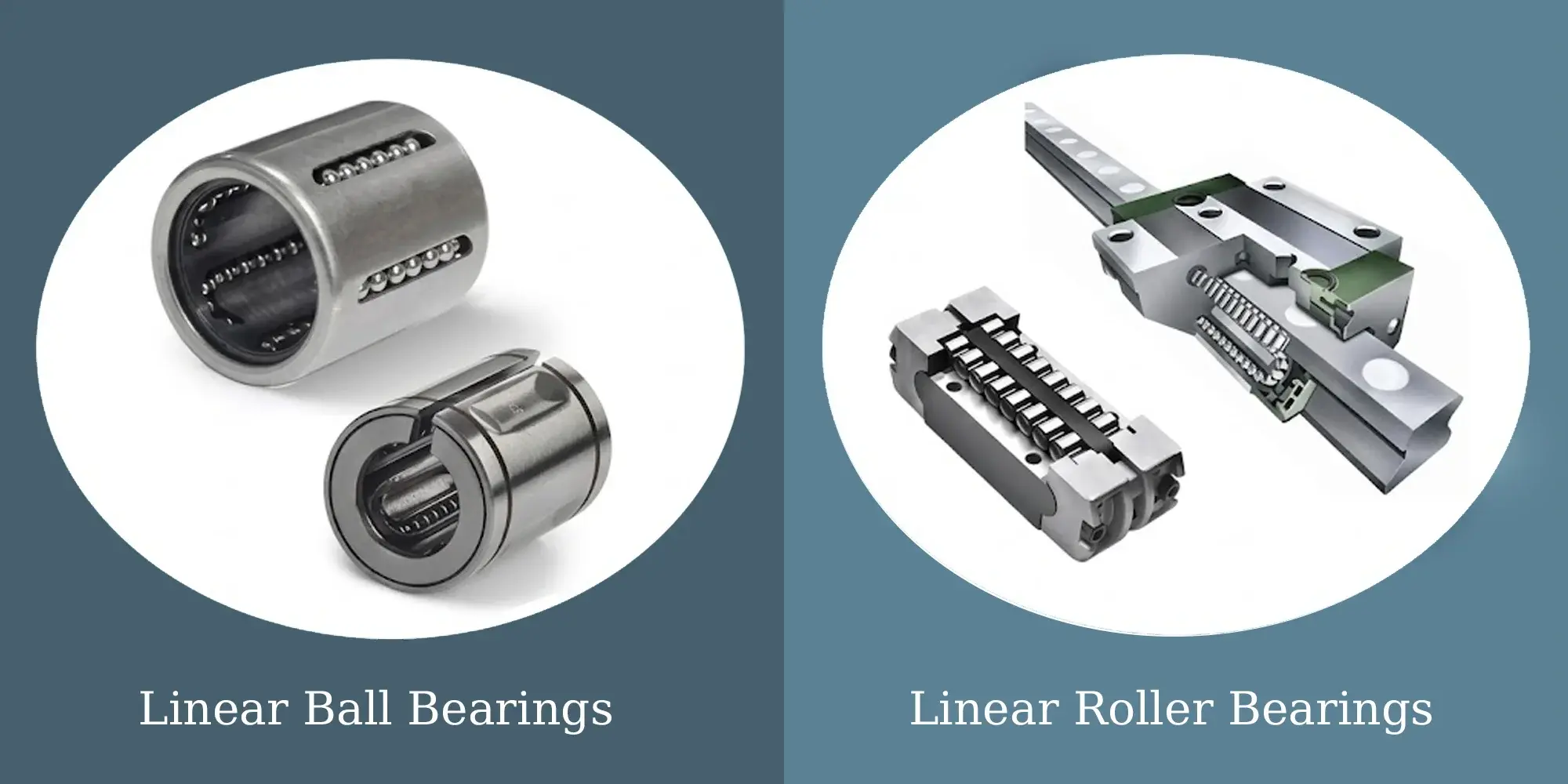
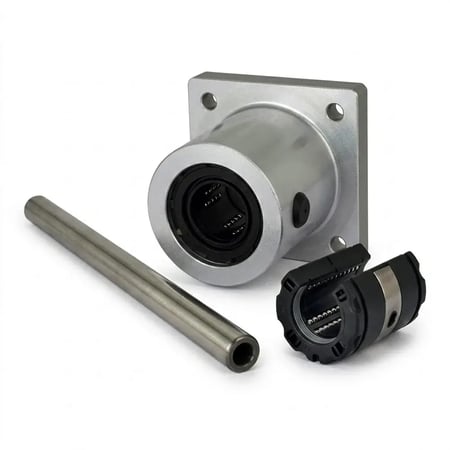
Linear ball bearings suit applications where load stays under ~2,000 N and stroke speed exceeds 0.5 m/s — they fit a standard round shaft directly, which simplifies both design and maintenance.

Linear Ball Bearings

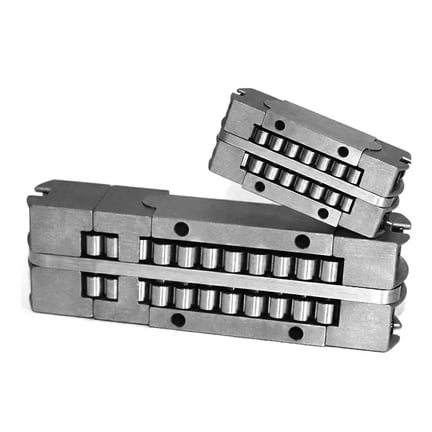
Linear roller bearings are the correct choice once load, rigidity, or precision requirements move beyond what ball-type geometry can sustain.

Linear Roller Bearings

Noise, Vibration, and Environmental Tolerance

Ball recirculating bearings produce an audible, repetitive tick at each ball recirculation event.

At low speeds the sound is slight; at high duty cycles it becomes a characteristic hum.

Roller bearings tend to run quieter at comparable speeds, making them preferable in medical devices and laboratory automation where acoustic cleanliness matters.

Contamination tolerance differs significantly.

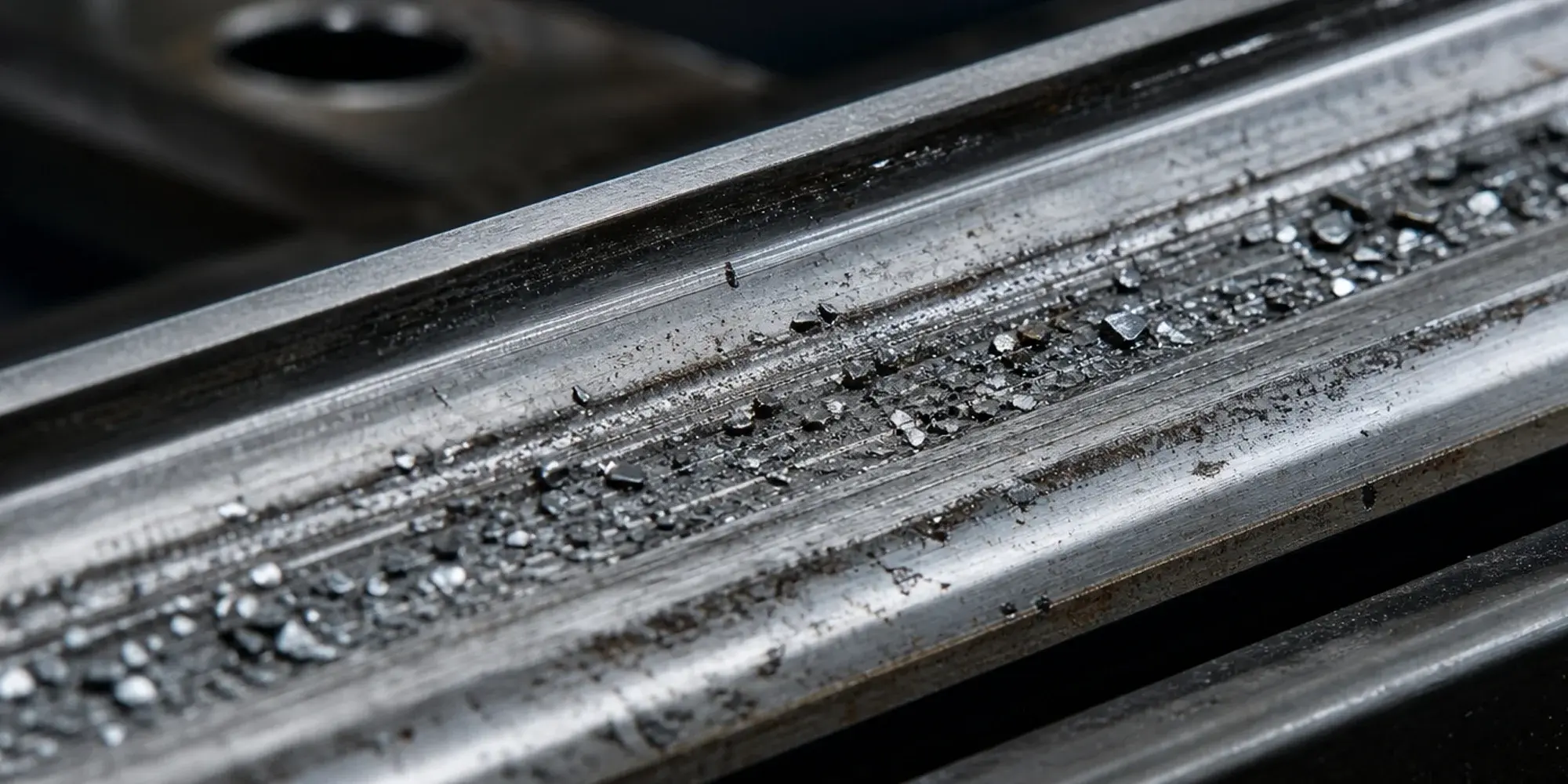
Ball bearings running on precision-ground shafts require filtered lubricant and sealed housings — a single particle of grit large enough to sit in a ball groove can score the raceway and fail the bearing in hours.

Roller bearing arrangements — particularly open profiled rail systems — often have larger sealing lips and clearances that shed or bypass minor contamination.

For wash-down environments or open industrial settings, this shifts the calculation.

Side-by-Side Comparison

Parameter Linear ball bearing Linear roller bearing
Contact type Point contact Line contact
Dynamic load (C) ~500–5,000 N ~2,000–50,000 N
Max stroke velocity 1–3 m/s 0.5–1.5 m/s
Friction coefficient (μ) 0.002–0.004 0.003–0.008
Rigidity Moderate High
Noise (mid-speed) Low to moderate Low
Moment load handling Limited Good to excellent
Shaft/rail requirement Hardened, ground round shaft Profiled rail or round shaft
Best suited for Speed, light load, cost budget Load capacity, stiffness, precision
Infographic 4 — Quick selection flowchart
Three-step decision tree. Step 1: Is radial load above 2000N? Step 2: Is stroke speed above 1.5 m/s? Step 3: Is submicron precision or high moment load required? Roller bearing wins on high load and precision; ball bearing wins on high speed and light loads. Start here Know your application Radial load > 2,000 N? Yes Roller bearing No Speed > 1.5 m/s? Yes Ball bearing No Submicron precision or moment load? Yes Roller bearing No Ball bearing LM-series, round shaft

Lubrication and Maintenance

Both types require periodic lubrication — typically a lithium-based grease (NLGI Grade 2) or a light machine oil for high-speed applications.

A practical starting point for most industrial applications is every 100–500 km of travel or every 6 months, whichever comes first.

Contamination is the leading cause of premature failure in both types.

If particulate ingress is unavoidable — foundry environments, woodworking, food processing — consider lip-sealed variants and evaluate whether a plain polymer bushing or crossed-roller guide might outlast either option in your specific conditions.

The relationship between Hertzian contact stress and rolling element bearing fatigue life is covered in depth in the NASA Technical Reports Server review on rolling bearing life prediction (Zaretsky, 2016).

Frequently Asked Questions

Can a linear ball bearing be replaced with a roller bearing on the same shaft?

Not directly, in most cases. Standard linear ball bearings (LM series) run on precision ground round shafts. Most linear roller bearing systems use profiled rails with a different carriage interface. Some cylindrical roller linear bearings do exist for round shafts, but they are less common and typically larger in envelope. Confirm the interface before specifying a replacement.

Which type lasts longer?

At equivalent loads, roller bearings last longer because line contact reduces peak Hertzian stress. At loads well within a ball bearing's rated capacity, however, an LM-series ball bearing can achieve L10 life beyond 10,000 km. Life is primarily a function of load ratio (actual load vs. rated C), calculated as L10 = (C/P)³ × 10&sup6; revolutions equivalent, adapted for linear stroke. Bearing type alone does not determine longevity.

Are roller linear bearings always more expensive?

Yes, in unit cost. Roller carriages and profiled rail systems require tighter manufacturing tolerances and more material. However, cost per kilonewton of load capacity can favor rollers in heavy-duty applications, since you may need multiple ball bearing units to handle the same load a single roller carriage manages. System cost — including shaft grinding, housings, and alignment — matters more than unit price alone.

What shaft material and tolerance do linear ball bearings require?

Most LM-series linear ball bearings specify a shaft ground to h6 or js6 tolerance, surface-hardened to HRC 58–64, in SUJ2 bearing steel (equivalent to AISI 52100 / EN31). Running on softer or un-ground shafting dramatically shortens bearing life and voids most manufacturers’ load ratings.

Can either type run without lubrication?

Standard steel-on-steel linear bearings — both ball and roller — require lubrication. Self-lubricating variants exist: polymer-cage ball bearings with embedded lubricant and PTFE-lined options for cleanroom or food-contact environments. Expect a load rating reduction of 30–60% versus the lubricated value and confirm compatibility with your cleanliness requirements before specifying.

Linear Guides vs. Linear Bushings vs. Dovetail Slides

Linear Guides vs. Linear Bushings vs. Dovetail Slides

Introduction: Why Linear Motion Choice Matters Every machine that moves in a straight line relies on a linear motion system — from the most delicate...
Read More
Linear Guide: Key Factors That Influence Linear Rail Costs

Linear Guide: Key Factors That Influence Linear Rail Costs

For purchasing engineers or equipment manufacturers, the cost of linear motion guides is a key consideration when selecting products. However, the...

Read More
Linear Bearing Noise & Failure: Causes, Diagnosis & When to Replace

Linear Bearing Noise & Failure: Causes, Diagnosis & When to Replace

A linear bearing that's failing doesn't always give you much warning. Sometimes it starts with a subtle grinding sound at one end of the stroke. ...

Read More