

Sprocket Types and Sprocket Ratio Selection Guide
A $50 sprocket mistake can cost you $50,000 in downtime. Incorrect sprocket selection is the leading cause of premature chain failure. This single...
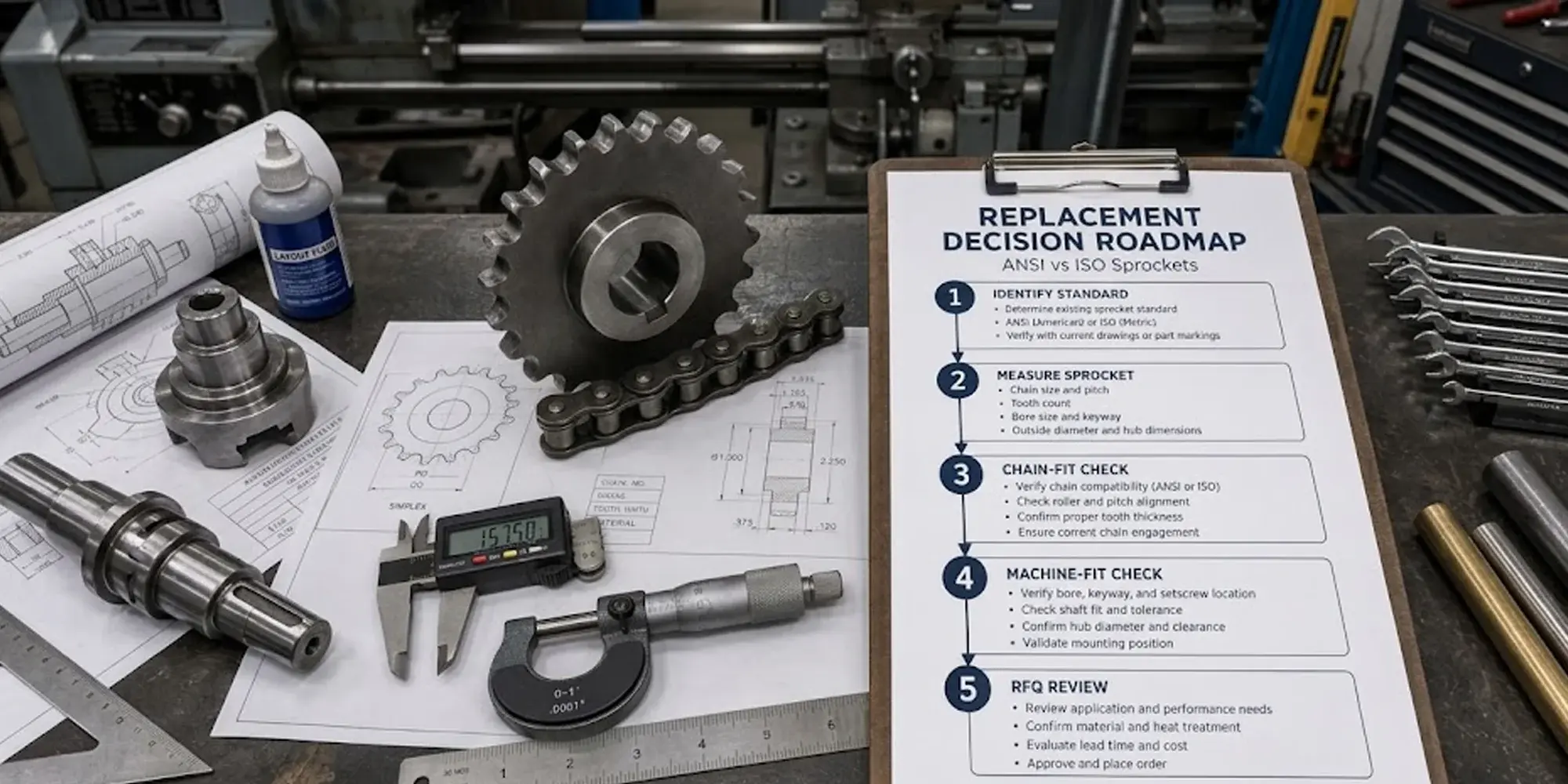
Table of Contents
If you've been riding for a while, you've probably heard someone say "go smaller on the sprocket for more speed" — and walked away wondering: smaller which sprocket? The answer is completely different depending on which one you're talking about.
A smaller rear sprocket increases top speed.
A smaller front sprocket does the opposite — it raises the gear ratio and cuts top speed while boosting acceleration.
Mixing these two up is probably the most common gearing mistake riders make.
This article is focused on motorcycle chain-drive systems, where the principle is easiest to illustrate.
The same gear ratio physics apply directly to industrial chain drives — conveyors, packaging lines, agricultural equipment — though industrial systems bring additional variables like multi-strand chains, ANSI/ISO pitch standards, and load ratings that go beyond a simple tooth swap.
Every chain-drive motorcycle has two sprockets connected by a roller chain. The front (drive) sprocket sits on the engine's output shaft. The rear (driven) sprocket mounts to the wheel hub. The size relationship between the two — called the final drive ratio — determines how many times the engine turns for each full wheel rotation.
Fitting a smaller rear sprocket lowers the final drive ratio. At any given engine RPM, the rear wheel rotates faster, pushing the bike to a higher speed before hitting the rev ceiling.
What changes with a 15T front / 45T → 42T rear swap:
| Stock (45T rear) | Modified (42T rear) | |
|---|---|---|
| Final Drive Ratio | 3.00 | 2.80 |
| Ratio change | — | -6.7% |
| Theoretical top speed gain | — | ~6–7% |
| Acceleration off the line | Baseline | Noticeably softer |
If the stock bike tops out at 100 mph in ideal conditions, you're looking at roughly 106–107 mph theoretically — provided the engine has enough power to pull the taller gearing to redline. On underpowered bikes, an overly tall ratio just creates a sluggish top end that never fully opens up.
What you give up:
Acceleration. With a lower ratio, the engine has less mechanical leverage over the wheel. Off-the-line feel gets softer. For highway riding, open tracks, or long-distance touring, this trade-off is usually worth it. For city traffic or circuit riding, it generally isn't.
A smaller front sprocket raises the final drive ratio — the opposite of a smaller rear.
Because the front sprocket is smaller, each tooth represents a larger percentage of the total. Dropping the front by just 1 tooth has roughly the same gearing effect as adding 3–4 teeth to the rear. Changes happen fast, so it's easy to overshoot.
What you gain: Sharper acceleration, more torque at the wheel, better low-speed punch. This is why stunt riders and off-road racers almost always run smaller front sprockets.
What you lose: Top speed drops proportionally. Engine RPM runs higher at any given speed, which increases fuel consumption and often adds noticeable vibration on highway runs.
There's also a mechanical concern worth taking seriously: going smaller than stock on the front forces the chain to wrap around a tighter radius at every engagement point. This increases stress on each link and accelerates wear on both chain and sprocket. Most manufacturers recommend against going below stock front sprocket size for regular street use.
Changing the rear sprocket gives you finer, more predictable adjustments. On a 45T rear, each tooth is about 2.2% of the total — small, controllable steps. Rear sprockets typically cost $30–$80 for aftermarket steel.
Changing the front sprocket is cheaper ($15–$40) and has a bigger impact per tooth. Useful when you want a meaningful gearing shift, but comes with the chain wear caveat and the margin for error is smaller.
Every motorcycle chain has a pitch — the distance between roller pins — and a corresponding width. These are encoded in the chain's size number. The first digit refers to the pitch in eighths of an inch, and the last two digits indicate the inner width. When you swap sprockets, your new sprockets must match the chain pitch already on the bike.
| Chain Size | Pitch | Inner Width | Typical Application |
|---|---|---|---|
| 420 | 1/2" (12.7 mm) | 1/4" (6.35 mm) | 50cc–125cc, pit bikes |
| 428 | 1/2" (12.7 mm) | 5/16" (7.94 mm) | 125cc–250cc, small street |
| 520 | 5/8" (15.9 mm) | 1/4" (6.35 mm) | 250cc–600cc street, dirt, ATV |
| 525 | 5/8" (15.9 mm) | 5/16" (7.94 mm) | 600cc–900cc street bikes |
| 530 | 5/8" (15.9 mm) | 3/8" (9.53 mm) | Large displacement, cruisers |
A 530-pitch chain will not seat correctly on a 520-pitch sprocket — the fit will be sloppy and dangerous. The chain size is stamped on the outer side plates of your existing chain. If worn off, check your owner's manual.
A worn chain develops slightly elongated link spacing as pins and bushings wear down. Pairing a new sprocket with a stretched chain — or vice versa — means the two are never quite in sync. The mismatch accelerates wear on both components fast.
A well-maintained chain typically lasts 15,000–25,000 miles under normal street use. Riders who lubricate every 300–500 miles and maintain proper chain tension are consistently at the higher end. Neglect maintenance, and you can halve that — some chains show significant wear before 10,000 miles in dirty or wet conditions.
Budget for the full set when swapping. Parts typically run $100–$250. Steel rear sprockets last longer — typically 20,000–30,000 miles under normal use. Standard (non-anodized) aluminum sprockets wear significantly faster, often needing replacement in the 6,000–10,000 mile range, roughly half to one-third the lifespan of steel. Hard-anodized aluminum closes that gap considerably but still won't outlast a quality steel sprocket on the street.
Yes. Many motorcycles read speed from the countershaft area (near the front sprocket). Gearing up (smaller rear or larger front) typically causes the speedo to read higher than actual speed. Some aftermarket instruments allow recalibration; OEM units usually don't. Check before you ride on public roads.
Drop 2–3 teeth on the rear (e.g., 45T → 42T). Lower RPM at cruise speed, better fuel efficiency, higher theoretical top speed. Accept softer off-the-line feel.
Add 2–3 teeth to the rear or drop 1 tooth on the front. More punch at low speeds. Top speed drops, but you likely weren't using it anyway.
Stay within 1–2 teeth of stock in either direction. Small adjustments shift the balance without undoing the factory baseline.
For a deeper look at choosing the best overall sprocket setup, see What Sprocket Is Best for Speed?
Go more than 3 teeth away from stock on the rear, or below stock on the front, without also checking chain clearance, swingarm fit, and chain length.
Large rear sprocket changes reduce the chain's wrap angle around the front sprocket (chain contact arc), which increases stress per tooth and accelerates wear.
They also consume axle adjustment travel — push it too far and you run out of room to tension the chain correctly, or you need a different chain length altogether.
A smaller sprocket increases speed only when it's the rear one. Smaller rear = lower ratio = wheel spins faster = more top speed.
A smaller front sprocket raises the ratio, boosts acceleration, and reduces top speed. It also adds mechanical stress to the chain and shouldn't go below stock size for regular use.
If top speed is the goal: drop 2–3 teeth on the rear, calculate the ratio change first, replace the chain at the same time, and verify the chain pitch matches. One tooth at a time is the right pace for dialing in.
A smaller front sprocket increases acceleration by raising the final drive ratio. A smaller rear sprocket does the opposite — it lowers the ratio, improving top speed but making the bike feel slower off the line.
Most 150cc commuter bikes run 420 or 428 chain and come geared conservatively from the factory. For urban riding, adding 1–2 teeth to the rear improves low-speed response. For occasional highway use, dropping 1 tooth on the rear moves the balance the other way. Stick to 1-tooth changes at a time — on a small-displacement engine, the effect is more pronounced than on larger bikes.
Rear sprockets typically cost $30–$80 for aftermarket steel; front sprockets run $15–$40. A complete front + rear + chain kit runs $100–$250 for quality parts. Professional installation adds $60–$150 depending on the shop.
Modifying the drivetrain on a bike under manufacturer warranty can void coverage for related components. Check your warranty terms before making changes. On bikes out of warranty, it's a straightforward decision.
Look at the tooth profile. Healthy teeth are rounded and even.
Worn teeth develop a hooked or shark-fin shape — that's the signal to replace the full set before the chain starts skipping under load.
Also check the chain itself before fitting new sprockets.
Pull the chain taut and measure across 20 links (pin center to pin center). A new 520-pitch chain spans exactly 10 inches across 20 links (20 × 0.5").
If your measurement exceeds 10.2" — that's 2% elongation — the chain is at or past its service limit and must be replaced.
Per ANSI roller chain standards, chains should be retired at 1.5%–2% elongation to avoid accelerated sprocket wear.
A dedicated chain wear indicator tool makes this check faster and more reliable than a tape measure.
Need sprockets for an industrial application?
The gear ratio principles in this article apply equally to conveyors, packaging equipment, agricultural machinery, and other industrial chain drives. Lily Bearing stocks ANSI and metric roller chain sprockets — single-strand, double-strand, idler, and machinable-bore — built to ISO, ANSI, and DIN standards. Browse industrial sprockets →
A $50 sprocket mistake can cost you $50,000 in downtime. Incorrect sprocket selection is the leading cause of premature chain failure. This single...
ANSI and ISO sprockets follow different roller chain standard systems. For a buyer replacing a worn sprocket or sourcing a custom part, the...
In any power transmission setup, the relationship between the chain and the sprocket is symbiotic. While much attention is often given to chain...