

Home/
Blog/
Brushless vs Brushed DC Gear Motor: Efficiency, Life & Cost

6 min read

Brushless DC Gear Motor vs Brushed: A Complete Comparison

Brushless DC Gear Motor vs Brushed: A Complete Comparison
Brushless vs Brushed DC Gear Motor: Efficiency, Life & Cost
14:27

The choice between brushed and brushless DC gear motors shapes maintenance schedules, total cost of ownership, acoustic environment, and the complexity of your drive electronics. For applications running fewer than 500 hours per year, the difference is modest. For continuous-duty automation, medical devices, or precision robotics, it can mean the difference between a 2,000-hour motor replacement cycle and a system that runs a decade without touching the drivetrain.

Quick Answer

Brushed DC gear motors cost less upfront, work with simple controllers, and are easier to source in low volumes. Brushless (BLDC) gear motors offer 82–93% efficiency vs 70–85% for standard iron-core brushed designs, 3–5× longer service life, lower noise, zero brush maintenance, and better performance at high ambient temperatures. Choose brushless when duty cycle exceeds 40%, space is constrained, or reliability over 5,000+ hours is required.

This guide covers the mechanical and electrical differences, runs real efficiency and cost data, and maps each technology to the applications where it makes more sense.

LILY Bearing carries a range of gearmotors across different configurations if you're comparing options for a specific application.


How They're Built: The Core Difference

Both motor types convert electrical energy into rotational motion through electromagnetic interaction between a stator and rotor.

The fundamental difference is how commutation is handled — that is, how the current direction in the windings is switched to keep the rotor spinning.

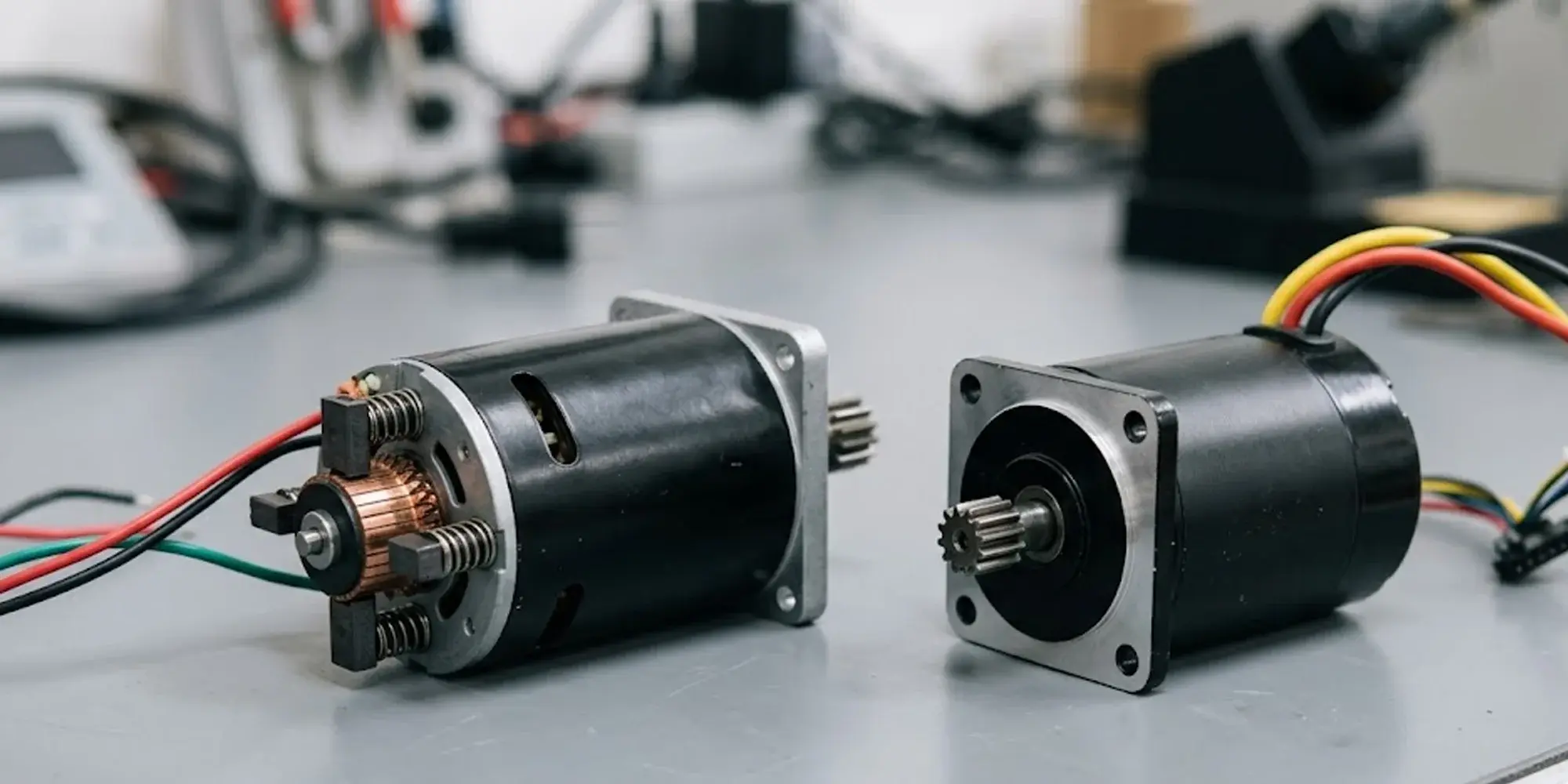
Internal Construction: Brushed vs Brushless
Brushed DC Motor
● Rotor (armature): carries the windings
● Stator: permanent magnets (fixed)
● Commutator: segmented copper ring on shaft
● Carbon brushes: spring-loaded, sliding contact
● Gear reduction stage
⚠ Brushes wear at 0.01–0.03 mm/hour under load
Brushless DC Motor
● Rotor: permanent magnets (spins)
● Stator: carries the 3-phase windings (fixed)
● Hall sensors or encoder: position feedback
● No commutator, no brushes
● External ESC / BLDC controller required
✓ Only bearings wear — service life 3–5× longer

The commutator-brush interface in a brushed motor introduces three failure modes that don't exist in a brushless design: brush wear (leading to eventual open circuit), commutator groove wear (leading to increased contact resistance), and arc-induced electrical noise (EMI).

Removing these three failure sources accounts for most of the lifetime advantage of brushless designs.

Efficiency: Where the Numbers Diverge

Motor efficiency is the ratio of mechanical output power to electrical input power.

Brushed motors add a fourth loss source beyond core losses, copper losses, and friction: brush contact resistance losses, typically 1–3% of input power, plus commutation switching losses that increase with speed.

Typical Efficiency at Rated Load — Same Power Class
Brushed DC, small frame (≤50W)70–78%
 
Brushless DC, small frame (≤50W)82–88%
 
Brushed DC, mid frame (50–200W)75–85%
 
Brushless DC, mid frame (50–200W)87–93%
 

Based on published manufacturer datasheets across multiple motor suppliers. Efficiency measured at rated load and rated speed.

A 10% efficiency advantage compounded over a continuous-duty cycle adds up fast.

A 100W brushed motor running at 78% efficiency draws 128W from its supply.

The brushless equivalent at 90% efficiency draws only 111W — 17W less, continuously.

Over 2,000 operating hours at an average $0.12/kWh electricity cost, that saves approximately $40 in energy alone, on top of reduced heat and extended bearing life.

Service Life and Maintenance

Expected Service Life Under Normal Operating Conditions
Brushed DC Gearmotor
1,000–
3,000
Hours (brush life)
⚠ Brush replacement required
Brushless DC Gearmotor
5,000–
15,000
Hours (bearing-limited)
✓ No brush replacement needed
Maintenance Cost Reality Check Carbon brush replacement for a typical NEMA 17–34 frame gearmotor takes 20–40 minutes of technician time plus $5–$20 in brush hardware. In a facility running 20 gearmotors on a single shift, that translates to 40–80 hours of maintenance labor per brush replacement cycle — a real operational cost that rarely appears in initial purchase price comparisons.

New and worn carbon brushes from a DC gear motor side by side, showing significant wear after extended use

Complete Specification Comparison

Brushed vs Brushless DC Gear Motor: Technical Parameters
Parameter Brushed Brushless
Efficiency (rated load) 75–85% 85–93% +10%
Brush Service Life 1,000–3,000 hrs N/A (no brushes)
Overall Motor Life 2,000–5,000 hrs 5,000–15,000 hrs
Torque Density Moderate 20–30% higher
Speed Range Limited at high RPM Wider, stable
EMI / Noise Brush arcing EMI Low EMI
Acoustic Noise 55–75 dB(A) 45–65 dB(A)
Controller Cost $2–$30 $15–$150
Motor Unit Cost (100W) $20–$80 $60–$200
Wiring Complexity 2-wire (simple) 3-phase + sensor wiring

Cost: Upfront vs Total Cost of Ownership

At the motor level, a quality 100W brushed DC gearmotor with a 30:1 ratio typically lists at $30–$80, while an equivalent brushless BLDC gearmotor runs $80–$200.

The controller differential adds another $10–$120. For a single prototype, that premium matters.

For a production system running continuous shifts, total cost of ownership tells a different story.

Cost Profile — 100W Gearmotor at 5-Year Horizon
Cost Item Brushed Brushless
Motor (100W) $30–$80 $80–$200
Controller $2–$30 $15–$150
Brush maintenance / year (1,500 hr cycle) $15 parts + 30 min labor ~$0
Energy (100W, 2,000 hrs @ $0.12/kWh) ~$31 (78% eff.) ~$27 (90% eff.)

Noise and EMI

For medical devices, laboratory automation, consumer appliances, and food processing equipment, acoustic noise and electromagnetic interference are engineering constraints, not afterthoughts.

Brush contact generates both.

Noise Comparison — Typical 50W Gearmotor at 1 Meter
Brushed DC Gearmotor
55–75
dB(A) typical range
● Brush-commutator friction
● Arc-generated audible noise
● Commutation ripple vibration
● Gear mesh noise
Brushless DC Gearmotor
45–65
dB(A) typical range
● Bearing noise only (low)
● Gear mesh noise
● Minimal commutation vibration
● PWM switching (ultrasonic)

A 10 dB(A) reduction is perceived by the human auditory system as approximately half as loud — significant in any shared workspace.

For explosive atmospheres classified under ATEX/IECEx zones 1 and 2, brush sparking is unacceptable and brushless or totally enclosed AC motors must be used instead.

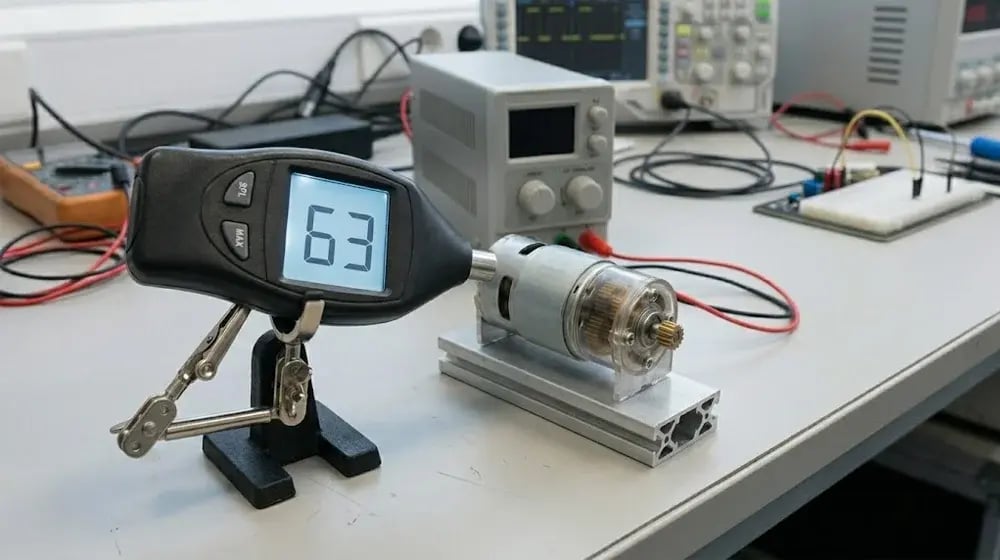
Sound level meter reading 63 dB next to a running DC gear motor in a laboratory setting

Torque Density and Speed Control

For the same motor frame size, brushless designs achieve 20–30% higher continuous torque density.

Windings are on the stator in a BLDC motor, in direct contact with the outer housing, making heat rejection far more effective than the rotating armature windings of a brushed design.

Higher allowable winding temperature (Class F or H insulation at 155–180°C) combined with better cooling translates directly to higher current density and therefore higher torque from the same frame volume.

Brushless systems with Hall sensor feedback maintain smooth, linear torque delivery down to near-zero speed — critical for precision positioning in medical, semiconductor, and robotics applications.

Brushed motors exhibit brush contact resistance dead-band at low PWM duty cycles, causing velocity instability at very low speeds.

Application Matching Guide

Application Matching Guide
Brushed DC is a better fit for…
→ Low-volume prototyping and one-off machines
→ Duty cycles under 20–30% (intermittent use)
→ Applications where controller simplicity matters
→ Budget-constrained consumer products under 50W
→ DIY automation and maker projects
Brushless is clearly the better fit for…
→ Continuous or high-duty-cycle industrial automation
→ AGVs, mobile robots, and collaborative robots
→ Medical devices (low noise, no contamination risk)
→ Food processing (brush particle contamination unacceptable)
→ Applications requiring 5,000+ hours between service

A Note on Brushless Gear Motor Controllers

Today, integrated BLDC driver ICs (Texas Instruments DRV8313, STMicroelectronics STSPIN series) handle 3-phase commutation, current limiting, and Hall sensor decoding in a single $3–$8 chip.

Off-the-shelf BLDC controllers for 24V / 10A systems are now widely available from $15–$50, with CAN or RS-485 interfaces for easy integration into automation networks.

Sensorless BLDC Control Modern sensorless BLDC controllers use back-EMF zero-crossing detection instead of Hall sensors, eliminating the sensor wiring harness and simplifying the motor cable to three power wires. This works well above roughly 10% of rated speed, making it suitable for most conveyor, fan, and pump applications.

Not sure whether 12V or 24V is right for your application? Our 12V vs 24V DC gear motor guide breaks down the current, wiring, and thermal tradeoffs in detail.


Engineering Verdict
Brushed or Brushless?

The question has a clear answer for most applications once duty cycle, service requirements, and total cost of ownership are factored in.

Brushed: Best For

Prototypes, intermittent loads under 50W, simple 2-wire control, cost-driven consumer products. Replace every 1,000–3,000 hours and the economics work.

Brushless: Best For

Industrial automation, medical, food processing, robotics, continuous duty. Higher upfront cost recovers in 1–2 years through lower energy use and zero brush maintenance.


FAQ

Can a brushless DC gear motor replace a brushed one directly?

Mechanically, yes in most cases — the output shaft, gear ratio, and mounting pattern can be matched. Electrically, no. You'll need to replace the motor controller, as a simple H-bridge or PWM driver used for brushed motors cannot drive a 3-phase BLDC motor. The wiring harness will also change from 2 conductors to 3 power conductors plus sensor wires.

Why do brushed motors spark and is it dangerous?

Sparking at the brush-commutator interface is normal and results from armature winding inductance creating a voltage spike during commutation. In properly designed motors, this sparking is confined within the housing and poses no fire hazard under standard conditions. In explosive atmospheres (ATEX/IECEx zones 1 and 2), even minor sparking is unacceptable — brushless or totally enclosed AC motors must be used instead.

How much more efficient is a brushless gear motor in practice?

Efficiency gains depend heavily on load point and motor construction. At rated load with standard iron-core designs, the gap typically runs 8–12 percentage points in favor of brushless. Note that premium ironless-rotor brushed motors can reach 88–92% peak efficiency by eliminating armature iron losses — narrowing the gap considerably. Standard brushed motors, however, typically achieve only 70–82% efficiency, well below brushless alternatives.

What causes brushed DC gear motors to fail prematurely?

The four most common failure causes in order of frequency: brush wear-through causing loss of contact; commutator groove erosion from particulate brush material; bearing failure from overloading or contamination; and winding insulation breakdown from sustained overtemperature operation. Per IEC 60034-18, the Arrhenius relationship suggests each 10°C above rated temperature cuts expected insulation life approximately in half.

Is a BLDC gear motor worth the extra cost for a low-use application?

For machinery operating less than 200 hours per year, the payback calculation usually favors brushed. The brush lifespan of 1,000–3,000 hours may never be reached in the product's design life. Brushless earns its premium clearly when annual operating hours exceed 500–1,000 hours, or where brush maintenance downtime has hard costs in a production environment.

Ceramic Bearings for Electric Motors:Solving Electrical Erosion Problems

Ceramic Bearings for Electric Motors:Solving Electrical Erosion Problems

What Is Electrical Erosion in Electric Motors? As variable frequency drives (VFDs) and inverter-driven electric motors become the backbone of modern...
Read More
What Is a Sleeve Bearing? Types, Materials, Uses & How It Works

What Is a Sleeve Bearing? Types, Materials, Uses & How It Works

If you've ever taken apart a pump, an electric motor, or a piece of heavy industrial equipment, you've almost certainly encountered a sleeve bearing...

Read More
Thrust Bearings: Types, How They Work & How to Choose the Right One

Thrust Bearings: Types, How They Work & How to Choose the Right One

Thrust bearings are one of those components that rarely get attention until something goes wrong — a gearbox overheats, a pump shaft walks, a...

Read More