

Needle Bearings vs Roller Bearings: 2026 Selection Guide
Can you fit a bearing with 35,000N load capacity in a 30mm radial envelope? The answer is no for cylindrical roller bearings, but yes for needle...
8 min read
Richard
:
Jun 9, 2026 2:59:53 AM
Table of Contents
If you've ever specced a bearing for a conveyor drive shaft, a fan housing, or agricultural gearbox, you've probably run into the same question: self-aligning ball bearing or spherical roller bearing?
Both accommodate shaft misalignment. Both come in double-row configurations. Both show up in catalogues from SKF, NSK, and FAG.
But they are not interchangeable.
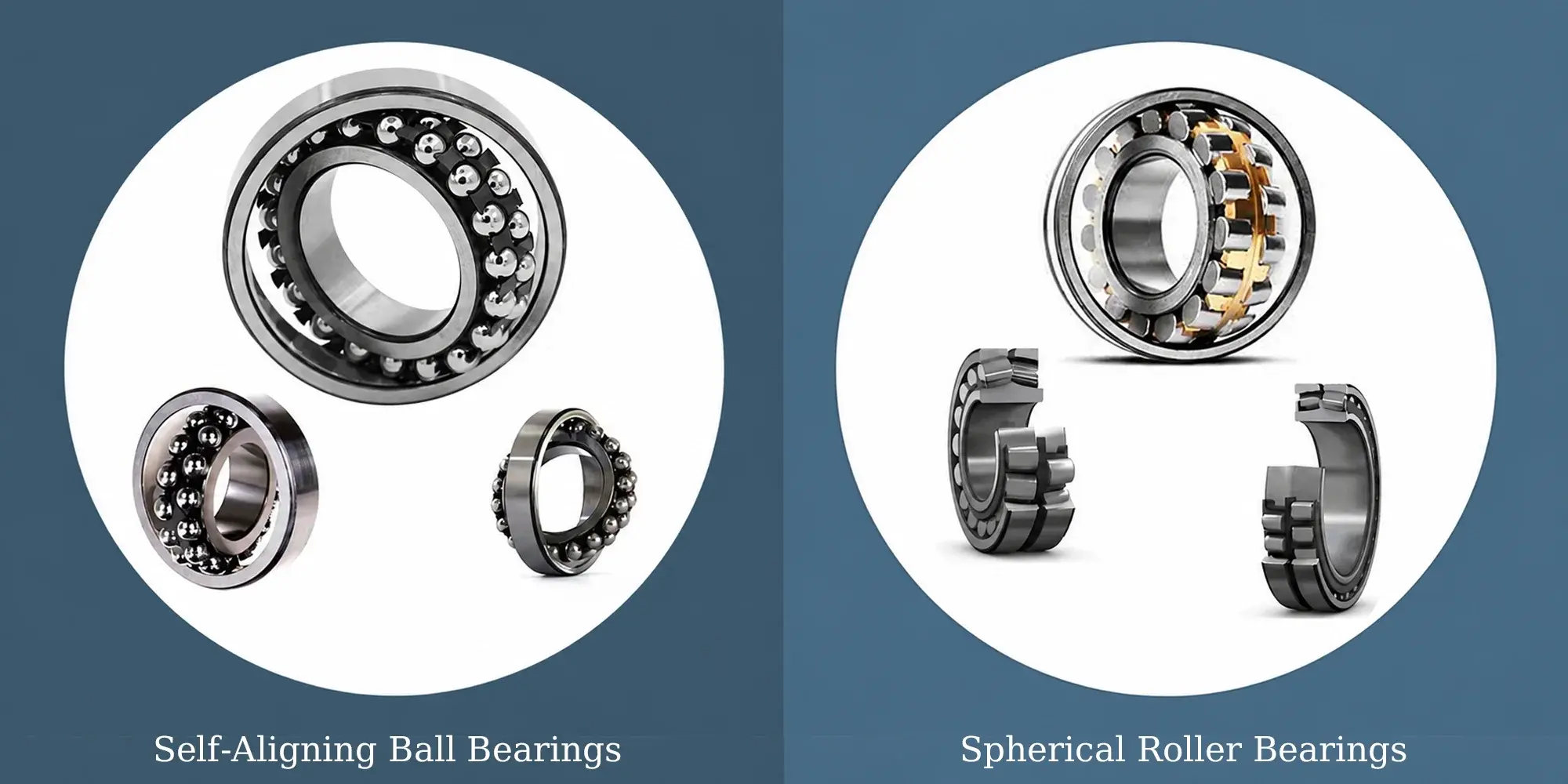
Self-aligning ball bearings (SABBs) and spherical roller bearings (SRBs) differ fundamentally in load capacity, speed capability, and the misalignment range they're designed to handle.
Getting the distinction right isn't academic — it directly affects equipment uptime and total cost of ownership.
This guide breaks down both bearing types with specific numbers, application examples, and a clear framework for choosing between them.

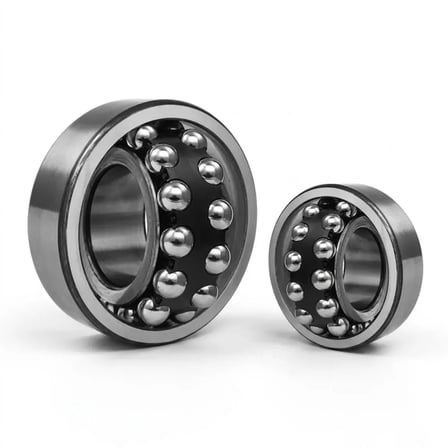
A self-aligning ball bearing uses two rows of balls running in a common spherical outer raceway.
That concave outer race allows the inner ring, balls, and cage to tilt relative to the outer ring — typically up to ±3° depending on the series.
This geometry was patented by Sven Wingqvist of SKF in 1907 specifically to solve shaft deflection problems in textile machinery.

The result: low friction, high rotational speed, and genuine tolerance for angular misalignment — all in a compact envelope.
The trade-off is modest radial load capacity relative to size and limited axial load handling.
Common series: 12xx, 13xx, 22xx, 23xx (the 22/23 series are wider bore variants).
A 1210 bearing (50mm bore) has a dynamic load rating of roughly 20.8 kN.

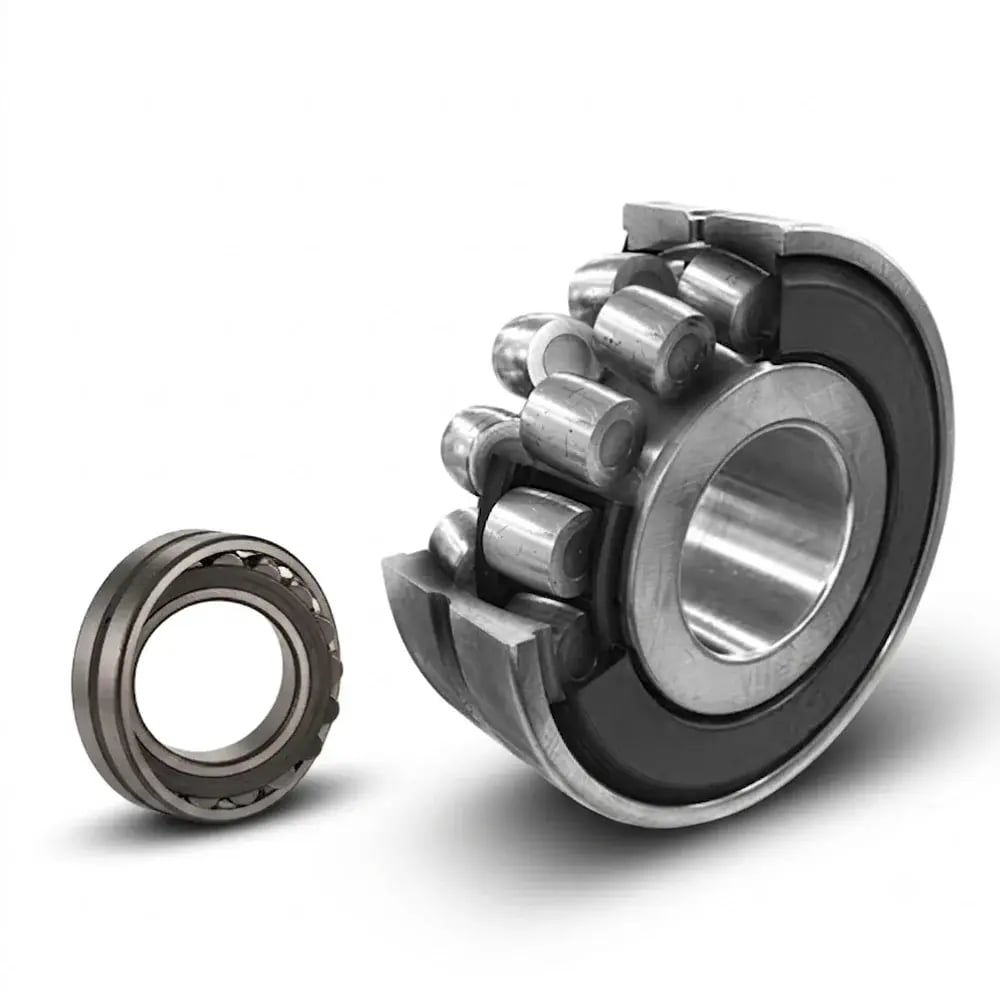
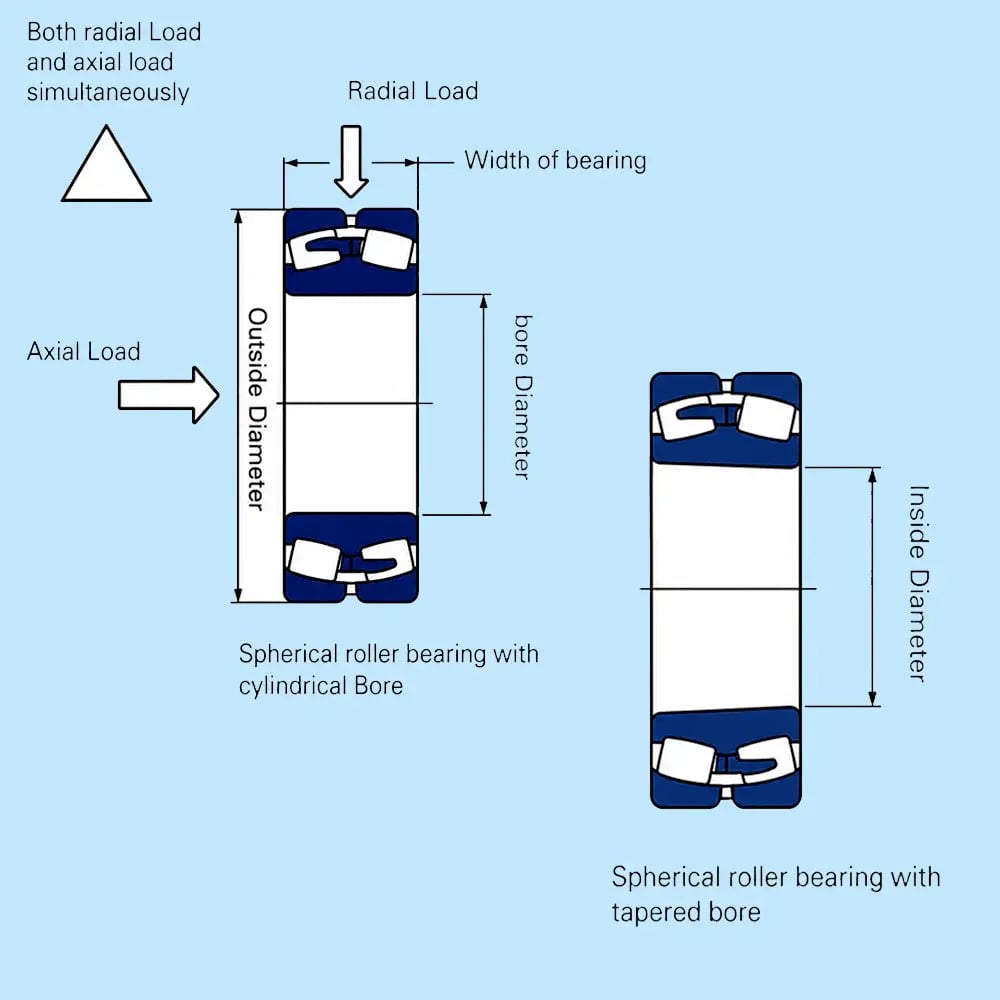
A spherical roller bearing replaces balls with barrel-shaped rollers — two rows of them, arranged symmetrically around a spherical outer raceway.
The roller geometry dramatically increases the contact area with the raceway compared to balls, which is why SRBs can carry radial loads 3–5× higher than a same-bore SABB.
They also handle substantial combined loads — radial plus axial simultaneously — and tolerate misalignment up to ±1.5° to ±2° in most standard designs, with some heavy-duty variants reaching ±2.5°.
A 22210E bearing (50mm bore, same as the 1210 SABB above) carries a dynamic load rating of approximately 96 kN — nearly 4.6× greater.

This is the biggest practical difference. Ball-to-raceway contact is theoretically a point; roller-to-raceway contact is a line.
That line contact distributes load across a far larger surface area, which is why SRBs carry so much more.
For a 60mm bore comparison (a very common industrial size):
| Bearing | Dynamic C (kN) | Static C₀ (kN) | Weight (kg) |
|---|---|---|---|
| 1212 SABB (60mm bore) | 25.5 | 10.0 | 0.28 |
| 22212E SRB (60mm bore) | 120 | 105 | 0.90 |
The SRB carries 4.7× the dynamic load of the equivalent SABB. You're also paying for it — in weight, size, and price. The 22212E is roughly 3× heavier and typically 2–3× more expensive.
Balls generate less friction and less heat at speed than rollers.
For the same 60mm bore, a 1212 SABB has a reference speed of around 7,500 rpm.
The 22212E SRB sits closer to 4,300 rpm.
In high-speed electric motor applications — where operating speeds regularly exceed 5,000 rpm — the SABB is the natural choice when loads permit.
SRBs work best when speeds stay below their thermal reference speed, or when oil-bath or forced-lubrication systems are in place to manage heat.
Both bearing types tolerate misalignment — that's their shared purpose. But they're calibrated differently:
SABBs: up to ±3° in the 12xx series, ±2.5° in the 22xx series. This generous tolerance makes them ideal for light shafts prone to bending deflection, flexible couplings, or applications where precision alignment is difficult to maintain.
SRBs: typically ±1.5° to ±2°. The roller geometry naturally limits how far the inner assembly can tilt before edge loading becomes a problem. In practice, most SRB installations are designed with misalignment below 1° — the tolerance is there as a safety margin, not a design target.
If your application involves significant, unavoidable misalignment (e.g., a long agricultural drive shaft with multiple bearing housings), an SABB's larger misalignment window is a genuine functional advantage — not just a spec sheet number.
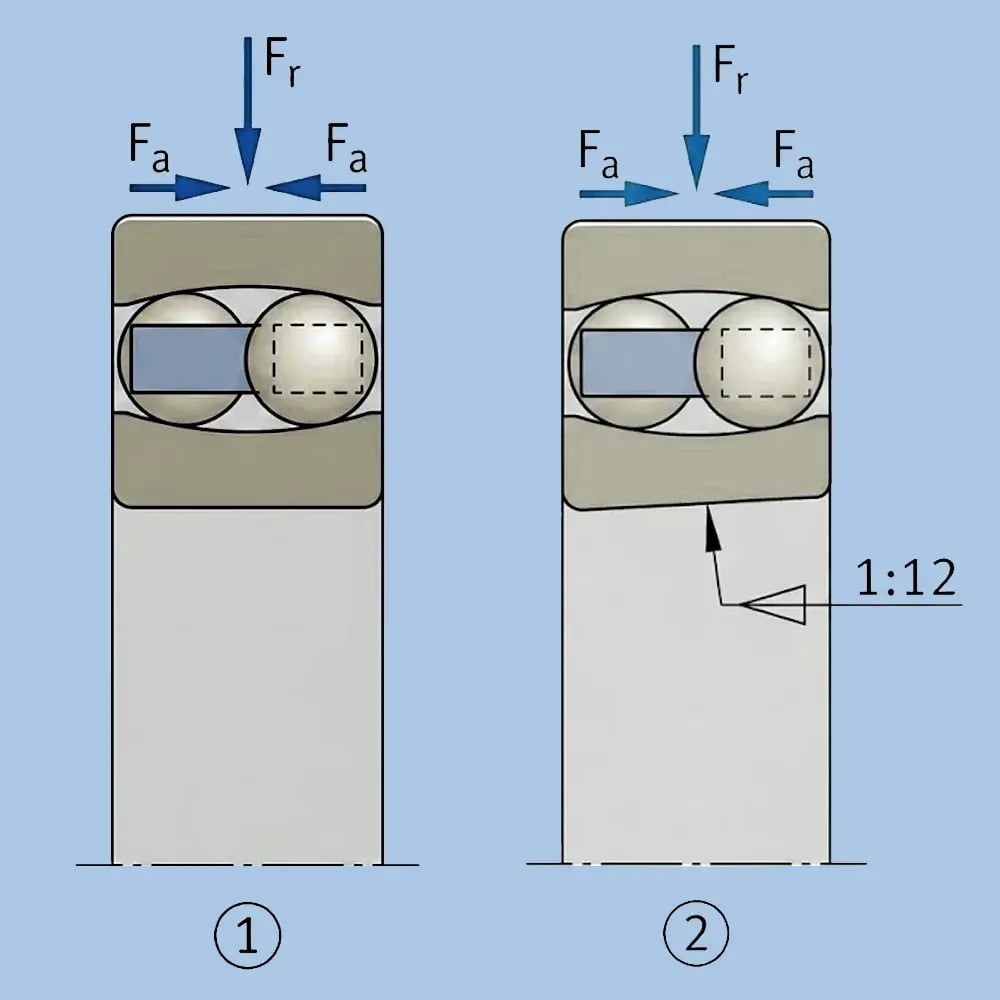
SABBs handle axial loads up to roughly 20–25% of their radial load capacity — limited, but acceptable for lightly loaded thrust scenarios.
SRBs can take combined loads in both directions simultaneously, with axial capacity reaching 20–35% of radial depending on the internal geometry (E vs C design profile).
In applications with significant thrust — gearbox shafts, crane hooks, marine propeller shafts — SRBs are the default.
60mm bore reference values from standard catalogue data (SKF/NSK). Actual figures vary by series and manufacturer.
Self-aligning ball bearings are well-suited to applications where loads are moderate, speeds are elevated, and misalignment is a real but unpredictable variable.
Common deployment environments:
Electric motors & pumps
High rotational speeds (often 3,000–8,000 rpm), moderate shaft loads, and housings that may not be perfectly aligned. SABBs are standard on the non-drive end of small-to-medium motors.
Textile & light conveyor machinery
Long shafts with multiple bearing points are prone to bending under their own weight. SABBs absorb this deflection without inducing edge stress in the raceway.
Agricultural equipment: light drives
Seed drills, planting attachments, and lighter harvesting mechanisms where shaft alignment shifts with implement flexing during field operation.
Pillow block housings
Many pillow block bearing units are internally fitted with SABBs or spherical insert bearings — chosen specifically because bolt-down housings on uneven machine beds create inherent misalignment.
Spherical roller bearings are the workhorse of heavy industry.
When load is the primary design constraint — and speed isn't — SRBs are almost always the answer:
Paper mills & rolling mills
Heavy rolls operating at low-to-moderate speeds under enormous radial loads. SRBs in the 22300 and 23000 series are essentially universal in these environments.
Mining & quarrying equipment
Vibrating screens, crushers, and conveyor head pulleys face radial shock loads that would rapidly fatigue a ball bearing. SRBs — especially spherical roller bearings with CA cage design — absorb this without failure.
Gearboxes & power transmission
Combined radial and thrust loads at the gear mesh point, plus shaft deflection under load — SRBs are preferred on output shafts of industrial gearboxes where loads are highest.
Agricultural main drives (combine harvesters, balers)
Crop processing involves sudden shock loads as material density varies. SRBs in the 22200 series are common on threshing drum shafts and main drive shafts where loads can spike to 60–100 kN.
One underappreciated difference between these bearings is what happens in the field over time, not just at installation.
SABBs are typically grease-lubricated for life in smaller sizes (below 60–70mm bore). Sealed variants (2RS, ZZ) require zero maintenance. Open designs in pillow block housings need regreasing every 2,000–3,000 operating hours under normal conditions — a schedule that fits most light industrial PM programs.
SRBs in heavy-duty applications are almost always open and require regular lubrication — either grease replenishment through nipples or continuous oil circulation. In paper mill rolls and mining screens, relubrication intervals can be as short as 200–500 hours depending on speed, temperature, and contamination levels.
A 2018 study published in Tribology International found that inadequate lubrication accounts for approximately 36% of premature rolling bearing failures, with fatigue and contamination each contributing around 14%. For SRBs under heavy load, getting the grease quantity and grade right is not optional — it's the single biggest factor in service life.
A standard 22212E SRB costs roughly 2–4× what a 1212 SABB costs at standard catalogue pricing.
But purchase price is the wrong lens for industrial bearing selection.
Put an SABB into an application requiring 120 kN of load capacity and it will fail prematurely — potentially taking shafts, seals, and adjacent components with it.
The downtime cost alone, in industries where unplanned stoppages run $10,000–$50,000+ per hour, dwarfs any bearing savings.
Conversely, installing an SRB in a light, high-speed application wastes money on an oversized component and may actually shorten bearing life due to increased operating temperature.
The right bearing for the application is always the cheapest bearing in the long run.
1. Replacing an SRB with a same-bore SABB to "save cost"
If the original designer specified an SRB, there's a load reason. Swapping in an SABB at the same bore dramatically cuts load capacity. The bearing may run fine for weeks and fail catastrophically at the worst moment.
2. Using an SRB in a light application because "it handles more"
Oversized bearings in light-load applications often suffer from slippage and inadequate lubrication film formation — rollers need a minimum load to roll properly rather than skid. The result: sliding wear and premature failure from an unexpected direction.
3. Assuming both tolerances are equivalent
A ±3° SABB and a ±2° SRB sound similar on paper. In a long conveyor with flexible mounts where actual misalignment regularly hits 2.5°, only the SABB survives long-term. Always measure — or estimate with engineering calculations — rather than assume tolerance is a "comfort zone" number.
Both bearing types are covered under international standards.
For self-aligning ball bearings, the primary dimension standard is ISO 15:2017 (radial bearings — boundary dimensions).
Spherical roller bearings fall under ISO 15:2017 for dimensions and ISO 281:2007 for dynamic load ratings and life calculation — the standard that defines the L10 life calculation methodology used in bearing catalogues globally.
For engineers who need to go deeper, the ISO 281:2007 standard on bearing life calculation provides the technical foundation for load rating methodology referenced in all major manufacturer catalogues.
The ANSI/ABMA standards 9 and 11 cover equivalent ground for the North American market.
All dynamic load ratings cited in this article follow ISO 281 methodology and are based on published catalogue values from major bearing manufacturers.
Not without verifying load requirements. Same bore does not mean same load capacity — a 22212E SRB carries roughly 4.7× the dynamic load of a 1212 SABB. If the original design called for an SRB, the load calculation drove that choice. Substituting an SABB without recalculating bearing life is an engineering decision that requires proper analysis, not a routine maintenance swap.
It depends on the specific function. Light drives, planting mechanisms, and augers with moderate loads but variable alignment conditions suit SABBs well. Heavy main drives on combine harvesters, balers, and forage harvesters — where loads can exceed 60 kN and shock loading is common — call for spherical roller bearings. Many agricultural machines use both types in different locations.
As a general rule, yes — SABBs handle up to ±3° while standard SRBs sit at ±1.5° to ±2°. However, some specialized SRB variants with modified internal geometry extend tolerance to ±2.5°. In practice, both bearing types perform best when misalignment is minimized through proper alignment during installation; the rated tolerance is a design safety margin, not a recommended operating condition.
Self-aligning ball bearings use series prefixes 12xx and 13xx (single row-type) or 22xx/23xx (wide series). Spherical roller bearings typically use 222xx, 223xx, 231xx, 232xx, 239xx, 240xx, or 241xx series designations. If you see a five-digit number starting with 22 or 23, check the full catalogue designation — it could be either type depending on the sub-series.
SRBs require a minimum load to ensure the rollers roll rather than skid. Most manufacturer guidelines specify a minimum radial load of approximately 0.02 × C (2% of dynamic load rating). For a 22212E with C = 120 kN, that means a minimum radial load of around 2.4 kN. Operating below minimum load — common when oversizing — leads to roller skidding, smearing of the raceway surface, and shortened bearing life.
SABBs are widely available in sealed configurations (2RS suffix — rubber seals both sides), suitable for maintenance-free operation in light industrial environments. Sealed SRBs exist but are less common and generally limited to smaller bore sizes; most SRBs in heavy-duty service rely on bearing housing seals and regular relubrication rather than integral bearing seals.
If your application is light-to-moderate load, high speed, and needs genuine flexibility on misalignment tolerance — use a self-aligning ball bearing. If your application is heavy load, combined loading, or involves shock and vibration at lower speeds — use a spherical roller bearing.
Both are purpose-designed bearings that perform exceptionally well in the right conditions. Neither is universally "better." The right call comes from matching the bearing's load rating, speed capability, and misalignment tolerance to your actual operating requirements — not the other way around.
Browse Self-Aligning Ball Bearings →Sources: Load ratings referenced from SKF and NSK standard product catalogues (60mm bore series). Speed values based on catalogue reference speed data. Lubrication failure statistics: widely cited industry figure; see SKF Bearing Maintenance Handbook and Neale, M.J. (ed.), Tribology Handbook (2nd ed., Butterworth-Heinemann, 1995). Misalignment tolerance per ISO 15:2017 and manufacturer technical documentation. Dynamic load rating methodology per ISO 281:2007.
Can you fit a bearing with 35,000N load capacity in a 30mm radial envelope? The answer is no for cylindrical roller bearings, but yes for needle...
Linear Bearings vs Rotary Bearings — Key Differences Dimension ▶ Linear Bearing ▶ Rotary Bearing Motion type TranslationBack-and-forth...
Industrial bearings are essential in industrial machinery, enabling smooth operation and reducing wear for prolonged equipment life. There exists a...