


Needle Bearings vs Roller Bearings: 2026 Selection Guide
Can you fit a bearing with 35,000N load capacity in a 30mm radial envelope? The answer is no for cylindrical roller bearings, but yes for needle...
Every mechanical engineer faces the needle-vs-ball decision dozens of times a year. It appears deceptively simple — both are rolling element bearings, both reduce friction between rotating and stationary surfaces.
But beneath that surface similarity lies a fundamental geometric difference that creates entirely different performance envelopes, failure modes, and application fits.
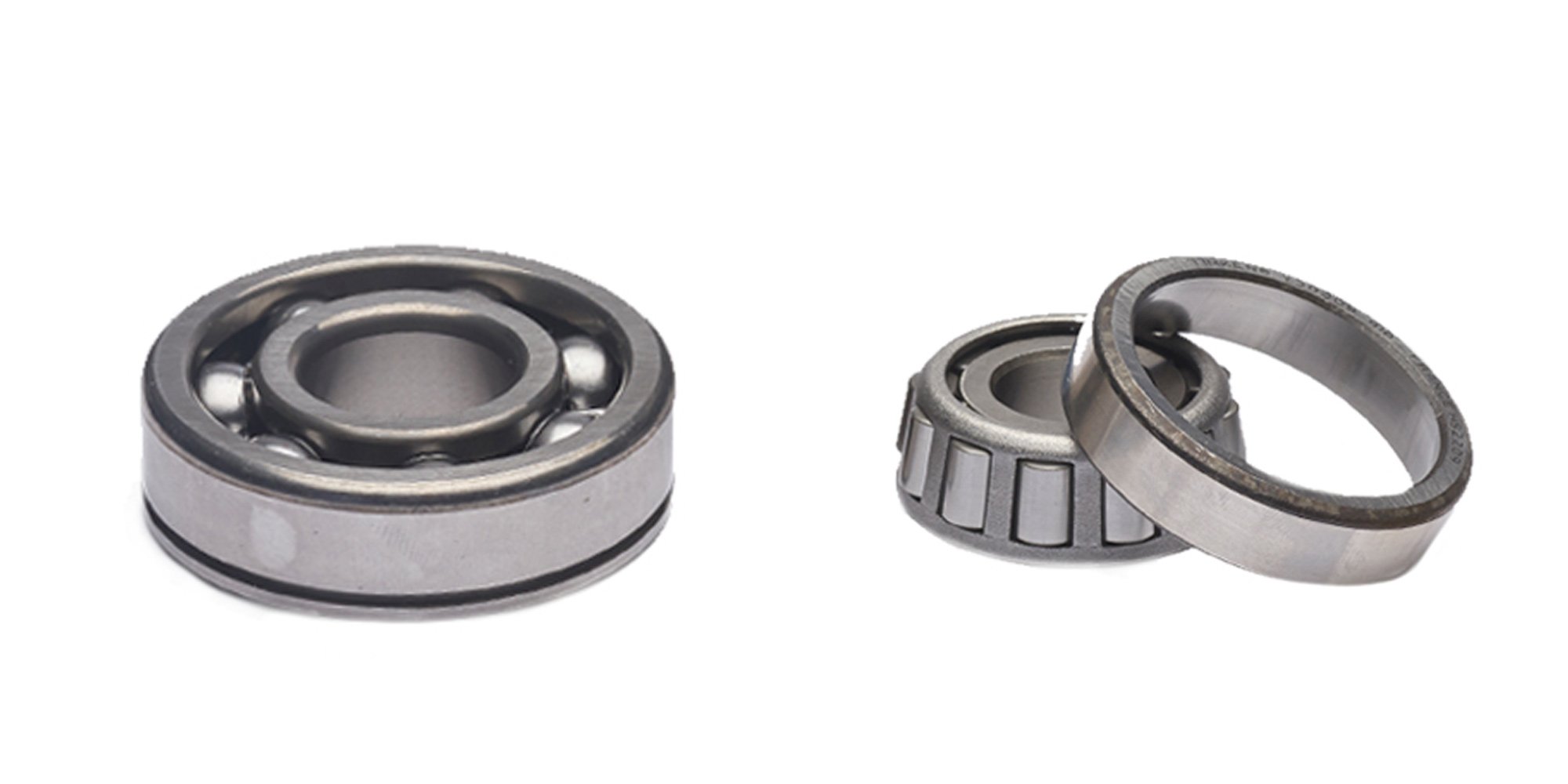
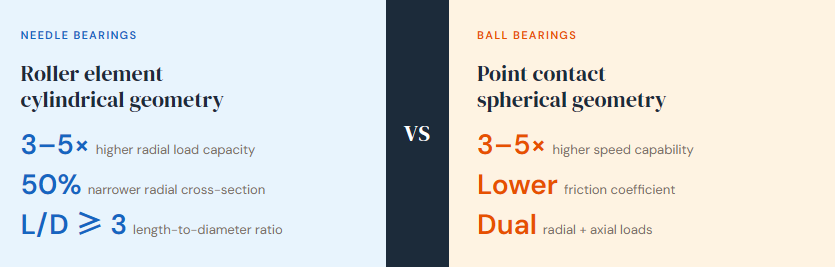
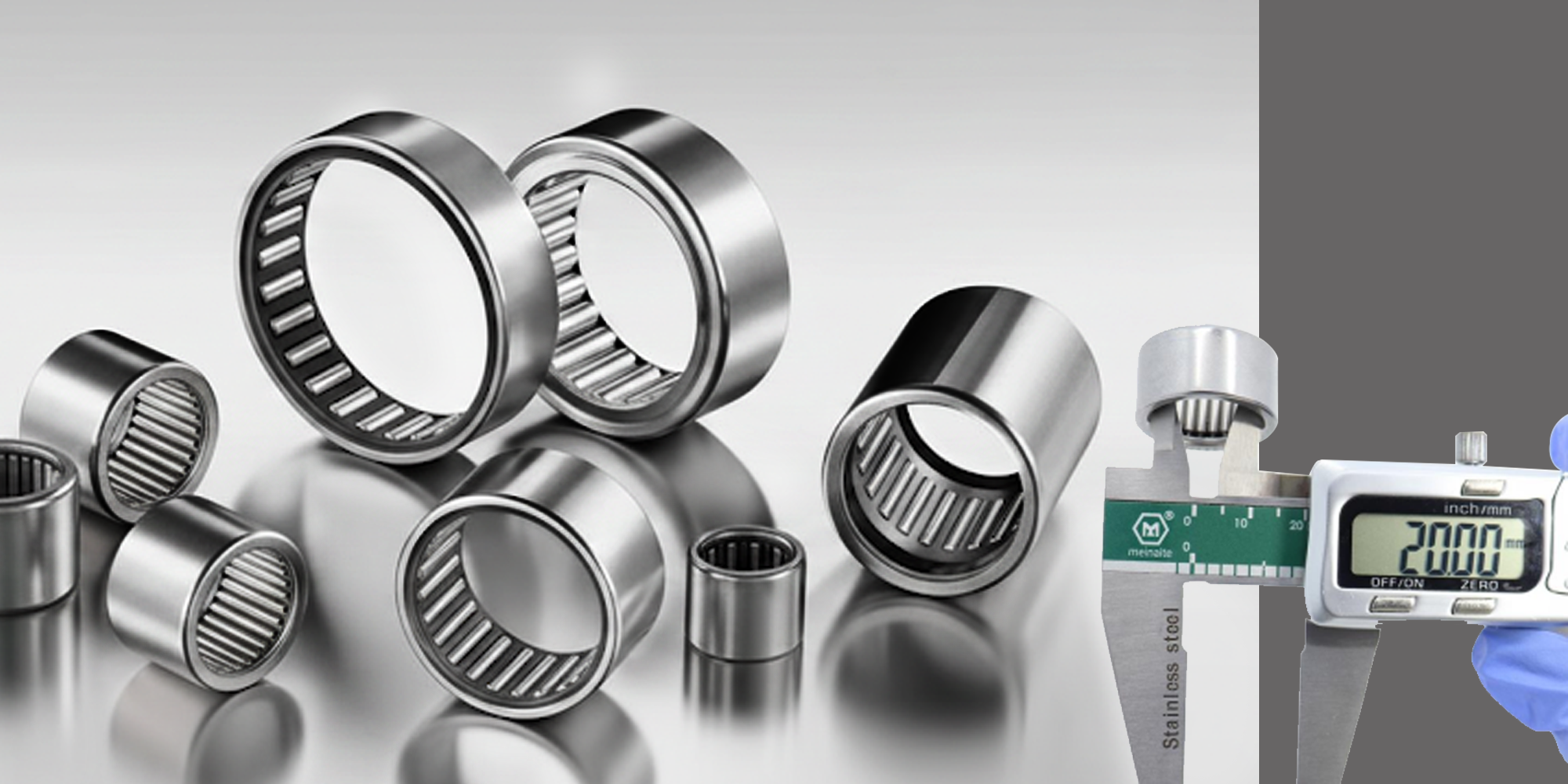
Needle bearings use cylindrical rolling elements with length-to-diameter ratios of 3:1 or greater, creating line contact with the raceway. Ball bearings use spherical rolling elements creating point contact.
This single geometric distinction cascades into dramatic differences across every performance dimension: load capacity, speed limits, friction losses, space requirements, misalignment tolerance, and total cost of ownership.

The most important difference between needle and ball bearings is not visible from the outside — it lives in the microscopic contact zone between rolling element and raceway.
Each cylindrical roller contacts the raceway along its entire length — a contact zone that might be 10–25 mm long but only a few micrometers wide (Hertzian line contact). This spreads the applied load across a large area, producing relatively low contact stress per unit area.
Each spherical element contacts the raceway at a single point that elastically deforms into a small ellipse under load (Hertzian point contact). The contact area is dramatically smaller, producing much higher contact stress for the same applied load. However, this geometry allows freer rolling in all directions, enabling higher speeds and the ability to carry axial as well as radial loads.
|
Contact Mechanics Insight Hertz contact theory predicts that maximum contact pressure for a cylinder on a flat (needle) scales as P_max ∝ (F/L)^0.5, while for a sphere on a flat (ball) it scales as P_max ∝ F^(1/3). This means needle bearings handle increasing load much more gracefully — doubling the load only increases contact stress by ~41%, versus ~26% for balls. But balls are geometrically free to roll in any direction, making them naturally faster and more versatile. |
Load capacity is where needle bearings claim their most decisive advantage. For the same shaft diameter and radial envelope, a needle roller bearing typically carries 3 to 5 times the radial load of a comparable deep groove ball bearing. This dramatic difference stems directly from the contact geometry.
|
Shaft Dia. |
DGBB Dynamic Rating (C) |
Needle Bearing Dynamic Rating (C) |
Needle Advantage |
|
20 mm |
9,360 N (6204) |
28,400 N (NK 20/16) |
3.0× |
|
30 mm |
19,500 N (6206) |
71,200 N (NK 30/20) |
3.7× |
|
40 mm |
30,700 N (6208) |
110,000 N (NK 40/20) |
3.6× |
|
50 mm |
43,500 N (6210) |
143,000 N (NK 50/25) |
3.3× |
|
60 mm |
55,900 N (6212) |
190,000 N (NK 60/25) |
3.4× |
However, this comparison has a critical caveat: needle bearings carry radial loads only. Standard needle roller bearings have essentially zero axial load capacity — applying axial thrust will cause the rollers to skew and the bearing to fail rapidly. Ball bearings, especially angular contact types, handle combined radial and axial loading with ease.
|
⚠ Critical Limitation Standard needle roller bearings cannot carry axial (thrust) loads. In applications with any thrust component — helical gears, bevel gears, angled belt drives — ball bearings or combined needle/thrust bearing assemblies are required. This single limitation eliminates needle bearings from a large fraction of potential applications. |
Ball bearings are significantly faster than needle bearings. The difference isn’t marginal — it’s structural, rooted in the contact geometry and the dynamics of rolling element motion.
|
Parameter |
Needle Bearing |
Ball Bearing |
Advantage |
|
Limiting speed (30mm bore) |
5,000–8,000 RPM |
12,000–18,000 RPM |
Ball: ~2–3× |
|
Friction coefficient (μ) |
0.002–0.004 |
0.001–0.0015 |
Ball: ~50% lower |
|
Starting torque |
Higher (roller inertia) |
Lower (ball geometry) |
Ball |
|
Heat generation at speed |
Higher |
Lower |
Ball |
|
DN value (reference) |
200,000–400,000 |
400,000–1,200,000 |
Ball: 3–4× |
|
Radial load at speed |
Superior |
Limited by contact stress |
Needle |
The speed disadvantage of needle bearings comes from two sources. First, the cylindrical roller has higher rotational inertia than a ball of equivalent cross-section.
Second, the line contact zone has a slight velocity differential across the contact width, causing a small amount of sliding friction (microslip) that generates heat and limits speed.
This is arguably the most underappreciated differentiator. In applications where radial space is severely constrained — automotive transmissions, power tools, two-stroke engines, connecting rods — needle bearings offer a radial section so thin that no ball bearing can compete.
|
Bore |
Needle OD |
Needle Section |
DGBB OD |
DGBB Section |
Radial Space Saved |
|
20 mm |
28 mm |
4 mm |
47 mm |
13.5 mm |
9.5 mm / side |
|
30 mm |
40 mm |
5 mm |
62 mm |
16 mm |
11 mm / side |
|
40 mm |
52 mm |
6 mm |
80 mm |
20 mm |
14 mm / side |
|
50 mm |
65 mm |
7.5 mm |
90 mm |
20 mm |
12.5 mm / side |
For a 30 mm shaft, a standard needle roller bearing (NK 30/20) has an outer diameter of just 40 mm — a radial wall of only 5 mm. The equivalent deep groove ball bearing (6206) has an outer diameter of 62 mm, occupying 16 mm of radial space per side. In a compact gearbox or connecting rod, this 11 mm difference per side is the margin between a feasible and unfeasible design.
|
Type |
Description |
Key Feature |
Application |
|
Drawn Cup (HK/BK) |
Thin-walled stamped outer ring |
Extremely compact, low cost |
Small motors, power tools |
|
Solid Outer Ring (NK) |
Machined outer ring, no inner |
Shaft acts as inner race |
Automotive transmissions |
|
Caged Roller (K) |
Rollers + cage, no rings |
Minimal envelope, max rollers |
Connecting rods, pin joints |
|
Combined (NKI/RNA) |
Needle + inner ring |
Works on unhardened shaft |
General industrial use |
|
Thrust Needle (AXK) |
Axial needle roller design |
Axial load only |
Steering columns, clutches |
|
Combined Needle + Thrust |
Radial + axial in one unit |
Handles combined loads |
Gearboxes, differentials |
|
Type |
Max Speed |
Axial Load |
Misalignment |
Application |
|
Deep Groove (DGBB) |
Very High |
Moderate |
Low |
Motors, pumps, gearboxes |
|
Angular Contact |
High |
High (one dir.) |
Low |
Spindles, wheel hubs |
|
Self-Aligning (2-row) |
Medium |
Low |
High (±3°) |
Conveyors, agitators |
|
Four-Point Contact |
Medium |
High both dirs. |
Low |
Wind turbines, cranes |
|
Miniature / Instrument |
Very High |
Low |
Low |
Dental drills, hard drives |
Lubrication strategy is a major differentiator between needle and ball bearings — and one that significantly affects total cost of ownership in practice.
|
Factor |
Needle Bearings |
Ball Bearings |
|
Grease life |
Shorter (high stress, more surfaces) |
Longer (sealed-for-life common) |
|
Oil lubrication |
Often required at higher speeds |
Grease often sufficient |
|
Misalignment sensitivity |
Critical — even 0.1° causes edge loading |
Low — geometry tolerates misalignment |
|
Cleanliness requirement |
Critical — particles abrade contact zone |
Important but more tolerant |
|
Sealed variants |
Limited availability |
Widely available (2RS, ZZ) |
|
Re-lubrication interval |
Shorter |
Longer |
|
Misalignment: The Hidden Killer of Needle Bearings Needle roller bearings are extremely sensitive to shaft misalignment. Even 0.1° of angular misalignment concentrates load on the roller edges (edge loading), producing contact stresses 3–5× higher than the design value. This leads to rapid fatigue failure at the roller ends. Ball bearings, with their spherical geometry, are far more forgiving of minor misalignment. In real-world machinery where perfect alignment is difficult to achieve, this is a significant practical advantage for ball bearings. |
|
Performance Dimension |
Needle Bearings |
Ball Bearings |
Winner |
|
Radial load capacity |
Excellent (3–5× higher) |
Good |
Needle |
|
Axial load capacity |
None (standard types) |
Good–Excellent |
Ball |
|
Combined load |
Poor (needs combined units) |
Excellent |
Ball |
|
Maximum speed (DN) |
200k–400k |
400k–1,500k |
Ball: 3–4× |
|
Friction / power loss |
Moderate |
Low |
Ball: ~50% lower |
|
Radial space efficiency |
Outstanding |
Moderate |
Needle: 50–70% thinner |
|
Misalignment tolerance |
Very low (<0.05°) |
Low–Moderate |
Ball |
|
Shock load resistance |
Good (line contact) |
Moderate (point contact) |
Needle |
|
Vibration / noise |
Higher (roller dynamics) |
Lower (smoother running) |
Ball |
|
Unit cost |
Generally lower |
Moderate (varies by type) |
Needle (often) |
|
Maintenance complexity |
Higher |
Lower (sealed options) |
Ball |
|
Stiffness under radial load |
Very high |
Moderate |
Needle |
Understanding which bearing type dominates each industry reveals the practical logic behind the engineering principles above.
|
NEEDLE BEARINGS DOMINATE Automotive Transmissions Planetary gear sets, differential pinions, and manual gearbox layshafts universally use needle bearings. The extreme radial loads from gear tooth forces, combined with the need to fit within tight gear pocket geometries, make needle bearings the only viable solution. A typical 6-speed manual gearbox contains 8–12 needle bearing assemblies. |
|
BALL BEARINGS DOMINATE Electric Motors The vast majority of electric motors — from fractional-horsepower fans to 100 kW industrial drives — use deep groove ball bearings. The combined radial + axial load capability handles belt tension and shaft weight simultaneously. Sealed-for-life variants eliminate maintenance entirely. |
|
NEEDLE BEARINGS DOMINATE Two-Stroke Engines / Connecting Rods Connecting rod big-end and small-end bearings in two-stroke and high-performance four-stroke engines are almost universally needle roller cages. The oscillating load pattern, extremely high radial forces, and space constraints within the rod make needle cages the only feasible solution. |
|
BALL BEARINGS DOMINATE High-Speed Spindles & Turbines CNC machining center spindles, gas turbines, dental handpieces, and centrifugal compressors overwhelmingly favor angular contact ball bearings. The DN value requirements (often exceeding 1,000,000) are simply unachievable for needle bearings. |
|
Industry / Application |
Preferred Bearing |
Primary Reason |
|
Automotive manual gearbox |
Needle |
Radial load + space constraints |
|
Automotive EV motor |
Ball |
Combined loads, speed, sealed-for-life |
|
Two-stroke engine conrod |
Needle |
Oscillating load, minimal space |
|
Industrial electric motor |
Ball |
Combined loads, versatility, low maintenance |
|
CNC machine tool spindle |
Ball (angular contact) |
High speed, combined loads |
|
Hydraulic pump |
Needle (often) |
High radial load at moderate speed |
|
Power tool gearbox |
Needle |
Space constraints, radial load |
|
Wind turbine main shaft |
Ball / cylindrical roller |
Combined loads, long-term reliability |
|
Construction equipment pivots |
Needle |
Shock loads, contamination tolerance |
|
HVAC compressor |
Ball |
Combined loads, sealed options |
Use this five-question decision process to identify the right bearing type systematically:
Step 1: Q1: Does the application have ANY axial (thrust) load?
YES → Choose ball bearings (or combined needle/thrust assembly)
NO → Continue to Q2
Step 2: Q2: Is the required speed above DN 400,000?
YES → Choose ball bearings
NO → Continue to Q3
Step 3: Q3: Is radial space severely constrained?
YES → Strong candidate for needle bearings
NO → Continue to Q4
Step 4: Q4: Is the primary load heavy radial at low-to-moderate speed?
YES → Choose needle bearings
NO → Continue to Q5
Step 5: Q5: Is shaft alignment guaranteed to better than 0.1°?
YES → Needle bearings viable
NO → Choose ball bearings (misalignment tolerance required)
|
✓ Golden Rule If your application has ANY significant axial load component, start with ball bearings (or combined needle/thrust assemblies). If your application is purely radial, slow-to-moderate speed, and space-constrained, needle bearings will almost always be the superior choice — delivering 3× the load capacity in half the radial space. |
|
Cost Factor |
Needle Bearings |
Ball Bearings |
Notes |
|
Purchase price |
Lower (often 30–50%) |
Moderate |
Drawn cup types are cheaply mass-produced |
|
Housing machining |
Simpler (thin wall) |
Standard tolerances |
Needle seats can be formed in cast housings |
|
Shaft preparation |
Higher (hardening required) |
Standard shaft tolerances |
Needle shaft raceway: 58–62 HRC, Ra ≤0.4 μm |
|
Maintenance cost |
Higher (frequent relubrication) |
Lower (sealed options) |
Sealed DGBB can be maintenance-free for years |
|
Overall TCO (typical) |
Competitive where technically fit |
Lower in general purpose use |
Ball wins on TCO when both are technically suitable |
One cost factor that surprises many engineers: needle bearings that use the shaft as the inner raceway require that shaft section to be hardened to 58–62 HRC and ground to Ra ≤0.4 µm.
This shaft preparation can cost more than the bearing itself in small production runs. Ball bearings with their own inner ring work on standard turned shafts with h6 tolerances, dramatically simplifying manufacture.
The choice between needle bearings and ball bearings depends on your specific application needs.
By understanding the key differences between these bearings, you can make a more informed decision. This will help you choose based on your machine's needs.
If you want to learn more about bearings, you can contact LILY Bearing.
Can you fit a bearing with 35,000N load capacity in a 30mm radial envelope? The answer is no for cylindrical roller bearings, but yes for needle...
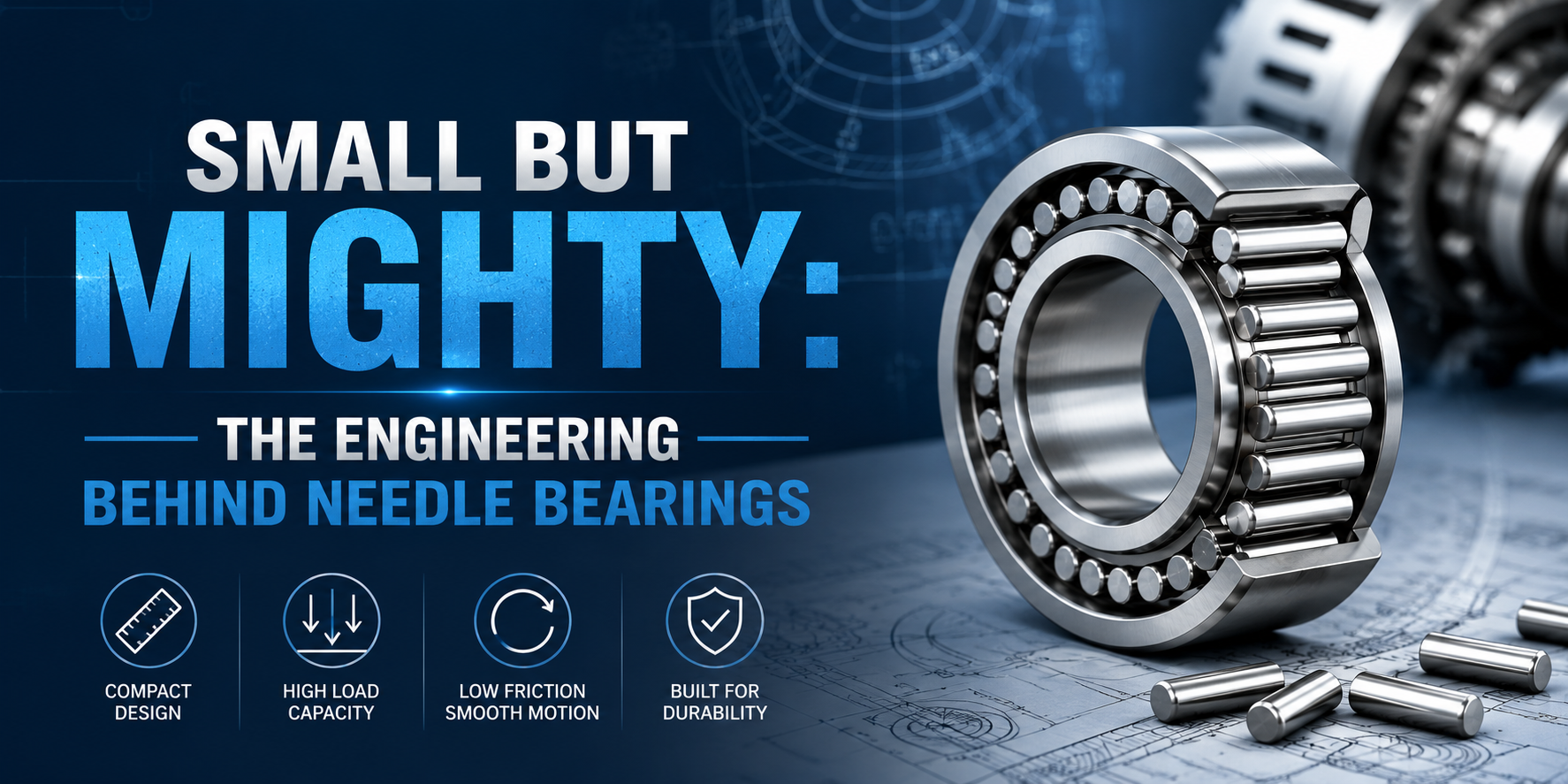
It's important to measure needle bearing dimensions and choose the correct bearing type when designing a new system, replacing a damaged bearing,...
What Are Needle Bearings? Needle bearings are a specialized type of roller bearing that use long, thin cylindrical rollers — called needles — to...