

Home/
Blog/
Linear Guides vs Linear Bearings: What’s the Difference?

6 min read

Linear Guides vs Linear Bearings: What’s the Difference?

Linear Guides vs Linear Bearings: What’s the Difference?
9:07

Both move things in a straight line — but choosing the wrong one can cost you precision, payload capacity, or thousands in unplanned downtime. Here’s exactly how to tell them apart.

Walk into any modern machine shop, semiconductor fab, or robotics cell and you’ll find components quietly doing one of engineering’s most fundamental jobs: guiding motion in a perfectly straight line.

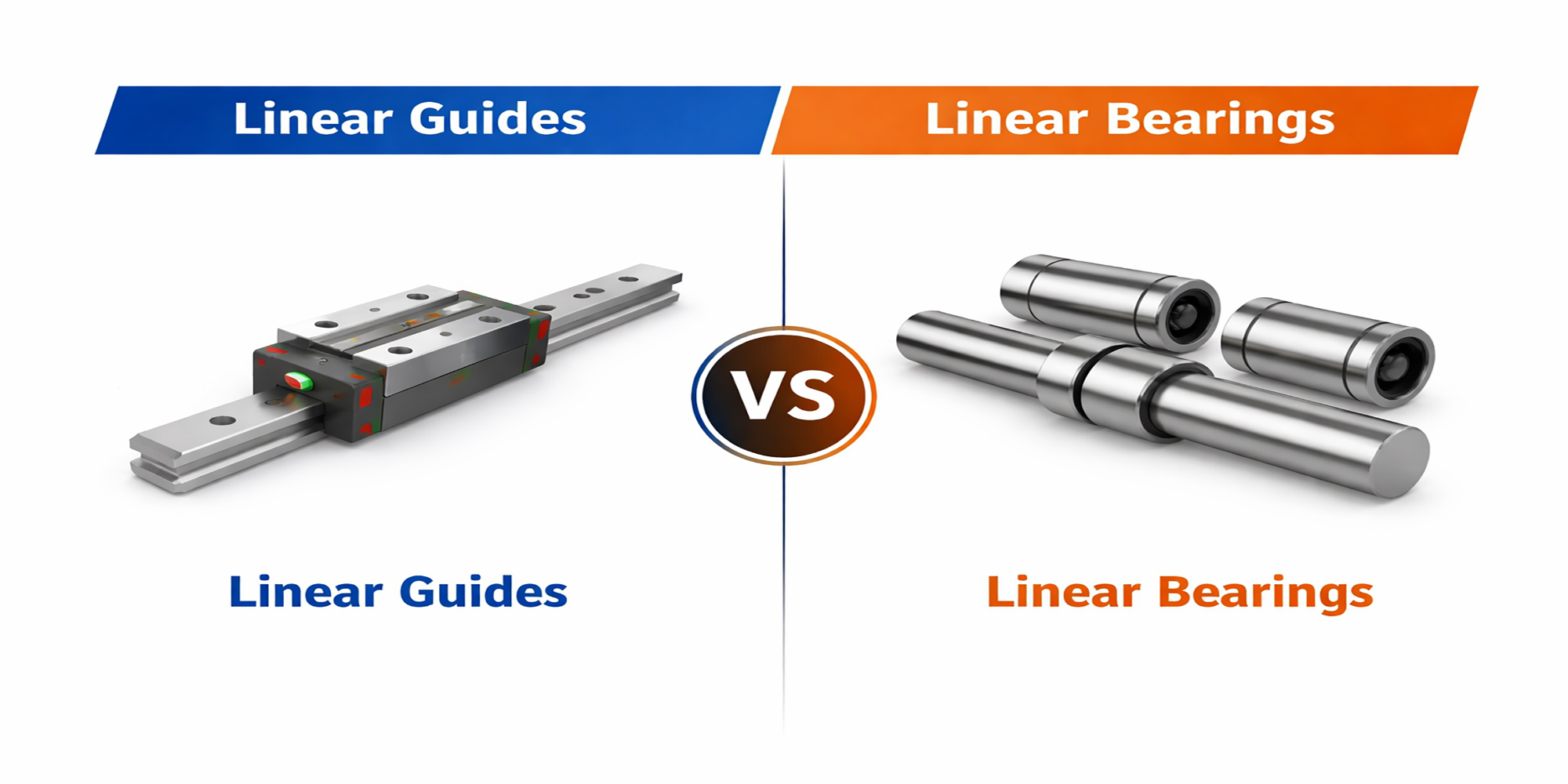
Two technologies dominate this space — linear guides (also called linear guideways or profile rail guides) and linear bearings (round-shaft ball bushings). They look similar at a glance. In practice, they’re built for very different missions.

This guide cuts through the jargon and gives you the clearest, most practical comparison available — covering structure, stiffness, precision, load capacity, maintenance, cost, and real-world application fit.


Understanding Linear Guides

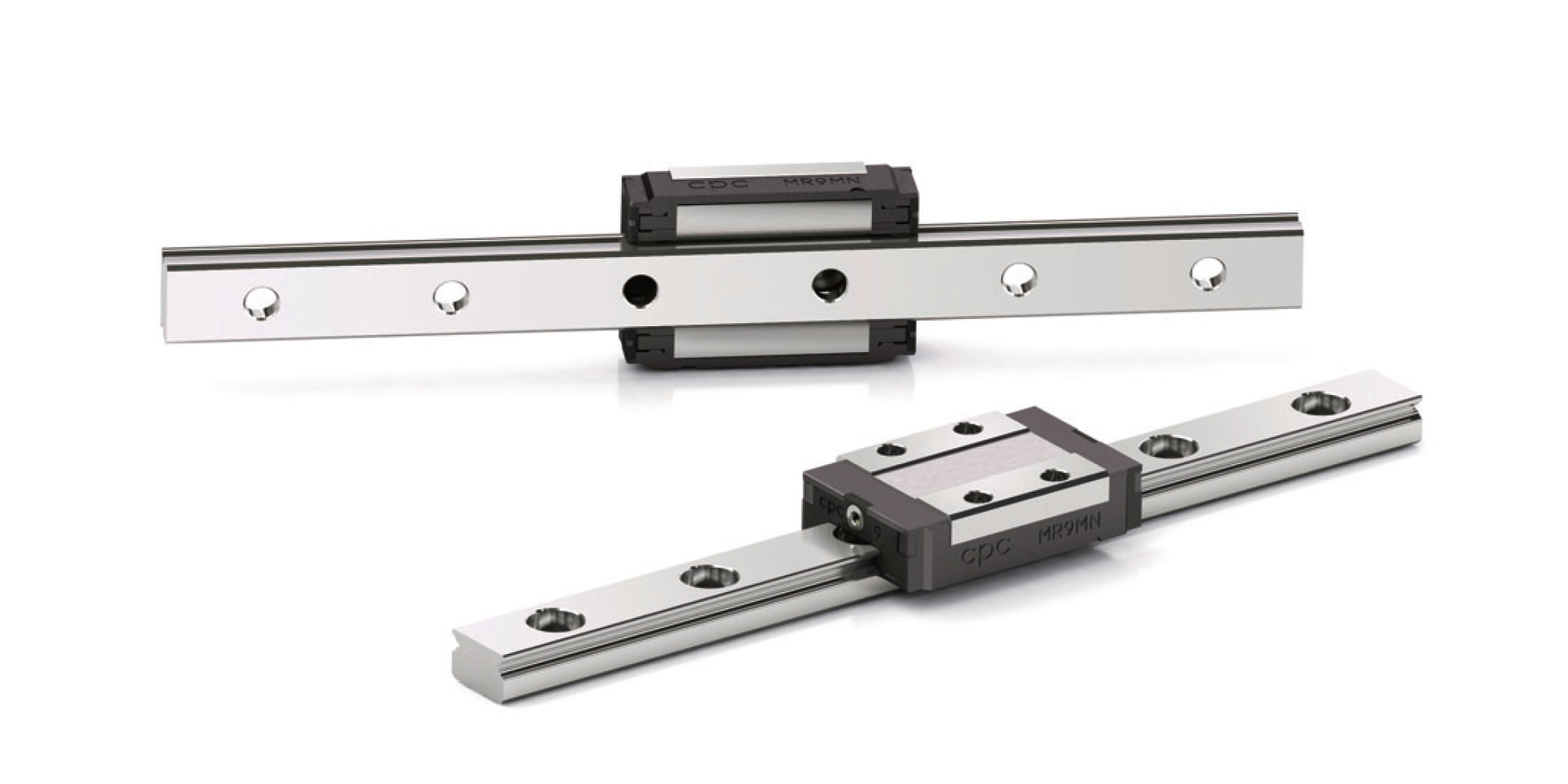
Linear guides—frequently termed linear guideways or rails—are precision-engineered systems designed to facilitate fluid, accurate linear motion.

Comprised of a rail and a carriage housing rolling elements (balls or rollers), these systems minimize friction while maximizing mechanical rigidity and load-bearing capacity.

Their ability to maintain exceptional positional accuracy under heavy stress makes them indispensable in high-tech sectors such as semiconductor fabrication, CNC machining, and industrial automation.

Beyond simple movement, modern guides focus on optimizing load distribution and reducing deflection, ensuring long-term reliability and minimal wear in the most demanding environments.


Understanding Linear Bearings

Linear bearings are precision mechanical components engineered to facilitate smooth linear travel along a shaft or rail while minimizing frictional resistance.

Typically constructed with an outer housing, an inner sleeve, and rolling elements, these bearings offer a streamlined and space-efficient solution for motion control.

Unlike high-precision linear guides, linear bearings are often the preferred choice for material handling, conveyor systems, and general automation where ease of installation and moderate accuracy are prioritized.

Their robust design also provides superior tolerance to environmental contaminants like dust and debris, ensuring reliable performance in demanding operational settings with reduced maintenance requirements.


How They Work: The Core Mechanics

Linear Guide — Working Principle

  • Rail is bolted to a fixed machine structure

  • Carriage slides along the rail on recirculating balls or rollers

  • 4-point contact raceways resist loads in X, Y, and Z directions

  • Preload (adjustable) eliminates play for high-precision use

  • End caps and seals prevent contamination

  • Available in ball-type (smoother) or roller-type (higher load)


Linear Bearing — Working Principle

  • Cylindrical bearing housing fits into a bore or bracket

  • A precision-ground shaft passes through the bore

  • Balls recirculate in axial tracks as shaft moves

  • Motion is constrained to one axis (axial)

  • No inherent preload — radial clearance is standard

  • Retaining clips or flanged versions available

The critical mechanical difference lies in the contact geometry. Linear guide carriages feature opposing ball circuit rows that create a four-directional load path — meaning the system can simultaneously resist vertical forces, horizontal (lateral) forces, and tilting (moment) forces. Linear bearings, by contrast, provide only radial support against the shaft and are not designed to resist moments or lateral forces without additional shaft supports.


Types of Linear Guides & Linear Bearings


Types of Linear Guides

Type

Description

Best For

Ball-Type Linear Guide

Uses recirculating steel balls. Low friction, high speed capability.

Precision applications, CNC axes, automation

Roller-Type Linear Guide

Uses cylindrical rollers. Higher load capacity and rigidity.

Heavy-duty machining, pressing, grinding

Miniature Linear Guide

Compact versions for small machines.

Medical devices, semiconductors, instruments

Stainless / Corrosion-Resistant

Full stainless or zinc-nickel plated construction.

Food processing, pharmaceutical, wet environments


Types of Linear Bearings

Type

Description

Best For

Standard Linear Bushing

Basic cylindrical form fits into matching bore.

General-purpose axial motion, low cost

Flanged Linear Bearing

Integral flange for end-mounting to plates or brackets.

Easy mounting without separate housings

Pillow Block / Linear Unit

Pre-assembled bearing in housing block.

Prototyping, lower-precision production machinery

Polymer / Plain Linear Bearing

Self-lubricating polymer liner, no balls.

Cleanrooms, dusty environments, maintenance-free


The Core Distinction

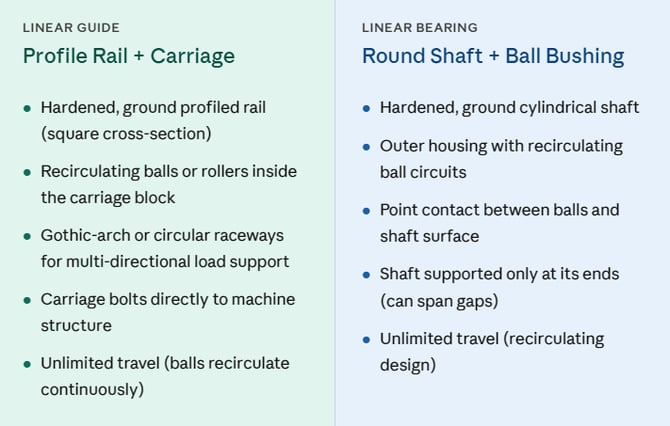
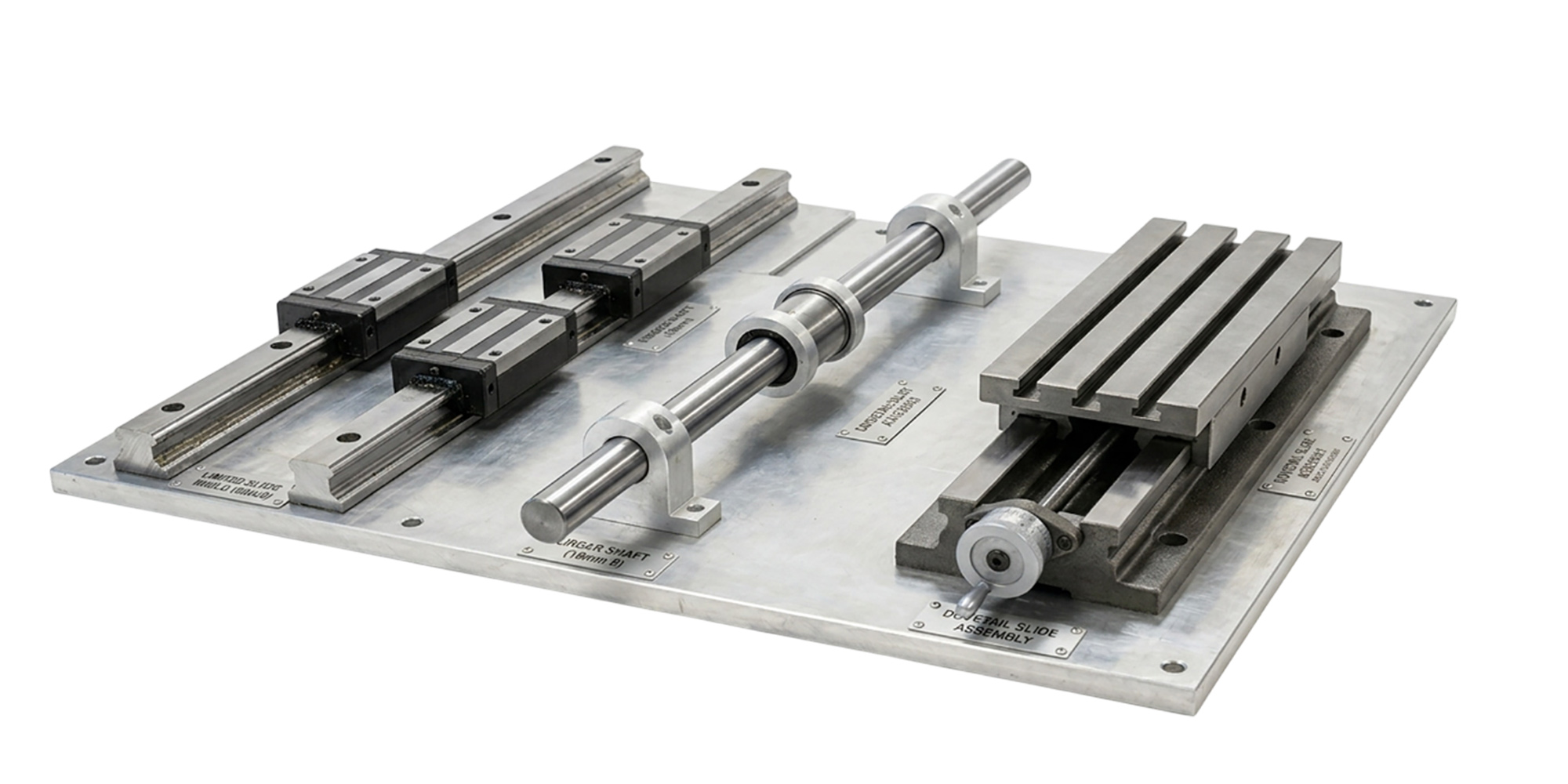
Think of it this way: a linear bearing wraps around a round shaft. A linear guide rides on top of a profiled rail. That single structural difference cascades into almost every performance characteristic that follows.

微信图片_20260320095218_184_33


c536967c-a7f3-462a-b376-e7e8f5377613


Head-to-Head Comparison

FACTOR

LINEAR GUIDE

LINEAR BEARING

Stiffness

Up to 10× higher — full rail support + conforming raceways

Moderate — point contact limits rigidity; shaft deflects under load

Load Capacity

High in all 4 directions — 45° contact angle

Direction-dependent — radial loads handled well, moment loads less so

Precision

Sub-micron to micron range — precision-ground raceways

Moderate — accuracy depends on shaft straightness

Friction

0.002 – 0.01 (with preload)

0.001 – 0.005 (lower, point contact)

Installation

Demanding — rail must be flat, parallel, fully supported

Flexible — shaft spans gaps, tolerates misalignment

Maintenance

Regular lubrication required; integrated grease ports

Near maintenance-free — fewer moving parts

Environment

Better — seals and wipers protect raceways

Vulnerable to contamination between ball and shaft

Cost

Higher upfront cost

Significantly lower — simpler manufacture

Preload

Yes — Z0 to C3 grades; eliminates play, boosts rigidity

No — cannot be meaningfully preloaded


Stiffness: The Number That Changes Everything

Industry data from Thomson Industries places linear guides at roughly 10× the stiffness of equivalent linear bearings. This isn’t a minor advantage — it’s the reason entire industry verticals have migrated from round-shaft to profile-rail systems over the past two decades.

The physics are straightforward. A linear bearing makes point contact between each ball and the round shaft — a tiny contact patch under high stress.

A linear guide uses gothic-arch raceways that conform to the ball’s curvature, dramatically increasing contact area and spreading the load. Add preload (a deliberate internal compressive force that removes clearance), and stiffness climbs further — up to 13% of the dynamic load rating without significantly sacrificing service life.

For applications where deflection under load translates directly to positioning error — semiconductor wafer handling, 5-axis CNC, coordinate measuring machines — this stiffness advantage is non-negotiable.

Stiffness is not just a performance spec. In precision machinery, it’s the difference between a part that passes inspection and one that doesn’t.


Load Direction Matters More Than You Think

Linear bearings have a dirty secret: their load capacity varies dramatically depending on which direction you push them.

Radial loads (perpendicular to the shaft) are handled well. Moment loads — the kind that arise when a load is cantilevered away from the bearing center — cause rapid rating reductions. Engineers must apply the 2:1 bearing ratio rule to avoid binding.

Linear guides carry equal rated loads in all four principal planes. Their 45° ball contact geometry means a downward force, an upward force, and a side force all engage the same number of balls under approximately the same contact mechanics. This makes system design far more predictable.


Where Each Technology Excels

Choose a Linear Guide when:

  • Your application demands micron or sub-micron repeatability

  • Loads are heavy, multi-directional, or involve significant moments

  • Preload is needed to eliminate backlash or increase dynamic stiffness

  • The rail can be fully supported and precisely aligned throughout its length

  • Long-term precision retention under continuous duty cycles is required

Best fits: CNC Machining, Semiconductor Equipment, Laser Cutting, Inspection & Metrology, Industrial Robots, Medical Imaging Systems, High-Speed Gantries


Choose a Linear Bearing when:

  •  Budget constraints are real and precision requirements are moderate (±0.1 mm)

  • The shaft needs to span unsupported gaps (e.g. gantry-style designs)

  • Installation surfaces are not precisely machined or aligned

  • Loads are primarily radial and relatively light

  • Interchangeability between supplier brands is a priority

 Best fits: Conveyor Systems, 3D Printers, Light Pick-and-Place, Gantry Bridging, Material Handling, Cost-Sensitive Automation 


The Preload Advantage — Exclusive to Linear Guides

One feature sets linear guides entirely apart: preload. By using oversized balls or offset raceways, manufacturers introduce a controlled internal compressive force that removes all internal clearance.

The result is a system with zero play — one that behaves more like a rigid structure than a bearing.

Preload grades typically run from Z0 (light, ~2% of dynamic rating) through C0, C1, C2, up to C3 (heavy, ~15%). Higher preload means higher stiffness, but also higher friction and heat generation.

Selecting the right grade requires balancing your stiffness requirements against your drive force budget.

Linear bearings offer no equivalent mechanism. Their clearance is fixed by manufacturing tolerances, and while loose fits can be specified, tight fits risk binding on thermal expansion.


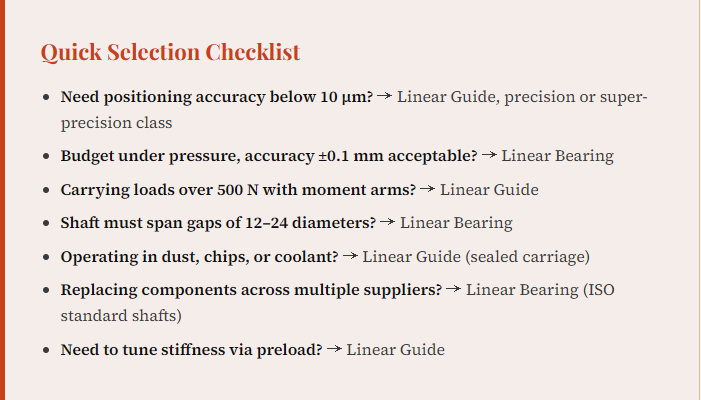
Quick Selection Checklist

微信图片_20260320105254_185_33


Maintenance & Expected Lifespan

Proper maintenance directly impacts the service life and total cost of ownership of both component types.

Factor

Linear Guide

Linear Bearing

Lubrication Interval

Every 50–500 km travel or 6 months

Light relubrication as needed; some lifetime-lubricated

Lubricant Type

Grease (ISO VG 32–68) or oil mist

Light grease or oil; polymer types need none

Typical L10 Life

50,000 – 500,000 km

5,000 – 100,000 km

Failure Mode

Pitting, flaking of raceways; ball wear

Ball cage fracture, shaft wear, brinelling

Replacement Cost

High (precision rails + carriages)

Low (bearings cheap; shaft may need replacement)

Self-Lubricating Option

Available (lube units in end caps)

Yes — polymer/PTFE-lined bushings


Pro Maintenance Tip: For linear guides in CNC applications, use centralized lubrication systems (oil mist or micro-dosing) rather than manual greasing. This ensures consistent film formation in the raceways and can extend carriage life by 3–5× compared to periodic manual lubrication.

For linear bearings used on ground shafts, inspect shaft hardness (HRC 60+ recommended), surface finish (Ra 0.2–0.4 μm), and roundness before replacing bearings. A worn shaft will destroy new bearings rapidly.


How to Choose: Linear Guide or Linear Bearing?

Use this decision framework to quickly narrow down the right choice for your application. Start with the most critical constraint, then verify with secondary factors.

Decision Rule #1 — Load & Rigidity: If your application involves cutting forces, moment loads, or you need sub-100-micron repeatability, always choose a linear guide. Linear bearings simply cannot provide the structural stiffness required.

Decision Rule #2 — Budget & Simplicity: If loads are light and primarily axial, stroke lengths are short-to-medium, and cost is a major constraint, a linear bearing on a ground shaft is often the right answer — especially for high-volume production where per-unit BOM cost matters.


Plain Bearings: A Third Option Worth Knowing

Both technologies above use rolling elements. But a third category — plain (sliding) linear bearings — replaces balls with a low-friction polymer or bronze surface sliding directly on a shaft or boxway.

Plain bearings carry the highest loads of any linear bearing design, absorb shock without catastrophic failure, and tolerate contamination that would destroy a ball-type system.

Their friction coefficient (typically 0.05–0.1) is far higher than rolling-element designs, and they lack the precision of profiled rails. But in heavy machine tools, presses, and dirty industrial environments, they remain the most robust choice.


Conclusion

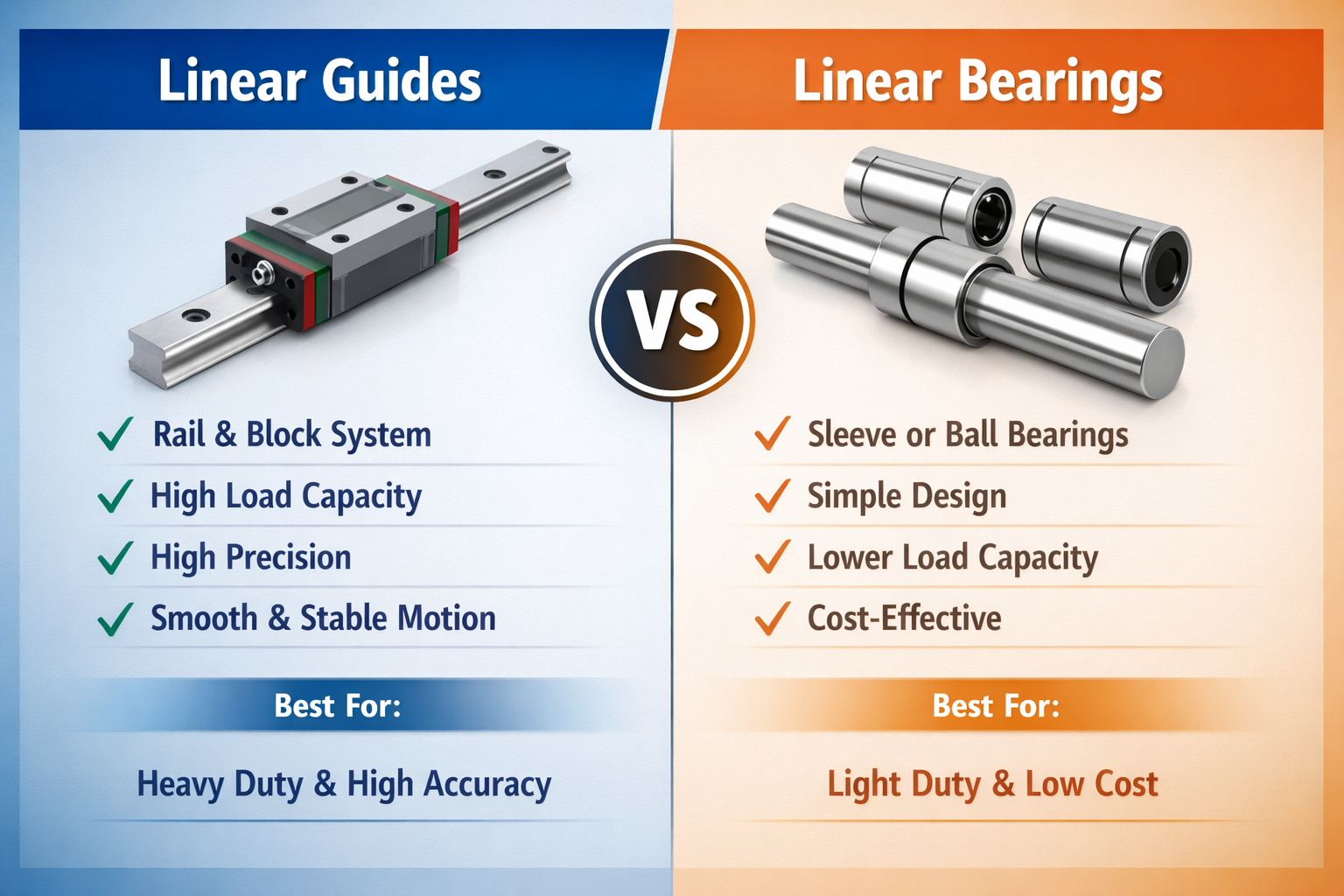
Linear guides win on stiffness, precision, preloadability, and multi-directional load handling. They are the default choice for any application where accuracy is a system requirement rather than a nice-to-have.

Linear bearings win on cost, installation flexibility, and simplicity. When the application doesn’t demand micron-level repeatability and the shaft needs to bridge unsupported gaps, they remain an elegant, economical solution.

The mistake engineers make most often isn’t choosing the “wrong” technology — it’s under-specifying. Define your precision, load, and environment requirements first. Let the physics make the decision.


Linear Guides vs. Linear Bushings vs. Dovetail Slides

Linear Guides vs. Linear Bushings vs. Dovetail Slides

Introduction: Why Linear Motion Choice Matters Every machine that moves in a straight line relies on a linear motion system — from the most delicate...
Read More
Linear Guide: Key Factors That Influence Linear Rail Costs

Linear Guide: Key Factors That Influence Linear Rail Costs

For purchasing engineers or equipment manufacturers, the cost of linear motion guides is a key consideration when selecting products. However, the...

Read More
Linear Guides in Robotics: Enabling the Next Generation of Automation

Linear Guides in Robotics: Enabling the Next Generation of Automation

What Are Linear Guides? A linear guide — also called a linear motion guide, LM guide, or linear rail — is a precision bearing system engineered to...

Read More