


Bearing Static vs Dynamic Load: C, C0, L10 Explained + Free Calculator
Bearings play a vital role in machinery by ensuring smooth motion and reducing friction. Understanding load capacities, specifically static load vs...
4 min read
William
:
Jun 1, 2026 5:49:37 AM
Table of Contents
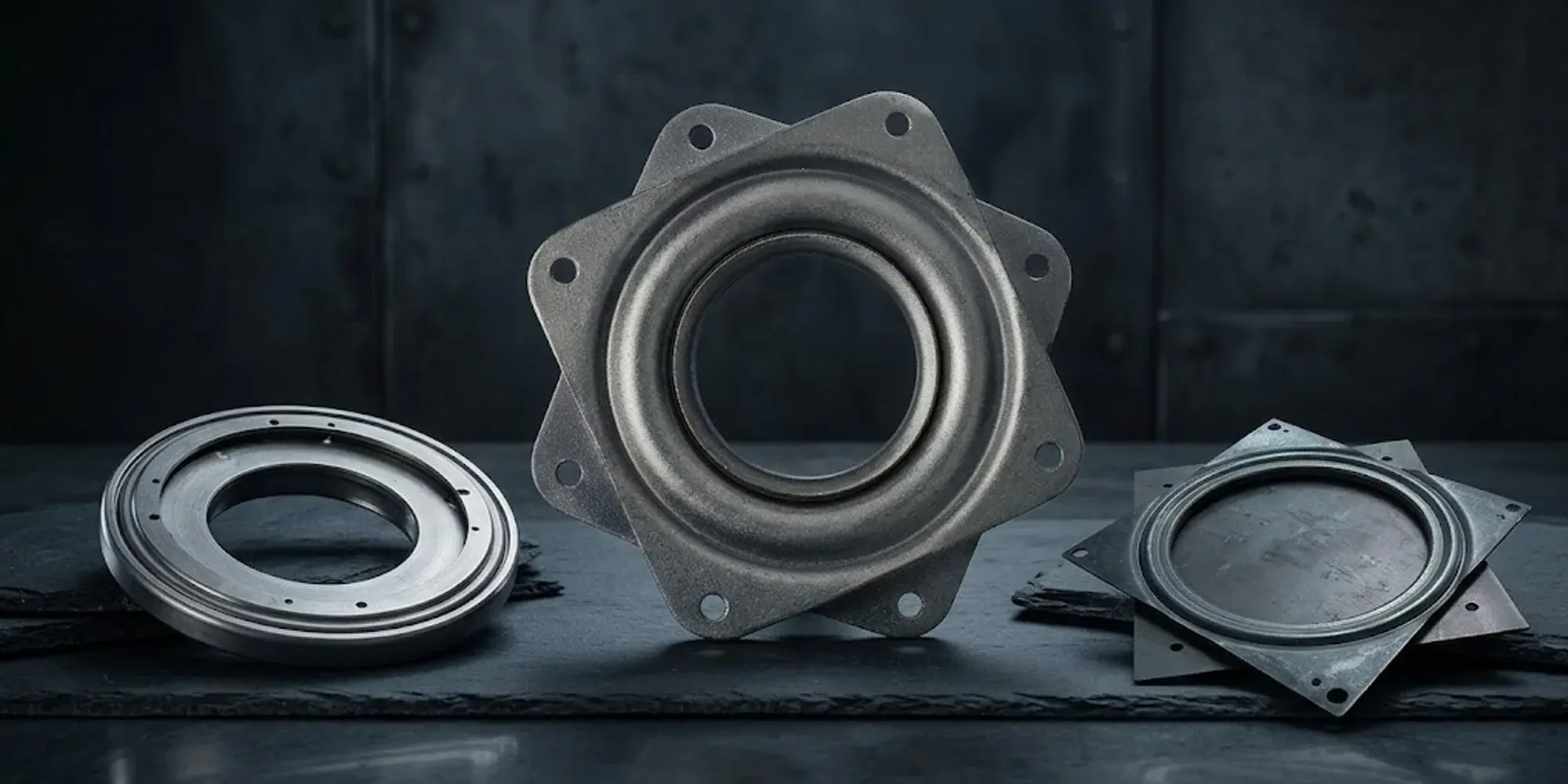
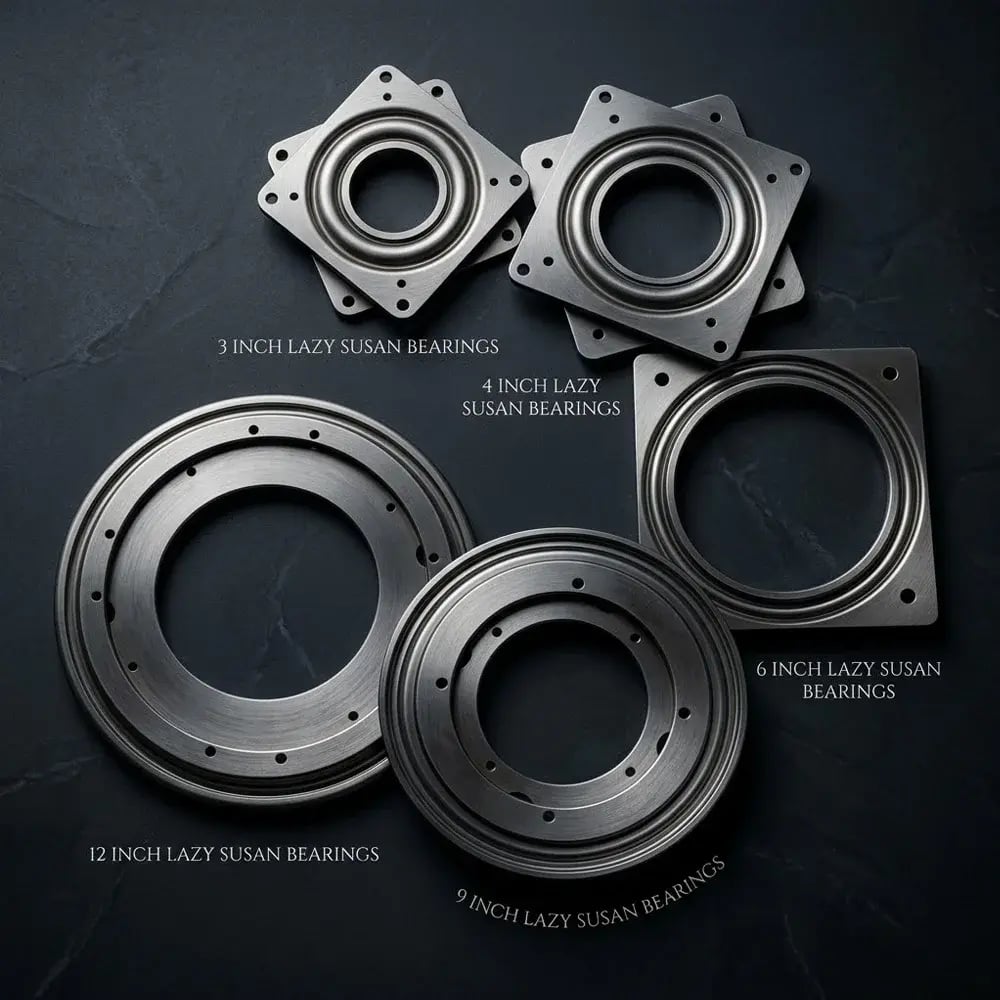
The term gets used loosely. In practice, lazy susan hardware refers to the turntable bearing assembly — two circular steel (or aluminum) plates with ball bearings between them — that sits between your rotating surface and its fixed base.
It's not the tray, the cabinet, or the shelf. It's the mechanical component that makes smooth, load-bearing rotation possible.

Getting this component right determines whether your platform spins effortlessly for years or wobbles and binds after a few months of use.
The single most common sizing mistake: choosing a bearing diameter based on the bearing itself, not the turntable it will support.
Here's the practical rule: your bearing diameter should be roughly 1/3 to 1/2 of your turntable's total diameter. A 12-inch lazy susan tray doesn't need a 12-inch bearing — it needs a 3" or 4" one.
Bearing Size → Supported Turntable Diameter
The 6-inch bearing covers the widest practical range and is the most commonly specified size for kitchen, retail, and display applications. If your turntable falls between two ranges, go up one size — the extra stability is worth it.
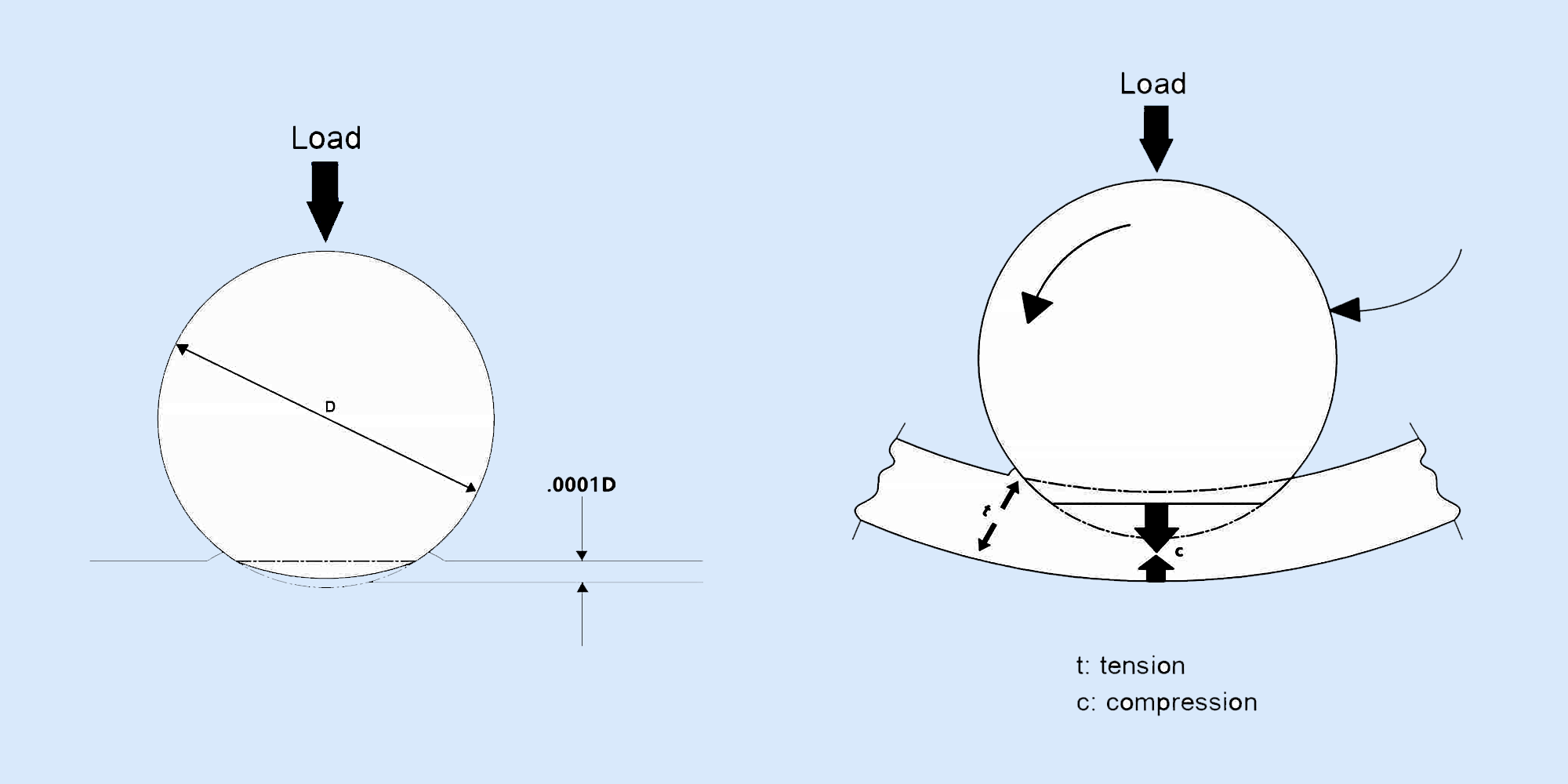
Every bearing has a rated load capacity. Exceeding it doesn't just wear the bearing faster — it can cause the bearing to deform under load, creating binding, noise, and uneven rotation.
Load Capacity — Standard Steel Bearings
For our aluminum thin-section bearings (ASL series), the range extends from 100 lbs (ASL120-085) up to 1,450 lbs (ASL1000-160).
A practical approach: estimate your maximum load (contents + platform weight), then add a 25–30% safety margin before selecting. A display rotating with 400 lbs of product should use a bearing rated for at least 500–520 lbs — i.e., a 6-inch or 9-inch unit.
For tall rotating structures (> 4 ft)
Use two bearings — one at the top, one at the base. A single bearing concentrates all lateral force at one point; doubling up distributes that force and prevents premature deformation of the ball races.
Both options are available across the bearing lineup. The choice affects noise, maintenance frequency, and operating environment.
Ungreased
✓ Apply your own lubricant
✓ Easy to inspect & maintain
✓ Better for dry/clean environments
Slightly more friction out of box
Greased (CG)
✓ Pre-loaded, quieter from day one
✓ Ideal for high-cycle use
✓ Best when maintenance access is limited
Avoid in food-contact use unless food-safe grease
Available greased models:
6CG 9CG 12CGA detent is a small notch mechanism that creates a tactile "click" stop at set positions during rotation. Not every application needs one — but when it matters, it really matters.
Detent availability by bearing size
Standard lazy susan bearings are cold-rolled steel — robust, cost-effective, and suitable for the vast majority of applications. But there's a second bearing family worth knowing: our aluminum thin-section bearings (the ASL series).
The ASL series is machined from aluminum alloy and designed for applications where weight, precision, and compact cross-section matter more than raw load capacity at the lowest price point.
| Standard Steel | Aluminum Thin-Section (ASL) | |
|---|---|---|
| Material | Cold-rolled steel | Aluminum alloy |
| Width | ~0.75"–1" profile | 8.5 mm–16 mm (very thin) |
| Outside diameter | 3"–12" | 119.8 mm–990 mm |
| Load range | 200–1,000 lbs | 100–1,450 lbs |
| Best for | Furniture, storage, display | Robotics, scientific instruments, precision displays |
The ASL series runs from ASL120-085 (119.8 mm OD, 100 lb thrust capacity) to ASL1000-160 (990 mm OD, 1,450 lb capacity). The thin cross-section — as narrow as 8.5 mm — makes them ideal when vertical clearance is constrained.
Use this table to match your project type directly to the right bearing spec.
| Project Type | Size | Load | Greased? | Detent? |
|---|---|---|---|---|
| Kitchen cabinet | 3" or 4" | 200–300 lbs | Optional | No |
| Dining table turntable | 6" | 500 lbs | Yes (6CG) | No |
| Retail product display | 6" or 9" | 500–750 lbs | Yes | Yes (9") |
| Heavy display / industrial | 12" | 1,000 lbs | Yes | Yes |
| Precision / robotics | ASL series | 100–1,450 lbs | N/A | No |
Matching the right screw to the bearing prevents two common failures: screws that bottom out before clamping, and holes that strip because the pilot diameter was wrong.
| Bearing Size | Screw Size | Pilot Hole |
|---|---|---|
| 3", 4", 6" | #6 screws | 5/32" |
| 9", 12" | #8 screws | 3/16" |
For 12-inch bearings using #10 flat head screws: countersink the holes to prevent screw heads from protruding above the plate surface and causing contact with the rotating plate. Need a full installation walkthrough? See our lazy susan hardware kit guide.
Lazy susan hardware isn't complicated — but the details matter. Size your bearing to your turntable diameter, not the other way around. Build in a 25–30% load margin. Choose greased if noise and maintenance access are concerns. Add a detent only where fixed stop positions add real value.
If you're working on a precision application where weight and cross-section matter, our ASL aluminum thin-section series opens up options that standard steel bearings simply can't match.
Technically possible if the load is light (under 200 lbs), but a 4-inch bearing rated for turntables up to 25" is the safer, more stable choice for that diameter.
A single-detent 9-inch bearing locks at one position (usually 0°). The 8-detent version creates 8 equally spaced click stops at 45° intervals — useful for display platforms that need to present multiple faces at set angles.
Only if your rotating structure exceeds approximately 4 feet in height. At that height, side-to-side (moment) loads become significant enough to damage a single bearing. Two bearings — one near the top, one at the base — distribute those forces properly.
Both can last for years with proper use. Greased bearings stay quieter longer in high-cycle applications. Ungreased bearings are easier to maintain and relubricate on your own schedule. For most household use, either works well.
Not directly — they use metric dimensions (millimeters) and different bolt circle patterns. Always cross-reference part numbers. The ASL series includes cross-reference codes (e.g., KIT12876 for ASL120-085) to assist with sourcing.
Bearings play a vital role in machinery by ensuring smooth motion and reducing friction. Understanding load capacities, specifically static load vs...
Bearing size charts are not complicated once you know the logic. The numbers follow a fixed pattern — and once you get one bearing number right,...
Can you fit a bearing with 35,000N load capacity in a 30mm radial envelope? The answer is no for cylindrical roller bearings, but yes for needle...