

 Robert
How to Clean Ceramic Bearings?
 Richard : Aug 26, 2025 10:55:56 PM
Curious about maintaining ceramic bearings? Questions like “What makes ceramic bearings better?”, "What can I use to clean ceramic bearings?" or...
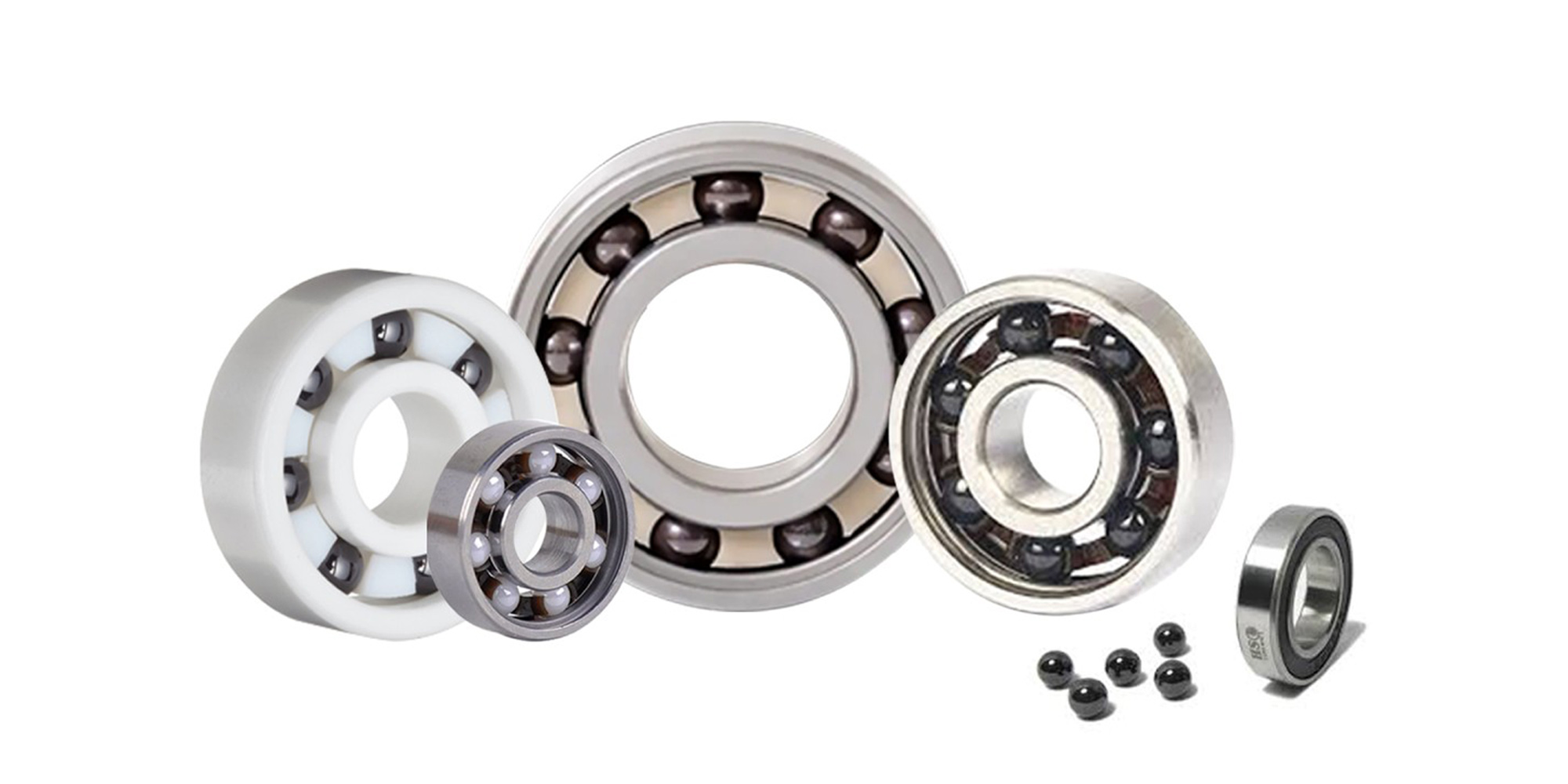
Ask any mechanical engineer to name one part they replaced with ceramic. Bearings will come up almost every time, and they never looked back. The reasons are rooted in physics and materials science — and once you understand them, the enthusiasm becomes entirely rational.
Before diving into ceramics specifically, it helps to be precise about what a bearing is doing mechanically.
A bearing’s job seems simple. It lets one machine part rotate (or slide) against another. It also carries a load and reduces friction.
The bearing achieves this by interposing rolling elements — balls or rollers — between two rings called races.
Instead of one large surface grinding against another, you get many small rolling contacts. Each contact has a tiny contact patch, which greatly reduces friction energy.
The enemy of any bearing is the energy lost at those rolling contact points. Some of it escapes as heat, some as vibration, some as acoustic noise.
Over time, repeated contact cycles fatigue the metal, pitting and spalling the race surfaces until the bearing eventually fails.
Everything that makes a ceramic bearing remarkable comes from its superior behavior at exactly these contact zones.
|
30% Friction reduction vs. steel |
40% Lighter than steel balls |
10x Longer fatigue life (typical) |
1000°C Operating temp ceiling |
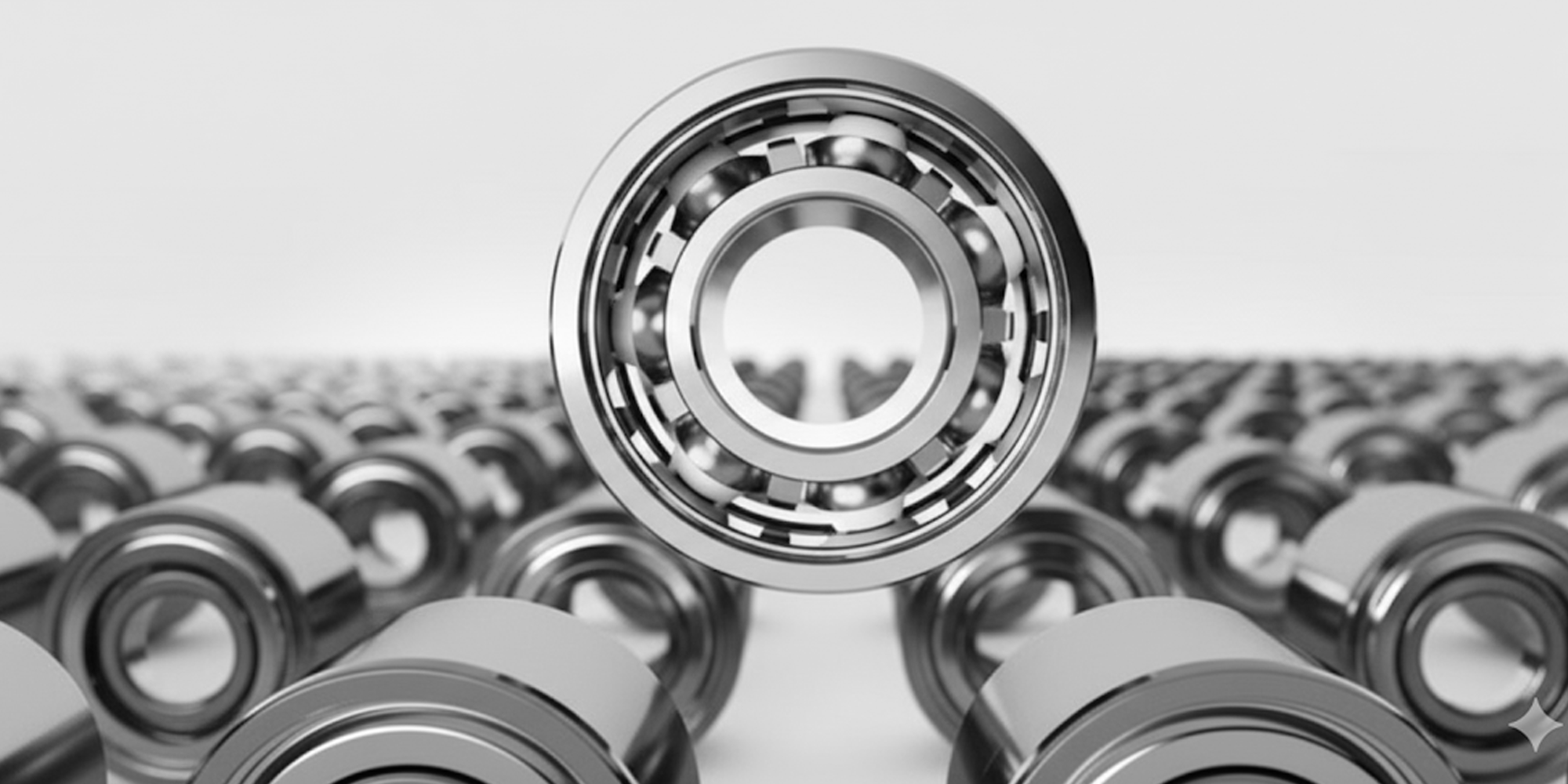
A standard ceramic (hybrid) bearing shares the same geometric architecture as any conventional deep-groove ball bearing.
The difference lies entirely in what the rolling elements are made of.
A bearing has four main parts. They are the outer race, which is fixed in the housing. They also include the inner race, which rotates on the shaft.
The rolling elements are balls or rollers. The cage, or retainer, keeps the rolling elements evenly spaced around the races.
In a hybrid ceramic bearing, the balls are silicon nitride (Si₃N₄) while the races remain hardened steel.
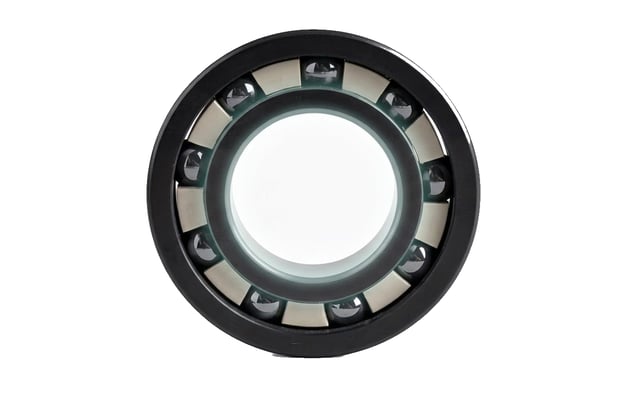
In a full ceramic bearing, all components — races and balls alike — are ceramic.
Each configuration offers a different balance of performance, cost, and application suitability.
|
Component |
Hybrid Ceramic |
Full Ceramic |
|
Balls / Rolling elements |
Silicon nitride (Si₃N₄) |
Silicon nitride or ZrO₂ |
|
Inner race |
Hardened steel |
Ceramic |
|
Outer race |
Hardened steel |
Ceramic |
|
Cage / Retainer |
Nylon or steel |
Nylon, PTFE, or ceramic |
|
Standard drop-in fit |
Yes — ISO/ABEC compliant |
Yes — ISO/ABEC compliant |
In high-speed applications, ceramic bearings are often perceived to provide significant performance benefits because their unique properties.
The performance advantages of ceramic bearings are direct consequences of measurable material properties. Understanding these five properties explains everything engineers experience when they switch from steel to ceramic.
Silicon nitride registers around 1,580 HV on the Vickers hardness scale — more than twice as hard as typical bearing steel at around 700 HV.
Hardness governs resistance to surface indentation and wear. A harder rolling element resists micro-pitting at the contact zone — the primary fatigue mechanism in steel bearings.
The harder the ball, the longer it maintains its perfectly spherical geometry under cyclic stress.
Silicon nitride has a density of approximately 3.2 g/cm³, compared to bearing steel at roughly 7.8 g/cm³. That makes ceramic balls about 60% lighter for an equivalent size.
This matters enormously at high rotational speeds because spinning balls generate centrifugal force proportional to their mass.
Lighter balls exert far less force on the outer race to reduce stress and heat. This lower wear is the primary reason ceramic bearings achieve much higher speed ratings.
Ceramic's coefficient of thermal expansion (CTE) is substantially lower than steel's.
Operating heat causes steel bearings to expand and alter internal clearances or preload. This thermal expansion compromises precision and can often lead to premature failure.
Ceramic balls expand far less, maintaining dimensional stability across a wider temperature range. In applications with rapid thermal cycling, this stability is critical.
Modern silicon nitride balls are manufactured to extremely fine surface finish tolerances. They often exceed the finish quality of equivalent steel balls at the same grade.
A smoother ball surface means a smaller, more consistent contact patch against the race, lower friction, less heat, and less lubricant shear.
Silicon nitride does not oxidize, rust, or react with most acids, alkalis, and solvents.
Steel bearings require lubrication partly for corrosion protection — and still fail in aggressive chemical environments. Ceramic's inertness removes this vulnerability entirely.
Follow the energy path through a ceramic bearing during operation:
Radial or axial forces from the rotating shaft pass directly into the inner race. These forces are then transmitted to the rolling elements at the specific contact zones.
Because ceramic is harder and smoother than steel, the contact patch between ball and race is smaller and more stable. Less elastic deformation at the contact means less energy lost as heat and vibration.
The lighter ceramic balls generate far less centrifugal force pressing outward against the outer race. This keeps contact stresses low even at high RPM — the key reason ceramic bearings achieve higher speed ratings.
Reduced friction generates less heat, and that lower operating temperature means the lubricant degrades more slowly. Lubrication intervals extend and the overall thermal profile of the assembly stays more stable.
Each revolution subjects rolling elements and races to cyclic stress. The harder ceramic surface resists crack initiation and micro-pitting far longer than steel. This superior durability explains the 5–10x service life extension seen in comparative testing.
|
“Ceramic bearings don’t just reduce friction — they change the entire thermal and stress regime inside the bearing. The cumulative impact of these factors creates a powerful cascading effect. This explains why performance improvements are far more significant than material property differences alone would suggest.” Senior Applications Engineer, Industrial Bearing Systems |
|
Feature |
Hybrid Ceramic |
Full Ceramic |
|
Rolling elements |
Ceramic (Si₃N₄) |
Ceramic |
|
Races |
Hardened steel |
Ceramic (ZrO₂ or Si₃N₄) |
|
Corrosion resistance |
Moderate — races still corrode |
Full corrosion immunity |
|
Electrical insulation |
Partial |
Complete |
|
Speed capability |
Very high |
Very high |
|
Shock load tolerance |
Good |
Moderate — brittle races |
|
Drop-in replacement |
Yes |
Yes |
|
Cost premium vs. steel |
3–10x |
20–50x |
|
Best for |
High-speed machinery, motors, spindles |
Corrosive environments, MRI, food processing |
Hybrid ceramic is the pragmatic choice for the vast majority of industrial, automotive, and performance applications. It delivers most of the performance gains at a fraction of the cost of full ceramic bearings.
Furthermore, hybrid designs tolerate shock loads and misalignment much better than full ceramic options. This is because full ceramic races are often too brittle to handle those specific stresses.

Lighter balls + lower friction = higher DN limits. CNC machine tool spindles, turbochargers, and dental handpieces all operate at RPM ranges where this matters most.
Lab testing consistently shows hybrid ceramic bearings lasting 5–10x longer than equivalent steel bearings under identical conditions. In high-cost production environments, this transforms maintenance scheduling.
Less friction means less heat. Cooler bearings preserve lubrication, maintain tighter tolerances, and reduce thermal expansion effects throughout the assembly.
Electric motors and generators often suffer from a specific failure mode known as electrical fluting. This occurs when stray bearing currents create microscopic arc pitting across the surface of the race. Since ceramic is electrically non-conductive, it breaks the current path. As electric vehicles proliferate, this benefit increasingly drives ceramic adoption.
Full ceramic bearings run indefinitely in wet, acidic, and alkaline environments where steel would fail within hours. Applications in food processing, pharmaceutical production, chemical plants, and marine equipment leverage this directly.
Ceramic materials feature low friction and chemical inertness that allow bearings to operate with lighter lubricants. This efficiency results in longer re-lubrication intervals or even lubrication-free operation in specialized environments.
Such capabilities are critical for vacuum chambers and cleanroom robotics where traditional lubricants could contaminate the environment.
Steel bearings are magnetic — a serious problem in MRI systems, electron microscopes, and precision instruments. Ceramic bearings are entirely non-magnetic, enabling use in environments where metal would compromise measurement accuracy or patient safety.
|
Brittleness Warning Ceramic bearings offer more than just reduced friction. Unlike steel that deforms plastically, ceramics will crack under sufficient impact or bending stress. This makes ceramic unsuitable for applications with high shock loading, vibration, or significant misalignment. |
|
Limitation |
Impact |
Mitigation |
|
Brittleness |
Risk of fracture under shock load |
Avoid impact applications; use hybrid not full ceramic |
|
Cost |
3–50x more expensive than steel |
Evaluate on total cost of ownership, not unit price |
|
Misalignment sensitivity |
Edge loading can crack ceramic balls |
Ensure precise shaft/housing alignment on install |
|
Installation fragility |
Impact during fitting can chip ceramic |
Use press tools; never hammer; handle carefully |
|
Lower load capacity (full ceramic) |
Ceramic races have lower fracture toughness |
Use hybrid for heavy radial loads |
Ceramic bearings have transitioned from exclusive aerospace use into a broad range of industries over the last twenty years. This shift is driven by enhanced manufacturing processes and the falling cost of silicon nitride.
High-speed CNC machining centers and grinding spindles were among the first mass adopters. Gemini said
Higher speed ratings and lower heat generation directly impact machining precision. These factors extend service life and improve production uptime, which is measurable in dollars per shift.
The rapid growth of electric vehicles has made electrical fluting protection a mainstream concern.
Traction motors and generators increasingly specify ceramic bearings as standard equipment. This shift occurs as motors spin faster and carry higher electrical currents.
Jet engine auxiliary gearboxes and gyroscopic instruments leverage ceramic’s light weight and thermal stability. Satellite attitude control systems and landing gear actuators also rely on these materials for their corrosion resistance. These advantages are critical in aerospace applications where failure is not an option.
Dental handpieces run at up to 400,000 RPM — essentially impossible for steel bearings to sustain reliably. Ceramic bearings are now standard in high-speed dental drills. MRI and CT scanner gantries use full ceramic for non-magnetic requirements.
Pump and agitator bearings in concentrated acids or alkalis use full zirconia or silicon nitride ceramic. These materials eliminate corrosion failure and prevent metal contamination of process streams.
Formula One teams have used ceramic bearings in gearboxes and wheel assemblies for years. Ceramic bottom brackets and hub bearings are now available for competitive cycling.
These components offer measurable efficiency gains for road and mountain biking. Such performance improvements are highly valued at the professional and consumer levels.

Yes, in almost all cases. Ceramic bearings follow the same ISO and ABEC dimensional standards as steel bearings. They fit into existing housings and shafts without any modification. This compatibility allows for a direct, "drop-in" replacement in most industrial or performance machines.
The only consideration is ensuring the application’s load and speed conditions are appropriate for ceramic. It is particularly important to avoid high shock or impact loads for full ceramic variants. This precaution prevents the brittle races from cracking under sudden stress.
The lower rolling friction of ceramic reduces the mechanical energy converted to heat at each ball-race contact. Lighter ceramic balls also generate less centrifugal force at speed, further reducing contact stress and heat generation.
Operating at high speeds, ceramic bearings can run 20–40°C cooler than equivalent steel bearings. This lower temperature directly extends the life of the lubricant. It also helps the components maintain their critical dimensional stability during intense operation.
Hybrid ceramic bearings still require lubrication. This is because the steel races remain vulnerable to corrosion and fatigue without a protective layer.
Full ceramic bearings can sometimes run unlubricated in specific conditions (vacuum, cleanroom, food processing), but lubrication still extends life significantly in most applications.
Silicon nitride is a synthetic engineering ceramic. It is formed by sintering silicon and nitrogen under high pressure and temperature.
Silicon nitride combines extreme hardness (≈1,580 HV) with excellent fracture toughness for a ceramic. Its low density ($3.2\text{ g/cm}^3$) combined with high thermal stability makes it ideal for high-speed use. These properties, along with its chemical inertness, make it the dominant material for hybrid bearing balls globally.
Hybrid silicon nitride bearings consistently demonstrate 5–10x longer fatigue life than equivalent all-steel bearings. This holds true under comparable conditions in controlled laboratory tests.
Real-world results naturally vary across different operating conditions. Still, most maintenance engineers who have switched report a 3–5x improvement in bearing service life.
It depends entirely on the application. For low-speed, lightly loaded, easily accessible bearings, the TCO advantage rarely justifies the premium.
Ceramic bearings deliver the strongest ROI in high-speed, high-temperature, corrosive, or hard-to-access applications. In these conditions, extended service life and reduced downtime generate significant savings. Lower energy consumption adds further, with a positive ROI typically achieved within one to three years.
Ceramic bearings work because the physics demands it. Harder surfaces resist fatigue. Lighter balls reduce centrifugal stress.
Smoother contact generates less heat. Chemical inertness eliminates corrosion. None of these are marginal gains — in the right application, they're transformative.
The engineers who swear by them aren't enthusiasts. They're pragmatists who've seen the maintenance logs, measured the temperature differentials, and watched the service intervals extend. The science is settled. The only question left is whether your application is the right one.
If you want to learn more about ceramic bearings, please contact LILY Bearing.
|
The Bottom Line Ceramic bearings work by exploiting fundamental material properties that steel simply cannot match. Hardness, low density, thermal stability, and chemical inertness each contribute a distinct performance advantage.
Together, they create a rolling contact environment dramatically superior to steel at high speeds and in demanding conditions. Engineers rely on these bearings for reasons far beyond a simple interest in new technology. The underlying physics consistently delivers the performance levels promised by the technical specifications.
As manufacturing costs continue to fall and electric motor adoption accelerates globally, ceramic bearings are transitioning from specialist components to mainstream engineering practice. Understanding how they work is increasingly baseline knowledge for any mechanical engineer. |
 Richard : Aug 26, 2025 10:55:56 PM
Curious about maintaining ceramic bearings? Questions like “What makes ceramic bearings better?”, "What can I use to clean ceramic bearings?" or...
 Robert : Mar 12, 2026 9:57:32 PM
KEY NUMBERS AT A GLANCE �� $64.73 Billion EV Bearing Market (2033) �� 32.14% Market CAGR 2023–2033 ⚙️ $693 Million Si₃N₄ Market...
 William : Aug 26, 2025 9:54:35 PM
Low temperature bearings, also known as cryogenic bearings, are designed to operate in extreme low temperature environments ranging from minus 40...