

Home/
Blog/
High Temperature Bearings for Furnace & Oven Use

7 min read

High Temperature Bearings for Furnace & Oven Use

High Temperature Bearings for Furnace & Oven Use
11:03

High temperature bearings are crucial for furnaces and ovens because they handle extreme heat without failing. They ensure smooth operation, last longer, and reduce downtime in high-heat conditions.

Standard bearings are not designed to withstand extreme heat and may experience deformation, accelerated wear, or premature failure. Their lubricants can also break down, causing poor performance and faster damage.


What Are High Temperature Bearings?

High temperature bearings are precision-engineered rolling or sliding elements designed to operate reliably at temperatures that would cause conventional bearings to seize, deform, or fail outright.

In furnace conveyors, tunnel ovens, rotary kilns, and heat treatment equipment, bearings must endure not only extreme ambient heat but also rapid thermal cycling, oxidizing atmospheres, and contamination from ash, scale, or process gases.

Broadly speaking, a bearing is classified as "high temperature" when it is engineered to operate continuously above 150°C (302°F). Industrial applications for cement kilns, glass furnaces, and continuous annealing lines may push requirements to 600°C (1112°F) and beyond.


Key Characteristics of High Temperature Bearings


Advanced Materials and Coatings

Alloys such as stainless steel and graphite-based materials are commonly used in high temperature bearings. These materials are designed to withstand temperatures exceeding 400°C. These materials stay strong and resist heat, ensuring durability. Graphite helps reduce friction and wear, which makes the high temperature bearings last longer in extreme heat.

Protective coatings, like phosphate treatments, create a tough surface on bearings. This corrosion-resistant surface enhances wear resistance and helps the bearings last longer. These coatings reduce friction and prevent material degradation. This helps the bearings maintain their performance and durability in demanding conditions.


Lubrication Methods

Solid lubricants like graphite or molybdenum disulfide reduce friction in high heat without breaking down. High-temperature greases, made with special oils, stay stable in extreme heat. They keep the high temperature bearings lubricated, preventing failure and extending their life.

Minimal relubrication and less downtime are important in harsh environments to keep things running smoothly. They help reduce the need for frequent maintenance. With high-quality lubricants and coatings, high temperature bearings last longer without needing relubrication. This leads to fewer interruptions and better productivity, especially in tough conditions.


Internal Clearance and Sealing

Increased clearances in bearings allow space for materials to expand at extreme temperatures. This prevents stress or deformation, ensuring smooth operation. This extra room allows the bearing components to move freely and maintain smooth operation, even under high heat. It prevents damage and helps maintain the bearing's performance.

Specialized seals or shields are needed in high temperature bearings to prevent contamination from dust, dirt, or moisture. This helps protect the bearing from performance degradation. They help retain lubricants by preventing them from leaking out. This ensures consistent lubrication, reduces friction, and extends the bearing's lifespan.

Oxidation Resistant

Loose Clearance

HT Lubrication

Special Alloys

Heat Resistant


Why Standard Bearings Fail in High Heat

Standard carbon-chromium steel bearings (e.g., AISI 52100 / GCr15) are heat-treated to a hardness of 58–64 HRC. This hardness is maintained reliably only below approximately 120°C (248°F). Beyond this threshold, a series of failure modes accelerate rapidly:


Table 1 — Common High-Temperature Bearing Failure Modes

Failure Mode

Temperature Trigger

Root Cause

Consequence

Dimensional Instability

> 120°C

Retained austenite transforms, causing steel to grow

Preload loss, bearing seizure

Softening / Tempering

> 150°C

Steel hardness drops below 58 HRC

Plastic deformation of raceways

Lubricant Degradation

> 180°C

Grease base oil evaporates or oxidizes

Metal-to-metal contact, wear

Cage Failure

> 200°C (polymer)

Nylon/polyamide cage melts or chars

Rolling element scatter

Thermal Creep of Ring

> 250°C

Differential expansion loosens fits

Spinning, fretting, shaft damage

Oxidation / Scaling

> 300°C

Standard steel oxidizes rapidly in air

Surface pitting, loss of geometry


KEY INSIGHT

Even a brief excursion to 200°C in a standard bearing can cause permanent ring growth of up to 50 µm — enough to critically alter internal clearances and preload in precision spindle applications.


Key Materials & Their Temperature Ratings

Material selection is the single most important decision when specifying a high-temperature bearing. Each material brings a unique trade-off between maximum service temperature, hardness retention, corrosion resistance, and cost.

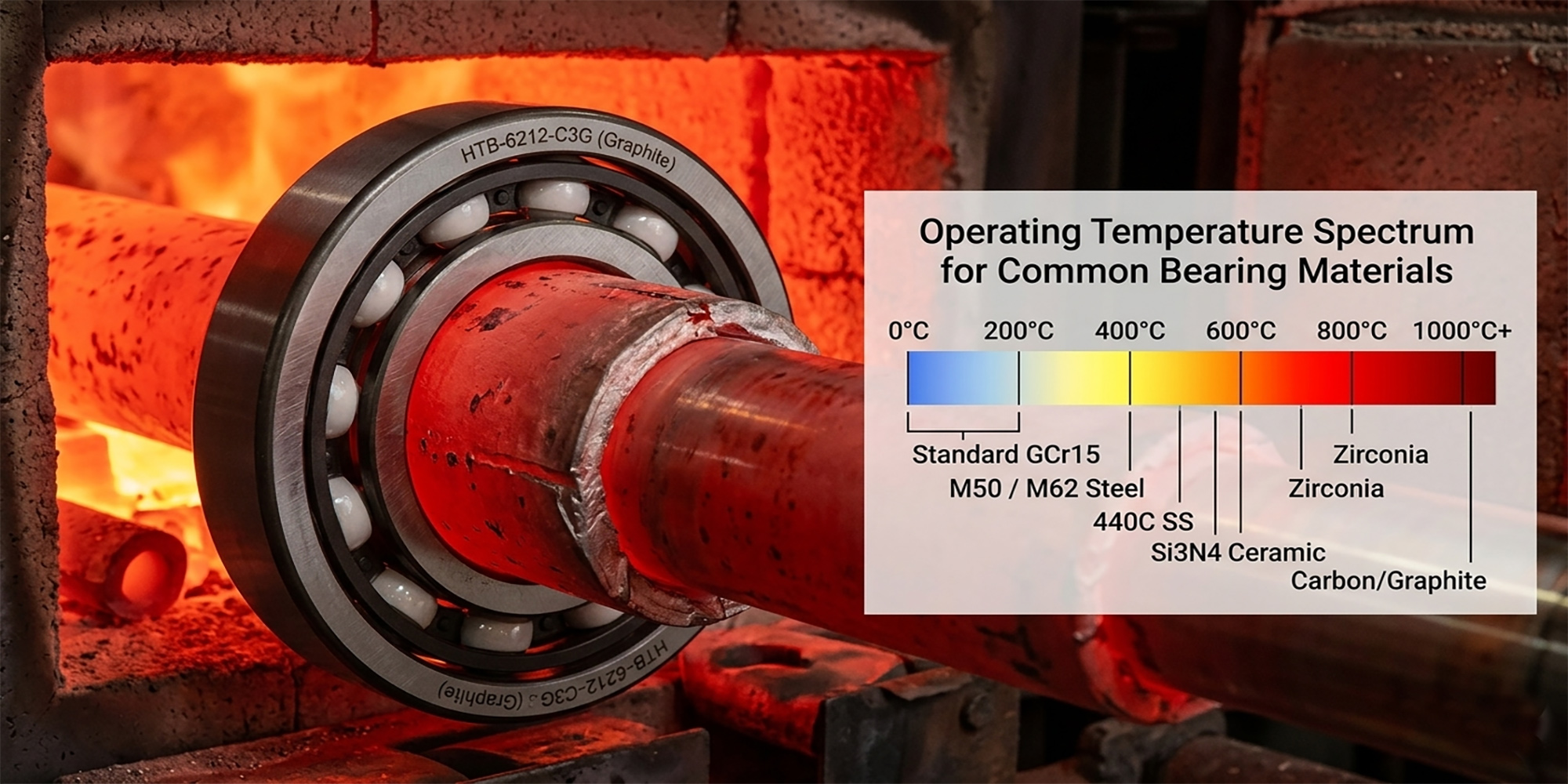
Operating Temperature Spectrum


Table 2 — Bearing Materials: Temperature Ratings & Properties

Material

Max Continuous Temp

Hardness

Key Advantage

Typical Use Case

GCr15 / 52100 Standard

120°C (248°F)

58-64 HRC

Low cost, widely available

Room-temp & mild heat only

M50 High-Speed Steel

315°C (600°F)

60-64 HRC

Excellent hardness retention at temp

Jet engines, industrial ovens

M62 High-Speed Steel

370°C (700°F)

62-66 HRC

Superior to M50 at higher temps

Aerospace, high-temp turbines

440C Stainless Steel

200°C (392°F)

58-62 HRC

Corrosion resistance

Food ovens, chemical environments

Silicon Nitride (Si3N4)

650°C (1200°F)

78 HRA

Low density, self-lubricating

Ceramics kilns, glass furnaces

Zirconia (ZrO2)

600°C (1112°F)

75 HRA

Excellent thermal shock resistance

Tunnel kilns, refractory handling

Carbon / Graphite

1000°C (1832°F) inert

N/A (soft)

Self-lubricating, extreme temp

Vacuum furnaces, inert-gas ovens

Inconel / Nimonic Alloy

500°C (930°F)

35-45 HRC

Superior oxidation resistance

Continuous annealing lines


Types of High Temp Bearings: Side-by-Side Comparison

Not all high-temperature bearings share the same rolling geometry. The bearing type determines load capacity, speed limits, and how well it handles angular misalignment — critical factors in furnace and oven equipment where thermal distortion of frames and shafts is common.


Table 3 — High Temp Bearing Types: Comparison Matrix

Bearing Type

Radial Load

Axial Load

Misalignment

Best Application

Deep Groove Ball (DGBB)

★★★

★★☆

Low

Small conveyors, fans, dampers

Angular Contact Ball

★★★

★★★

Low

Spindle drives in precision kilns

Cylindrical Roller

★★★★

Low

Low

Heavy roller hearth furnaces

Spherical Roller

★★★★

★★☆

HIGH

Rotary kilns, tunnel ovens, dryers

Tapered Roller

★★★★

★★★★

Low

Furnace door hinges, drives

Self-Aligning Ball

★★★

Low

VERY HIGH

Long conveyor shafts

Full-Complement Roller

★★★★★

Low

Low

Slow, very heavy kiln trunion rings

Sliding / Plain Bearing

★★★★

★★★

HIGH

Ultra-high temp (>600°C) support


PRO TIP

For rotary kiln riding rings and support rollers operating above 400°C, spherical roller bearings with an M50 or ceramic inner ring are the preferred configuration worldwide. The spherical geometry absorbs shaft deflection from thermal bowing while maintaining full-load capacity.


Lubrication Strategies for Extreme Heat

Lubrication failure is the primary cause of premature bearing failure in high-temperature environments. As temperature rises, conventional greases lose viscosity, separate (bleed), oxidize, and ultimately carbonize into abrasive sludge. Selecting the right lubrication strategy is as important as selecting the right bearing material.


Grease Lubrication Options


Table 4 — High Temperature Greases for Bearing Lubrication

Grease Type

Max Temp (Continuous)

Thickener

Key Properties

Typical Application

Lithium Complex

180°C (356°F)

Li-complex soap

Water resistant, good EP

Baking ovens, food conveyors

Polyurea

220°C (428°F)

Polyurea

Oxidation resistant, long life

Industrial ovens, motors

Bentonite / Clay

260°C (500°F)

Inorganic clay

No melt point, dry to touch

Kilns, paint-curing ovens

PFPE (Perfluoropolyether)

300°C (572°F)

PTFE

Inert, chemical resistant, FDA

Semiconductor furnaces, food ovens

Calcium Sulfonate Complex

250°C (482°F)

Ca-sulfonate

Excellent corrosion resistance

Steam ovens, moist environments


Solid & Dry Lubrication (Above 300°C)

When operating temperatures exceed the range of any grease, solid lubricants become the only viable solution. These include:

  • Graphite powder or graphite-bonded coatings — effective up to 500°C in oxidizing atmospheres

  • Molybdenum disulfide (MoS2) — excellent at 400°C in dry/inert environments; oxidizes above 450°C

  • Tungsten disulfide (WS2) — superior to MoS2 at higher temperatures and in vacuum

  • Hexagonal boron nitride (h-BN) — stable to 900°C, excellent for ceramic and refractory-lined furnaces

  • Carbon / graphite bushings — self-lubricating plain bearings for extreme temp applications up to 1000°C


Furnace & Oven Application Breakdown

Different thermal processing industries demand very different bearing specifications. Below is a concise reference for the most common high-temperature bearing applications across industrial and commercial sectors.


Table 5 — Industry Application Reference Guide

Application

Temp Range

Recommended Bearing

Material

Lubrication

Tunnel Baking Oven

150-280°C

Deep groove ball / CARB toroidal

440C SS or M50

Polyurea or PFPE grease

Pizza / Deck Oven Conveyor

200-350°C

Cylindrical roller or plain bearing

M50 or stainless

Bentonite or clay grease

Industrial Annealing Furnace

250-600°C

Spherical roller (C4 clearance)

M62 or Si3N4 hybrid

MoS2 or graphite paste

Rotary Kiln (Cement / Lime)

300-500°C

Large spherical roller, riding ring

Cast steel + M50 roller

Open gear grease + graphite

Glass Furnace Regenerator

400-750°C

Full ceramic or plain bearing

Si3N4 full ceramic

WS2 dry film

Vacuum Heat Treatment Furnace

200-1000°C (vac)

Angular contact ceramic

Si3N4 full ceramic

PTFE cage, dry or PFPE

Powder Coating Oven

180-220°C

Deep groove ball (shielded)

M50 or 52100 stabilized

PFPE or high-temp polyurea

Steelmaking Walking Beam Furnace

300-550°C

Spherical roller (C5 clearance)

M50 high-speed steel

Graphite paste, re-greased weekly


How to Choose the Right Bearing

Selecting a high-temperature bearing is a multi-variable engineering decision. The following seven-step framework guides engineers and procurement specialists through the process systematically.


Table 6 — 7-Step High Temperature Bearing Selection Checklist

Step

Factor

Key Question

Action

1

Temperature Profile

What is peak vs. continuous temp?

Define all three: continuous, peak excursion, thermal cycle frequency

2

Load Type & Magnitude

Radial, axial, or combined?

Calculate dynamic equivalent load P using bearing geometry

3

Misalignment Risk

Will the shaft deflect from heat?

If deflection >0.05°, specify spherical roller or self-aligning geometry

4

Bearing Material

What is the max service temp?

M50 for 150-315°C; Si3N4 ceramic above 400°C (see Table 2)

5

Internal Clearance

Will thermal expansion reduce clearance?

C3 at 150-250°C; C4 at 250-400°C; C5 above 400°C

6

Cage Material

Will the cage survive at temperature?

Brass or steel cage; PEEK or Si3N4 retainer for ceramics

7

Lubrication Method

Does any grease survive the peak temp?

Match lubricant to peak temp from Table 4; solid lube above 400°C


Table 7 — Quick-Reference Temperature vs. Specification Matrix

Temperature Range

Bearing Material

Clearance Class

Cage Material

Lubrication

Up to 120°C

GCr15 / 52100 Standard

CN or C3

Nylon / Polyamide

Standard lithium grease

120-200°C

52100 Stabilized / 440C SS

C3

Brass or steel

Lithium complex / polyurea

200-315°C

M50 High-Speed Steel

C3-C4

Machined brass

Bentonite / PFPE grease

315-400°C

M50 / M62 or Si3N4 hybrid

C4

Machined steel or PEEK

MoS2 paste / WS2 film

400-650°C

Si3N4 full ceramic

C4-C5

Si3N4 or carbon-graphite

WS2 or h-BN solid lubricant

Above 650°C

Carbon-graphite plain bearing

N/A

N/A (plain bearing)

Self-lubricating (carbon)


Installation & Maintenance Best Practices

Even the most precisely specified high-temperature bearing will fail prematurely if installed or maintained incorrectly. Heat-cycling, thermal expansion fits, and lubrication intervals all require special attention in furnace applications.


Installation Guidelines

  • Use induction heating for hot mounting — heat bearing evenly to 80-100°C above room temperature, maximum 120°C for standard grades. Never use open flame.

  • Verify interference fits at operating temperature — calculate thermal expansion of shaft and housing at maximum operating temperature.

  • Apply solid lubricant before assembly — for bearings above 300°C, apply a thin coat of WS2 or MoS2 to raceways and cage before installation.

  • Tighten to torque specification after thermal stabilization — allow equipment to reach operating temperature before final locknut tightening.

  • Use anti-fretting compound on housings — prevent fretting corrosion on bearings subject to repeated thermal expansion and contraction.


Preventive Maintenance Schedule


Table 8 — Recommended PM Intervals for High Temperature Bearings

Operating Temperature

Re-lubrication Interval

Vibration / Noise Check

Full Bearing Inspection

Up to 200°C

Every 1,000-2,000 hours

Monthly

Every 12 months

200-300°C

Every 500-1,000 hours

Every 2 weeks

Every 6 months

300-450°C

Every 200-500 hours

Weekly

Every 3 months

Above 450°C

Weekly or after each cycle (solid lube)

Daily monitoring recommended

Monthly visual + quarterly full


CRITICAL WARNING

Never mix lubricant types when regreasing high-temperature bearings. Lithium and polyurea greases are chemically incompatible — mixing causes rapid thickener breakdown and grease liquefaction, accelerating wear even at moderate temperatures.


Conclusion

High temperature bearings are perfect for furnaces and ovens because they can handle extreme heat. They use special materials and lubricants that keep them running smoothly and prevent wear. These bearings can also handle heavy loads, maintain accuracy, and resist damage from heat or dirt.

Choosing the right bearing and taking good care of it keep things running smoothly. This reduces unexpected problems, less downtime, and helps your equipment last longer.

For the best high temperature bearings, contact LILY Bearing. We can help you choose the right bearings for your needs and ensure your equipment runs smoothly for longer.


What Are Springs? Focusing on Industrial Springs

What Are Springs? Focusing on Industrial Springs

Most spring failures we see at Lily Bearing trace back to the same root cause: the spring was treated as an afterthought. The bearing got carefully...
Read More
Cam Follower Replacement

Cam Follower Replacement

Cam followers play a vital role in the overall health and efficiency of your engine. Neglecting the condition of this component can lead to major...

Read More
What Is a Spherical Roller Bearing Used For?

What Is a Spherical Roller Bearing Used For?

A spherical roller bearing is a type of bearing that helps support rotating shafts in machines. It has a set of round rollers inside that are shaped...

Read More