


Tapered Roller Bearings Supplier: What Industrial Buyers Need to Know Before They Request a Quote
A good tapered roller bearings supplier does more than list products and send back a number. For industrial buyers, the real question is whether the...
9 min read
William
:
Aug 28, 2025 1:44:22 AM
Table of Contents
If you're rotating anything heavier than a few hundred pounds on a regular basis — a welding fixture, a conveyor transfer point, a display platform — a standard bearing won't cut it.
You need a heavy duty turntable bearing built to handle sustained axial, radial, and moment loads without wearing out prematurely.
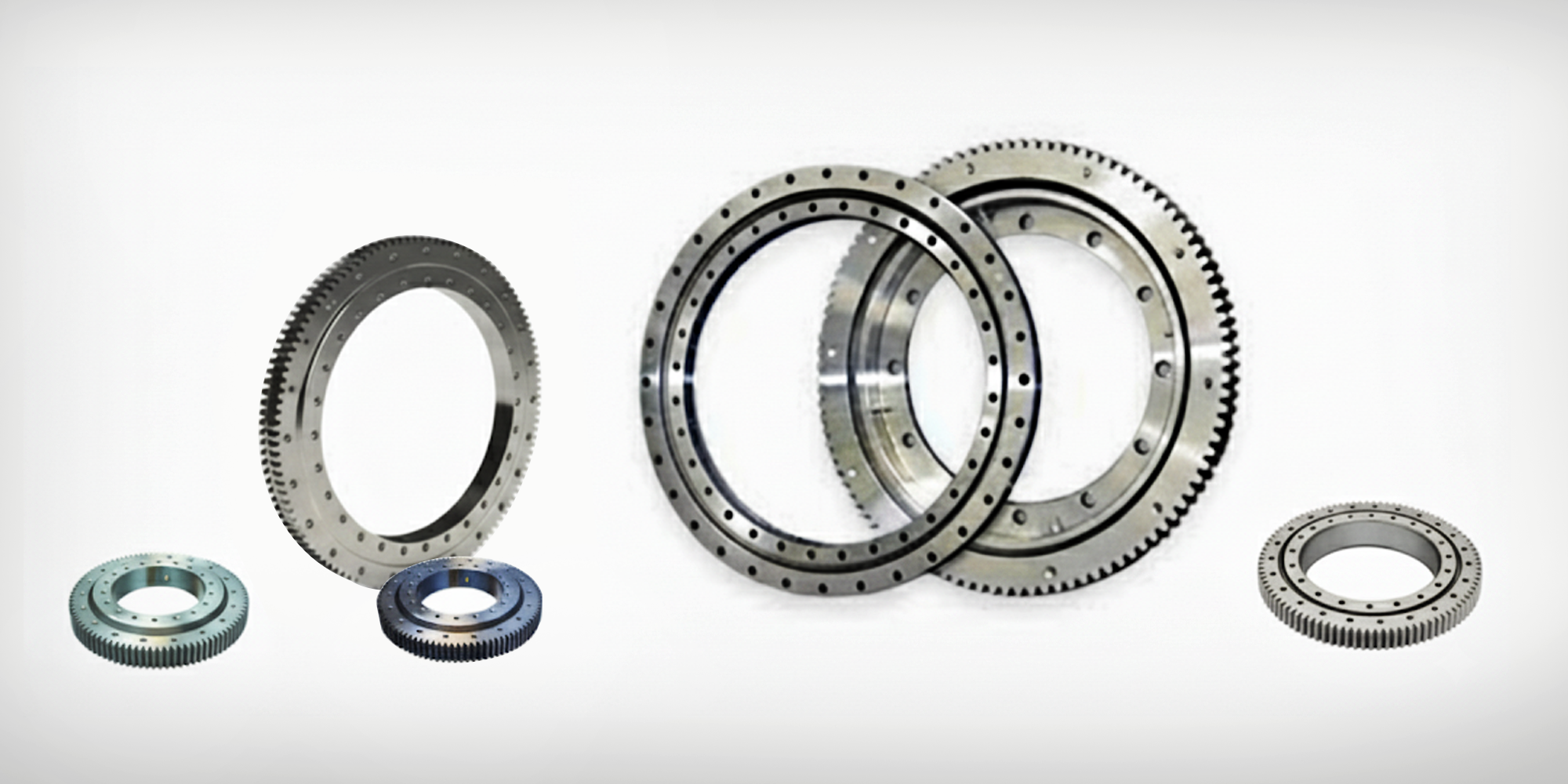
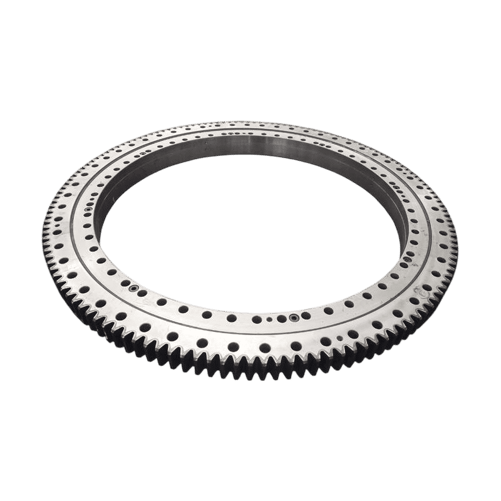
These bearings (also called slewing ring bearings) are the rotating foundation of some of the most load-intensive equipment in manufacturing, material handling, and commercial industries.
This guide covers everything you need to make the right call: how they're built, what the specs mean, where they're used, and how to keep them running.

A heavy duty turntable bearing is a large-diameter rolling-element bearing designed to carry simultaneous axial loads (vertical weight), radial loads (lateral force), and moment loads (tipping torque) — often all at once.
Rated capacities typically start around 500 lbs and extend beyond 25,000 lbs depending on size and design.
Unlike standard bearings that handle a single load direction, turntable bearings are engineered for combined loading in continuous or intermittent rotation.
That's what makes them suitable for cranes, industrial positioners, automated assembly lines, and heavy rotating platforms.
For a broader overview of how turntable bearings work across different load types and industries, see our guide: What Are Turntable Bearings?

Load ratings are the most critical spec. Heavy duty turntable bearings are rated across three load directions:
Capacities in this class typically run from 500 lbs on the low end to over 25,000 lbs for large-diameter industrial models.
Always size with a safety margin: if your calculated combined load is 8,000 lbs, don't select a bearing rated at exactly 8,000 lbs.
Three materials cover the majority of industrial applications:
Raceway hardness (typically 58–62 HRC on the rolling surface) directly affects load capacity and service life.
When comparing suppliers, ask for the raceway hardness spec — it's a more reliable quality indicator than material grade alone.
Full 360-degree rotation is standard. Starting torque and running torque depend on bearing size, preload, seal type, and lubrication.
Ball-type turntable bearings generally have lower friction and suit applications needing frequent repositioning.
Roller types are stiffer and better suited to heavy, slow-rotating platforms where positional stability matters more than low drag.

When ordering or specifying a heavy duty turntable bearing, you'll encounter these core dimensions:
Manufacturer datasheets list static and dynamic load ratings separately.
Static ratings apply when the bearing is stationary under load (e.g., a parked crane boom).
Dynamic ratings apply during rotation.
For most industrial turntable applications, the static moment load rating is the limiting factor — check it first.
Smaller-diameter turntable bearings (under 12 inches OD) typically weigh under 10 lbs.
Large-diameter industrial models — 36 inches and above — can exceed 200 lbs.
Bearing weight matters for both structural support design and handling during installation; factor it into your total load calculation.
Welding positioners are one of the most demanding turntable bearing applications.
The bearing must support the weight of the workpiece (often several thousand pounds), withstand vibration from welding equipment, and allow smooth repositioning by a single operator.
A properly matched turntable bearing reduces the physical effort required to rotate heavy weldments and keeps the joint in the optimal position — which directly affects weld quality.
Automotive showrooms, trade show displays, and retail installations use turntable bearings to rotate vehicles or large products.
Load ratings in these applications typically run 2,000–8,000 lbs.
Amusement ride platforms use larger-diameter bearings rated for dynamic loads that include passenger weight plus acceleration forces — safety factors of 3x or higher are standard in ride design.
Don't rely on a single number. Add up all three load types your application generates:
Apply a safety factor of at least 1.5×–2× over your calculated combined load.
Dynamic applications (frequent starts and stops, shock loading) warrant the higher end of that range.
Measure your available envelope carefully: OD must fit within your structural frame, ID must clear any central pass-through, and height must suit your stack-up.
Confirm that the bolt pattern is achievable — either by selecting a standard BCD that matches existing holes or by specifying custom drilling.
A bearing that's installed incorrectly will fail well before its rated service life — regardless of quality.
Follow these steps:
The terms sometimes get confused in supplier searches, so it's worth being direct about this.
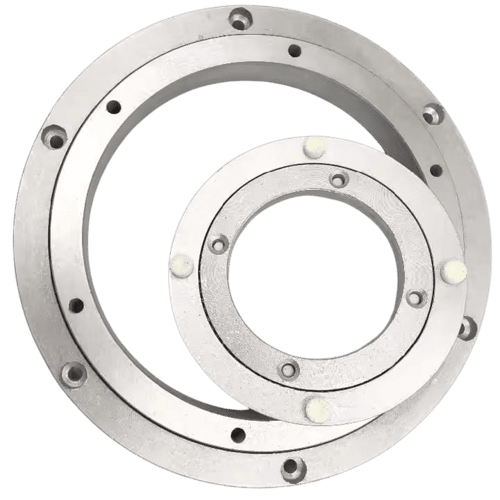
Lazy Susan bearings are light-duty plate bearings designed for light rotational loads — typically under 1,000 lbs, often far less. They're used in kitchen cabinet organizers, small display turntables, and office equipment. Precision is limited, and they're not rated for the combined axial + radial + moment loading that industrial applications generate.
Heavy duty turntable bearings are engineered components with published load ratings in all three directions, hardened raceways, industrial sealing, and defined maintenance intervals. The two products don't overlap in application — if your load exceeds a few hundred pounds or your environment involves shock loading, vibration, or contamination, you need an industrial turntable bearing.

Grinding, squealing, or clicking during rotation usually points to one of three causes: insufficient lubrication, contamination in the raceway, or raceway damage from prior overloading.
Start with relubrication — purge old grease and replenish with fresh grease of the correct type.
If noise persists after proper lubrication, inspect the seals for damage and, if possible, check for visible raceway scoring or pitting.
A bearing making consistent metallic noise is past the maintenance fix stage and should be scheduled for replacement.
Stiffness that develops gradually usually indicates seal drag from contamination or hardened grease.
Stiffness that appears suddenly often means a rolling element or raceway is damaged.
Flush and regrease first; if stiffness remains, check bolt torque (over-torqued bolts distort the ring) and inspect for structural misalignment that may be imposing additional load on the bearing.
Most turntable bearing failures trace back to three root causes: operating beyond the rated load, incorrect installation (misalignment or improper bolt torque), or neglected lubrication.
All three are preventable. Keep a maintenance log — date, hours, grease amount, observations — so you can identify trends before they become failures.
It depends on the maximum workpiece weight your positioner will handle, plus the weight of the table itself, plus a safety factor.
A positioner rated for 2,000 lb workpieces typically uses a bearing with a static axial rating of 4,000–6,000 lbs to account for dynamic loading during repositioning and the moment load created by off-center parts.
When in doubt, size up — an oversized bearing costs more but lasts longer; an undersized one fails.
Replace when you observe: persistent noise after correct relubrication, visible raceway damage (scoring, pitting, spalling), measurable increase in axial or radial play beyond the manufacturer's tolerance, or seal failure that cannot be corrected.
Don't wait for complete seizure — by that point, the bearing has usually damaged the surrounding structure.
Not necessarily. Most manufacturers specify lithium complex or polyurea grease with an NLGI Grade 2 consistency for general industrial use.
High-temperature, high-speed, or food-grade applications require specialized formulations.
Using the wrong grease — or mixing incompatible types — can reduce lubrication film strength and shorten service life significantly.
Always check the bearing's maintenance datasheet before selecting a grease.
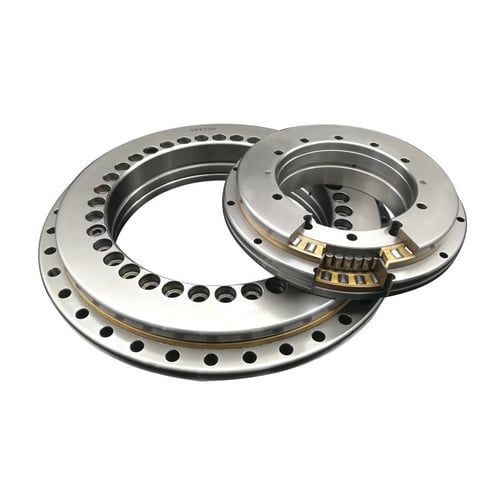
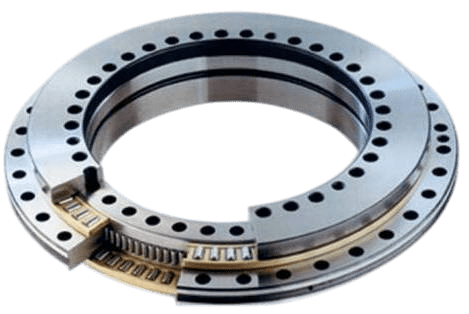
Ball-type bearings offer lower friction and handle combined loads well at moderate load levels — a common choice for rotating displays, light positioners, and conveyor transfer tables.
Roller-type (cylindrical or crossed-roller) bearings carry higher moment and axial loads in the same envelope, with greater stiffness — preferred for heavy crane slewing rings, large welding positioners, and any application where tipping torque is the dominant load.
The right choice depends on your specific load combination, speed, and stiffness requirements.
Every 100–200 operating hours is a standard starting point for most industrial applications under normal conditions.
Reduce that interval if the bearing operates in high temperatures (above 150°F / 65°C), contaminated environments, or at higher duty cycles.
Establish your interval from the manufacturer's recommendation, then adjust based on what you see when you grease — if old grease is heavily contaminated or discolored, shorten the interval.
Heavy duty turntable bearings aren't a commodity purchase — the right bearing for a 5,000 lb welding positioner in a foundry is a different product from the right bearing for a 3,000 lb automotive display in a showroom, even if the load numbers look similar on paper.
Material, sealing, lubrication spec, and installation method all matter.
If you're not certain which specification fits your application, the safest approach is to share your load calculations, environment details, and duty cycle with a bearing engineer before ordering.
Getting this right at the design stage is far less expensive than replacing a failed bearing — and the equipment around it — after the fact.
LILY's engineering team is available to review your application and recommend the right bearing for your requirements.
A good tapered roller bearings supplier does more than list products and send back a number. For industrial buyers, the real question is whether the...
In the world of machinery, ball bearings play a pivotal role. They reduce friction and ensure smooth operation of various mechanical systems. But did...
Importance of Bearings in Mechanical Systems Bearings are crucial for smooth and efficient motion in mechanical systems, while reducing friction,...