

Home/
Blog/
Corrosion-Resistant Bearings for Marine Use: 316L, 440C & Ceramic

7 min read

Corrosion-Resistant Bearings for Marine Use: 316L, 440C, Ceramic & More

Corrosion-Resistant Bearings for Marine Use: 316L, 440C, Ceramic & More
Corrosion-Resistant Bearings for Marine Use: 316L, 440C & Ceramic
16:18

Corrosion-resistant bearings for marine applications aren't a single product category — they're a spectrum of materials, coatings, and seal configurations matched to specific exposure levels.

Stainless steel has a strong reputation for corrosion resistance, which makes it genuinely surprising when stainless steel bearings start failing in saltwater environments within a single operating season.

The issue isn't the material choice per se; it's that marine environments vary enormously in aggression, and the right bearing for one marine application is often wrong for another.

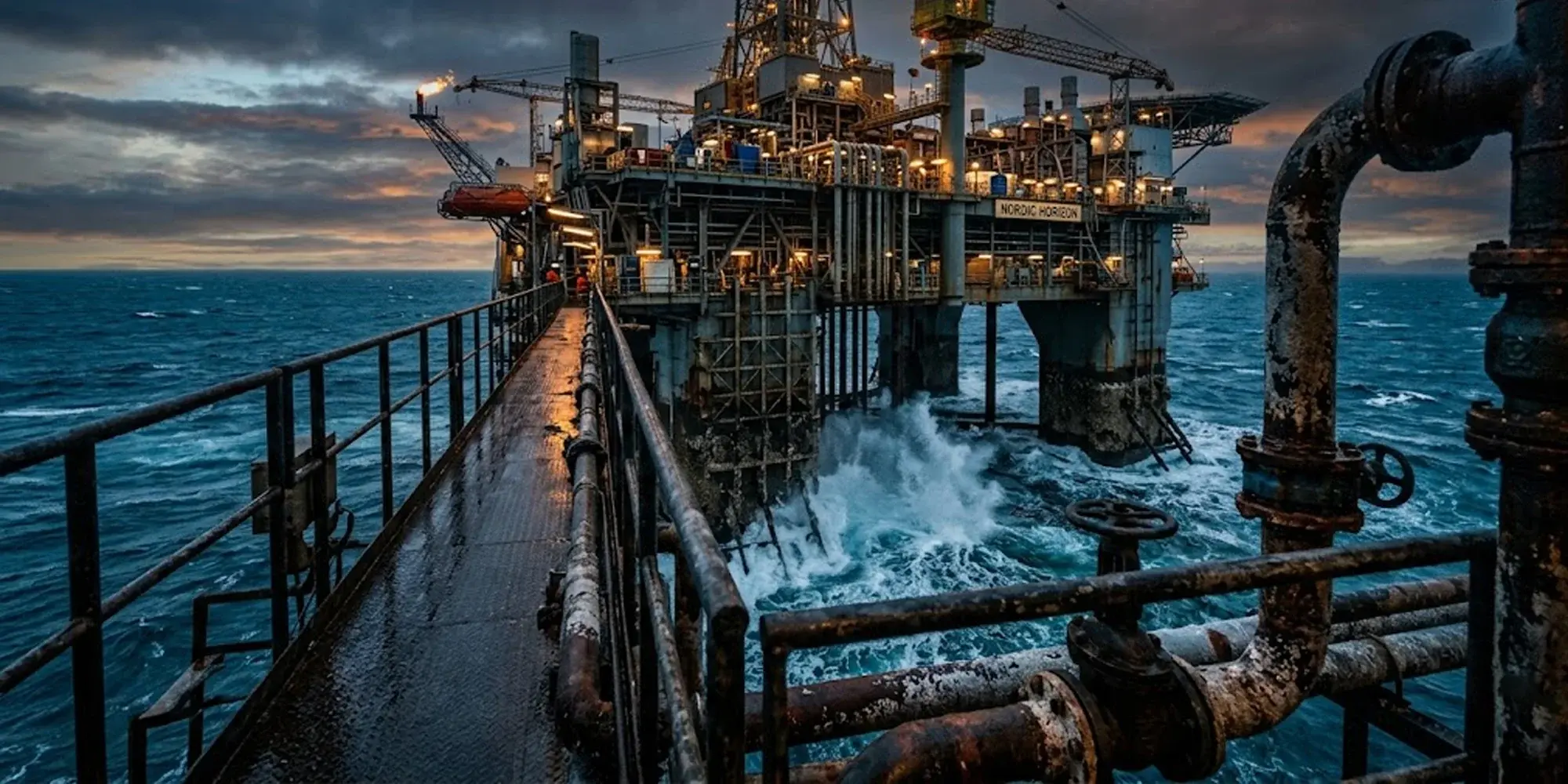
A North Sea operator documented that 316L stainless ball bearings in cooling water pump applications required replacement every 18 months on average under normal seawater service.

That's the real-world baseline.

Doing substantially better than that requires matching bearing material, coating, seal, and lubrication specifically to the exposure level — not just reaching for the "corrosion resistant" option from a catalogue.

See our detailed failure analysis in why stainless steel bearings fail in saltwater.


Marine Exposure: Three Levels That Need Different Answers

Not all marine environments corrode at the same rate.

Getting the bearing selection right starts with being specific about which category your application falls into.

Cross-section diagram showing three marine exposure zones: salt spray only (above waterline), splash zone and intermittent submersion (tidal zone), and continuous submersion (subsea). Salt spray & humidity only Deck equipment · above-waterline fixtures covered machinery spaces Splash zone & intermittent submersion Tidal zones · seawater pump inlets anchor windlass components Continuous submersion Subsea ROVs · propeller shafts underwater equipment Waterline ▼ 440C stainless or coated standard bearings — cost-effective choice 316 SS or passivated 440C ⚠ Most underestimated zone Full ceramic or 316 + cathodic protection only
  • Salt spray and humidity only — deck equipment, above-waterline fixtures, covered machinery spaces. Intermittent salt spray with high humidity but no direct water contact. This is where properly selected 440C stainless or well-coated standard bearings are viable and cost-effective.

  • Splash zone and intermittent submersion — tidal zones, seawater pump inlets, anchor windlass components. Periodic submersion followed by air exposure is actually one of the most aggressive conditions: it combines salt concentration, oxygen availability, and the wet/dry cycling that accelerates pitting. More bearings fail here than in continuous submersion, precisely because engineers underestimate it.

  • Continuous submersion — subsea equipment, propeller shafts, underwater ROVs. Subsea bearings — including those used in ROVs, propeller shafts, and underwater instrumentation — represent the most demanding category. Only full ceramic bearings or heavily sealed stainless assemblies combined with active cathodic protection are consistently reliable here. Everything else is a compromise.


Material Options: What Each Grade Actually Delivers

Bar chart comparing corrosion resistance and load capacity ratings (0–100) for 440C stainless, 316 stainless, full ceramic, and hybrid ceramic bearings. Material trade-offs: corrosion resistance vs. load capacity 0 25 50 75 100 440C SS 316 SS Full ceramic Hybrid ceramic Corrosion resistance Load capacity (Relative rating, not absolute)


440C Stainless Steel — The Standard "Marine" Choice

Close-up of a stainless steel ball bearing on a dark industrial surface, showing rolling elements and inner race detail

440C is the most common stainless grade for marine bearings, and for most above-waterline applications, it earns that position.

Its chromium content (16–18%) and carbon content (0.95–1.20%) allow through-hardening to 58–62 HRC, giving load and speed ratings comparable to standard chrome steel bearings of the same size.

440C performs well in damp environments and handles periodic salt spray exposure reliably.

Its limitation appears in direct seawater immersion and concentrated chloride conditions — particularly under static or low-flow situations where chlorides concentrate at the bearing surface and initiate pitting.

Both 440C and 316 stainless are often described as rust resistant bearings in general-purpose catalogues — the distinction that matters in marine service is chloride resistance, not just rust resistance.

440C performs well against rust in humid or spray conditions, but its lower molybdenum content makes it more vulnerable than 316 when chloride concentration is high.

For bearings rated well below their load limit in these conditions, passivation helps.

For heavily loaded bearings in continuous contact with seawater, 440C is the wrong material regardless of surface treatment. See our comparison of 440C vs 304 vs 316 stainless steel bearing grades.


316 Stainless Steel — True Marine Grade, With a Load Penalty

316 stainless (with 2–3% molybdenum) earns the "marine grade" label because molybdenum substantially improves chloride resistance compared to 440C, making it effective in direct seawater contact and splash zone applications.

The trade-off is mechanical. 316 cannot be hardened to the levels 440C achieves, so dynamic load ratings drop to roughly 50–70% of an equivalent chrome steel bearing of the same size.

For lightly loaded, low-speed, corrosion-critical applications, 316 is the correct call.

For high-load or high-speed marine applications, the load penalty is often disqualifying.

316 stainless is effective when temporarily submerged or in flowing seawater.

Under static permanent submersion, it becomes significantly less reliable — stagnant seawater allows chlorides to concentrate at the surface faster than the passive film can repair itself.

If permanent submersion is unavoidable, pair 316 with active cathodic protection or specify ceramic.


Full Ceramic — The Only Safe Choice for Continuous Submersion

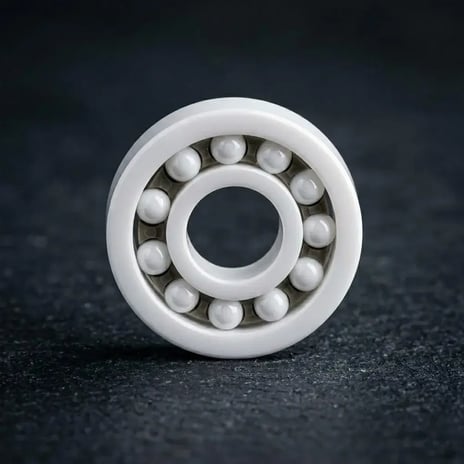
ZrO2 full ceramic ball bearing with white zirconia rings and balls — corrosion-proof option for continuous seawater submersion

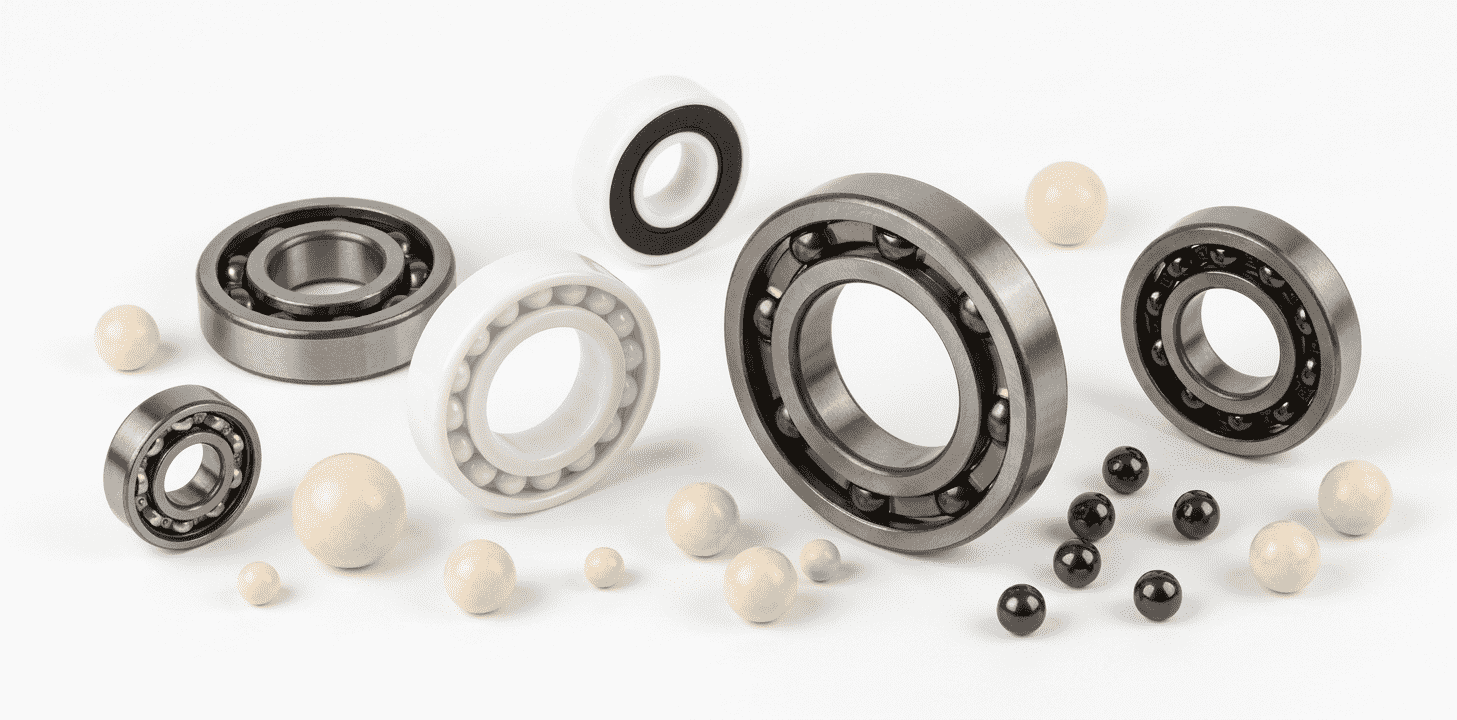
Zirconia (ZrO₂) and silicon nitride (Si₃N₄) full ceramic bearings are completely unaffected by seawater from a corrosion standpoint.

They don't corrode, don't need lubrication in low-load conditions, and can operate fully submerged indefinitely.

Their limitations are practical: ceramic is brittle and sensitive to shock loading, available in a narrower range of sizes, and significantly more expensive than stainless alternatives.

For subsea ROVs, underwater instrumentation, and propeller shaft applications, the cost is usually justified by eliminating the replacement cycle.


Hybrid Ceramic Bearings

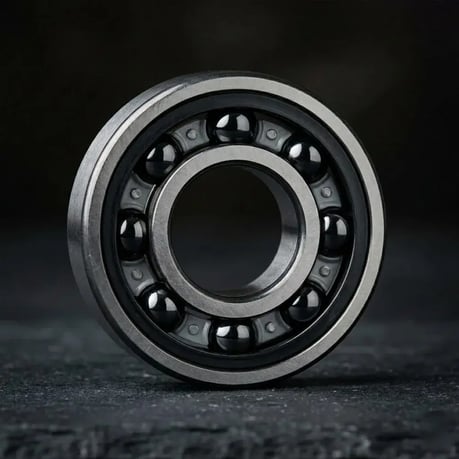
Hybrid ceramic ball bearing with steel rings and black silicon nitride rolling elements — combining corrosion resistance with high-speed performance

Hybrid bearings use steel rings with ceramic (typically Si₃N₄) rolling elements.

The ceramic balls are harder and lighter than steel, which reduces centrifugal forces at high speed and eliminates metal-to-metal contact.

Corrosion resistance is better than all-steel, but the steel rings will still corrode in submerged environments — hybrids don't solve the submersion problem.

They're the right choice for high-speed, moderate-corrosion marine applications: fast winches, high-speed pump impellers, propulsion motors operating in spray rather than immersion.


Coatings for Marine Bearing Components

Coatings extend the life of standard steel bearing housings and structural components in marine environments.

They're not a substitute for the right base material in severe applications — a good coating buys time, but the wrong substrate will fail eventually regardless.

For a full breakdown of anti-corrosion approaches, see our bearing anti-corrosion solution guide.

Horizontal bar chart showing salt spray resistance hours (ASTM B117) for three coating types: Zinc Nickel 500–1000h, Thin Dense Chromium 400–800h, Electroless Nickel 200–500h. Coating salt spray resistance (ASTM B117) 0 200 400 600 800 1,000 h Zinc Nickel (ZnNi) w/ chromate topcoat · 8–15 µm 500 – 1,000 h Thin Dense Chromium (TDC) 2–8 µm · 70–72 HRC surface 400 – 800 h Electroless Nickel (NiP) High P% = better corrosion resist. 200 – 500 h Solid fill = minimum; outlined range = maximum (ASTM B117 salt spray)


Zinc Nickel (ZnNi) Plating

Zinc nickel electroplating provides 500–1,000 hours of salt spray resistance (ASTM B117) with a chromate conversion topcoat.

The sacrificial zinc component protects exposed steel even when the coating is scratched — a meaningful advantage over non-sacrificial coatings.

Thickness typically runs 8–15 microns, which must be accounted for in precision fits.

Best applied to bearing housings, mounting flanges, and outer ring surfaces where dimensional tolerances allow.


Thin Dense Chromium (TDC)

TDC provides a hard surface (typically 70–72 HRC) with good corrosion resistance — particularly useful for linear bearing shafts and roller bearing applications in coastal and offshore installations.

Thickness is typically 2–8 microns, preserving dimensional accuracy better than thicker coatings.

A peer-reviewed study in NCBI/PMC on multilayer DLC coatings confirmed that hard carbon-based coatings on 316L stainless reduce corrosion current density by 1–2 orders of magnitude compared to bare stainless — relevant context for specifying hard coatings in marine use.


Nickel Phosphorus (Electroless Nickel)

Electroless nickel covers complex geometries uniformly — including bearing bores and raceway-adjacent profiles that electroplating cannot reach consistently.

Protection runs 200–500 hours depending on phosphorus content: higher P content means better corrosion resistance but lower hardness.

Widely used on pump shafts and bearing housings in marine equipment where geometry complexity rules out electroplating.


Seals and Lubrication: What Actually Fails First

In most marine bearing failures, the seal or lubricant fails before the bearing material does.

Standard nitrile (NBR) rubber seals degrade in prolonged seawater immersion. The right choices for marine service:


Seal Selection

  • PTFE seals: Excellent chemical resistance against seawater and most marine chemicals. Low friction but limited dynamic sealing pressure — best for moderate-speed applications.
  • Viton (FKM) seals: Better than NBR for chemical and temperature resistance. Suitable for splash zone and intermittent submersion where NBR degrades too quickly.
  • PEEK cages: Replace metal cages where cage corrosion is a documented failure mode in submerged applications.
  • Labyrinth seals: Non-contact, so no seal wear, but their effectiveness depends on tight control of ingress path geometry in splash and submersion environments.


Lubrication

  • Calcium sulfonate complex greases — best water resistance of standard grease types, the first choice for offshore deck equipment, winches, and exposed bearings
  • Lithium complex greases with water resistance additives — for splash zone applications where calcium sulfonate complex isn't available or budgeted
  • PTFE-based dry lubricants — for low-speed fully submerged applications where grease retention is impractical


Selection Guide by Application

Application Exposure Level Recommended Bearing Key Considerations
Deck machinery, winches Salt spray + humidity 440C stainless, sealed Calcium sulfonate grease; check seal integrity regularly
Seawater pumps (above waterline) Splash + intermittent submersion 316 stainless or 440C passivated Flow rate matters — static submersion degrades 316 faster
Offshore gearboxes Salt spray + vibration 440C + TDC or ZnNi coated housing Shock loads require adequate dynamic load rating
Propeller shafts Continuous submersion Full ceramic or 316 + cathodic protection Load capacity of full ceramic is a real constraint
Subsea ROVs Continuous submersion Full ceramic (Si₃N₄) Shock sensitivity of ceramic must be managed in the design
Tidal turbines Continuous submersion + dynamic loads Hybrid ceramic or 316 with external sealing Blade loads are high — don't sacrifice load rating for corrosion resistance alone
Marina/leisure craft Salt spray, occasional immersion 440C stainless, sealed Sealed 440C is sufficient for most leisure applications


FAQ


Can I use standard chrome steel bearings in marine applications if I coat them?

For above-waterline, salt-spray-only environments with a good coating system — ZnNi plating or TDC on housings — standard GCr15/52100 steel bearings can work adequately in structural positions. For the bearing rings and rolling elements themselves in any direct exposure environment, stainless is the right base material. Coatings on bearing rings are thin enough that any surface scratch or press-fit damage exposes bare steel immediately.


Is 440C or 316 better for a seawater pump?

For flowing seawater, 316 outperforms 440C — the molybdenum content makes a measurable difference in chloride resistance. In static or slow-flow conditions where chlorides concentrate, neither performs reliably long-term. In that scenario, full ceramic or well-sealed 440C with cathodic protection is more appropriate than trying to push either stainless grade further than it will go.


Which corrosion-resistant bearings perform best in outdoor and coastal applications?

For outdoor and coastal facilities where bearings face salt spray and humidity but not direct submersion, sealed 440C stainless with calcium sulfonate grease is the most cost-effective solution. Where splash or periodic immersion occurs — pump inlets, tidal zone equipment, anchor windlass components — 316 stainless is the better baseline due to its molybdenum content and superior chloride resistance. Full ceramic is reserved for continuous submersion or where replacement access is impractical and downtime costs are high.


How often should marine bearings be regreased?

With calcium sulfonate complex grease in offshore applications, regreasing intervals typically run 500–2,000 hours depending on load and operating temperature. In splash zone applications or high-humidity environments, err toward the shorter interval. A rise in bearing temperature or vibration is the earliest reliable indicator that grease has degraded — don't wait for the scheduled interval if you're seeing either.


References

NCBI/PMC — Enhanced Long-Term Corrosion Resistance of 316L Stainless Steel by Multilayer DLC Coatings (2024)

Wikipedia — Pitting Corrosion (mechanism and materials)

ANSI Blog — ASTM B117-26: Standard Practice for Operating Salt Spray Apparatus

ASTM A276 — Standard Specification for Stainless Steel Bars and Shapes

Schaeffler TPI 186 — Surface Technology Coatings for Automotive and Industrial Applications


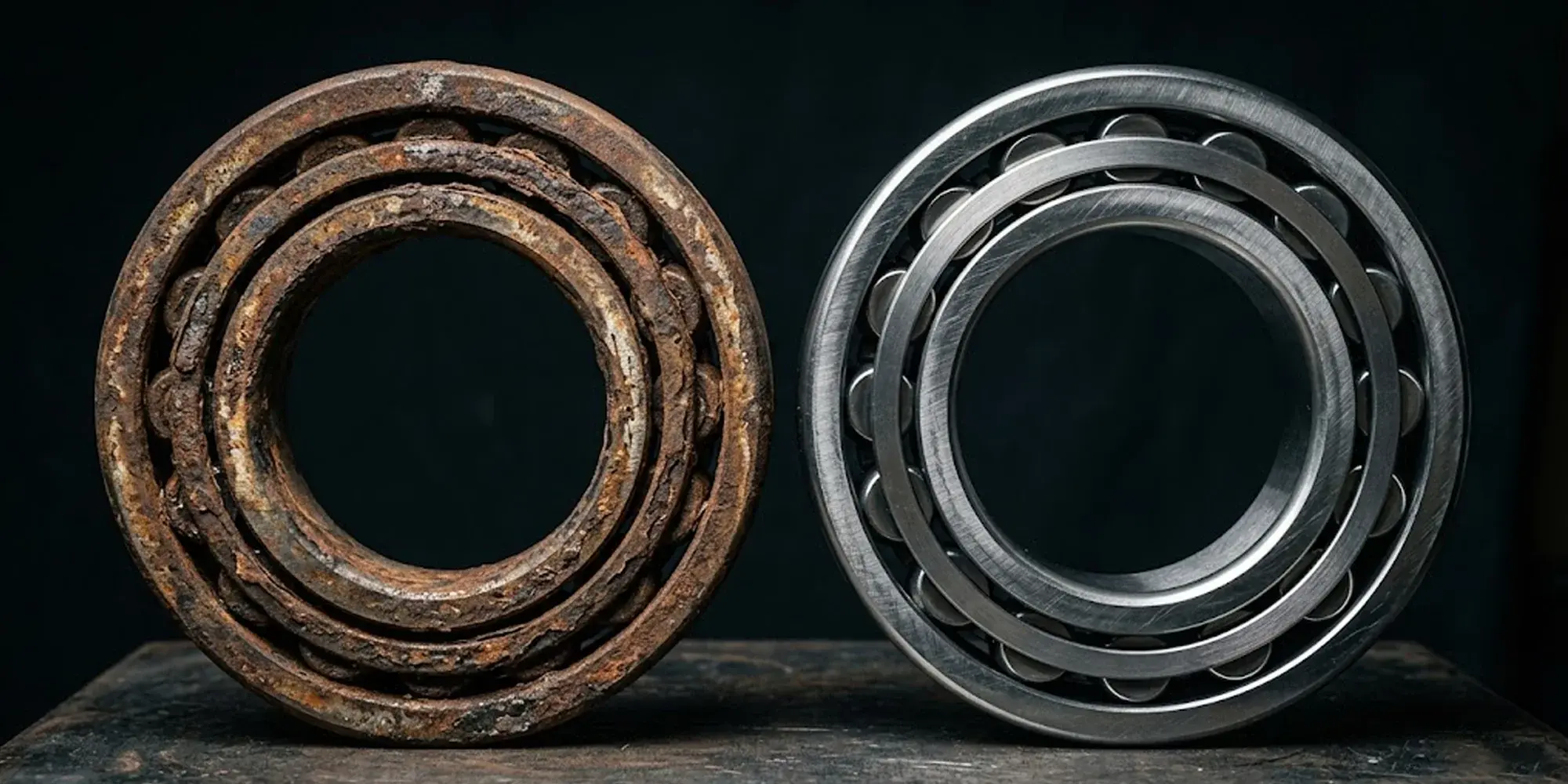
440C vs. 304 vs. 316 Stainless Steel Bearings: Choosing the Best Grade for Corrosive Environments

440C vs. 304 vs. 316 Stainless Steel Bearings: Choosing the Best Grade for Corrosive Environments

When selecting stainless steel bearings for harsh environments, many engineers assume that all "stainless" options offer the same protection. ...
Read More
Stainless Steel vs. Coated Bearings: Understanding the Real Trade-Offs

Stainless Steel vs. Coated Bearings: Understanding the Real Trade-Offs

Corrosion-resistant bearings come in two broad approaches: use a material that resists corrosion intrinsically, or use a standard bearing with a...

Read More
Ceramic Bearing Materials Compared: Si3N4 vs ZrO2 vs SiC vs Al2O3

Ceramic Bearing Materials Compared: Si3N4 vs ZrO2 vs SiC vs Al2O3

Most engineers arrive at 'ceramic bearing' and stop there. That's where the trouble starts. Si3N4, ZrO2, SiC, and Al2O3 share a category name but...

Read More