


Corrosion-Resistant Bearings for Marine Use: 316L, 440C, Ceramic & More
Corrosion-resistant bearings for marine applications aren't a single product category — they're a spectrum of materials, coatings, and seal...
4 min read
Robert
:
May 6, 2026 4:48:50 AM
Both black oxide and zinc phosphate are conversion coatings — they chemically react with the metal surface rather than depositing a separate layer on top.
Both show up regularly in bearing specifications.
And both get misapplied often enough that it's worth being clear about what each one actually does.
Black oxide is a precision finish — dimensionally inert, good-looking, and only modestly protective.
Zinc phosphate is a functional coating — it adds measurable thickness, improves surface texture, and earns its place mainly as a primer for topcoats.
Mixing them up in a specification is a mistake that shows up quickly in service.
A common version of this: engineers specify black oxide on bearing housings for outdoor conveyors to keep costs down, skip the re-oiling schedule, and then find the bearings rusting within six months.
The coating isn't wrong — the application is.
See our guide on bearing corrosion causes and rust prevention for how surface finishing fits into the wider protection strategy.
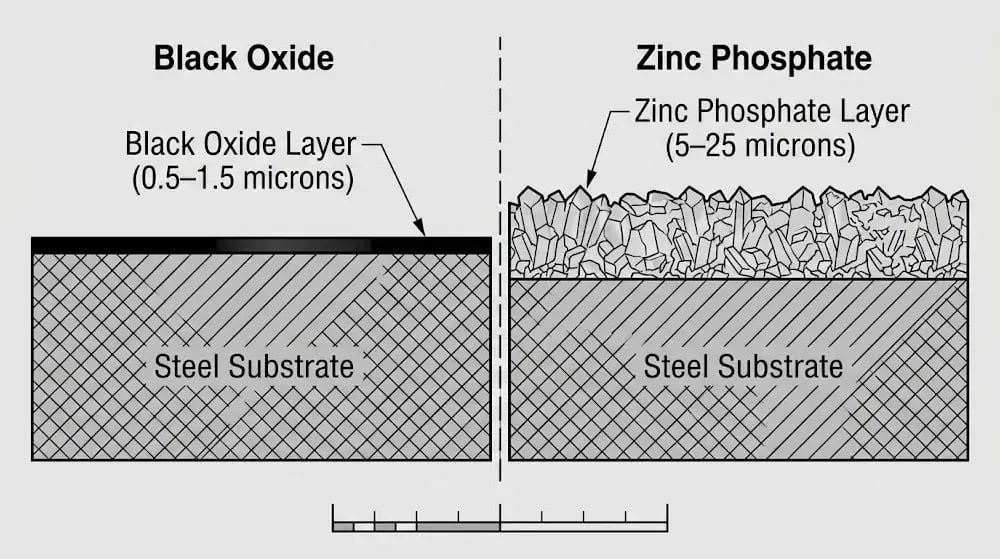
Black oxide works by immersing steel parts in a hot alkaline bath — sodium hydroxide and oxidising salts at 285–295°F / 141–146°C.
The reaction converts the iron surface into magnetite (Fe₃O₄), producing a layer typically 0.5 to 1.5 microns thick.
That negligible thickness is the whole point: parts retain tight tolerances, which is why black oxide is standard on precision bearing races, threaded fasteners, and gears where even a few extra microns would cause assembly problems.

Black oxide on its own provides almost no corrosion protection.
Unsealed, it survives just 1–4 hours in ASTM B117 neutral salt spray testing — a number that surprises engineers who assume the black finish is doing meaningful work.
The magnetite layer is porous, and moisture passes straight through it without a sealant.
All the protection comes from the post-treatment sealant (ASTM B117, with post-treatment):
Black oxide works for indoor, low-humidity environments where bearings get periodically re-oiled.
For marine, outdoor, or chemically aggressive applications, no sealant changes that equation enough to matter.
Note on stainless steel:
Black oxide on stainless doesn't improve corrosion resistance — the salt spray results with and without the coating are essentially identical. The passive chromium oxide film on stainless is already doing the protective work. Applying black oxide to stainless is purely aesthetic.
Zinc phosphate converts the steel surface into a crystalline Zn₃(PO₄)₂ layer.
The resulting surface is deliberately rough and porous at a microscopic level — that texture is what makes it so effective at holding subsequent coatings, oils, and lubricants.
Coating weight ranges from roughly 1–4 g/m² for light primer coatings, up to 7–30 g/m² for heavier bearing-component coatings, adding approximately 5–25 microns per side — which must be factored into tolerance calculations.
Zinc phosphate combined with oil provides 24–72 hours of salt spray resistance (ASTM B117, oil post-treatment) — comparable to sealed black oxide, but with one extra benefit: it physically improves bearing raceway run-in by reducing micro-roughness.
Manganese phosphate, a close relative, is specifically exploited for this property in gear and bearing applications where smooth bedding-in matters.
Where zinc phosphate earns its real place is as a primer.
Combined with e-coat or powder coat, corrosion resistance climbs to 500–1,000+ hours — a range black oxide cannot reach regardless of sealant.
A 2024 peer-reviewed study in NCBI/PMC tested zinc, magnesium, and manganese phosphate coatings in both river water and seawater.
Zinc phosphate outperformed both alternatives for overall corrosion protection.
If you're choosing between phosphate types for a component that will see moisture, that ordering matters in practice.

| Factor | Black Oxide | Zinc Phosphate |
|---|---|---|
| Coating thickness | 0.5–1.5 microns (negligible) | 5–25 microns (measurable) |
| Salt spray (unsealed) | 1–4 hours | 8–12 hours |
| Salt spray (oiled, ASTM B117) | 24–96 hours | 24–72 hours |
| Salt spray (with topcoat) | Up to 200 hours | 500–1,000+ hours |
| Dimensional change | None — precision safe | Measurable — check tolerances |
| Surface texture | Smooth, accepts oil well | Rough/porous, excellent paint adhesion |
| Run-in behaviour | Minimal effect | Improves raceway run-in |
| Cost | Lower | Slightly higher |
| Best use case | Precision indoor components | Functional protection + paint primer |
For marine, continuous-moisture, or chemically aggressive environments, both coatings fall short.
The right moves are either stainless steel bearings (316 or 440C depending on load requirements) or zinc nickel plating (500+ hours ASTM B117).
Our bearing anti-corrosion solution guide covers those options in detail.
Not without checking tolerances first. Zinc phosphate adds 5–25 microns per side, which can shift fits and clearances on precision components. Pull the engineering drawings and verify clearances before making the change.
On direct bearing surfaces, zinc phosphate with oil is sufficient for moderate protection. On housing components or outer ring surfaces exposed to corrosive environments, adding an e-coat or lacquer significantly extends service life — and that combination is often what the specification actually needs.
No. Black oxide with oil sealant isn't food-safe and can contaminate food contact surfaces. 440C or 316 stainless steel bearings, or PTFE-coated alternatives, are the standard choices for food industry applications.
Wikipedia — Salt Spray Test (ASTM B117 overview)
ISO 11408:1999 — Chemical conversion coatings: Black oxide coating on iron and steel
Schaeffler TPI 186 — Surface Technology Coatings for Automotive and Industrial Bearing Applications
Corrosion-resistant bearings for marine applications aren't a single product category — they're a spectrum of materials, coatings, and seal...
Corrosion-resistant bearings come in two broad approaches: use a material that resists corrosion intrinsically, or use a standard bearing with a...
Take wind power generation and tidal power generation as examples to discuss bearing corrosion prevention Wind power and tidal power, as renewable...