


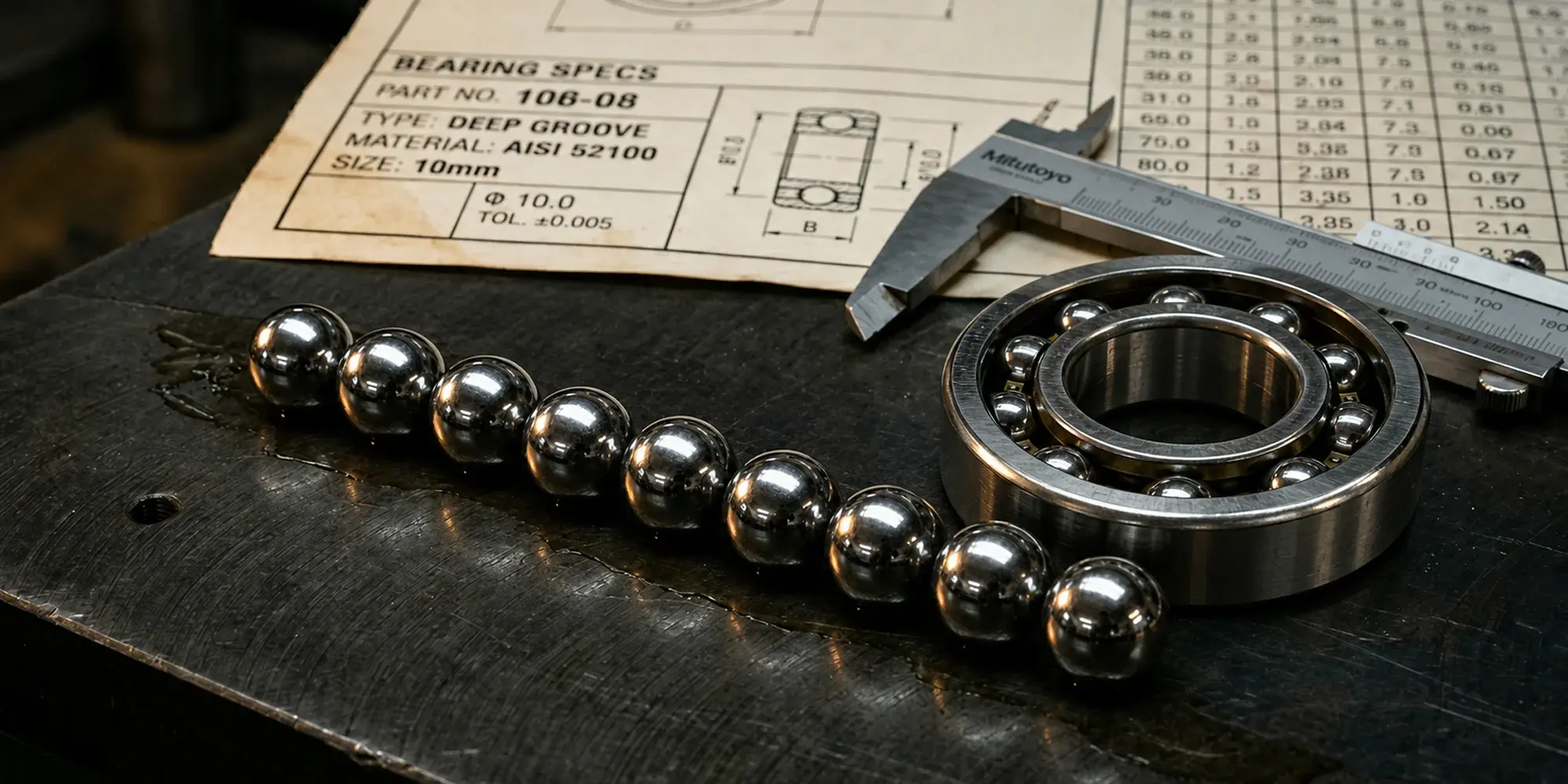
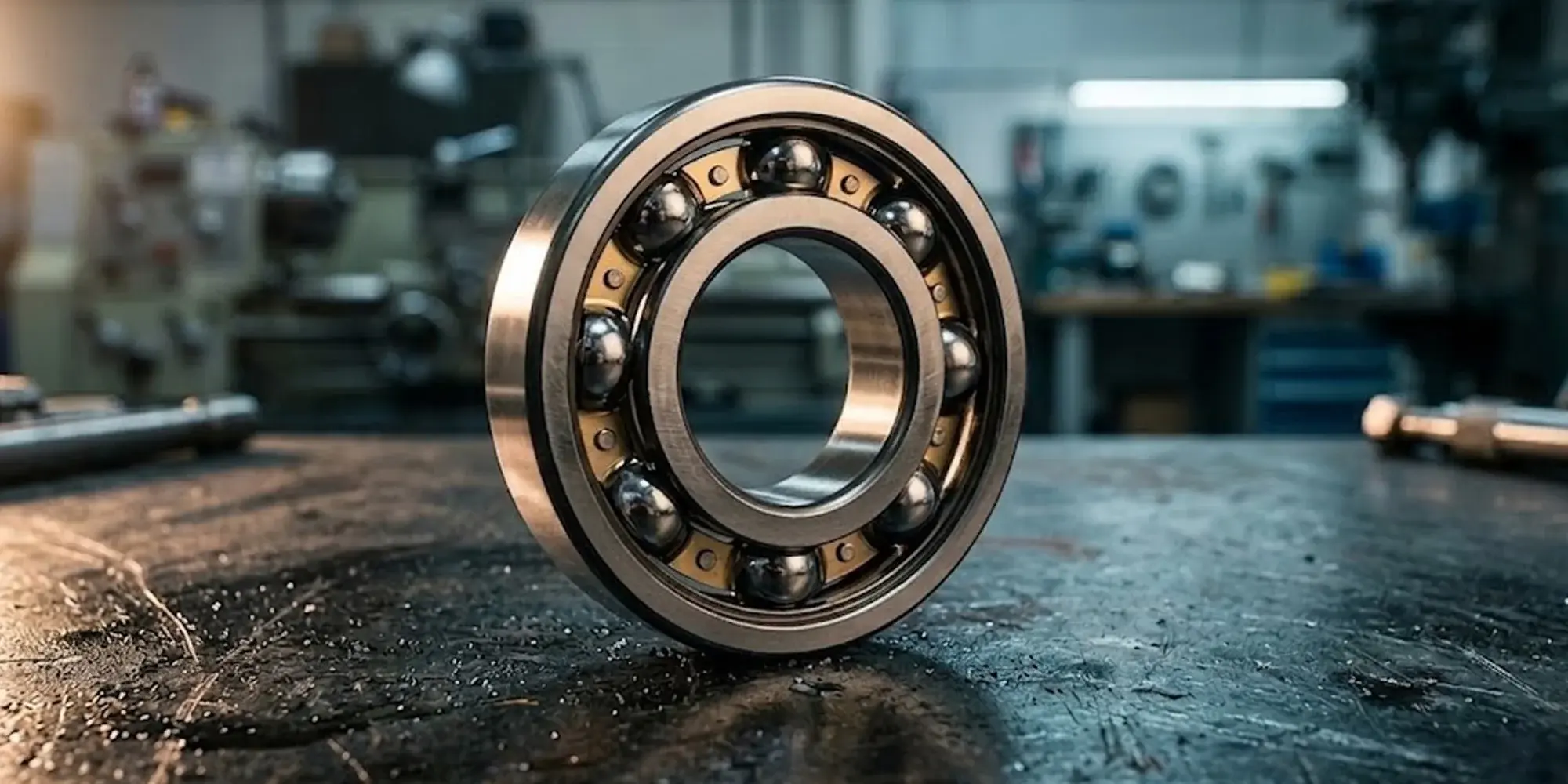
How to Read a Bearing Size Chart + Free Dimension Reference Tables
Bearing size charts are not complicated once you know the logic. The numbers follow a fixed pattern — and once you get one bearing number right,...
8 min read
Robert
:
May 25, 2026 3:16:21 AM
Table of Contents
A bearing size chart is a standardized reference table that maps bearing part numbers to their three core physical dimensions — bore diameter (d), outer diameter (D), and width (B or T) — along with load ratings and speed limits.
Charts are issued by major manufacturers including SKF, NSK, NTN, FAG, and Timken, and aligned to ISO dimensional standards. Two bearings carrying the same ISO part number from different brands will have identical outer dimensions. They will physically fit the same shaft and housing.
Every bearing selection — replacement or new design — starts with three numbers: bore (d), outer diameter (D), and width (B or T). Get all three right and the bearing fits. Miss one and you are placing another order.
Beyond fit, dimensions matter for three reasons:
|
Load Capacity
Larger cross-sections handle heavier loads. A 6308 (40 mm bore) has a dynamic load rating of 40.5 kN. A 6204 (20 mm bore) is rated at 12.8 kN — roughly a third of that, despite half the bore diameter. |
|
Speed Limits
Speed limits fall as bore increases. A 6200 (10 mm bore) runs to 22,000 rpm on grease. A 6210 (50 mm bore) is limited to 7,000 rpm. Bigger bearings need more conservative speed margins. |
|
Cross-Brand Sourcing
Part number matching alone is not enough. Always verify d, D, and B when switching suppliers. |
Bearing size charts follow ISO dimensional conventions, defined under ISO 492 for radial bearings and ISO 355 for tapered roller bearings. Every chart uses the same column structure:
| Column | What It Tells You |
|---|---|
| Bearing No. | Encodes type, series, and bore — see decoder below |
| d (mm) | Bore — must match your shaft diameter |
| D (mm) | Outer diameter — must match your housing bore |
| B or T (mm) | Width (radial bearings) or height (thrust bearings) |
| C (kN) | Dynamic load rating — for rotating load applications |
| C₀ (kN) | Static load rating — for stationary or slow oscillating loads |
| Max RPM | Limiting speed under grease lubrication |
For 6200 and 6300-series bearings, multiply the last two digits by 5 to get the bore in mm. Bearing 6208 → 08 × 5 = 40 mm bore. Codes 00–03 are fixed exceptions (10, 12, 15, 17 mm).
For a detailed walkthrough of the reading process, see our How to Read a Bearing Size Chart guide.
Enter bore, OD, and width to find matching bearing numbers instantly. Cross-reference across 25,000+ bearing types.
Open Cross Reference Tool →Deep groove ball bearings handle radial loads as their primary function, with the ability to carry moderate axial loads in both directions. That combination of versatility and low cost makes them the default choice across electric motors, water pumps, gearboxes, agricultural equipment, and home appliances.
The 6200 series (ISO dimension series 02) covers light-to-moderate radial loads. The 6300 series (ISO dimension series 03) shares the same bore sizes but a larger outer diameter — more ball complement, higher load ratings, and a housing that needs to be bored wider.
A 6205 bearing has a 25 mm bore, 52 mm outer diameter, 15 mm width, dynamic load rating of 14.8 kN. Its 6300-series equivalent, the 6305, shares the 25 mm bore but increases OD to 62 mm and raises the dynamic load rating to 22.5 kN — a 52% improvement in load capacity for the same shaft size.
| Bearing No. | d (mm) | D (mm) | B (mm) | C (kN) | C₀ (kN) | Max RPM |
|---|---|---|---|---|---|---|
| 6200 | 10 | 30 | 9 | 5.10 | 2.36 | 22,000 |
| 6201 | 12 | 32 | 10 | 6.82 | 3.10 | 20,000 |
| 6202 | 15 | 35 | 11 | 7.65 | 3.72 | 18,000 |
| 6203 | 17 | 40 | 12 | 9.56 | 4.75 | 17,000 |
| 6204 | 20 | 47 | 14 | 12.80 | 6.55 | 15,000 |
| 6205 | 25 | 52 | 15 | 14.80 | 7.80 | 13,000 |
| 6206 | 30 | 62 | 16 | 19.50 | 11.20 | 11,000 |
| 6207 | 35 | 72 | 17 | 25.70 | 15.30 | 9,500 |
| 6208 | 40 | 80 | 18 | 29.10 | 17.80 | 8,500 |
| 6209 | 45 | 85 | 19 | 32.50 | 21.20 | 7,800 |
| 6210 | 50 | 90 | 20 | 35.10 | 23.20 | 7,000 |
Source: SKF Rolling Bearings Catalogue. Verify against the current manufacturer datasheet for engineering calculations.
| Bearing No. | d (mm) | D (mm) | B (mm) | C (kN) | C₀ (kN) | Max RPM |
|---|---|---|---|---|---|---|
| 6300 | 10 | 35 | 11 | 8.06 | 3.72 | 20,000 |
| 6301 | 12 | 37 | 12 | 9.72 | 4.55 | 19,000 |
| 6302 | 15 | 42 | 13 | 11.40 | 5.40 | 17,000 |
| 6303 | 17 | 47 | 14 | 13.50 | 6.55 | 16,000 |
| 6304 | 20 | 52 | 15 | 15.90 | 7.80 | 14,000 |
| 6305 | 25 | 62 | 17 | 22.50 | 11.40 | 12,000 |
| 6306 | 30 | 72 | 19 | 28.00 | 15.00 | 10,000 |
| 6307 | 35 | 80 | 21 | 33.50 | 19.20 | 8,800 |
| 6308 | 40 | 90 | 23 | 40.50 | 24.00 | 7,800 |
| 6309 | 45 | 100 | 25 | 52.70 | 32.00 | 7,000 |
| 6310 | 50 | 110 | 27 | 62.00 | 38.00 | 6,400 |
Source: SKF Rolling Bearings Catalogue.
6200 vs 6300 — when to step up: If a 6205 keeps failing under load on a fixed 25 mm shaft, the 6305 is the next step. Same bore. Load rating up 52%. Your housing needs re-boring from 52 mm to 62 mm. That is the only trade-off.
Browse our deep groove ball bearings or go directly to the 6205 product page to check availability and request a quote.
Cylindrical roller bearings carry significantly heavier radial loads than ball bearings of the same bore. The roller-to-raceway contact is a line rather than a point, which spreads load across a larger area. A NU206 (30 mm bore) is rated at 36 kN dynamic, versus 19.5 kN for the 6206 ball bearing — 85% more load capacity on the same bore.
The tradeoff is axial capacity. Most NU-series bearings carry zero axial load. If your application has combined radial and axial loading — helical gears, for example — you need angular contact or spherical roller bearings. See our cylindrical roller bearing guide for application selection detail.
| Bearing No. | d (mm) | D (mm) | B (mm) | C (kN) | C₀ (kN) | Max RPM |
|---|---|---|---|---|---|---|
| NU204 | 20 | 47 | 14 | 25.50 | 17.00 | 12,000 |
| NU205 | 25 | 52 | 15 | 27.00 | 18.30 | 11,000 |
| NU206 | 30 | 62 | 16 | 36.00 | 25.00 | 9,500 |
| NU207 | 35 | 72 | 17 | 48.00 | 34.00 | 8,000 |
| NU208 | 40 | 80 | 18 | 56.00 | 40.00 | 7,000 |
| NU209 | 45 | 85 | 19 | 60.00 | 44.00 | 6,300 |
| NU210 | 50 | 90 | 20 | 64.00 | 49.00 | 6,000 |
| NU211 | 55 | 100 | 21 | 83.00 | 63.00 | 5,300 |
| NU212 | 60 | 110 | 22 | 96.00 | 75.00 | 5,000 |
Source: SKF Rolling Bearings Catalogue. Verify current datasheet before use in load calculations.
Thrust bearings handle axial loads — forces running parallel to the shaft. They appear in vertical pump shafts, machine tool spindles, automotive steering columns, and jacking mechanisms.
Single-direction thrust ball bearings (51100 series) cannot carry radial load. This is the most common misapplication we see. If your shaft has combined loading, angular contact ball bearings handle both directions in a single unit.
| Bearing No. | d (mm) | D (mm) | T (mm) | C (kN) | C₀ (kN) |
|---|---|---|---|---|---|
| 51100 | 10 | 24 | 9 | 7.65 | 17.00 |
| 51101 | 12 | 26 | 9 | 8.00 | 18.00 |
| 51102 | 15 | 28 | 9 | 8.00 | 18.30 |
| 51104 | 20 | 35 | 10 | 15.10 | 29.00 |
| 51105 | 25 | 42 | 11 | 18.00 | 36.00 |
| 51106 | 30 | 47 | 11 | 18.30 | 38.00 |
| 51107 | 35 | 52 | 12 | 20.40 | 42.50 |
| 51108 | 40 | 60 | 13 | 27.00 | 58.50 |
| 51110 | 50 | 70 | 14 | 29.00 | 67.00 |
| 51112 | 60 | 85 | 17 | 42.50 | 100.00 |
Source: SKF Rolling Bearings Catalogue (51100 series). Verify against current datasheet before use.
For thrust bearings, C₀ is the primary sizing parameter. The C column is listed for completeness, but the static rating governs axial load selection in this series. For background, see our static vs dynamic load ratings guide.
Metric bearings cover global industrial and OEM applications. Inch bearings remain common in North American agricultural machinery and equipment built before metric standardization.
| Feature | Metric Bearings | Inch Bearings |
|---|---|---|
| Standards body | ISO / DIN | ABMA / AFBMA |
| Bore | Millimeters | Fractions of an inch |
| Common series | 6200, 6300, NU, 51100 | R series, 1600 series |
| Primary markets | Global | North America, legacy UK |
| Example | 6205 — 25 mm bore | R10 — 5/8" (15.875 mm) bore |
When switching between systems, match all three dimensions. A 0.5 mm OD mismatch is enough to cause the outer ring to spin under load. Use our Bearing Cross Reference tool to cross-reference part numbers across brands or measurement systems.
This decoder applies to 6×00-series deep groove ball bearings. NU-series, 22-series, and 32-series bearings follow variant prefix conventions.
| Position | Meaning | Example: 6207-2RS/C3 |
|---|---|---|
| First digit | Bearing type | 6 = deep groove ball bearing |
| Second digit | ISO dimension series | 2 = series 02 (6200 family) |
| Last two digits | Bore code × 5 = bore mm | 07 × 5 = 35 mm |
| Suffix before slash | Sealing type | 2RS = double rubber lip seal |
| Suffix after slash | Internal clearance | C3 = greater than standard |
Type codes:
| 6 | Deep groove ball bearing |
| 7 | Angular contact ball bearing |
| NU / NJ / N | Cylindrical roller bearing |
| 22 / 23 | Spherical roller bearing |
| 32 / 33 | Tapered roller bearing |
| 51 / 52 | Thrust ball bearing |
Three errors come up repeatedly when customers contact us after a failed replacement:
Ordering by part number without measuring the old bearing
Stamped numbers corrode and get misread. A "6205" misread as "6206" on a dirty shaft means a wrong order and downtime. Measure bore, OD, and width with calipers before confirming — even when the number looks readable.
Buying sealed (2RS) to replace open bearings without checking width
A sealed bearing runs about 0.5–1 mm wider than the open equivalent. In tight motor end plates, that extra millimeter binds the shaft. Always check the sealed bearing's own dimension row, not the open spec.
Assuming generic and branded bearings carry identical load ratings
ISO dimensions are standardized. Load ratings are not. A lower-grade bearing with identical dimensions can have a dynamic load rating 20–40% below a premium brand's specification. For high-cycle applications, that difference matters in service life.
Usually a fit problem. Check OD first: did you install the same series? A 6205 sitting in a housing bored for a 6305 has 10 mm of radial clearance — the outer ring spins, fretting corrosion follows, and the housing seat is damaged within hours. The size chart shows you the OD difference immediately: 52 mm vs 62 mm.
Points to contamination or lubrication rather than a dimension mismatch — but the suffix column is still relevant. If you swapped from 2RS to ZZ to reduce cost, a metal shield does not exclude fine particles the way a rubber seal does. The suffix column tells you exactly what protection you actually have.
Usually means a single-direction 51100 was installed in a reversing application, or a radial bearing was put where a thrust bearing was needed. The T dimension column and C₀ value in the thrust chart give you the geometry and capacity immediately.
Only if you re-bore the housing from 52 mm to 62 mm. The shaft fit is identical (25 mm bore), but the housing requirement is completely different. The 6305 gives you a 52% higher load rating in exchange for that larger housing diameter.
Measure bore, OD, and width with digital calipers. Match all three to a row in the size chart. If dimensions fall exactly on a row, that is your bearing. If they land between two series, check the R-series inch bearing chart — it is likely an inch size.
Yes, slightly. Major brands each publish their own calculated ratings for identical ISO part numbers. Differences are typically within 5%. For critical load calculations, always use the specific brand's current datasheet rather than a generic table.
The L10 life formula is standardized under ISO 281: L10 = (C/P)³ × 10⁶ revolutions for ball bearings, where P is the applied dynamic load. Use our Bearing Life Calculator to run this automatically.
Browse our 6205 product page for specifications and availability, or use the inquiry form on the homepage for bulk pricing.
| 01 |
Start with shaft diameter. Bore (d) is always first. Everything else follows. |
| 02 |
Measure the housing directly. Housing bores wear over time. Measure the housing itself, not the old bearing's OD. |
| 03 |
Match load direction to bearing type. Radial → ball or cylindrical roller. Axial → thrust. Combined → angular contact. |
| 04 |
Check the speed limit before finalizing. Sealed bearings have a lower speed limit than open equivalents. Confirm your RPM is below the rated maximum for the specific variant you are ordering. |
| 05 |
Verify all three dimensions when cross-referencing brands. Part number alone is not enough. d, D, and B must all match. |
Bearing selection starts with three numbers: bore, outer diameter, and width. Match those to your shaft and housing, verify the load rating covers your application, confirm you are within the speed limit, and the bearing will fit and run.
Load ratings in this article are based on SKF Rolling Bearings Catalogue values. Always verify against the specific manufacturer's current datasheet for engineering calculations and safety-critical applications.
Bearing size charts are not complicated once you know the logic. The numbers follow a fixed pattern — and once you get one bearing number right,...
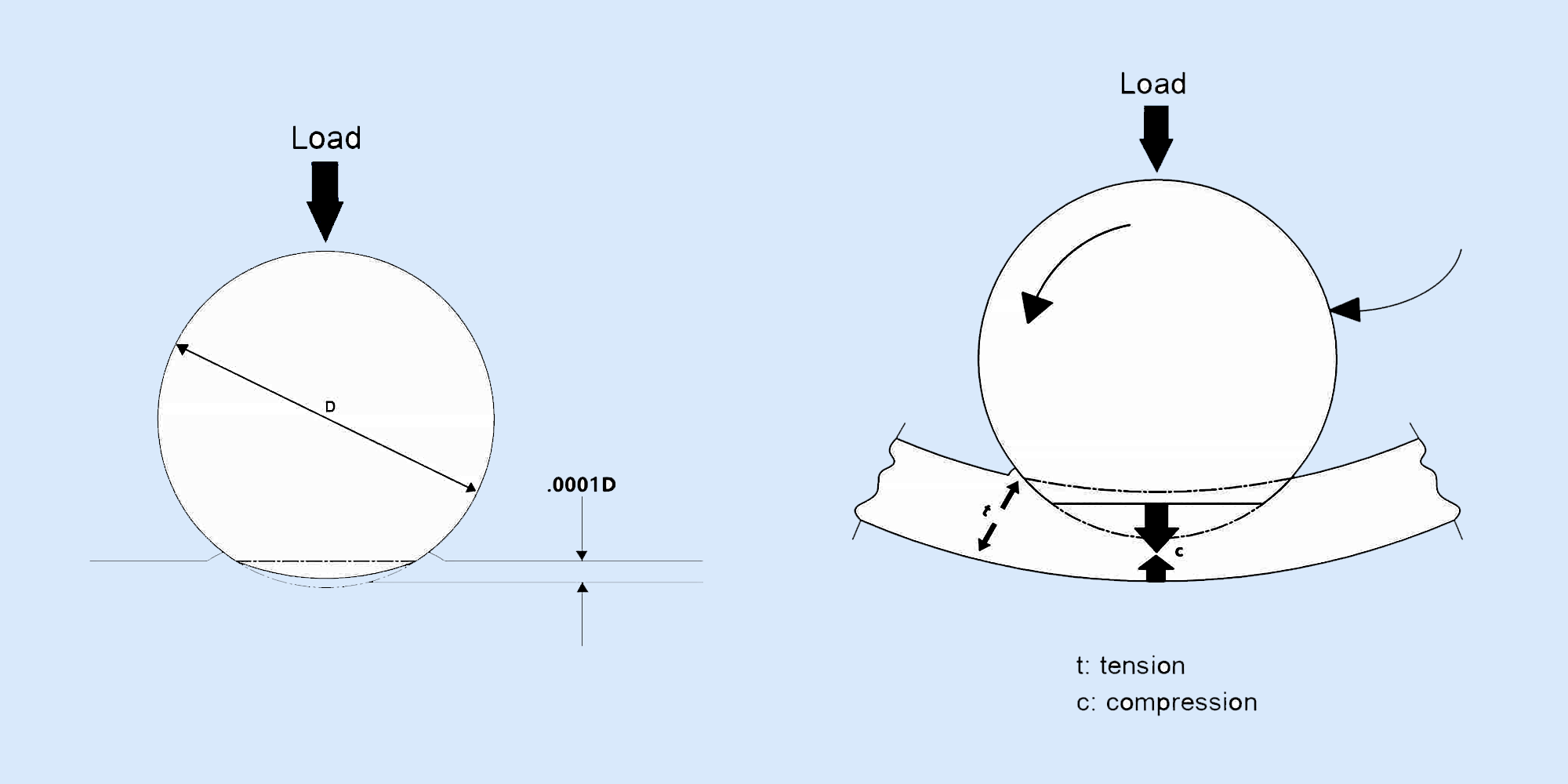
Bearings play a vital role in machinery by ensuring smooth motion and reducing friction. Understanding load capacities, specifically static load vs...
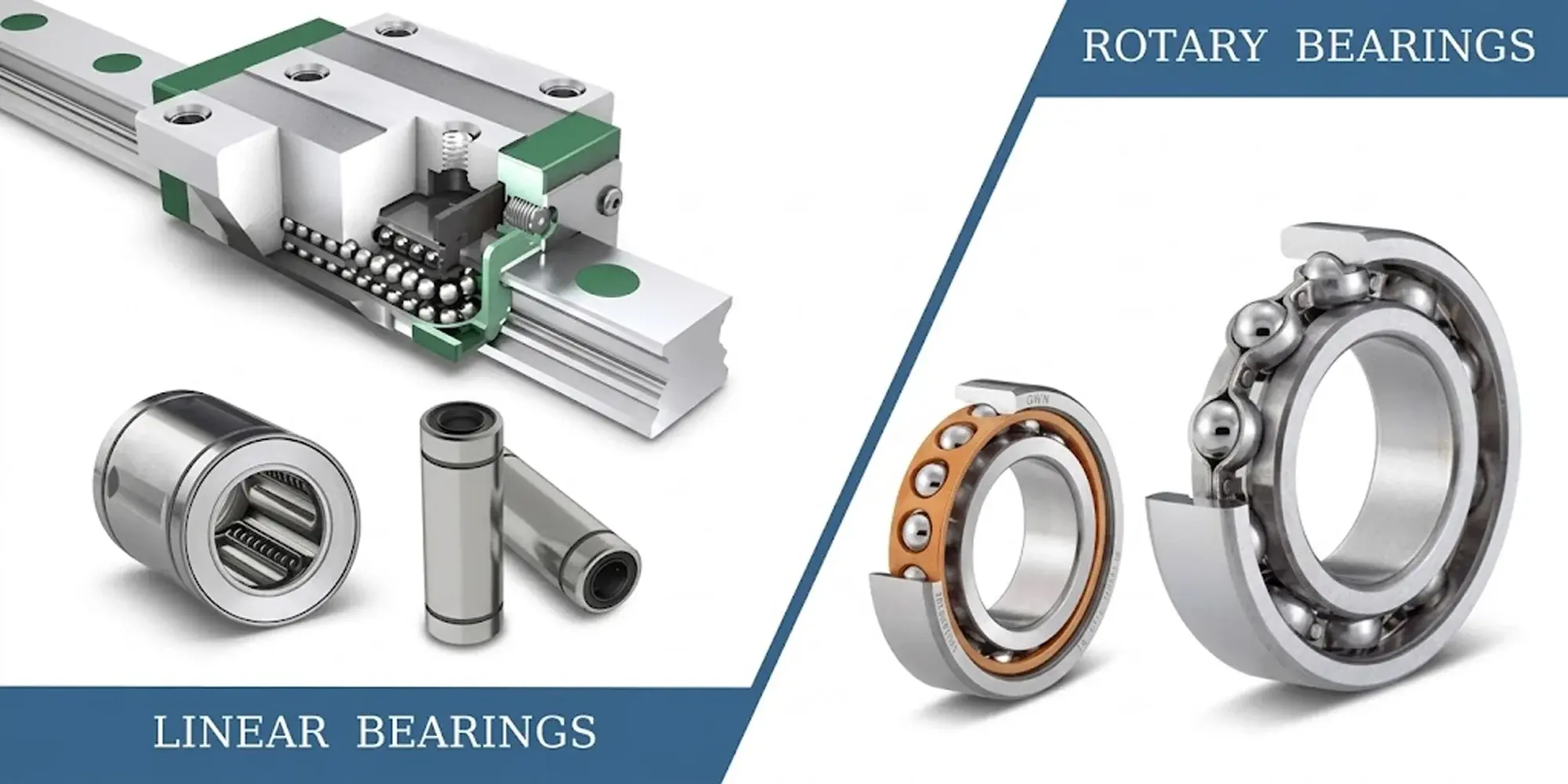
Linear Bearings vs Rotary Bearings — Key Differences Dimension ▶ Linear Bearing ▶ Rotary Bearing Motion type TranslationBack-and-forth...