

L10 Fatigue Life and Internal Clearance: What Every Spindle Engineer Must Know
Key Takeaways → The ISO 281 L10 formula assumes zero internal clearance — an assumption no real spindle meets → Three factors consume initial...
7 min read
William
:
May 15, 2026 2:53:52 AM
Table of Contents
If you've ordered bearings more than once, you've run into the ABEC number. Sometimes it's on the box. Sometimes buried in a spec sheet. And sometimes a salesperson throws it at you like it explains everything. It doesn't.
ABEC grade tells you one specific thing about a bearing: how tightly its physical dimensions were controlled during manufacturing.
That's genuinely useful information — but it's only part of the picture.
In our experience working with engineers across industries, the ABEC number is probably the most misunderstood spec in bearing selection.
We've seen customers pay three times more for ABEC 7 bearings and install them in low-speed conveyor drives running under 500 RPM.
We've also seen engineers spec ABEC 1 for high-speed spindle applications and then wonder why vibration levels are unacceptable after 200 hours. Both mistakes are avoidable.
This guide will help you make the right call.
ABEC stands for Annular Bearing Engineering Committee, a technical committee within the American Bearing Manufacturers Association (ABMA).
They publish dimensional tolerance standards for precision ball bearings — that's ABMA Standard 20, if you want the source document.
The scale has five grades: 1, 3, 5, 7, and 9 — odd numbers only, five grades total.
Higher number means tighter tolerance means more precise bearing.
There is no ABEC 2, 4, 6, or 8.
And there is no official ABEC 11 or ABEC 13, despite what some packaging claims.
ABEC is the dominant standard in North America. Internationally, equivalent systems exist: ISO 492 (global), DIN 620 (Germany), and JIS B1514 (Japan).
| ABEC Grade | ISO 492 | DIN 620 | Precision Level |
|---|---|---|---|
| ABEC 1 | Normal (6X) | P0 | Standard |
| ABEC 3 | Class 6 | P6 | Above Standard |
| ABEC 5 | Class 5 | P5 | High Precision |
| ABEC 7 | Class 4 | P4 | Super Precision |
| ABEC 9 | Class 2 | P2 | Ultra Precision |
Source: ABMA Standard 20; ISO 492:2014
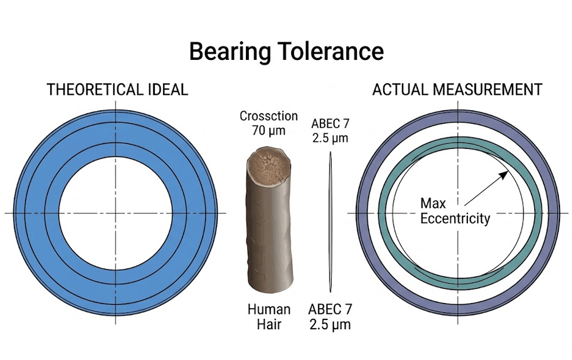
A bearing tolerance specifies the allowable deviation from its nominal dimensions — bore diameter, outer diameter, ring width, and critically, runout (how far the inner ring deviates from a perfect circle as it rotates).
For reference: a human hair is approximately 70 μm in diameter.

| ABEC Grade | Max Eccentricity (20mm bore) | Relative Precision |
|---|---|---|
| ABEC 1 | 10 μm | Baseline |
| ABEC 3 | 7 μm | 1.4× ABEC 1 |
| ABEC 5 | 4 μm | 2.5× ABEC 1 |
| ABEC 7 | 2.5 μm | 4× ABEC 1 |
| ABEC 9 | <1.5 μm | 7×+ ABEC 1 |
Let's be direct: ABEC 1 is unglamorous. It's the standard grade, the one nobody brags about.
It's also the grade used in the vast majority of bearings sold worldwide.
For most mechanical applications, ABEC 1 is not a compromise — it's the correct specification.
Where it works well:
Conveyor and material handling systems
Agricultural machinery and automotive wheel hubs
General-purpose electric motors and industrial gearboxes
Any application running below 3,000 RPM without precision positioning needs
ABEC 3 sits between standard and high-precision.
The eccentricity tolerance drops from 10 μm to 7 μm — real but relatively modest.
In most specifications, engineers either stay at ABEC 1 or jump directly to ABEC 5.
Practical applications: light industrial machinery, standard commercial electric motors, HVAC fans and blowers.
Practical note: many off-the-shelf bearings labeled simply as "precision" with no explicit ABEC marking will fall into ABEC 1 or ABEC 3.
If a supplier can't tell you the grade, assume ABEC 1.
This is where the jump becomes meaningful.
From ABEC 1 to ABEC 5, the eccentricity tolerance on a 20 mm bore drops from 10 μm to 4 μm — a 60% reduction.
At elevated speeds, that reduced runout directly translates to lower vibration, less heat generation, longer grease life, and more predictable bearing behavior over time.
ABEC 5 is a good starting point when your application runs above 10,000 RPM, or when positioning accuracy matters in robotics, precision actuators, or CNC applications.
Pricing typically runs 1.5–2× ABEC 1 bearings of comparable size.
If ABEC 5 is where precision starts, ABEC 7 is where it gets serious.
The tolerance reduction from ABEC 5 to ABEC 7 is dramatic — 4 μm down to 2.5 μm on a 20 mm bore.
More importantly, ABEC 7 bearings carry tighter specifications across multiple dimensions simultaneously: bore, outer diameter, runout, and ring width all held to tighter limits together.
Manufacturing ABEC 7 bearings requires specialized grinding equipment and extended inspection time.

Pricing is typically 4–5× that of equivalent ABEC 1 bearings.
For spindle applications: an ABEC 7 bearing at 30,000 RPM with correct preload and lubrication will produce measurably lower vibration and maintain tighter positional accuracy over its service life.
Typical applications: Machine tool spindles (milling, grinding, turning centers), high-speed CNC at 25,000–50,000 RPM, surgical and dental equipment, aerospace instrumentation, precision measuring systems.
ABEC 9 is the top of the official scale. Tolerances reach sub-micron levels in some dimensions.
You cannot manufacture these on standard production lines.
Dedicated equipment, controlled-environment production, and rigorous 100% inspection are standard practice.
Pricing: typically 5–10× or more vs ABEC 1. Lead times can run weeks to months.
Real applications: gyroscopes and inertial navigation systems, ultra-precision coordinate measuring machines, semiconductor manufacturing equipment, high-end aerospace instruments, defense systems.
Putting an ABEC 9 bearing into a housing bored to ABEC 1 fit tolerances accomplishes nothing. Match precision across the whole system — not just at the bearing.
You'll see these numbers on skateboard bearing packaging, hobby motor listings, and some consumer products. They are not real ABEC ratings.
The ABMA standard stops at ABEC 9. Any number above that is a marketing label — there is no technical standard, no testing committee, and no verifiable specification behind it.
Evaluate such bearings on material spec, manufacturer reputation, and application fit — not the number on the box.
ABEC grade controls dimensional tolerance only. It says nothing about:
Steel grade and hardness — AISI 52100 chrome steel is standard; not every bearing uses it
Ball precision grade — rolling elements are graded separately (Grade 10, 25, 100 per ABMA/ISO)
Raceway surface finish — roughness affects friction, noise, and fatigue life independently
Internal clearance — C2/C0/C3 clearance classes are completely separate specifications
Cage design and material — stamped steel, machined brass, and polymer cages perform differently
Lubrication — grease specification has an enormous effect on high-speed performance
Load capacity — ABEC grade does not change dynamic or static load ratings
Noise and vibration — not controlled by ABEC specifications
A well-manufactured ABEC 3 bearing from a reputable mill — with correct clearance, quality steel, and appropriate lubrication — will outperform a carelessly manufactured ABEC 7 bearing in most real-world conditions. We've seen this firsthand.
Customers switching from branded ABEC 5 to unbranded ABEC 7 sometimes see worse performance, because the underlying material and process quality didn't support the tighter tolerance spec.
Rather than defaulting to "higher is safer," work through these questions:
|
Speed Range |
Starting Grade |
Typical Applications |
|
Under 3,000 RPM |
ABEC 1 |
Conveyor, agricultural, automotive |
|
3,000–10,000 RPM |
ABEC 1 or 3 |
Standard motors, HVAC, fans |
|
10,000–25,000 RPM |
ABEC 5 |
Precision CNC, robotics, medical devices |
|
25,000–50,000 RPM |
ABEC 7 |
Machine tools, high-speed spindles |
|
50,000+ RPM |
ABEC 7 or 9 |
Aerospace instruments, gyroscopes |
Speed is a baseline only — also consider positioning accuracy, failure consequences, and system fit tolerances.

Precision positioning — robotics, CNC, measurement equipment — demands tighter runout control independent of speed.
If shaft position matters to system output, move up at least one grade from your speed baseline.
Medical, aerospace, and defense applications justify higher-grade bearings partly on cost-of-failure grounds.
A conveyor bearing failing early means a bearing swap. In a surgical tool, the calculus is completely different.
Specifying ABEC 9 into a housing bored to ABEC 1 fit tolerances wastes the premium completely.
Match precision across the system, not just at the bearing.
|
Grade |
Precision |
Best For |
Cost vs ABEC 1 |
|
ABEC 1 |
Standard |
Conveyor, automotive, general industrial |
Baseline $ |
|
ABEC 3 |
Above Std |
Light industrial, standard motors |
~1.2–1.5× |
|
ABEC 5 |
High Prec. |
Robotics, high-speed motors, CNC |
~1.5–2× |
|
ABEC 7 |
Super Prec. |
Machine tools, surgical, spindles |
~4–5× |
|
ABEC 9 |
Ultra Prec. |
Aerospace, gyroscopes, semiconductor |
5–10×+ |
Eccentricity values for 20mm bore per ABMA Standard 20 / ISO 492:2014. Cost multiples are indicative industry ranges.
If you source bearings from European or Asian manufacturers, you'll see ISO 492 or JIS B1514 designations rather than ABEC numbers.
ISO numbering runs in reverse — a lower ISO number means tighter tolerance.
ISO P5 = ABEC 5
ISO P4 = ABEC 7
ISO P2 = ABEC 9
Confirm equivalence with your supplier — there are slight differences in how the standards define certain parameters even at matching precision levels.
Not directly. ABEC grade controls dimensional precision, which enables higher speeds — but actual speed capability also depends on cage design, lubrication, internal clearance, and preload.
An ABEC 9 bearing with incorrect grease fill will not outperform a well-lubricated ABEC 5 at high speed. The grade creates the potential; the full specification delivers it.
Potentially, but test first. If the application genuinely ran at speeds and precision requirements calling for ABEC 7, stepping down will show up — either as elevated vibration, reduced service life, or measurable positioning error. Don't assume without verifying.
They're separate specifications addressing different things. ABEC grade defines how precisely the bearing components were manufactured.
C3 clearance defines the internal play between the balls and raceways in the assembled bearing.
A bearing can be ABEC 5 with C3 clearance, or ABEC 1 with C0 (standard) clearance — the two specs don't imply each other.
No. The ABMA standard tops out at ABEC 9. These are marketing designations with no standardized technical definition.
Evaluate such bearings on material spec, manufacturer reputation, and application fit — not the number on the box.
Not directly. ABEC classifications cover ball bearings.
Roller bearings fall under RBEC (Roller Bearing Engineers Committee) classifications in ABMA Standard 20.
If you're working with cylindrical, tapered, or spherical roller bearings, confirm whether RBEC or ISO 492 classifications apply to your spec.
If your application runs above 15,000 RPM, requires positional accuracy below 5 μm, or operates in a critical environment (medical, aerospace, food-grade), it's worth a conversation with an application engineer before committing to a grade.
The wrong choice in either direction — over-spec or under-spec — costs more than the bearing itself.
ABEC grade is one input into bearing selection — not the whole answer.
For most applications, ABEC 1 or ABEC 3 is the correct and sufficient specification.
Reach for ABEC 5, 7, or 9 when your speed requirements, precision demands, or operating environment actually call for it.
Overpaying for tolerances your machine will never use doesn't improve performance.
It adds procurement cost and sometimes creates sourcing headaches for a spec that was never necessary.
Work from your application requirements outward — speed, load, accuracy, environment — rather than from the grade inward.
At LILY Bearing, we work with engineers across industries to match bearing specifications to real application requirements.
Share your operating conditions and we'll help you find the right grade.
Contact our technical team →
Key Takeaways → The ISO 281 L10 formula assumes zero internal clearance — an assumption no real spindle meets → Three factors consume initial...
Bearings are crucial components in the mechanical world, helping rotating equipment run smoothly and efficiently. Preloading a bearing is an...
In my 15 years at LILY Bearing, I've seen one specification error cost companies $30K-50K in unplanned downtime: confusing polyurethane rollers with...