

ABEC Grades 1–9: Which Bearing Precision Do You Actually Need?
If you've ordered bearings more than once, you've run into the ABEC number. Sometimes it's on the box. Sometimes buried in a spec sheet. And...
6 min read
William
:
May 27, 2026 5:12:41 AM
Table of Contents
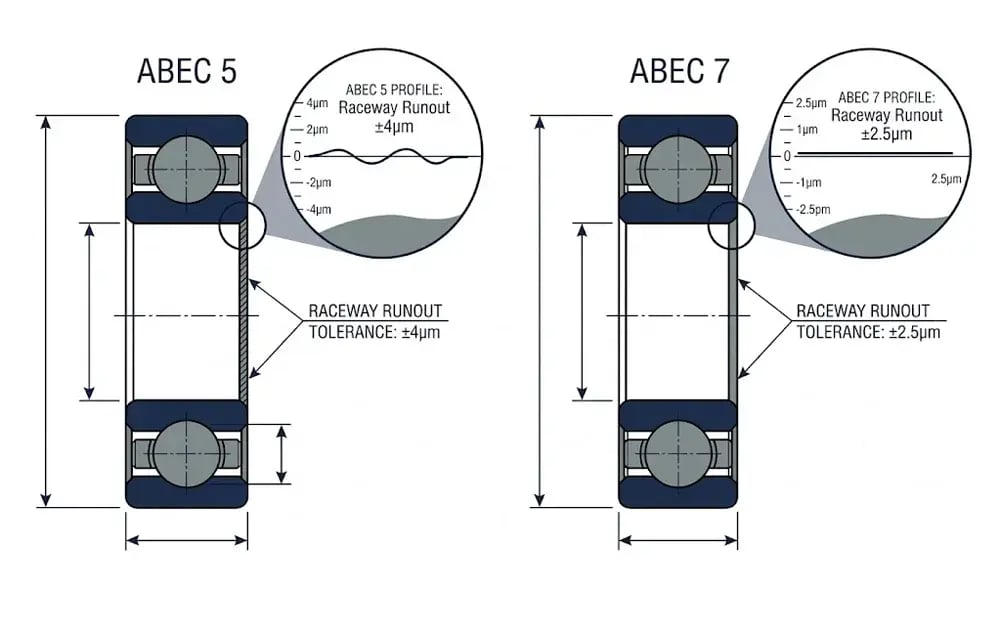
ABEC 5 and ABEC 7 are precision grades defined by the American Bearing Manufacturers Association (ABMA). ABEC 7 holds tighter dimensional tolerances than ABEC 5 — roughly 37% tighter on bore diameter — but that difference only translates into measurable performance gains above certain speeds and in applications where runout directly affects output quality.
For everything else, ABEC 5 is the right call. Here's how to tell the difference.
ABEC (Annular Bearing Engineers' Committee) is a precision grading system published by ABMA. It defines tolerances for:
The grades run in odd steps: ABEC 1 → 3 → 5 → 7 → 9. Each step up tightens tolerances by roughly 30–50% depending on the parameter. ABEC 1 is the loosest; ABEC 9 is the tightest.
ABEC does not define load capacity, material quality, internal clearance, or lubrication — common misconceptions that lead to poor specification decisions.
Further reading: ABEC Bearing Precision Grades — Complete Guide
Table 1: Tolerance comparison for a 25mm bore deep groove ball bearing
| Parameter | ABEC 5 | ABEC 7 |
|---|---|---|
| Bore diameter tolerance | ±4 µm | ±2.5 µm |
| Outer diameter tolerance | ±5 µm | ±4 µm |
| Radial runout (inner ring) | ≤3 µm | ≤2 µm |
| Axial runout (inner ring) | ≤5 µm | ≤3 µm |
| Width tolerance | ±120 µm | ±120 µm |
Source: ABMA Standard 20 / ISO 492

The bore tolerance tightens by 37.5% moving from ABEC 5 to ABEC 7. Radial runout drops by 33%.
Width tolerance is identical — a detail often overlooked.
In high-speed or high-precision applications, a 1–2 µm shift in radial runout directly affects vibration amplitude and heat generation at the rolling contact.
The standard engineering method for matching bearing precision to speed is the speed factor (n × dm):
Table 2: Speed factor guidelines by ABEC grade
| Speed Factor (n × dm) | Recommended Grade |
|---|---|
| Below 250,000 | ABEC 1 or 3 usually sufficient |
| 250,000 – 500,000 | ABEC 5 |
| 500,000 – 1,000,000 | ABEC 7 |
| Above 1,000,000 | ABEC 9 |
Worked example:
A 6205 bearing (25mm bore, 52mm OD) has a mean diameter of 38.5mm.
Running at 8,000 RPM, its speed factor is 8,000 × 38.5 = 308,000 — comfortably within ABEC 5 range.
The same bearing at 18,000 RPM produces a speed factor of 693,000, which puts it squarely in ABEC 7 territory.
The mechanism behind this: tighter tolerances reduce rotational eccentricity.
At high RPM, even a 2 µm mass imbalance generates measurable vibration, heat, and fatigue loading at the contact zone.
Industrial electric motors (1,500–6,000 RPM): The vast majority of motors in pumps, fans, and conveyors operate well within ABEC 5 tolerances. Upgrading to ABEC 7 adds cost without any measurable performance benefit.
Gearboxes and general machinery: Most gear shafts run below 3,000 RPM. ABEC 5 handles runout requirements at these speeds without difficulty.
Agricultural and construction equipment: Ambient vibration in these environments far exceeds anything the ABEC 5-to-7 tolerance gap would influence. ABEC 5 is the industry standard here.
Automotive wheel hubs: Wheel bearing units are typically manufactured to ISO P5 (equivalent to ABEC 5). Loads are high; speeds are moderate; the precision grade matches the requirement.
CNC machine tool spindles (10,000–30,000 RPM): The most straightforward use case for ABEC 7. Spindle runout directly determines surface finish quality. A 2 µm improvement in radial runout can shift surface finish from Ra 0.8 to Ra 0.4 on precision-machined parts — a meaningful difference in many aerospace and medical component specifications.
Dental handpieces (up to 350,000 RPM, depending on model): At these speeds, ABEC 7 is the minimum acceptable grade. Many dental turbine applications specify ABEC 9.
Aerospace gyroscopes and inertial navigation systems: Here the driver is angular accuracy rather than speed alone. ABEC 7 is typically the starting point; mission-critical applications often go higher.
Medical imaging equipment (CT scanner gantries, MRI gradient coil assemblies): Bearing vibration creates image artifacts. ABEC 7 is standard in these assemblies to keep mechanical noise below detectable thresholds.
High-frequency motors above 10,000 RPM: Heat from runout-driven imbalance accumulates faster at elevated speeds. ABEC 7 runs measurably cooler in sustained high-speed operation.
See also: ABEC 7 Bearings — What Do They Mean?
ABEC 7 bearings typically cost 30–60% more than equivalent ABEC 5 bearings from the same manufacturer.
For a standard 6205 deep groove ball bearing as a market reference:
*Prices are market reference estimates and vary by distributor, quantity, and region. Contact us for current pricing.
The premium compounds for larger or more specialized bearings.
A 100mm bore cylindrical roller bearing in ABEC 7 can run 2–3× the cost of the ABEC 5 equivalent.
For most operations replacing bearings in volume, ABEC 7 is objectively more precise — but that precision has no value if the application doesn't require it.
In most industrial equipment running below 5,000 RPM under standard load, it doesn't.
1. Upgrading grade instead of diagnosing the actual failure mode. Premature bearing failure in an ABEC 5 application is almost always caused by misalignment, contamination, or incorrect fit — not insufficient precision. Specifying ABEC 7 won't compensate for a shaft that's 15 µm out of alignment.
2. Ignoring shaft and housing tolerances. An ABEC 7 bearing mounted in a housing bored to h7 tolerance is a waste of money. The bearing's precision is only realizable when mating components are machined to match — shaft tolerances of k5 or m5 and housing tolerances of K6 or M6 are typically required.
3. Conflating ABEC grade with internal clearance. ABEC governs external dimensions and runout. Internal clearance (C2, CN, C3) is a separate, independent specification. A high-speed application may require both ABEC 7 and C3 clearance — these don't come as a package.
Choose ABEC 5
n × dm below 500,000
Typical cost
$12–18 / unit (6205 reference)
Choose ABEC 7
n × dm above 500,000
Typical cost
$18–28 / unit (6205 reference)
Yes, in almost all cases. ABEC 5 and ABEC 7 bearings share the same boundary dimensions (bore, OD, width), so they are physically interchangeable. The upgrade only delivers a performance benefit if the shaft and housing tolerances are tight enough to take advantage of it — in a loosely toleranced housing, the installed runout will be dominated by the fit, not the bearing grade.
They are equivalent in precision level. ABEC 7 is the ABMA/American designation; ISO P4 (defined in ISO 492) is the international equivalent. SKF, FAG, and other European manufacturers label their ABEC 7-equivalent bearings as P4. When cross-referencing specifications: ABEC 5 = ISO P5, ABEC 7 = ISO P4.
ABEC grade is not itself a noise specification — manufacturers use separate vibration ratings measured in velocity units (µm/s). However, tighter runout tolerances in ABEC 7 reduce the geometric irregularities that generate vibration, so ABEC 7 bearings run with lower vibration levels than ABEC 5 at equivalent speeds and loads. The effect is most pronounced above 8,000 RPM; at low speeds, the difference in measured vibration between grades is negligible.
Check the manufacturer's marking on the bearing outer ring or packaging. SKF marks precision grade as P5 or P4 in the designation (e.g., 6205-2Z/P5). NSK uses the same P5/P4 suffix convention. For bearings without clear markings — common with lower-cost sources — request the inspection certificate or dimensional report showing actual measured tolerances against ABMA Standard 20 or ISO 492. When precision grade matters for your application, buy from traceable sources.
Not automatically. ABEC grade affects dimensional precision, not fatigue life (L10), which is determined by load rating, actual applied loads, lubrication, and contamination levels. An ABEC 7 bearing in a misaligned or poorly lubricated housing will fail faster than a correctly installed ABEC 5.
Need help specifying the right bearing grade for your application?
Contact our engineering teamWe supply both ABEC 5 and ABEC 7 across hundreds of bearing types and can confirm the right grade for your speed, load, and environment requirements.
If you've ordered bearings more than once, you've run into the ABEC number. Sometimes it's on the box. Sometimes buried in a spec sheet. And...
ABEC 7 bearings are high-precision bearings designed to provide superior performance in applications requiring tight tolerances and high-speed...
Bearing wear is a significant concern in machinery. It not only hampers the efficiency of the machine but can also lead to premature bearing failure...