Global Bearing Market Analysis Report 2024-2030
According to the Grand View Research report, the global bearing market was valued at USD 120.98 billion in 2023, and it is expected to grow at a compound annual growth rate (CAGR) of 9.5% from 2024 to 2030. Bearings are widely used in various types of equipment and machinery, from automotive components, agricultural equipment, and household appliances to defense and aerospace equipment. This broad application is expected to drive market growth in the future. Additionally, there is an increasing demand for bearings with low maintenance requirements, higher efficiency, and longer service life. The demand for customized bearing solutions to meet the specific needs and challenges of various industries is also growing, further driving market development. For instance, the application of high-power products in wind turbines is increasing, which is expected to significantly drive demand. Wind turbines use these products to improve turbine performance and reliability, increase energy output, and reduce lubricant consumption.
Manufacturers are continuously optimizing product designs to enhance performance and energy efficiency. They use special materials for raceways, cages, and rolling elements, as well as redesigning raceway structures. Additionally, advancements in sealing and lubrication technologies, along with the use of lightweight materials in high-performance products, are creating significant opportunities for manufacturers. The integration of electromechanical properties directly into bearings helps improve performance while reducing product size and cost.
The growing demand for high-performance bearings is driving manufacturers to integrate advanced sensor units into their products. Sensor units enable digital monitoring of axial movement, deceleration, acceleration, rotation speed, and load capacity. Additionally, the rise of the agricultural Internet of Things (IoT) has promoted the adoption of connected equipment and machinery for continuous monitoring. This trend is positively influencing the market.
Some major suppliers have begun offering smart bearings, which enable continuous monitoring and predict failures before they occur. These products are still in the early stages, but it is expected that more leading manufacturers will incorporate smart bearings into their product portfolios in the near future. Since smart bearings can predict failures, thus reducing the cost of unplanned downtime, their adoption is expected to increase significantly during the forecast period.
Product Analysis
The bearing market is divided into ball bearings, roller bearings, sliding bearings, and other types based on product type. Among these, roller bearings accounted for more than 45% of the revenue share in 2023, making them the largest revenue segment. This segment is expected to maintain its leading position and become the fastest-growing sub-segment in the coming years. Roller bearings effectively reduce rotational friction, support radial and axial loads, and are more efficient in handling extreme axial loads and heavy radial loads compared to other types. Roller bearings are widely used in industries such as capital equipment, automotive, household appliances, and aerospace, which is expected to positively impact product demand.
Ball bearings, due to their smaller contact area, greatly reduce friction and are suitable for both thrust and radial loads. This makes ball bearings increasingly popular in two-wheeled and four-wheeled vehicles, and this sub-segment is expected to see healthy growth during the forecast period.
Sliding bearings (also known as sleeve bearings) are the most basic type of bearing, with no rolling components. They are mainly used for sliding, swinging, rotating, and reciprocating movements. In sliding applications, they are used as bearing strips, sliding bearings, and wear-resistant plates. Due to their larger contact area and stronger load-bearing capacity, sliding bearings can handle higher shock loads and load capacities compared to roller bearings. These advantages make sliding bearings the preferred choice in applications that require resistance to larger oscillation movements. Demand for sliding bearings is expected to grow steadily during the forecast period.
Application Analysis
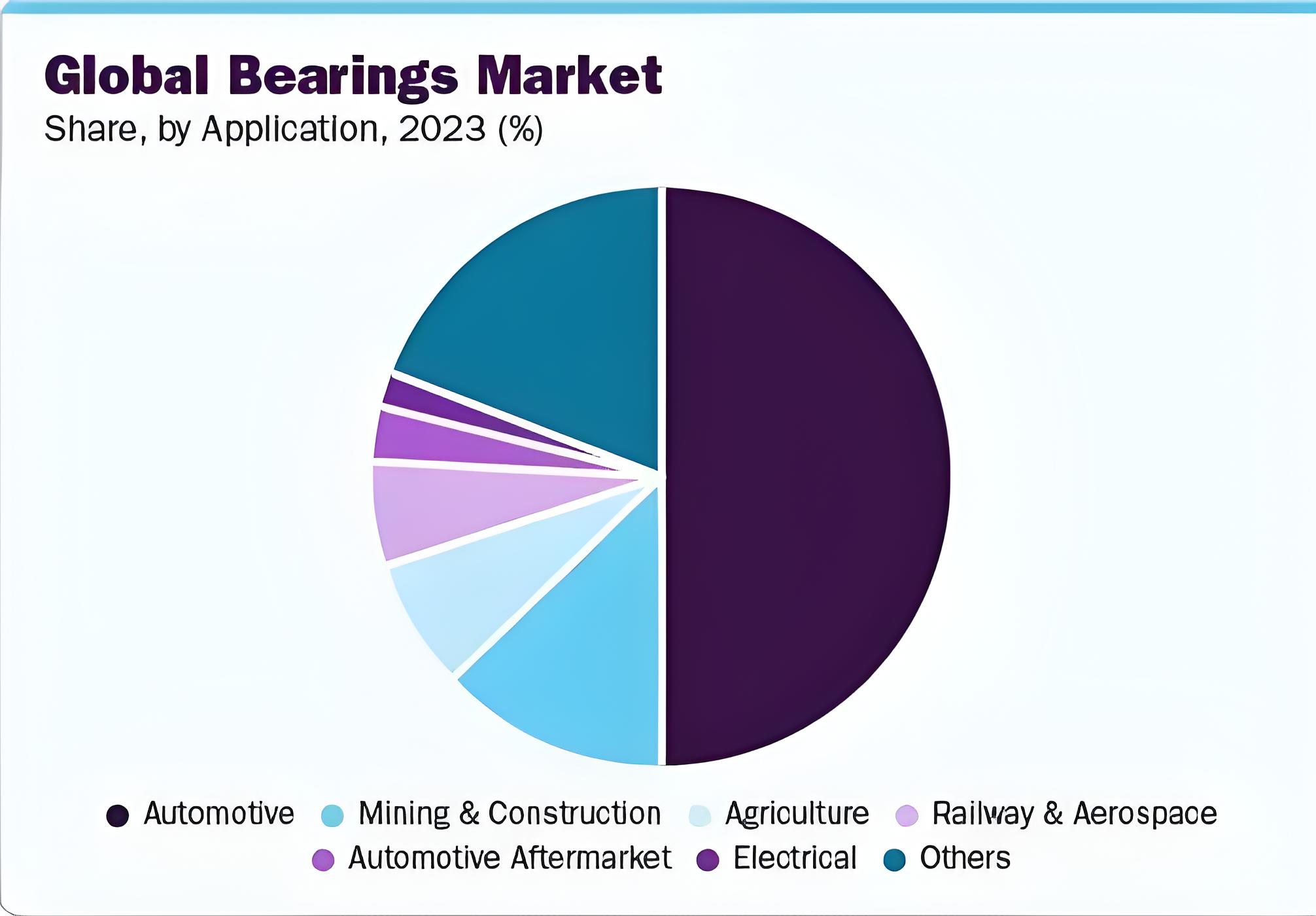
In 2023, the automotive segment dominated the market, accounting for 49.0% of the market share. This high share is attributed to the high production volume of vehicles worldwide. Additionally, the demand for vehicles with advanced technological solutions is continually increasing, driving the growth of automotive instrumentation products. The growth in demand for advanced vehicles and the subsequent improvement in vehicle performance has led to an upgraded demand for bearings in the automotive industry. Furthermore, it is expected that the automotive aftermarket will grow at a higher CAGR during the forecast period, further driving bearing demand.
The railway and aerospace sectors are expected to be the fastest-growing segments by 2030. This growth is driven by increased travel activities, the need to replace aging fleets (due to strict environmental regulations and fuel price pressures), and the continuous improvement of global and local transportation systems. As railway construction accelerates in developing countries, demand in the railway sector is also expected to rise. In addition, the surge in demand for small single-aisle airplanes and helicopters in emerging economies is expected to further boost growth in this sub-segment.
Regional Analysis
Asia-Pacific
The Asia-Pacific region accounted for 40.0% of the market share in 2023 and is expected to achieve the fastest revenue growth, with revenue expected to exceed USD 98.2 billion by 2030. China, as a major market, is projected to see significant sales growth in the coming years, driven by the rapid expansion of machinery and vehicle production, as well as a strong aftermarket for industrial equipment and vehicle maintenance. In addition, India’s strong construction and mining equipment markets are expected to drive continued market growth until 2030.
Europe
The European market is expected to see good growth during the forecast period, mainly due to sustainable economic growth and increased investments. In mature markets such as the U.S., Western Europe, and Japan, demand is driven by the recovery in vehicle production and healthy fixed investment environments. Additionally, the growth in sales of high-value bearings (such as custom large-diameter bearings for heavy machinery and wind turbines) in North America is also expected to further boost the market.
Middle East and Africa
Rapid urban infrastructure development in the Middle East and Africa is positively impacting overall market growth.
Major Country Market Analysis
United Kingdom
The UK bearing market accounted for 9.93% of the Western European market revenue share in 2023. Growth in the UK market is attributed to increased industrial activity and the advancement of infrastructure development projects, which are driving demand for bearings.
France
The French bearing market accounted for 18.40% of the Western European market revenue share in 2023. This market share is attributed to a focus on renewable energy projects and advancements in the automotive industry, which are driving demand for bearings in wind turbines, electric vehicles, and machinery.
Germany
The German bearing market accounted for 29.89% of the Western European market revenue share in 2023. Market growth is primarily driven by strong developments in the machinery and automotive industries, supported by technological innovation and export demand, which has increased the need for bearings as key components.
China
The Chinese bearing market accounted for 53.75% of the Asia-Pacific market revenue share in 2023. This market share is driven by rapid urbanization, industrialization, and infrastructure development projects, which are driving strong demand for bearings in construction machinery, automotive manufacturing, and industrial equipment.
India
The Indian bearing market accounted for 9.39% of the Asia-Pacific market revenue share in 2023. Market growth is driven by the expansion of the manufacturing, construction, and infrastructure sectors, supported by government initiatives such as “Make in India” and investments in transportation and renewable energy projects, which are increasing demand for bearings.
Japan
The Japanese bearing market accounted for 19.74% of the Asia-Pacific market revenue share in 2023. This market share is primarily driven by technological innovation and automation in manufacturing processes, as well as growth in the automotive and electronics industries, which is boosting demand for high-precision bearings in robotics, machinery, and precision equipment.
Brazil
The Brazilian bearing market accounted for 54.99% of the Latin American market revenue share in 2023. Market growth is driven by the recovery in the automotive and industrial sectors, as well as support from economic reforms and infrastructure investments, which are boosting demand for bearings in vehicle production and industrial machinery.
Saudi Arabia
The growth of the Saudi Arabian bearing market is driven by efforts to diversify its non-oil industries, including investments in manufacturing, construction, and transportation, which is stimulating demand for bearings in machinery, automotive, and infrastructure projects.
Keep Learning
-
VISIT LILY BEARING AT IMTS 2026, BOOTH NO. E134668
The team at LILY Bearing will be attending and participating in IMTS 2026! Stop by our booth, #No. E134668, to chat with our team members ...
-
China's Bearing Industry Advances Under 14th Five-Year Plan
Under the dual drive of the 14th Five-Year Plan and the global intelligent transformation of the manufacturing industry, China's bearing industry is p...
-
Bearing Industry 2025: Key Breakthroughs You Should Know
As we approach the midpoint of 2025, the bearing industry has seen remarkable advancements in technology, market dynamics, and industrial collaboratio...
-
LILY Bearing Showcases High-Precision Solutions at 2025 CMEF in Shanghai
The CMEF (China International Medical Equipment Fair), established in 1979, has evolved over more than 40 years into a premier event in the Asia-Pacif...

Richard
Richard is a senior engineer with 18 years of experience in the bearing industry, specializing in product quality supervision, inspection, and customer-oriented product evaluation. He excels at identifying and correcting quality anomalies during production, implementing effective on-site controls, corrective actions, and preventive measures to ensure products consistently meet high standards. With deep expertise in bearing product standardization, Richard is skilled at resolving technical issues related to materials, heat treatment, and machining processes — continuously optimizing product quality and production processes to deliver reliable technical support and solutions to clients.
Share this article