THK Linear Guides
4417 Products

What Are Linear Guides?
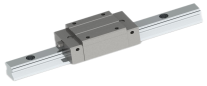
Linear guides, also called linear guideways or linear rails, are precision mechanical components that constrain and guide motion along a single axis. A typical linear guide consists of a rail and one or more carriages equipped with recirculating rolling elements — balls or rollers — that move along the rail with minimal friction. They are widely used wherever accurate, smooth, and repeatable linear motion is required.
Key Features & Advantages
- High precision — minimal running parallelism error and excellent positioning repeatability across the full stroke length.
Multi-directional load capacity — simultaneously handles radial, reverse radial, and lateral loads as well as moment loads in all directions. - Low friction & energy efficiency — rolling contact significantly reduces friction compared to sliding guides, lowering energy consumption and heat generation.
- Long service life — the recirculating design distributes load evenly across rolling elements, enabling rated service lives exceeding 20,000 km under normal conditions.
- High rigidity — preloaded carriages eliminate clearance and provide stiffness in all load directions.
Easy installation & interchangeability — standardized profiles and bolt-hole patterns simplify mounting and replacement.
How to Select The Right Linear Guides?
1. Define your load profile
Identify the direction and magnitude of all applied loads — radial, reverse radial, lateral, and moment loads in pitch, yaw, and roll. Standard ball-type guides (HG, EG) handle balanced multi-directional loads well. If moment loads dominate, consider WE or CG series. For exceptionally heavy radial loads, choose the roller-based RG series.
2. Determine the required precision grade
Most general industrial applications are adequately served by Normal or H grade. Semiconductor equipment, optics, and metrology instruments typically require P or SP grade (equivalent to ISO P3–P5). Always specify the grade based on the tightest tolerance in your system — over-specifying increases cost without benefit.
3. Consider speed and acceleration
For traversing speeds above 3 m/s or high-frequency reciprocating cycles, select the QH series with its optimized recirculation design. Standard series guides may generate excessive noise and heat at elevated speeds.
4. Account for space constraints
When vertical clearance is limited, the EG low-profile series reduces installation height without sacrificing performance. For miniature applications below 15 mm rail width, the MG series is the appropriate choice. If a single-rail layout is required, the QW series provides the necessary moment rigidity.
5. Calculate service life
Use the ISO 14728 L10 life calculation — L10 (km) = (C / P)³ × 50, where C is the dynamic load rating and P is the applied load. Target a minimum L10 life of 20,000 km for most industrial applications. If the calculated life falls short, select the next size up or consider a higher-capacity series.
6. Environment and lubrication
Standard guides require periodic grease lubrication via the carriage grease nipple. For clean-room or food-grade environments, specify stainless steel variants and compatible lubricants. The QW series features enhanced seal design and superior lubricant retention for extended maintenance intervals.
Linear Guides Series
- HG Series — Standard precision ball linear guides
Precision grade: Compact Grade(C)/ High Grade (H) / Precision Grade (P) | Comparable to THK HSR, NSK WH
The HG Series is our flagship standard linear guide, engineered around a 4-row circular arc groove design that distributes load evenly across all rolling elements. This geometry delivers exceptional rigidity in radial, reverse radial, and lateral directions simultaneously, making it one of the most versatile guides in our lineup. With precision grades spanning Normal through P, the HG Series serves a broad spectrum of applications — from everyday industrial automation to demanding CNC machine tools and large-span gantry systems. Its standardized bolt-hole pattern ensures drop-in compatibility with THK HSR, NSK NH, and IKO LWH mounting layouts, simplifying retrofits and reducing downtime. Whether you are building a new axis or upgrading an existing machine, the HG Series delivers the reliability, load capacity, and smooth motion your application demands. - EG Series — Low-profile linear guides
Precision grade: Compact Grade (C) / High Grade (H) / Precision Grade (P) | Comparable to THK SR, NSK WS
The EG Series redefines what a compact linear guide can achieve. By reducing the overall cross-section height without compromising internal geometry or preload design, EG delivers the rigidity and positioning repeatability of a full-size guide in a significantly smaller envelope. The reduced installation height makes it the go-to choice for space-constrained machine layouts where every millimeter of vertical clearance counts. Typical applications include PCB handling and inspection equipment, compact packaging lines, flat-panel display processing machines, and any automated system where a standard-height guide simply will not fit. Available in Normal and H precision grades, the EG Series ensures you never have to trade performance for space. - QH Series — High-speed linear guides
Precision grade: Compact Grade (C) / High Grade (H) / Precision Grade (P), operating speed up to 5 m/s | Comparable to THK SHS
Optimized recirculation geometry minimizes noise and vibration even at peak acceleration. Best suited for pick-and-place robots, laser cutting machines, and any application demanding rapid, repetitive positioning cycles. - QE Series — Ultra-precision linear guides
Precision grade: Compact Grade (C) / High Grade (H) / Precision Grade (P) | Comparable to THK SSR
Engineered for applications where every micron matters. Designed for semiconductor wafer handling, coordinate measuring machines (CMM), and optical instrument positioning stages requiring the tightest possible running parallelism and positioning repeatability. - RG Series — Roller-type linear guides
Precision grade: Compact Grade (C) / High Grade (H) / Precision Grade (P), load rating 2–3× ball-type | Comparable to THK SRQ
Cylindrical rollers replace balls to deliver significantly higher load capacity and rigidity. The preferred choice for heavy-duty machining centers, press machines, and applications subject to high moment loads or heavy workpiece weights. - MG Series — Miniature linear guides
Precision grade: Compact Grade (C) / High Grade (H) / Precision Grade (P), rail width from 7 mm | Comparable to THK RSR
The MG Series brings full-specification linear guide performance to the smallest possible footprint. With rail widths starting at just 7 mm, MG is purpose-engineered for applications where installation space is measured in millimeters, not centimeters. Despite its compact dimensions, the MG Series maintains the same recirculating ball design, preload options, and precision grades found in our larger series — delivering smooth, repeatable motion with minimal friction at micro scale. It is the preferred choice for medical diagnostic devices, laboratory automation platforms, micro-robotic systems, semiconductor test equipment, and any precision instrument where size and weight constraints are non-negotiable. When your design leaves no room for compromise, MG delivers. - WE Series — Wide-type linear guides
Precision grade: Compact Grade (C) / High Grade (H) / Precision Grade (P), enlarged carriage footprint
Enlarged slider width increases the moment arm, enhancing resistance to overturning moments. Well suited for cantilevered axis designs, large-format plotters and printers, and portal-type structural frames. - QW Series — Single-rail / space-saving linear guides
Precision grade: Compact Grade (C) / High Grade (H) / Precision Grade (P), low-noise optimized
Superior lubrication retention extends service intervals. Ideal for single-rail configurations, clean-room environments, and precision measuring instruments. - CG Series — Moment-resistant linear guides
Precision grade: Compact Grade (C) / High Grade (H) / Precision Grade (P), moment load rating +50% vs standard
Optimized bearing circulation geometry delivers up to 50% higher moment load capacity versus conventional designs. Recommended for robotic arm axes, overhung load configurations, and multi-axis machining applications with complex force vectors.