

What Is a Take-Up Bearing?
A conveyor belt or chain doesn't stay the same length forever. It stretches with use, and if nothing compensates for that stretch, the result is slippage, misalignment, or a belt that eventually runs off the pulley.
A take-up bearing solves this. Instead of bolting the bearing to one fixed spot like a standard pillow block, the housing has an elongated mounting slot, so it can be shifted along that slot to restore proper tension as the belt or chain stretches — without a full rebuild.
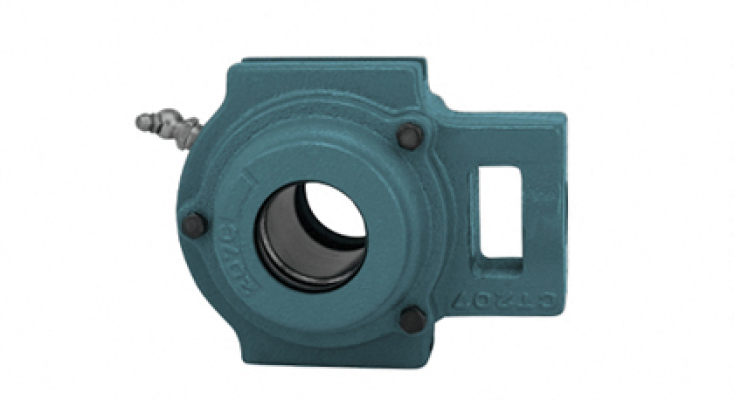
Take-up bearings show up on belt conveyors, bucket elevators, drag chain conveyors, and overhung shaft drives — anywhere tension needs periodic correction. Nip and pinch points at these tensioning locations are also a recognized workplace hazard on conveyor systems; OSHA's guidance on conveyor guarding covers what needs to stay shielded during operation, including drive, take-up, and pulley points.
How a Take-Up Bearing Is Built
Every take-up bearing unit is a ball bearing insert — wide inner ring, double-sealed, AISI 52100 bearing steel — pressed into a cast iron housing with that elongated slot machined into the base. A set screw locks the insert to the shaft; the slot is what lets the whole housing slide.
Standard grease-lubricated units run from about -30°C to 110°C. If the line runs hotter than that — a drying oven, a hot-process line — ask about a high-temperature grease option before assuming a standard unit will hold up.
Choosing Between the Take-Up Series
Every unit uses the same ball bearing insert. What changes between series is the housing — slot width, cover, and corrosion protection — matched to load size and environment.
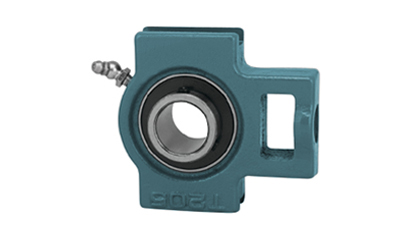 Standard
- Set-screw locking, open housing
- 200-size for smaller shafts, 300-size for heavier duty
- General dry indoor use
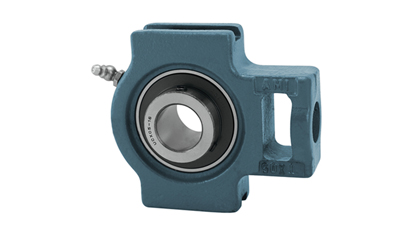 Extra-Capacity
- Wider slot, larger housing footprint
- Bigger bore sizes, higher radial load
- Not a bigger standard unit — a different housing
Covered
- Same 200-size unit with open or closed covers
- Extra protection against dust and debris
- Good default for general workshop floors
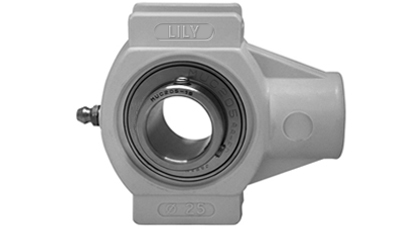 Corrosion-Protected
- Coated or treated housing
- Washdown, food-grade, high-moisture lines
- Same bore range as the standard series
A few representative sizes across the range, for a sense of scale:
Part Number | Series | Bore | Unit Price |
|---|---|---|---|
CUCT201C | CUCT200C (covered) | 12 mm | $15.73 |
CUCT208C | CUCT200C (covered) | 40 mm | $28.45 |
UCTX17 | UCTX00 (extra-capacity) | 85 mm | $107.46 |
UCT328 | UCT300 (standard, heavy duty) | 140 mm | $647.12 |
How to Choose the Right Take-Up Bearing
Confirm the shaft bore diameter. The first, non-negotiable filter.
Check how much travel you actually need in the mounting slot, based on expected belt or chain stretch over the equipment's service life — not just what fits the available space.
Match the series to your environment. Standard for general dry indoor use, covered where dust and debris are a concern, corrosion-protected for washdown and food-grade lines.
Verify bolt center-to-center spacing against your current mounting holes before ordering — this varies by series and size, not just bore.
Confirm the locking method. Most units use set screws; some corrosion-protected lines use a concentric locking collar instead, which changes the installation procedure.
Replacing a Take-Up Bearing from Another Supplier
If you're replacing a take-up unit currently supplied under a different brand, match in this order: bore diameter, mounting slot travel, bolt center-to-center spacing, and locking method. Our bearing cross-reference tool is a good starting point for matching an existing part to an equivalent bore and series.
Don't assume a catalog number maps directly across brands. Confirm all five dimensions — bore, travel, bolt spacing, frame footprint, and locking method — against the actual unit you're replacing, especially on older equipment where the original supplier may no longer carry that exact part.
LILY's take-up bearing line covers metric and imperial bore from 12 mm to 140 mm, across standard, extra-capacity, covered, and corrosion-protected series.
Browse Take-Up BearingsFAQ
How do I know when a take-up bearing needs replacing?
Watch for the mounting slot running out of usable travel, unusual heat or noise from the bearing, or the belt slipping even after you've taken up the available slack. Any one of these means it's time to inspect, not just re-tighten.
Can I convert a fixed pillow block into a take-up bearing?
No. A take-up unit needs the elongated slot housing built into the base — you can't retrofit slide function onto a bolted pillow block mount.
Can I get a longer travel length than what's listed for my bore size?
Travel length and bore size aren't strictly linked. Some suppliers offer extended-travel versions of a standard bore on request, built on a longer frame than the catalog default. Check with your supplier before assuming the standard travel figure is your only option, especially on long conveyor runs with significant expected belt stretch.
About the Author


