

What Is a Hanger Bearing Unit?
If a shaft runs unsupported for any real length — a screw conveyor, an overhung fan shaft, a long belt drive — it needs an intermediate support point, or it sags and vibrates under load. A hanger bearing unit is that support: it's suspended from an I-beam or bracket to hold the shaft at a fixed point along its length.
Worth knowing before you spec one:
"Hanger bearing" covers two genuinely different products.
One is a CEMA-standard sleeve (journal) bearing, built to CEMA style 216/226 dimensions with materials like hard iron or bronze, used specifically in screw conveyor hanger brackets.
The other — covered in this guide — is a ball-bearing hanger unit used for general suspended-shaft support across conveyors, agricultural equipment, fans, and material handling. If you're speccing a screw conveyor specifically, confirm which type your system actually calls for before ordering.
How a Hanger Bearing Unit Is Built
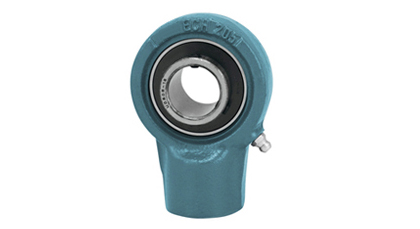
A ball bearing insert — wide inner ring, double-sealed, AISI 52100 steel — sits in a split or clamp-style cast iron housing. The split design is what makes it a "hanger" bearing: it clamps around the shaft rather than sliding a shaft through a closed bore, so it can be installed or removed without disassembling the equipment on either side.
Standard operating range is about -30°C to 110°C. Locking comes in two forms: standard set screws, or a concentric locking collar for applications where set-screw marking on the shaft is a concern.
Locking Methods and Series Options
Standard
- Lowest cost option
- Good default for infrequent servicing
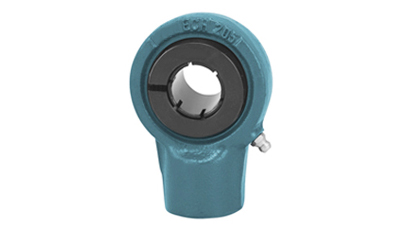 Concentric Collar
- Cleaner shaft removal
- Reduced shaft marking over repeat servicing
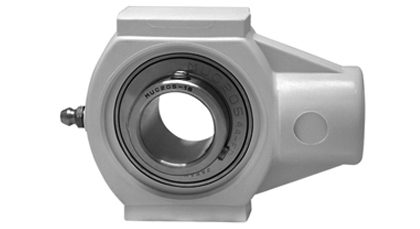 Corrosion-Protected
- Coated housings
- Washdown, food-grade, outdoor/agricultural use
Part Number | Locking Method | Bore | Unit Price |
|---|---|---|---|
UCECH201-8 | Set screw | 0.5" (12.7 mm) | $7.86 |
UCECH207 | Set screw | 35 mm | $15.54 |
UCECH215 | Set screw | 75 mm | $67.96 |
Where Hanger Bearing Units Are Used
Conveyor systems — supporting overhanging or intermediate shaft sections in belt and roller conveyors.
Agricultural equipment — augers, harvesters, and conveyors where a shaft runs suspended along its length. Shaft entanglement around augers is a well-documented injury risk; CDC/NIOSH surveillance data outlines why guards and shields around these shafts matter.
Industrial fans and blowers — supporting overhung fan shafts to reduce vibration.
General manufacturing machinery — mixers, rollers, and other equipment with cantilevered shaft sections.
How to Choose the Right Hanger Bearing Unit
Confirm the shaft bore diameter.
Choose a locking method based on how often you'll need to remove the shaft, and whether set-screw marking is a concern.
Match the series to your environment. Standard for dry indoor use, corrosion-protected for washdown or outdoor/agricultural exposure.
Check the mounting/attachment dimensions against your existing bracket or I-beam spacing before ordering.
Cross-Referencing a Hanger Bearing Unit
If you're sourcing a replacement for a hanger bearing unit currently supplied elsewhere, the same rule applies as with any mounted bearing: match bore diameter, locking method, and bracket/mounting dimensions rather than relying on a catalog number alone.
If your equipment specifically requires a CEMA 216/226 sleeve-type hanger, confirm that against the original conveyor spec before substituting a ball-bearing unit — the two are not interchangeable, even though both are called "hanger bearings."
LILY's hanger bearing units cover metric and imperial bore from 1/2" to 75 mm, in set-screw, concentric collar, and corrosion-protected series.
Browse Hanger Bearing UnitsFAQ
How often should a hanger bearing unit be replaced?
Watch for shaft play at the mounting point, unusual heat or noise, or visible housing wear at the split line. Any of these means it's time to pull and inspect.
Is a concentric collar (Accu-Loc) hanger bearing worth the extra cost over set screw?
It's worth it if you remove the shaft often, or if set-screw indentation on the shaft surface is a real concern over the equipment's service life. For a low-maintenance, rarely-serviced application, standard set-screw locking is the more economical choice.
How can I tell which type of hanger bearing my equipment currently uses?
Pull the unit and look at the insert. A ball-bearing hanger unit has a visible sealed rolling-element bearing pressed into the housing. A CEMA sleeve/journal hanger has a solid bushing with no rolling elements, and the housing is typically stamped with a style number like 216 or 226. If you're not sure, check the equipment's original manual before ordering a replacement.
About the Author


