

Home/
Blog/
Advantages of Using Needle Bearings

5 min read

Advantages of Using Needle Bearings

Advantages of Using Needle Bearings
17:19

Rolling-element bearings are primarily classified into ball bearings and roller bearings.

The roller bearing category includes cylindricaltaperedspherical, and needle bearings.

Among these, needle roller bearings are the smallest and lightest, offering distinct advantages for applications where weight and space need to be minimized.

Their long roller length to diameter ratios not only gives them their name but also defines their unique operating properties.

In this blog, we will focus on needle bearings. We’ll cover their advantages, performance, and common uses, as well as any challenges they may have.


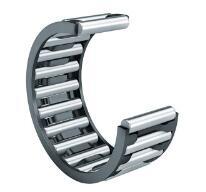
needle roller bearing


What Are Needle Bearings?

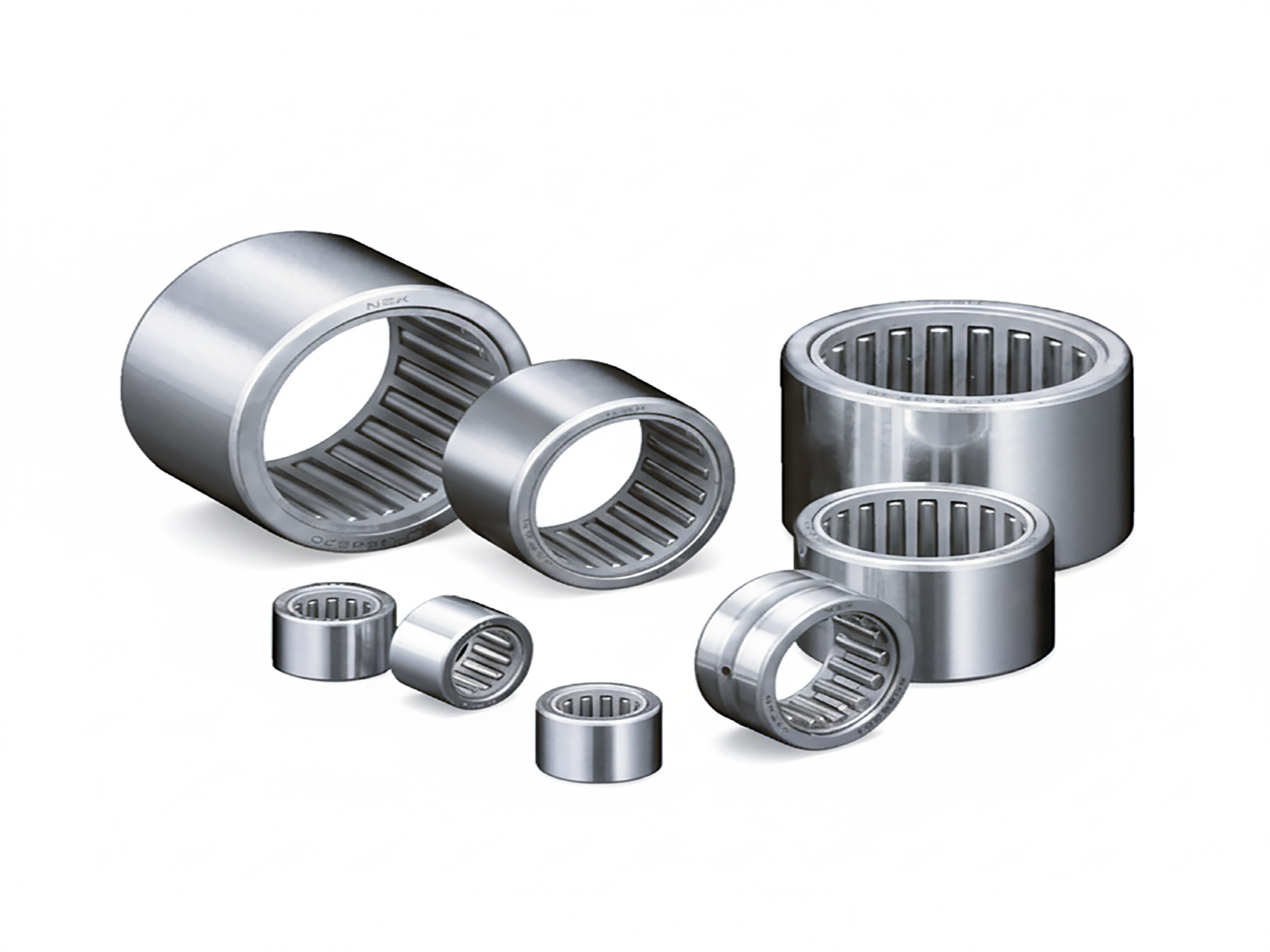
Needle roller bearings are a specialized type of rolling-element bearing that use long, thin cylindrical rollers — called "needles" — to carry high radial loads within an extremely compact radial cross-section. Despite their slender profile, needle bearings deliver outstanding load capacity, making them a go-to solution wherever space is tight but performance cannot be compromised.

From automotive transmissions and aerospace actuators to industrial gearboxes and two-stroke engines, needle bearings are found in some of the world's most demanding mechanical systems.


needle bearing


Key Advantages at a Glance

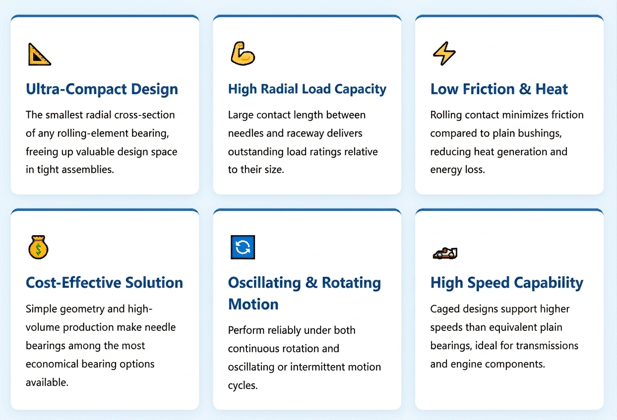
Before diving deeper, here is a high-level overview of why engineers choose needle bearings:

Key Advantages at a Glance


Exceptional Space Efficiency & Compact Cross-Section

The defining characteristic of a needle roller bearing is its remarkably small radial height. The needle rollers — typically with a length-to-diameter ratio between 3:1 and 10:1 — allow the bearing to fit into shaft bores or housings where no other rolling-element bearing would be practical.

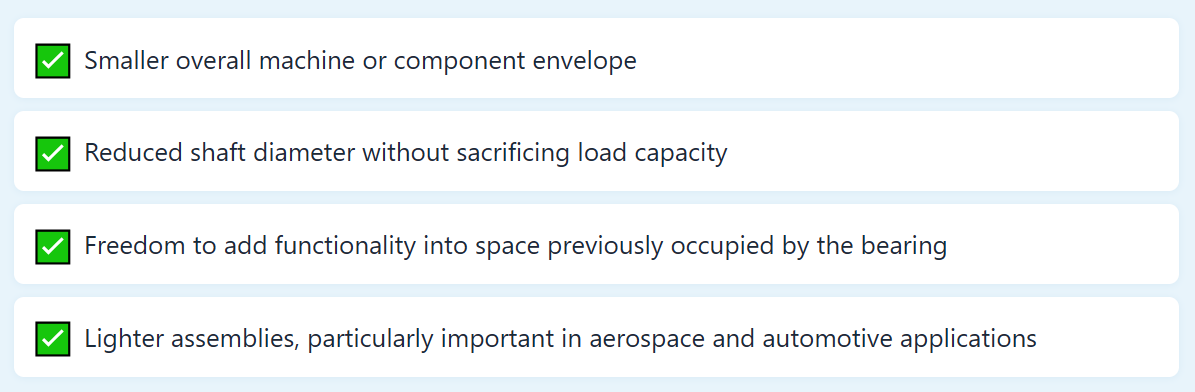
In practical terms, this means a needle bearing can replace a plain bronze bushing in a connecting rod, a gear bore, or a pump housing — delivering the load capacity of a much larger bearing in the original compact space. For product designers, this translates directly to:

Exceptional Space Efficiency & Compact Cross-Section

Design Tip: When upgrading from a plain bushing to a needle bearing in an existing design, you can often retain the original shaft and housing dimensions with zero modifications — a significant cost and time saving during product re-engineering.


High Radial Load Capacity Relative to Size

Despite their slim profile, needle bearings carry surprisingly heavy radial loads. This is because the long needle rollers create an extended contact line against the inner and outer raceways, distributing load across a much greater surface area than ball bearings of equivalent bore size.

Bearing Type

Radial Load Capacity

Radial Height

Best Application

Needle Roller

★★★★★ Very High

★★★★★ Minimal

Compact, heavy radial load

Deep Groove Ball

★★★ Moderate

★★★ Medium

Combined load, high speed

Cylindrical Roller

★★★★ High

★★ Larger

High radial, high speed

Plain Bushing

★★★ Moderate

★★★★★ Minimal

Low speed, oscillating

Spherical Roller

★★★★★ Very High

★ Very Large

Misalignment, heavy loads


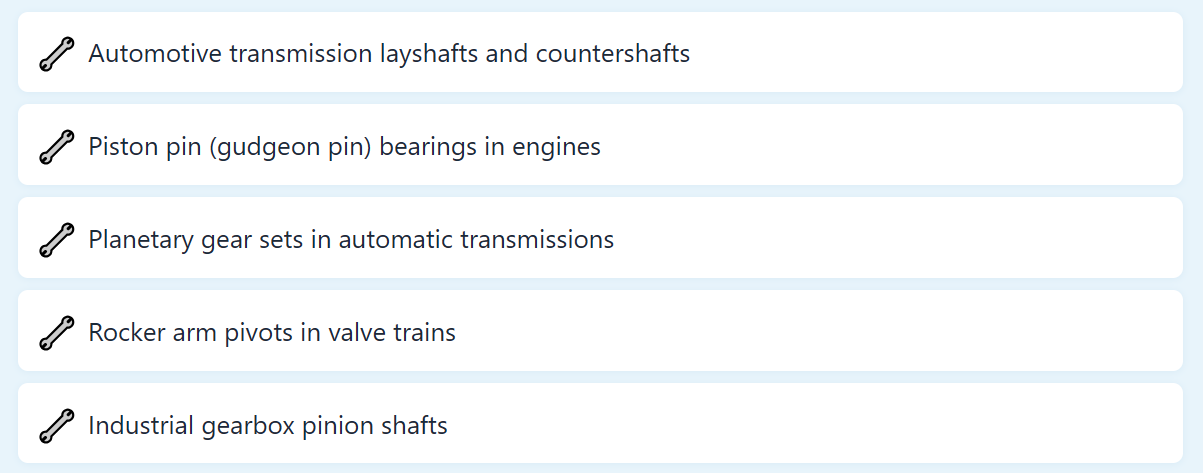
This high load-to-size ratio is particularly valuable in applications like:

This high load-to-size ratio is particularly valuable in applications


Low Friction and Improved Energy Efficiency

Compared to plain bearings (bushings) of equivalent size, needle roller bearings generate substantially less friction. This is a direct consequence of rolling contact replacing sliding contact as the primary load-transfer mechanism.

Benefit

Practical Impact

Measurable Outcome

Reduced heat generation

Less thermal stress on lubricant and adjacent components

Extended lubricant and seal life

Lower power consumption

Machine drive system works less hard

Energy savings of 5–15% vs. plain bearings

Faster startup

Lower breakaway torque at cold start

Improved cold-weather reliability

Reduced wear

Less material loss from contact surfaces

Longer service intervals

Higher operating speeds

Thermal limits raised vs. plain bearings

Higher permissible ndm values


Engineering Insight: In high-cycle applications such as automotive rocker arms or two-stroke engine connecting rods, the switch from plain bushings to needle bearings can reduce component wear rates by 60–80%, dramatically improving engine overhaul intervals.


Versatility Across Motion Types and Operating Conditions

One of the most underappreciated advantages of needle bearings is their ability to function reliably across a wide range of motion profiles — not just continuous rotation. This makes them uniquely versatile in applications where motion is intermittent, oscillating, or subject to frequent reversal.

Motion Type

Performance

Typical Applications

Continuous rotation

Excellent — low friction, long life

Gearboxes, motors, pumps

Oscillating motion

Very Good — uniform load distribution

Rocker arms, control linkages, hinges

Intermittent motion

Good — lower risk of false brinelling vs. ball bearings

Actuators, indexing mechanisms

High-speed rotation

Good (caged designs) — exceeds plain bearing limits

Transmissions, textile machinery

Shock loading

Moderate — line contact helps; use full complement types

Off-road vehicle drivelines, presses


Wide Range of Designs for Every Application

The needle bearing family encompasses multiple sub-types, each optimized for particular installation and performance requirements.

Type

Key Feature

Load

Speed

Best For

Drawn Cup (Shell)

Thin stamped steel outer ring; most compact

Med–High

Medium

Automotive, small mechanisms

Caged Needle Roller

Cage maintains equal roller spacing

High

High

Gearboxes, transmissions

Full Complement

No cage; maximum rollers

Very High

Low–Med

Heavy radial, low speed

Needle & Cage Assembly

No inner/outer ring; shaft as raceway

High

Med–High

Space-critical bores

Combined Needle

Radial needle + axial needle or ball row

High (both)

Medium

Combined load scenarios

Track Roller / Yoke

Thick outer ring; runs on surface

Very High

Low–Med

Cam followers, conveyors


Cost Efficiency and Economic Value

Needle bearings offer compelling economic advantages that extend far beyond the unit purchase price. When evaluating total cost of ownership (TCO), needle bearings frequently outperform both plain bearings and larger rolling-element alternatives.

Lower unit cost: Simple geometry and high manufacturing volumes keep purchase prices competitive

Reduced system cost: Compact size allows smaller shafts, housings, and gear sets, reducing total material cost

Extended service life: Rolling contact results in longer operating life than equivalent plain bearings

Lower energy costs: Friction reduction translates to measurable energy savings over equipment lifecycle

Minimal lubrication demand: Many types are pre-lubricated or require minimal re-lubrication, cutting maintenance labor


Industrial Applications Where Needle Bearings Excel

Needle bearings have become standard components across a remarkable breadth of industries. The following table highlights the most common applications and the specific advantage in each case:

Industry

Typical Application

Primary Requirement

Needle Bearing Advantage

Automotive

Transmission layshafts, rocker arms, torque converters

Compact space, high load, high cycle

Minimal radial height; long fatigue life

Industrial Gearboxes

Planetary gear bores, pinion shafts

High radial load, moderate speed

Full complement designs for maximum load density

Hydraulics & Pumps

Piston pump swashplates, valve actuators

High pressure, oscillating motion

Reliable under oscillation; low friction

Aerospace

Flight control actuators, engine accessories

Weight minimization, reliability

Lightest bearing per unit load capacity

Textile Machinery

Rapier heads, weft insertion mechanisms

Very high speed, lightweight

Caged designs support extreme cycle rates

Power Tools

Drill chucks, impact mechanisms

Compact, shock-resistant, cost-effective

Drawn cup types fit standard power tool geometries

Agricultural Equipment

PTO shafts, combine harvester drives

Shock loads, contamination

High static load; sealed variants available

Medical Devices

Surgical robots, imaging equipment

Precision, low noise, compact

High positional accuracy, smooth rolling motion


How to Select the Right Needle Bearing

Follow this systematic approach to ensure correct needle bearing selection for your application:

How to Select the Right Needle Bearing


Challenges and Considerations When Using Needle Bearings


Sensitivity to Misalignment

Needle roller bearings have a limited tolerance for misalignment, meaning they need to be properly aligned to function well.

If the bearing shafts or components they support are not perfectly aligned, it can cause uneven wear and increased friction. This can lead to overheating and, eventually, bearing failure.

In applications like motors and gearboxes, misalignment can be especially risky. It may cause vibrations, reduce efficiency, and shorten the lifespan of the bearings and the machinery.

In severe cases, it can lead to costly breakdowns and repairs. Therefore, ensuring proper alignment is crucial when using needle roller bearings to maintain performance and reliability.


Solutions to manage the limited tolerance for misalignment in needle roller bearings

  • Aligning Needle Roller Bearings: These bearings are designed to handle slight misalignments, helping to keep things running smoothly even when parts aren’t perfectly aligned.
  • Flexible Mounting Systems: Using mounts that allow some flexibility can help absorb misalignment without putting too much stress on the bearings.
  • Regular Maintenance: Checking and maintaining the equipment regularly can catch misalignment issues early, allowing for fixes before they cause serious problems.
  • Precision Engineering: Making sure components are built and installed accurately can help prevent misalignment from happening in the first place.
  • Monitoring Systems: Using vibration monitoring can detect misalignment in real-time, helping to address issues before they lead to bearings failure.


Limited Axial Load Capacity

Needle bearings are primarily designed to handle radial loads, which are forces that push straight down on them from the side.

They work best in applications where these types of loads are common. However, they are not suitable for high axial loads, which are forces that push along the axis of the bearing.

Using needle bearings in situations with high axial loads can lead to failure or damage.

Thrust needle roller bearings are designed to handle axial loads in high-load situations.

They use long, thin rollers (needles) arranged in a cage, allowing them to support heavy loads while saving space.

These bearings have low friction, which improves efficiency, especially at high speeds. Their compact design makes installation easy and often requires less machining than other types of bearings.

Made from durable materials, they provide a long service life.


Conclusion

Needle roller bearings are strong, space-saving, and lightweight, making them a popular choice over ball bearings in confined spaces.

They feature needle-like rollers, typically four times longer than their diameter.

Like all bearings, their main purpose is to minimize friction between moving parts.

Please contact us today to learn more about needle roller bearings or to request a quote.

What Are the Advantages of Cross Roller Bearings?

What Are the Advantages of Cross Roller Bearings?

In the world of machinery, the choice of bearings can greatly impact performance. Cross roller bearings, a specific type of roller bearings, offer...

Read More
Crane Slewing Bearings: Key Features, Benefits and Uses

Crane Slewing Bearings: Key Features, Benefits and Uses

Crane slewing bearings are essential parts that let cranes make their full 360-degree turns. This ability is crucial for handling various lifting...

Read More
Si3N4 Ceramic Bearings & Electric Vehicle Industry

Si3N4 Ceramic Bearings & Electric Vehicle Industry

For the sake of environmental protection, the electric vehicle industry has been growing rapidly in recent years. The electric vehicles in China...

Read More